Walnut Miniatures: Tiny Worlds Hidden Inside a Shell

Walnut Miniatures: Tiny Worlds Hidden Inside a Shell

DariaCurated by Daria
Jump to the 14 picks

There's a Bedroom in Your Fruit Bowl

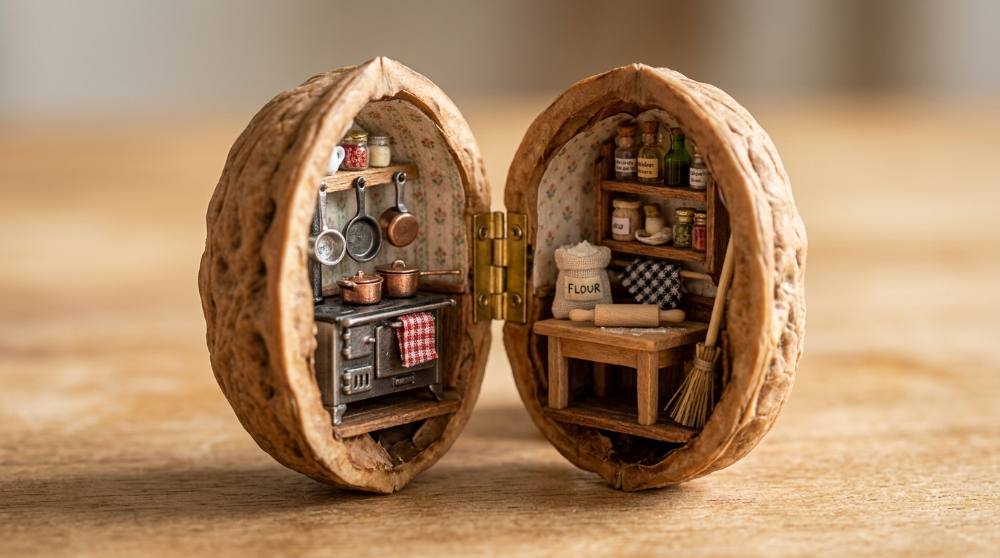
Somewhere on the internet right now, someone is gluing a knitted hammock into half a walnut shell. That's the craft: split a walnut, scrape it clean, build a scene inside — a bedroom, a bakery, a marsh with a glossy pond — then hinge the halves back together so a whole world snaps shut in your fist. It isn't new, either. Victorian fancywork books from the 1870s and 80s printed nutshell projects for children, and antique china dolls tucked inside walnut shells still turn up at auction with their original string closures. The truly obsessed eventually go smaller, into pistachio and even hazelnut shells.

What hooks people isn't cuteness, it's scale shock. An empty half shell looks like nothing — a little wooden bowl. Then you stand one tiny clay pumpkin in it and it becomes a room, and your brain refuses to file something from the snack aisle as architecture. Fair warning: your first evening will vanish.

Start stingier than feels reasonable. Whole walnuts, one sharp hobby knife, sandpaper, a bit of clay and a bottle of glue will carry you through your first several shells; the drills, lights and magnifiers can wait until you know you're hooked.

Nothing below costs much more than a takeaway lunch, so a shell that splits wrong never feels like money lost.

One more thing before the shopping list: this craft needs no workshop. People build walnut scenes on kitchen tables and dorm desks, and the entire kit lives in a shoebox between sessions. If you already enjoy pocket-scale making — say, sculpting small wool figures with a felting needle — this scratches the same itch at a tenth the size.

The Bare-Minimum Walnut Kit

Everything in this section fits in one drawer. The surprise for most beginners is that the walnuts themselves are the most important gear: you want whole, unbroken shells, and even with good technique some will split wrong, so a generous bag beats a handful of pretty ones. The other quiet workhorse is polymer clay — nearly every tiny bed, teapot and pumpkin in these scenes started as a pinch of it. Never touched the stuff? Our beginner polymer clay setup covers the clay side properly.

Premium Jumbo California Walnuts Pack

Pick 01 of 14

Premium Jumbo California Walnuts Pack

A bag of whole, uncracked walnuts is the raw material of this craft: every diorama starts as one of these split along its seam. Bigger nuts give roomier interiors and thicker walls that survive prying, so jumbo in-shell walnuts are worth seeking out. Buy more than you think you need, because a share of shells always breaks wrong, and the kernels are simply a snack.

Why we picked this exact one: The Diamond of California jumbo in-shell walnuts are sold for holiday cracking, which is exactly what a miniaturist wants: big, mature shells with defined seams. Five one-pound bags sound excessive until you learn how many halves split badly, and here the spares cost almost nothing. Buyers rate them 4.6 stars, and the brand is a household name in California walnuts.

See it on Amazon
Precision Crafting Knife Set

Pick 02 of 14

Precision Crafting Knife Set

A pencil-grip hobby knife with replaceable pointed blades handles the small surgery of this craft: scraping papery membrane out of shells, cutting craft-stick shelves, trimming tiny paper books, and lifting stray glue out of corners. A set with several handles and a deep stack of spare blades matters more than one fancy knife, because fine tips dull and snap quickly against hard shell.

Why we picked this exact one: The DIYSELF four-knife set with forty No. 11 blades costs less than a single brand-name handle. Its 4.6-star average comes from more than five thousand reviewers, unusually deep for a budget tool. The handles are plain aluminum with no cushioned grip, but at this price you can park one knife on glue duty and keep a fresh blade in another at all times.

See it on Amazon
Assorted Grit Sandpaper Sheets

Pick 03 of 14

Assorted Grit Sandpaper Sheets

Small sheets across a range of grits do three jobs here: flattening the cut rim so both halves meet cleanly, smoothing the hollowed interior before paint, and softening the edges of drilled hinge holes. Wet-dry silicon carbide paper handles shell well, with coarser grits shaping and finer grits polishing.

Why we picked this exact one: The YXYL 48-sheet assortment runs from 120 grit up through polishing grades, covering the whole shaping-to-finishing ladder in one pack. It holds a 4.7-star average, and the small quarter-size sheets suit shell work better than full sheets you would only cut down anyway. It's generic-brand paper, so expect the backing to wear a bit faster than premium stock.

See it on Amazon
24-Piece Glitter Clay Set

Pick 04 of 14

24-Piece Glitter Clay Set

Polymer clay is the material behind most of what lives inside a walnut: beds, teapots, pumpkins, mice, mushrooms. It stays soft until baked in a regular home oven, so you can fuss over a tiny spoon for an hour without it drying out. A multi-color set spares a beginner from mixing every shade out of primaries.

Why we picked this exact one: This Sculpey multipack bundles two dozen bars of the Premo and Souffle lines, the clays experienced sculptors actually point beginners toward: firm enough to hold detail, flexible after baking instead of brittle. Clay forums consistently warn away from the cheaper Sculpey III for exactly that brittleness, so the line matters more than the logo. At 4.5 stars the recurring complaint is small bar size, which at walnut scale is no complaint at all.

See it on Amazon
All-Purpose Craft Adhesive

Pick 05 of 14

All-Purpose Craft Adhesive

A thick white craft glue grabs quickly, dries clear, and bonds clay, paper, fabric and shell to one another, which covers every material a walnut scene mixes. Thickness is the point: runny school glue lets parts slide downhill inside a curved shell, while a tacky formula holds them where you set them.

Why we picked this exact one: Aleene's Original Tacky Glue has been the default craft adhesive for decades, and its 4.7-star average comes from thousands of crafters. It's cheap, nontoxic and forgiving, so parts can be nudged for a minute before the bond sets. The trade-off is drying time: some makers add a superglue later for instant bonds on slick bits, but the tacky bottle covers nearly every job in a first kit.

See it on Amazon

With these five things a shell goes from snack to finished room: split, sand the rim flat, build, glue. Don't be discouraged if your first two shells crumble — makers with dozens of finished walnuts still lose halves to bad seams. And if baking clay in your oven feels like one step too many this week, air dry clay shapes almost the same and hardens on a windowsill.

Tools for When Your Fingers Feel Huge

None of this is required for a first shell. But the moment you try to stand a four-millimeter teacup in a curved room with bare fingers, you'll understand why miniaturists hoard tweezers. This is also where the famous hinge lives: the classic walnut hinge is coiled from soft copper wire with pliers — a few tight loops around a toothpick, an L-bend, done — then set into holes far smaller than any power drill should be trusted with. Skip the rotary tool for now; a knife and a rolled strip of sandpaper reach everywhere a beginner needs to go.

Precision Mini Drill Bit Set

Pick 06 of 14

Precision Mini Drill Bit Set

A pin vise is a slim hand-twisted drill that grips bits under a millimeter across, the size class that hinge holes in a shell wall call for. Because it turns at finger speed, it can't overheat the shell or punch through the far side the way a power tool can, and you feel the bit bite before anything goes wrong.

Why we picked this exact one: The Craft911 set pairs a comfortable pin vise with a wide spread of micro bits and holds a 4.5-star rating from around a thousand buyers. The bits are high-speed steel, plenty for shell and cured clay, though the finest sizes bend if you lean on them, so let the tool cut at its own pace. It's the same rig resin and jewelry crafters use, so it won't sit idle if you wander between hobbies.

See it on Amazon
Ultra-Precise Multi-Tip Tweezers Set

Pick 07 of 14

Ultra-Precise Multi-Tip Tweezers Set

Precision tweezers are how a three-millimeter teacup travels from your palm to the back corner of a shell without a disaster on the way. A small set covering straight fine tips, an angled pair and a blunt pair handles placing, holding parts while glue grabs, and pulling membrane out of tight spots.

Why we picked this exact one: The iFixit precision tweezers were built for electronics repair, a harsher life than craftwork, and the machining shows: tips meet cleanly instead of crossing. They carry a 4.7-star average. You pay a little more than for a no-name six-pack, but tweezers whose tips actually align are the difference between placing a piece once and chasing it around the shell.

See it on Amazon
Jewelry Making Copper Wire Set

Pick 08 of 14

Jewelry Making Copper Wire Set

Dead-soft copper wire coils neatly around a pin or toothpick, which is exactly how the classic walnut hinge is made: a few tight loops on one length, an L-bend on the second, and the coil becomes a working knuckle. A kit spanning several gauges lets you match wire to shell size, and the leftovers become lamp posts, pot handles and plant stems inside scenes.

Why we picked this exact one: The FIVEIZERO kit covers six gauges from 18 to 28 in bare dead-soft copper, the temper you want when coiling by hand. It's rated 4.5 stars, and because the copper is uncoated it takes a natural patina if you like an antique look on visible hinges. The individual rolls are short, but a single hinge uses centimeters of wire, not meters.

See it on Amazon
High-Performance Cut Resistant Gloves

Pick 09 of 14

High-Performance Cut Resistant Gloves

A knit glove with high cut resistance goes on whichever hand steadies the walnut while the knife works the seam. It doesn't make careless force safe; it turns a slipped blade into a scare instead of an injury. Food-grade versions wash easily and keep enough dexterity to grip a damp nut firmly.

Why we picked this exact one: The NoCry level-5 glove is something of a kitchen default for mandoline and oyster work, and its 4.5-star average is backed by one of the deepest review pools in the category. The knit resists slicing cuts rather than stabs, so the slow, prying technique still matters; the glove is the backup plan, not the plan. It costs about as much as two replacement blade packs, which is cheap insurance.

See it on Amazon
Hands-Free LED Magnifying Headset

Pick 10 of 14

Hands-Free LED Magnifying Headset

A headband magnifier holds a lens between your eyes and the work so both hands stay free for tweezers and glue. Swappable lens strengths and a small built-in light matter more than raw power, since most shell work happens at low magnification with good light rather than under a microscope.

Why we picked this exact one: The YOCTOSUN headband magnifier ships five swappable lenses and a rechargeable LED bar, and sits at 4.6 stars. It's plastic and looks faintly ridiculous on, which is true of everything in this class. What sold us is the lens range: the low-power lenses are the ones miniaturists actually live in, and cheaper single-lens visors skip exactly those.

See it on Amazon

Together these turn the fiddly parts from maddening into oddly soothing: the pin vise chews a clean hinge hole in under a minute, and tweezers that align make you feel strangely capable. Expect your first wire coil to fight back — make three hinges and keep the best one. And if twisting copper turns out to be your favorite part of the evening, there's a whole hobby waiting in our beginner wire art setup.

Lights, Magnets and Other Show-Off Moves

Once a plain shell closes cleanly, the upgrades start whispering. A single warm micro LED behind a scene turns a bedroom into a lit window at dusk — makers drill or burn one discreet hole for the wire and hide the coin cell in the stand. Others pour a spoonful of tinted epoxy resin into the shell floor, and suddenly there's a pond with a heron standing in it. None of it costs much. All of it is the difference between 'cute' and 'wait, hand me that again.'

Battery Operated Mini Fairy Lights

Pick 11 of 14

Battery Operated Mini Fairy Lights

Micro LED strings on hair-thin wire run off a coin-cell battery small enough to hide inside a stand or behind a shell. One or two warm points of light are enough to turn a walnut interior into a lit room at dusk; the rest of the string can wrap a display shelf or stay tucked away.

Why we picked this exact one: These BXROIU strings run on CR2032 coin cells, so there's no bulky battery box to disguise behind a thumb-sized artwork. Six strings cost seven dollars, meaning a sacrificed practice string costs nothing, and the 4.5-star average is unusually well-established for lights this cheap. The wire between LEDs is delicate at sharp bends, so feed it through a drilled hole in a gentle curve rather than a kink.

See it on Amazon
Powerful Mini Rare Earth Magnets

Pick 12 of 14

Powerful Mini Rare Earth Magnets

Neodymium discs a few millimeters across are strong enough to hold two shell halves shut through a layer of glue and paint. A pair set into facing rims makes a closure that's invisible from outside: the shell clicks shut and stays shut in a pocket or a gift box.

Why we picked this exact one: The Best Choice Magnets 240-pack of five-by-two-millimeter discs supplies closures for every shell you will ever make, plus the refrigerator, for under eight dollars. Buyers rate them 4.5 stars. They're genuinely strong for their size, and the practical caution comes during gluing, when an unattended pair will leap together across the bench and take wet glue with them.

See it on Amazon
Complete Jewelry Making Findings Kit

Pick 13 of 14

Complete Jewelry Making Findings Kit

A findings kit supplies the hardware that converts a finished shell into something wearable or hangable: screw eyes, jump rings, clasps and cord. A tiny screw eye twisted into the top of a shell takes a jump ring, and from there the same piece works as a necklace, a bag charm or a tree ornament.

Why we picked this exact one: The Paxcoo 2,880-piece assortment covers every finding a shell project could ask for in one compartment box, and it's rated 4.6 stars. The metal is plated alloy rather than sterling, which is fine for ornaments and casual wear but worth knowing before you gift to someone with sensitive skin. The honest upside: you will never need to buy jump rings again.

See it on Amazon
Glossy Finish Liquid Glaze

Pick 14 of 14

Glossy Finish Liquid Glaze

A brush-on water-based glaze seals baked clay pieces, deepens their color, and adds the wet-look shine that makes ponds, teapots and berries read as real. On the shell itself, a thin coat hardens flaky edges and gives the wood a warm, finished glow.

Why we picked this exact one: Sculpey's own Gloss Glaze is formulated for the same clay this kit bakes, which sidesteps the classic disaster of a random varnish staying sticky on polymer clay forever. It averages 4.6 stars, and a one-ounce bottle outlasts dozens of shells. The precise-flow tip matters at this scale, because you are glazing a five-millimeter teapot, not a fence.

See it on Amazon

These extras also unlock the gift angle: recessed magnets let a shell ride in a pocket without spilling its furniture, and one screw eye plus a cord turns the same piece into a pendant or a tree ornament. Paper earns its keep at this scale too — a folded micro star fills a corner for free, and beginner origami trains exactly that kind of finger patience. My advice: one upgrade per shell. Cramming lights, magnets and resin into your first walnut is the classic way to finish none of them.

The Knife Is the Whole Safety Briefing

Splitting a hard shell with a blade is the one genuinely risky minute of this craft, and it's the step beginners improvise worst. The safe version looks almost comically careful: soak the nut in warm water for about ten minutes, dry it completely so nothing is slippery, press it point-down into a lump of clay so it can't roll, and wear a cut-resistant glove on the holding hand. Then push the knife tip into the soft hole at the nut's base and rock it gently for a few minutes. Never twist. Twisting is how blades snap and skip.

Two smaller notes. Swap hobby-knife blades as soon as they drag — a dull blade needs force, and force is what slips. And bake polymer clay at the temperature printed on the package: properly baked it's safe, but scorched clay smells awful and the fumes irritate. Kids will love this hobby; the splitting step stays an adult job.

The Questions Every First Shell Asks

Why do my walnuts crumble instead of splitting in half?

Almost always: dry nuts, fast force and a twisted blade. Cracking with a nutcracker or twisting a knife in the seam sends the crack wherever it likes, and the shell shatters. Soak the nut in warm water for ten minutes, dry it, then work a rigid knife tip into the hole at the base and rock it slowly until the seam lets go. Even done right, some shells still fail — that's normal, not a sign you're doing it wrong.

Why won't my shell close once the scene is inside?

Because the scene was built inside the shell and glued as you went, which is the single most common first-build mistake. Anything taller than the rim on either half will hold the halves apart or shear off when they meet. Build every piece outside on the bench, dry-fit the loose parts with the shell closed, trim until it shuts, and only then glue. Makers who skip the dry fit end up with display-only shells they meant to be lockets.

Where do people get shells that split so cleanly?

The same place you do — the grocery store — which surprises most beginners. There is no special craft walnut; makers buy whole in-shell nuts and accept that batches vary, some splitting sweetly and others crumbling at a glance. Pick the biggest, most symmetrical nuts, split several in one sitting, and keep every clean half. The failed halves become test pieces for paint, stain and glaze before you risk a good shell.

How do people make furniture that small without losing their minds?

They don't sculpt inside the shell — everything is built out on the bench and moved in with tweezers. A cauldron is a ball of clay shaped over a pen tip; a spoon starts as a tiny carrot of clay rolled thin at one end; books are a chunk of old novel pages cut down with a fresh blade. Work next to a coin so your sense of scale never drifts, and expect to remake pieces. Even experienced makers cut their too-big books in half and try again.

Love what you see here? Save individual picks with on any item, or copy everything to a list of your own in one click — great for coming back to later, or dropping as a not-so-subtle hint.

Disclosure: Some product links may be affiliate links. If you make a purchase through one of these links, we may earn a small commission at no extra cost to you.