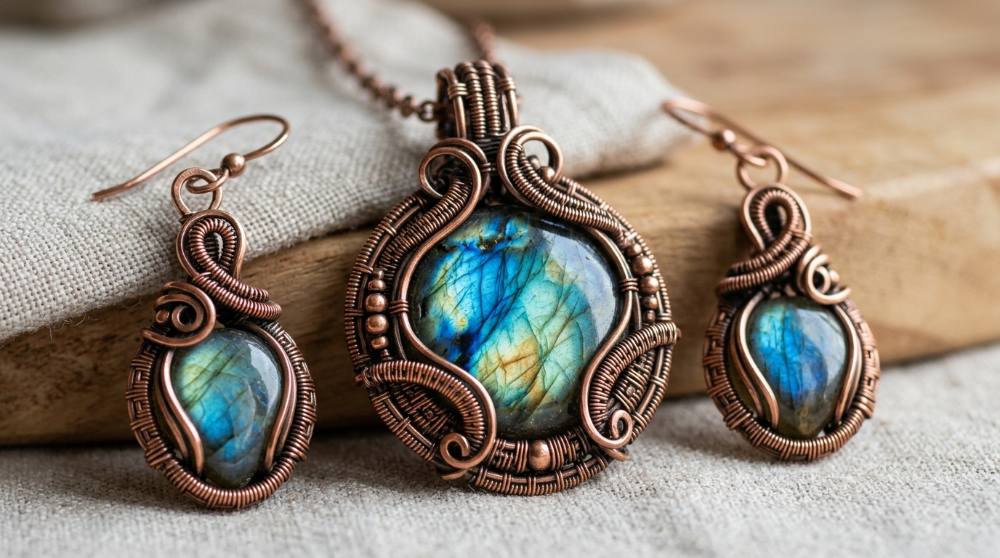
Wire-Wrapped Jewelry: Turn a Spool of Wire Into Earrings

Wire-Wrapped Jewelry: Turn a Spool of Wire Into Earrings

DariaCurated by Daria
Jump to the 8 picks

Your First Pendant Is Hiding in a Spool of Wire

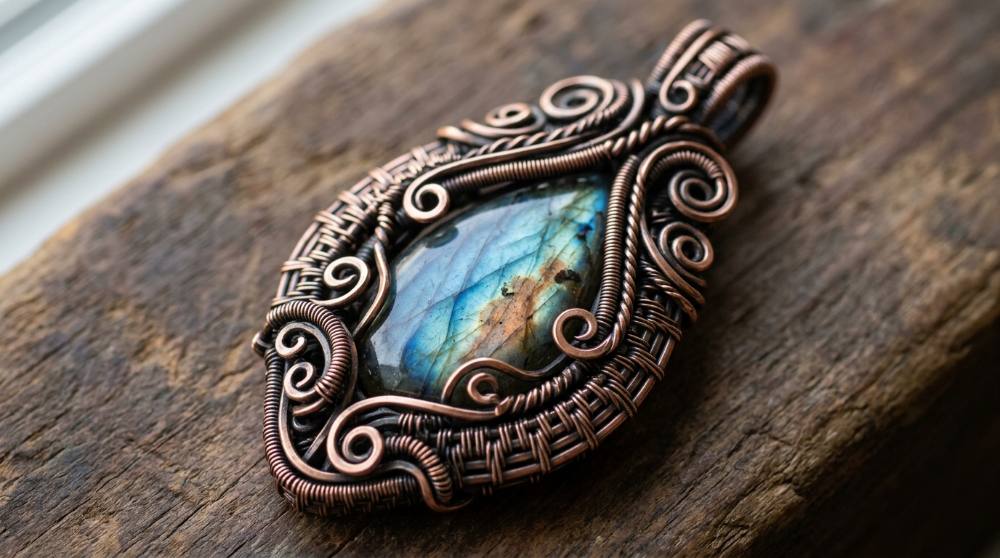
Wire wrapping is jewelry made from nothing but bent metal: you coil, loop, and weave wire around a stone until it sits caged in a frame you shaped by hand. No solder, no torch, no glue. Every joint is just wire wrapped around wire, which is why people were making jewelry this way around four thousand years ago — the British Museum keeps spiraled wire pieces from the Sumerian city of Ur, made before soldering even existed. The strange part is how little has changed since. Factories cast their jewelry in molds because it's cheaper, so nearly every wrapped piece you'll ever see was made by one person holding two pliers.

Fair warning about that teaser: your first afternoon really can end with a wearable pendant, but it'll be your third one you actually photograph. Copper pushes back. Your fingertips will feel the first hour, and the first wrap usually looks like a bird's nest — everyone's does. If you've already made little sculptures over on the wire art side of the craft, expect a different discipline here: smaller, tighter, and much fussier about neat coils.

Our philosophy stays stubborn: buy almost nothing. One small plier set, a thick copper wire for frames, a thin one for wrapping, and a handful of stones to practice on — that's the entire kit.

Everything below was picked so that if the hobby doesn't stick, you've spent less than a night out and own nothing you'll regret.

Jewelry Making Pliers Set

Pick 01 of 08

Jewelry Making Pliers Set

A small set of jewelry pliers: a round-nose pair for forming loops, a needle- or chain-nose pair for gripping and tucking wire ends, and cutters for trimming. Smooth, unserrated jaws are the detail to check — serrated household pliers chew visible marks into soft copper. Compact tips matter too, because finishing a wrap means reaching into tight spaces.

Why we picked this exact one: The Shynek 3-piece set covers the exact three tools beginners actually use — round nose, chain nose, and a cutter — for less than a single mid-range plier costs. It holds a 4.6-star rating across more than ten thousand reviews. The cutter is the weak point and won't stay razor-sharp forever, but by the time it dulls you'll know whether the hobby deserves better steel.

See it on Amazon
Flexible High-Purity Copper Wire

Pick 02 of 08

Flexible High-Purity Copper Wire

A spool of bare, dead-soft copper in 20 gauge — thick enough to hold a pendant's shape, soft enough to bend with your fingers. Dead-soft temper is the state beginners want: the wire moves where you push it instead of fighting back. Look for 99.9% pure copper, since plated or mystery-metal craft wire behaves unpredictably and can snap mid-wrap.

Why we picked this exact one: This ichenbao 105-foot spool is plain dead-soft copper, which is what wire wrappers consistently tell beginners to learn on before touching silver. It costs under ten dollars for enough wire to survive months of mistakes. Bare copper does darken with time — many wrappers like the patina, and a polishing cloth restores the shine if you don't.

See it on Amazon
Premium Soft Copper Wire Roll

Pick 03 of 08

Premium Soft Copper Wire Roll

The thin partner to the base wire: 26-gauge dead-soft copper for coiling around frames, binding base wires together, and weaving patterns. At 0.4 mm it's fine enough to wrap tightly yet still tolerates the repeated bends of weaving. A 400-plus-foot spool sounds like a lifetime supply; it isn't.

Why we picked this exact one: This is the 26-gauge sibling of the ichenbao 20-gauge spool, and the 20-plus-26 pairing lands inside the base-and-weaving combination practitioners recommend to beginners. It carries the same 4.7-star rating as the thicker spool. One caution from experience: fine copper kinks if you rush it, and a kink is usually permanent.

See it on Amazon
oval stone cabochons for practice pendants

Pick 04 of 08

oval stone cabochons for practice pendants

Flat-backed oval stones in mixed colors, 25 by 18 millimeters — the classic shape for wrapped pendants. A cabochon has no drill hole, which is the whole reason wire wrapping exists: the wire cage is what holds it. A mixed lot suits the first months best, because every stone is a fresh attempt rather than a precious one.

Why we picked this exact one: The PH PandaHall 25-piece lot works out to well under a dollar a stone. The 25×18 mm size is the quiet reason it's here: practitioners consistently say larger stones are easier for beginners because there's more to hold onto mid-wrap. Polish quality varies a little between stones, which honestly makes them better practice material than jewelry-grade cabs would be.

See it on Amazon

That's the entire starting kit — with these four things you can make wrapped-loop earrings, spirals, and your first caged cabochon this week. The learning curve is mostly in your hands, not your wallet: strength and muscle memory arrive around piece five. And once you trust your coils, anything flat-backed is fair game, including pieces you've poured yourself if resin art is already on your bench.

Worth Adding Once You're Hooked

None of this belongs in your first order, and that's deliberate. Wire wrapping punishes over-shopping more than most crafts — one regular here bought a ten-piece plier kit and ended up using two of them. Resist the kits. These four tools earn their place around piece ten, when the real annoyances show up: chewed-up wire, nowhere to grip small work, practice pieces you suddenly want to finish properly, and jewelry that bends when someone hugs you. If slowly assembling a small bench of hand tools sounds like your idea of fun, leather crafting runs on exactly the same pleasure.

nylon-jaw pliers for straightening wire without scratches

Pick 05 of 08

nylon-jaw pliers for straightening wire without scratches

Pliers with soft, replaceable nylon inserts instead of bare steel jaws. Their main job is pulling bends and kinks out of wire: grip the end, draw the wire through, and it comes out straight. Because nylon is softer than copper, the jaws leave no tool marks behind.

Why we picked this exact one: The VOUIU pair is the budget standard for this tool, rated 4.6 stars by nearly three thousand buyers. It ships with spare nylon inserts, which matters because the jaws are consumables that slowly wear grooves. The joint feels stiffer than a premium plier's, but for straightening duty you'll never notice.

See it on Amazon
wooden ring clamp for holding small work steady

Pick 06 of 08

wooden ring clamp for holding small work steady

A two-jawed wooden hand clamp with leather-lined jaws and a wedge that locks them closed. Squeeze a stone, a ring shank, or a half-finished pendant in one end and the whole clamp becomes a comfortable handle. It takes over when a wrap needs real pulling force and your fingertips have had enough.

Why we picked this exact one: The Beadalon wood clamp is a recognized jewelry brand's version of a tool mostly sold as anonymous imports. Its leather-lined jaws grip firmly without biting into the wire. It's a simple wooden object — the wedge can loosen after heavy use, but there's essentially nothing on it to break.

See it on Amazon
stainless steel ear wires for finishing earrings

Pick 07 of 08

stainless steel ear wires for finishing earrings

Pre-made French-hook ear wires in stainless steel, with a ball-and-coil detail and an open loop for attaching your work. Bending matching ear wires by hand is its own small skill, so most beginners buy them and focus on the decorative part. Stainless is the sensible default since many ears react badly to mystery-metal findings.

Why we picked this exact one: The BronaGrand pack holds a 4.7-star rating and gives you enough hooks for twenty-five pairs of experiments. Surgical stainless resists tarnish and suits sensitive ears better than plated brass findings. The loops arrive slightly open and need a quick pinch with chain-nose pliers — a ten-second job with tools you already own.

See it on Amazon
steel bench block and hammer for hardening finished pieces

Pick 08 of 08

steel bench block and hammer for hardening finished pieces

A hardened-steel block on a rubber base, paired with a small jewelry hammer. Copper comes off your pliers dead soft, and a few firm taps against the block stiffen a finished frame so it keeps its shape. The block also provides a dead-flat surface for flattening decorative wire ends.

Why we picked this exact one: The Tialero kit bundles block and hammer for less than many bare blocks cost, at a 4.7-star rating. The rubber base genuinely deadens the clang of steel on steel, which anyone sharing your home will appreciate. The hammer faces are stamping-sized and a little small, but for hardening frames they do the job.

See it on Amazon

Add these when the habit sticks and your pieces start leaving the house. There's no shame in a long tape-and-sharpie phase first — painters tape holds stones and a marker barrel bends perfectly good bails, and half this craft's tools began as improvisations. And if what hooked you was really the quiet evening with tiny tools, needle felting scratches the same itch with wool instead of metal.

When the Wire Fights Back

Why does my wire keep snapping in the middle of a wrap?

Every bend stiffens copper a little — that's work hardening — so a section that's been straightened and re-bent while you chase perfection eventually turns brittle and breaks. Beginners trigger it constantly by reworking the same spot. No-name craft wire and anything aluminum snap far sooner than plain dead-soft copper, which is why the brand on the spool matters more than it seems. Bend deliberately, accept small flaws, and once you've reworked a section twice, cut it and start that wrap fresh.

Why does the wire slide all over the stone instead of gripping it?

Round wire on a polished cabochon has almost no friction, so the frame slips until the final tucks lock it — it's the single most common first-project frustration, not proof you're doing it wrong. The practitioners' fix is humble: tape the base wires to the stone with painters tape while you work and peel it off at the end. Larger stones help too, since there's more surface to control. If slipping still ruins pieces months in, square base wire locks coils in place far better than round.

Where are all these scratches coming from?

Bare steel jaws mark soft copper every time you clamp hard, and those scratches won't polish out of a finished wrap. The habit that fixes it: grip with the pliers, then make the actual bend with your fingers, so steel never scrapes across moving wire. For straightening kinked wire, that's exactly what nylon jaws are for. And if a mark shows up on the stone itself, try an eraser before panicking — it's usually a streak of copper left behind by the wire, because most stones are far harder than the metal.

Do I need silver and real gemstones for pieces to be worth making?

No — and starting with them is the classic way to quit, because every mistake costs real money and you stop experimenting. The people who do this daily learn on dead-soft copper and cheap glass or mixed-lot stones, and the technique transfers to sterling one-to-one later. Copper pieces are genuinely wearable and sell at markets every weekend. Save the silver for a design you've already made twice.

Why do my finished rings and bracelets bend out of shape when worn?

Dead-soft wire stays dead soft: the same softness that made it easy to wrap lets a ring squeeze oval in a pocket and a bracelet flex at every tug. The fix is hardening the piece on purpose — a few firm hammer taps against a steel bench block stiffen the metal without changing the design. Do the hammering before a stone goes anywhere near the frame; steel meeting stone ends badly. Pendants mostly escape the problem, because nobody squeezes a pendant all day.

Love what you see here? Save individual picks with on any item, or copy everything to a list of your own in one click — great for coming back to later, or dropping as a not-so-subtle hint.

Disclosure: Some product links may be affiliate links. If you make a purchase through one of these links, we may earn a small commission at no extra cost to you.