Knot Friendship Bracelets That Actually Stay On

Knot Friendship Bracelets That Actually Stay On

Curated by Daria

This page may contain affiliate links.

Embroidery Floss for Knotting

Where I'd start

Floss that splits while undoing knots turns quick fixes into frayed messes you have to cut and replace.

Embroidery Floss for Knotting

See it on Amazon
Jump to the 8 picks

Tie One Knot, Then Tie It Four Hundred More

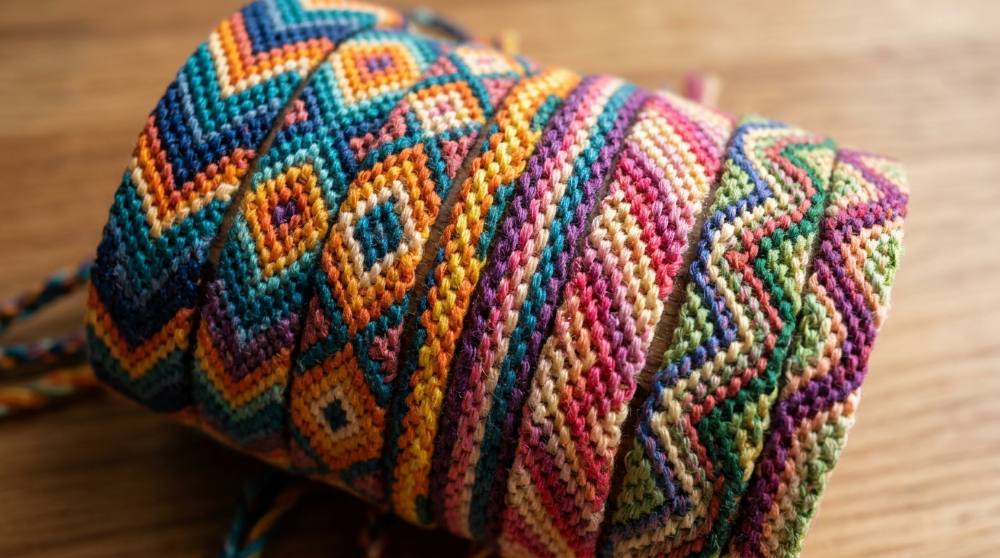
The knot is called a half hitch. Learn it once and you've basically got the whole craft — the chevrons, the diamonds and the little pixel-art letters are all that same knot repeated, and the only decision left is which string you tie onto which, and which way round. People make these on buses and at kitchen tables. What almost nobody remembers is how they reached American wrists in the first place: the 1980s surge came through protests over the disappearances of Mayan Indians and peasants in Guatemala, carried in by religious groups for political rallies. Forty years on they are being traded in stadium queues, which is a strange arc for a piece of string.

Here's what surprises most people: the hard part isn't the knot, it's doing it the same way four hundred times. Keep the pull consistent and the band comes out even. Pull too hard and you'll yank the whole bracelet off whatever is holding it, mid-row, which is its own particular kind of annoying. That's why your first one looks worse than your fourth. Everyone's does.

Our take: buy almost nothing to start. Two or three colours of floss, something that will hold the top of the bracelet still while you pull, and a pair of scissors gets you a finished bracelet by this evening. The rest can wait until you know you like it.

Nothing on this page costs enough to sulk about if the hobby doesn't stick.

If the knotting turns out to be the bit you enjoy, the step across to beginner macramé cord and knot basics is a short one, since the square knot you will eventually want for a sliding closure comes from exactly there. For now, though, the kit below really is all of it. Four things.

Four Things and a Free Afternoon

Beginners overbuy floss and underbuy patience, pretty much without exception. A pack of a hundred-odd skeins costs less than lunch and will outlast your first dozen bracelets, so the money question settles itself. What deserves the thought is what you anchor the bracelet to while you pull. Tape is the obvious answer. It is also the wrong one, for reasons the clipboard entry gets into. One clarification before the list, because these two get confused constantly: this is knotting, not braiding — if you want the braided cousin, where strings cross over a slotted disc instead of being tied onto each other, that is beginner kumihimo on a foam disk, and it asks something quite different of your hands.

Disclosure: This section may contain affiliate links to Amazon. We may earn a small commission from qualifying purchases at no extra cost to you.
Embroidery Floss for Knotting

Pick 01 of 08

Embroidery Floss for Knotting

Six-strand floss is the standard material for knotted bracelets: each skein is a loosely twisted bundle you use whole rather than splitting into single strands. A large multi-colour pack matters more than fibre quality at the start, because patterns are built out of colour contrast and you will burn through your favourite shades first. Check the length printed on the skein, since that is what decides how many bracelet strings you get from one.

Why we picked this exact one: The Paxcoo 124-skein pack is the one knotters name most often when somebody asks where to buy thread, and 124 colours is more palette than a first year will use. Each skein runs eight metres, which is roughly eight strings at the length a normal bracelet needs. It is a polyester-cotton blend rather than pure cotton, and that is the honest trade-off: cheaper and glossier, but it does not hold knot definition quite as crisply as the all-cotton skeins people move on to.

See it on Amazon
Letter-Size Clipboard

Pick 02 of 08

Letter-Size Clipboard

A hardboard clipboard gives you a flat surface and a sprung clip that holds the top of a bracelet still while you pull against it. The board matters as much as the clip, because a flexible plastic one bows the moment you tension a row. Look for a stiff hardboard body and a wide metal clip rather than a decorative one.

Why we picked this exact one: The Officemate 83100 is a plain recycled-hardboard clipboard with a six-inch spring clip, which is more clip than most craft-branded boards offer and the reason it holds through a hard pull. The hardboard body does not flex when you tension a row. Its one quirk is shared by every clipboard: the clip presses a shallow dent into the first centimetre of the bracelet, and that relaxes out once the work comes off the board.

See it on Amazon
Embroidery Scissors Set

Pick 03 of 08

Embroidery Scissors Set

Short-bladed embroidery scissors cut floss cleanly in one snip instead of crushing and splaying the end. Blades around three and a half inches give enough control to trim a tail flush against finished knots without nicking them. A protective sheath is worth having if the kit travels.

Why we picked this exact one: The PAFASON two-piece embroidery scissor set pairs a straight and a curved 3.5-inch pair in stainless steel, each with its own plastic sheath, and the sheaths are what let it live loose in a pencil case. It holds a 4.8-star rating across roughly 4,600 reviews. In practice the curved pair is largely redundant for bracelet work, so treat it as a spare rather than a second tool.

See it on Amazon
Flexible Sewing Tape Measure

Pick 04 of 08

Flexible Sewing Tape Measure

A soft tape measure does two jobs here: sizing a wrist before you commit to a length, and measuring strings before you cut them. A 150 cm tape covers the longest string a normal pattern asks for in a single pull. Double-sided markings save converting, since most string-length advice is given in centimetres.

Why we picked this exact one: The iBayam two-pack pairs a soft vinyl tailor's tape with a retractable one, and the soft tape is the half you will actually use, because it lies flat along a cut length of floss. It reads 150 cm on one face and 60 inches on the other, which covers the longest strings a normal pattern calls for. The retractable one is a bonus rather than a reason to buy, and its spring is loud enough to startle the cat.

See it on Amazon

Cut your strings about a metre each and you will have enough for a normal bracelet on a normal wrist, with a bit spare for tying it on. Strings that do most of the knotting run out first, so if one colour is carrying your pattern, give it extra from the start. Cotton floss makes a faint squeak as a knot slides up tight against the row above it, and that small sound is how you learn what tight enough actually feels like.

What to Buy Around Bracelet Number Six

None of this makes a better bracelet. It makes the twentieth one less annoying than the nineteenth, which turns out to matter more than you would expect. What actually drives people away from this craft is not difficulty — it is opening a drawer and finding every colour knotted into every other colour. That is a problem shared by most small-parts crafts, and anyone who has also tried beginner bead stringing will recognise the exact drawer. Honestly, I would hold off on the bobbins at first; plenty of long-time knotters wind a few and then quietly give up, because winding a hundred skeins is its own afternoon.

Assorted Steel Binder Clips

Pick 05 of 08

Assorted Steel Binder Clips

Binder clips let you clamp a bracelet to whatever is to hand, from a hardback book to the edge of a table. Mid-size clips grip a bundle of floss firmly without crushing it flat. Tempered steel keeps its spring, where thin plated clips splay open after a few weeks of real use.

Why we picked this exact one: The SANNIX 110-piece set spans six sizes from 0.6 to 2 inches, which matters because the useful clip for a bracelet is much smaller than the one most people reach for first. The tempered steel holds its tension through repeated clamping. You will obviously never need 110 binder clips for bracelets; this is a box that lives in a drawer and quietly supplies the rest of the house.

See it on Amazon
Embroidery Floss Organizer Box

Pick 06 of 08

Embroidery Floss Organizer Box

Floss is sold in loose skeins that unravel and knot into each other the moment they share a bag. Winding each colour onto a flat bobbin and filing it in a divided box keeps every shade findable and ready to pull. Boxes with removable dividers are the more useful kind, because you will want a few large spaces for part-finished bracelets.

Why we picked this exact one: The Epesl organiser is the finished version of a setup most knotters assemble piecemeal: a 36-compartment box with removable dividers, 120 plastic bobbins, a hand winder and pre-printed number labels. The winder earns its place, because winding bobbins by hand is the exact chore that makes people abandon the system half-done. Be realistic about the labels, though, since numbering only pays off once you are buying floss by colour code rather than by eye.

See it on Amazon
Assorted Heavy Duty Safety Pins

Pick 07 of 08

Assorted Heavy Duty Safety Pins

A safety pin through the starting loop of a bracelet, pinned to a trouser leg or a cushion, is the oldest portable anchor in the craft. Mid-size pins are the useful ones, because the smallest bend open under a hard pull. Nickel-plated steel resists the bending and rusting that cheap pins do early.

Why we picked this exact one: The Wenrook 300-pack covers four sizes from 0.87 to 1.46 inches in nickel-plated steel, so there is a size that passes through a starting loop without stretching it open. The pins arrive in a reusable compartment box rather than loose in a bag, which is worth more than it sounds. Three hundred is far more than this craft needs, and that is simply how they are sold at this price.

See it on Amazon
Cotton Embroidery Floss Collection

Pick 08 of 08 · Worth the upgrade

Cotton Embroidery Floss Collection

Pure cotton floss behaves differently from the blended kind: the plies compress less, so each knot keeps a defined edge instead of blurring into its neighbours. A large single-brand collection also means every colour carries a catalogue number, which is how patterns get shared between knotters. A hundred distinct shades is roughly the point where you stop substituting.

Why we picked this exact one: The DMC 100-colour assortment is the step up knotters make once they know they are staying: a hundred skeins of six-strand cotton with no duplicates. Cotton holds knot definition better than blended thread, which shows most on tight geometric patterns where the edges are the point. Wait on it, though, because at several times the price per colour of a budget variety pack it only makes sense after a handful of finished bracelets have told you which shades you actually reach for.

See it on Amazon

Buy these one at a time, as each annoyance actually turns up, rather than all at once in a fit of enthusiasm. If it turns out you like the jewellery side more than the knotting, beginner wire wrapping tools and stones head somewhere completely different from the same small table.

Questions You Will Have Around Row Twenty

Why does my floss keep splitting when I undo a mistake?

Six-strand floss is six separate threads twisted together, and backing a knot out drags them against each other until they start to separate. It's worst when you're picking at a tight knot with a needle. Dampening the strand slightly makes the plies cling together and behave, which is the fix knotters reach for most. If an end has already frizzed past saving, put a small overhand knot in that strand's tail to stop the fray travelling further — on the strand itself, never on the bracelet.

Should I just tape the bracelet to the table?

Almost every beginner starts with tape, because almost every photo tutorial shows tape. Two things go wrong with it. The adhesive gives up after half an hour of pulling, so you end up re-taping mid-row and losing the tension you had; and peeling tape off cotton floss roughs up the fibres right where the bracelet shows. Experienced knotters overwhelmingly clip instead, and a clip travels in a way a roll of tape doesn't.

Why did one colour run out before all the others?

Because strings don't get used evenly. The string doing the knotting shortens fast while the string being knotted onto barely moves, so a colour that leads a lot of rows can run dry while its neighbours still have ten or twenty centimetres spare. Cutting everything to the same length means you waste most of it and still come up short on one. Give the hard-working colour extra from the start, and if it does run out you can splice a fresh strand in rather than abandoning the bracelet.

Why does the thread burn a groove into my finger?

Nobody warns you that the pulling hand takes the damage. The working strand drags over the same spot with every knot, and after a long session that becomes a friction burn or a blister, with thin thread cutting in worse than thick. Some of it is technique — if it genuinely hurts, you're probably pulling harder than the knot needs. The practical fixes knotters use are a plaster over the hotspot before you start, moving which finger takes the tension so the wear shifts around, or athletic tape, which grips the thread and sticks only to itself so there's no adhesive to gum up.

Why won't my bracelet stay on?

Tying two bunches of thread in a bow around a wrist is how most people finish their first one, and it's why the first one ends up on the floor. The closure knotters use instead is a sliding one: braid three or four centimetres at each end, lay the two braids side by side so they overlap, then wrap a separate short strand around both in a run of square knots. Pull both braids and it tightens, because the knots grip the braids rather than the wrist. The thing that trips people up is starting the bracelet with a loop, since a loop and a sliding closure can't coexist — the same closure-first thinking catches people out in the usual beginner beaded jewelry mistakes, where it's a clasp rather than a braid.

Love what you see here? Save individual picks with on any item, or copy everything to a list of your own in one click — great for coming back to later, or dropping as a not-so-subtle hint.

Disclosure: This section may contain affiliate links to Amazon. We may earn a small commission from qualifying purchases at no extra cost to you.