The Seat Lifts Right Out, and That Changes Everything
Tip a dining chair over and look. On most of them the padded seat isn't fixed to anything at all - it rests in a shallow ledge cut into the rails, held by gravity and friction, and lifts straight out in your hands. Upholsterers call that a drop-in seat, and it has been the trade's first lesson for three hundred years. The word upholstery comes from the Middle English upholder, which meant the person who repaired furniture rather than the one who built it. The London guild those upholders belonged to spent its early years supplying cloth and fittings for funerals.
The appeal is that you can't really ruin anything. Nothing here is permanent. The chair frame never gets touched, and if your first corner looks like a folded napkin you pull the staples out and do it again. That is a different proposition from weaving a cane or rush seat back into an empty chair frame, where one broken strand means unpicking an afternoon. Do set aside a real afternoon, though: a working upholsterer takes about four hours over a drop-in seat, and a first attempt runs closer to six.
My advice: buy the five things that end up inside the finished seat, and nothing else. A staple gun, the right staples, a slab of foam, a layer of polyester wadding and about three-quarters of a yard of cloth will see a whole chair through. Specialist tools can wait. You'll know which ones you want after the second seat, not before the first.
Nothing below costs enough to sting if you decide after one chair that upholstery isn't for you.
Where This Little Kit Can Take You
A few real moments and results from this hobby — made with tools no fancier than the ones below.
Fresh botanical print, old chairThe pad was stripped back to bare timber before this cover went on, and the chair frame was never touched.
Lifting the finished pad outA drop-in seat is held in by nothing but gravity and friction, which is why it travels to the bench.
You don't need to be good at anything yet. Honestly. The pleasure of it sits close to the pleasure of patching a pair of jeans instead of replacing them, where something you already own stops being faintly embarrassing and starts being yours.
What Actually Goes Into the Pad
Good news if you can't sew: a drop-in cover is one piece of cloth folded round a board, with no seams anywhere a person can see. You won't need a sewing machine and a tote bag's worth of practice to finish this one. What you do need is a fastener that can actually bite into the pad frame. That is where first attempts come unstuck.
Disclosure: This section may contain affiliate links to Amazon. We may earn a small commission from qualifying purchases at no extra cost to you.
01Pick 01 of 11
heavy-duty manual staple gun for pulling upholstery cloth taut over a seat frame
A squeeze-handle staple gun drives a staple through fabric into wood with one hand, which matters when the other hand is holding cloth under tension. For upholstery the thing to check is the staple it takes, because thinner wire drives into hardwood and plywood far more easily than the thick general-purpose kind. Look for an adjustable power setting and a jaw that sits flat on the work, so the crown seats flush instead of standing proud.
Why we picked this exact one: The Arrow T50 is the staple gun most upholsterers assume you already own, and at a shade under twenty dollars it is the cheapest honest way into the craft. It is chrome-plated steel rather than plastic, and it takes a staple stocked in every hardware shop. One real limitation: T50 staples are thick-wire, so a hardboard seat base can defeat them, and on a board like that you will do better with tacks or an air gun.
three-eighths-inch heavy-duty staples for fixing seat fabric to a pad frame
Upholstery staples are sized by crown width and leg length, and both matter. A 3/8-inch leg is long enough to hold cloth and wadding against a wooden pad frame without punching through a thin board. Buy more than you think you need, because a single seat takes a few dozen and you will pull a fair number back out again.
Why we picked this exact one: Arrow 506 is the matching staple for the T50 gun, which removes the variable most likely to waste an afternoon. Twelve hundred and fifty of them covers a full set of dining chairs with plenty spare. More than thirty thousand ratings is an unusual thing to be able to say about a box of staples.
firm two-inch upholstery foam sheet for rebuilding a chair seat pad
Upholstery foam carries two ratings people constantly confuse: density, which is weight per cubic foot and decides how long it lasts, and firmness, which is only how it feels. A dining seat wants firm, because you sit upright and briefly and a soft slab bottoms out onto the board underneath. Two inches is the usual thickness for a drop-in pad, but measure the old foam before you cut, since the pad still has to fit back into its ledge.
Why we picked this exact one: The GoTo Foam 2-inch sheet states its 43ILD firmness rating on the listing, which most Amazon foam does not bother to do. At 24 by 72 inches it rebuilds four dining seats with offcuts left over, and it is cut in the USA rather than shipped squashed in a vacuum bag that leaves a permanent crease. It is genuinely firm, so for a low armchair rather than a dining chair you would want something softer.
half-inch polyester batting for wrapping seat foam before the cover goes on
Polyester batting, known in the trade as Dacron wadding, is the thin layer that goes over the foam and under the cloth. It rounds off the square cut edge of the foam, crowns the top so the seat looks filled rather than slabby, and gives the fabric a smooth surface to settle onto. Half an inch is the standard weight for an indoor seat, and the heavier grades are meant for plush furniture.
Why we picked this exact one: The Skowund half-inch Dacron wrap is the right weight for a seat pad rather than the thicker stuff sold for sofa cushions, which would push a drop-in pad out of its ledge. It comes as a roll you cut with ordinary scissors, so a small job wastes almost nothing. Under a hundred reviews is thin by Amazon standards, though the half-inch spec is the thing that matters here and this listing states it plainly.
heavyweight linen-look upholstery cloth for covering a dining chair seat
Upholstery cloth is woven tighter and heavier than dress fabric, which is why a quilting cotton goes thin and shiny on a chair within a year. A dining seat wants a flat, tight weave that takes a wipe and does not snag. About three-quarters of a yard of 54-inch-wide cloth covers one standard seat, so a two-yard cut handles two or three chairs.
Why we picked this exact one: The TinaKim thick linen-type cloth arrives as a 2-yard cut 57 inches wide, enough for two or three drop-in seats without a second order. The weave holds its grain under tension, which is what you want while you are pulling hard at the corners. A plain colour is also the forgiving choice first time round, because a pattern has to be centred on every seat and matched across the set, and that is a problem for chair number four.
Lay all five out on the table before you start. It helps. There is a moment about two-thirds of the way round when the cloth goes drum-tight under your palm and you feel the seat become a seat. If you'd rather work in hide than cloth, the same pull-and-staple logic carries over to cutting and shaping leather, though leather is far less forgiving of a staple in the wrong place.
The Tools You'll Want by the Third Chair
Here is the thing about upholstery tool lists: they are mostly written by people selling tool kits. A working upholsterer covers every job in the trade with about fifteen hand tools, and a drop-in seat calls on roughly seven of them. The same overbuying that catches people starting any craft catches them here, usually as a battery staple gun. I'd skip that one entirely. Everything below earns its keep on a second or third seat rather than a first.
06Pick 06 of 11
forked staple lifter and tack puller for stripping an old seat cover
A staple remover has a forked tip that slides under the crown of a staple and levers it straight up, instead of skidding off it the way a screwdriver does. Most sets pair that lifter with pliers for the broken legs that snap off and stay buried in the wood. Stripping is the unglamorous half of the job, and it is where the pad frame gets wrecked if you improvise.
Why we picked this exact one: This Fifatopo four-piece set handles both removal jobs a drop-in seat throws at you, the forked lifter for proud crowns and the pliers for snapped legs, for less than a single trade-brand ripping chisel costs. A chair re-covered twice before can hide three generations of staples, and you will reach for both tools. The handles are moulded plastic rather than hardwood, which is the trade-off at this price.
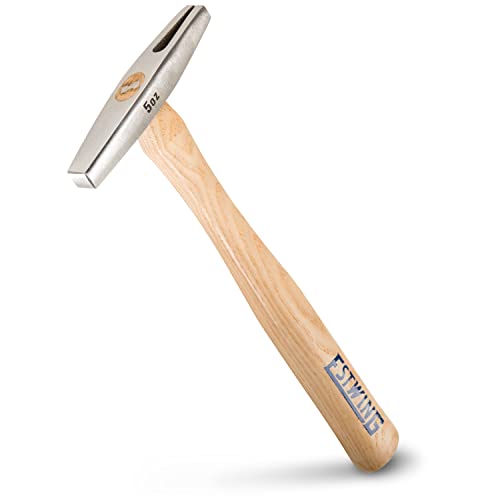
magnetic-tipped five-ounce tack hammer for driving upholstery tacks one-handed
A tack hammer has one magnetised face that lifts a tack out of the tin and presents it point-outwards, so you can place and drive it with one hand while the other keeps the cloth stretched. The head is small and light because upholstery tacks are small. It is also the tool that seats any staple left standing proud after a pass with the gun.
Why we picked this exact one: The Estwing Sure Strike MRWT is forged steel on a hickory handle at a price where most tack hammers are cast and painted. Trade upholsterers usually reach for C.S. Osborne instead, but those cost around three times as much and the difference is balance rather than function. Over three thousand reviewers is reassurance you rarely get on a tool this specialised.
short black upholstery tacks for fixing cloth to a thin seat frame
Upholstery tacks are sold by a number that corresponds to length, and the short sizes are the ones used underneath a pad where the timber has least to give. They come blued or blackened so they will not rust a mark through the cloth. Driven at roughly inch spacing around the underside they hold a cover as well as staples do, and they come out again without a fight.
Why we picked this exact one: The Dritz Home 9002 tin is the #3 short size in a 1.5-ounce quantity, which suits a set of dining chairs rather than a working shop. They are also the easiest upholstery tack to actually find in stock. At 4.4 stars across more than a thousand ratings they are the least-loved item on this page, though nobody is precious about tacks.
long steel regulator needle for shifting lumps of padding under a cover
A regulator is a long steel pin with a blunted point, used to push padding around underneath a cover without piercing the cloth. You work from the edge of a lump towards the hollow beside it, a little at a time, checking with the flat of your hand. It is not a sewing needle and you do not stitch with it.
Why we picked this exact one: The C.S. Osborne 520-8 is the regulator in most working toolboxes, and on Amazon it is most of what comes up when you search for one. Eight inches suits a seat pad, where the 10- and 12-inch versions are meant for deep chair backs. It is a steel spike with a plastic handle and there is nothing on it to wear out.
air-powered fine-wire upholstery stapler for anyone doing more than one chair
A pneumatic upholstery stapler fires a thin 22-gauge staple using compressed air, so it drives flush into hardwood and plywood that stop a hand gun dead. Long-nose versions reach into corners and along rails where a bulky head cannot sit flat. It needs a compressor to run, and that is the real cost and the real decision.
Why we picked this exact one: The 3PLUS H7116LSP-KT fires 22-gauge 71-series staples, the fine-wire standard actual upholstery shops work with, and arrives as a kit with six thousand of them. Buy it once you have finished a seat by hand and know you want five more, not before, because you will also need a compressor and working upholsterers treat that as a workshop decision rather than a first-project one. For a single footstool the hand gun above is the honest answer and this is money parked in a cupboard.
Strip one seat with a flathead screwdriver and you'll understand why the proper remover exists: the screwdriver skids off the staple crown and digs a scar into the ledge the pad has to drop back into. A forked lifter slides under the crown and pops it. No scar. Once the seat is sorted the frame underneath usually wants attention too, which is where sanding and repainting a tired piece picks up.
One Book Worth Owning
A book earns its place here because the next chair is always harder than the last one. Photographs do the work. Drop-in seats teach tension and corners, while a sprung dining chair or a buttoned stool wants stitching and an order of work you can't reason your way to. If you've done any hand-stitching with a hoop and floss you'll already recognise the instinct to keep a ground fabric evenly tensioned, which is the same instinct a seat cover asks for.
11Pick 11 of 11Book worth reading
illustrated step-by-step upholstery manual covering tools, padding and whole-chair projects
A good upholstery manual earns its place because sequence matters more than any single technique, and photographs carry sequence in a way instructions cannot. Look for one that covers stripping, building up padding and turning corners before it moves on to springs and buttoning. The useful ones also tell you what to check on a second-hand chair, which is where most projects actually start.
Why we picked this exact one: The Upholstery Bible by Cherry Dobson is written by someone who has taught the craft for over thirty years, and it shows in how much room goes to the steps beginners get wrong rather than the showpiece pieces. It runs from tools and fabric choice through to stripping and rebuilding entire chairs, in colour at every stage. At under fifteen dollars it costs less than the foam does.
One book is plenty. Buy a second only when you hit something the first one doesn't cover, which for most people is a year away. And if you're still weighing up whether this is the craft for you at all, working out which hobby actually suits you is a cheaper experiment than a boot full of foam.
Why Your First Seat Won't Drop Back In
I rebuilt the pad and now it won't go back into the chair. What did I do wrong?
Almost certainly you over-stuffed it, which is the signature drop-in mistake and an easy one to walk into. People replace a 40mm foam slab with a 50mm one, add wadding on top, then pick a cover thicker than the original, and the pad quietly gains a centimetre it has nowhere to put. The ledge only gives you about 5mm of clearance all round over the bare frame. Drop the stripped frame back into the chair and measure that gap before you cut any foam. If it is already covered and sitting proud, lift it, trim the foam back around the edges and re-cover, because compressing it by sitting on it does not last.
How tight am I supposed to pull the fabric?
Tighter than feels polite. A cover with any give in it on the bench will sag within a few months, because every time somebody sits the weave stretches a little further and it never recovers. Work the front and back first, then the two sides, then pleat the corners last. Fix each side loosely before you commit to it, so you can pull a staple and re-pull the cloth when the grain has gone crooked; the trade calls that temporary tacking and it is the step beginners skip most often.
My staples won't go in. Is the staple gun faulty?
Probably not, and it is worth checking the staple before you blame the tool. The T50-type staples stocked in every hardware shop are thick-wire, and a hardboard or hardwood pad base will throw them back out half-driven. Proper upholstery staplers use a much thinner 22-gauge wire that drives where the fat ones simply will not. Swapping to an electric gun does not fix this, because an electric gun fires the same staple with more noise; tacks and a tack hammer are the cheap way round it, and a fine-wire air stapler is the expensive one.
Do I need to put new webbing in?
It depends entirely on what you find when you turn the pad over, and this catches people who have read one tutorial. If the frame is a wooden border with an empty middle, the webbing is the seat's only suspension and it has to be replaced or the foam has nothing to sit on. If it is a solid plywood or hardboard base, which is what most mass-produced dining chairs have, you skip webbing completely and go straight to foam. On a solid base there is one trick worth stealing from the trade: drill a couple of small holes through the board first, so air can escape from under the foam when somebody sits instead of pumping against a sealed cover.
People Worth Following Into This Hobby
Real practitioners we found while researching this setup — people who do the work, show their process, and publish on sites they run themselves. No sponsorships, no affiliations; we just think they're worth your time.
Runs Greenwood Upholstery in Hebden Bridge and publishes his whole 34-year bench method as a free upholstery reference, timings and material costs included.
His drop-in dining seat chapter is the long version of this page: the 5mm rebate clearance that explains why an over-stuffed pad will not fit, the order you pull the cover in, and why he tells beginners to skip battery staple guns entirely.
Works as an upholsterer from her atelier at Veyrier-du-Lac near Lake Annecy and teaches the craft through filmed step-by-step tutorials and hands-on classes.
She is the clearest source on the open-frame versus solid-base question in our FAQ, including the ventilation holes to drill through a solid seat board before the foam goes on.
Builds custom furniture and carves by hand in Sanbornville, New Hampshire, and documents each stage of a build on his own blog, slip seat frames included.
He approaches the drop-in seat from the woodworking side and shows how the frame is sized for the fabric that will wrap it, which is the clearance problem in this page FAQ seen from the other end.
Films traditional British and modern upholstery courses from a training centre in Essex, working up from an ottoman box to a sprung dining chair.
Their foundation levels are the natural next step once a drop-in seat is finished, because they cover the sprung dining chair that usually sits elsewhere in the same house.
Love what you see here? Save individual picks with on any item, or copy everything to a list of your own in one click — great for coming back to later, or dropping as a not-so-subtle hint.