Japan has a word for cloth patched so many times it turns into something else: boro, from boroboro, meaning tattered. Farming families in the cold north couldn't buy fine cotton, which was effectively reserved for people above their station, so they grew, spun and wove their own and dyed it with indigo, the cheapest colour going and a decent moth repellent into the bargain. Then they patched it, for generations, until one jacket carried a century of repairs. Here's the part that still gets me. When living standards rose, most of that cloth went in the bin, because it was embarrassing, proof you'd been poor. A folklorist named Chuzaburo Tanaka collected it anyway and ended up with more than 20,000 pieces, 786 of which are now protected as Important Tangible Cultural Properties.
This page is about repair you wear, not art you hang up. If you want a hoop, a pattern and a finished piece to frame, beginner embroidery is a different kit and a different afternoon. Mending starts from damage instead, which changes everything: the hole picks the design and you only decide how loud to be about it. Most people's first one is a knee or an inner thigh, and it takes an evening. The business press keeps writing about young people picking the skill back up to get off their phones and save money, and whatever you make of that framing, the jeans don't care.
Start with almost nothing. A long needle, cotton thread, a scrap of denim and small sharp scissors will close the first hole; everything else can wait until you know you enjoy it.
Nothing on this page costs enough to sting if the habit doesn't stick. The whole starter list comes in under one new pair of jeans.
Where This Little Kit Can Take You
A few real moments and results from this hobby — made with tools no fancier than the ones below.
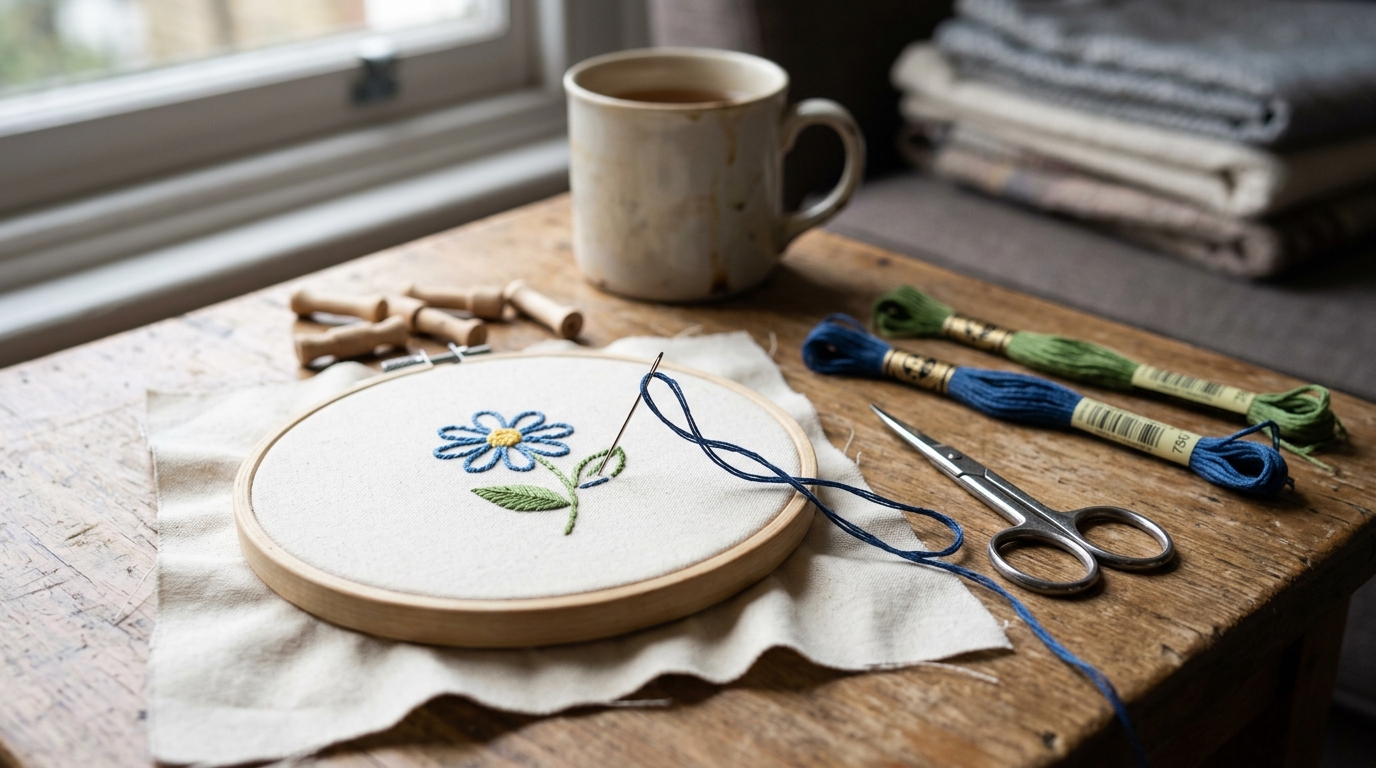
Patched jeans back on the lineBoth knees carry a different repair, and the trousers went back into the wardrobe instead of the bin.
Threading up for the eveningThe slowest part of any mend happens before a single stitch goes into the cloth.
A long needle waiting in denimParked mid-row, which is how most repairs survive a week of evenings.
The raw material for this hobby is already sitting in your laundry pile, which makes it the rare craft with no shopping trip before the shopping trip. Fair warning, though. Once you've patched one thing, every frayed cuff in the house starts looking like a project.
Five Things, One Evening, One Fixed Knee
People buy in the wrong order. The instinct is to pick thread colours first, and then to wonder why the needle keeps stalling halfway through two layers of denim. Denim is the problem to solve here, not colour. You want a needle long and stiff enough to carry a row of stitches through it, something to back the hole with, and something to hold the cloth steady while you work. Get those right and the rest really is decoration. The smell of a well-worn pair of jeans under a reading lamp is part of the deal, and so is the small thud of the needle finally going through.
Disclosure: This section may contain affiliate links to Amazon. We may earn a small commission from qualifying purchases at no extra cost to you.
01Pick 01 of 11
long sashiko needles for stitching through denim and patches
Sashiko needles are longer and stiffer than ordinary sewing needles, and the eye is wide enough to take thick cotton thread without shredding it. Around 3 mm of eye length is the shape to look for. The length is the real point: experienced stitchers load twenty or more stitches onto the shaft before pulling the thread through, which is how a row of running stitch ends up even.
Why we picked this exact one: The Tulip Hiroshima long sashiko needles come six to a tube in assorted thicknesses, which covers a thin shirt seam and a double-layer denim knee from the same pack. They hold 4.8 stars across more than a thousand reviews. The tube is tiny and easy to lose in a work basket, so it is worth keeping it rubber-banded to the thread.
cotton embroidery floss in a wide colour range for visible repairs
Six-strand cotton floss pulls apart into separate strands, so one skein gives you a fine thread for a shirt and a fat one for denim. Mending generally wants more strands than embroidery does, because the stitches have to take wear as well as show. A broad colour pack earns its place here: you are either matching a garment you already own or deliberately clashing with it.
Why we picked this exact one: The Maxee 100-colour floss set covers almost every denim blue and contrast brightness a beginner reaches for, and it holds 4.7 stars across roughly 650 reviews. It costs less than a takeaway. The skeins arrive loosely wound rather than on bobbins, so budget ten minutes to wind the ones you use or they knot in the box.
wooden darning mushroom for holding cloth taut behind a hole
A darning mushroom is a smooth wooden dome on a handle that sits under the damage so the cloth stays curved and still. You stretch the fabric over the dome and hold it there with an elastic band, which leaves both hands for the needle. The curve is deliberate. It keeps the finished darn slightly loose rather than drum tight, so the repair flexes when you move.
Why we picked this exact one: This Tendiren mushroom is a plain unvarnished dome on a long handle, which is everything this tool has ever needed to be. It rates 4.6 stars across just under 200 reviews. There is only one size, so a child's sock stretches a good deal tighter over the dome than an adult's does.
cotton denim patches for backing holes in jeans and jackets
These are rectangles of woven cotton denim with a heat-activated backing, cut large enough to sit behind an average knee hole. The patch goes underneath the damage rather than on top, so what shows afterwards is the stitching you add. A spread of denim shades is genuinely useful, because jeans fade unevenly and a patch rarely matches the leg it is going into.
Why we picked this exact one: The KING MOUNTAIN twenty-piece pack gives five denim shades at 3 by 4-1/4 inches each, which is enough fabric for a first dozen repairs. It carries 4.4 stars from over 7,000 reviews. The shades run bright rather than faded, so on a pale, well-worn pair the patch reads as new cloth until it has been through the wash a few times.
small sharp scissors for trimming thread and tidying frayed holes
Four-inch scissors with fine pointed blades do two jobs in mending: cutting thread flush against the cloth, and trimming the frayed edges around a hole before a patch goes in. The short blade gives you control close to the fabric in a way full-size shears cannot. Forged steel also holds its edge through denim longer than stamped craft scissors do.
Why we picked this exact one: The HAGUPIT 4-inch forged detail scissors have points fine enough to slide under a single stitch you want to unpick, and they hold 4.6 stars from more than 1,600 reviews. Forged blades at this price are unusual. They are properly sharp, which is a good reason to keep the sheath on them if the basket is shared.
With these five on the table you can close a knee, a pocket corner or a worn inner thigh in one evening, and the result will go through the wash without complaint. Give the first attempt to something you'd already half written off. The stitches get noticeably straighter by the third row, and you'd rather that happened on old work trousers than on the jeans you actually like. Everything after this section is about making the repair louder on purpose.
When You Want the Stitches to Show Off
There is a moment, usually on the second or third repair, when you stop trying to make the mend disappear and start arranging it. That is where this gear comes in. None of it makes a repair hold better than the essentials above do; it makes the repair look like a decision. The traditional running-stitch patterns are the obvious next step, and the honest warning is that they take four or five times longer than a plain grid of rows. Your fingers will tell you about it the next morning.
06Pick 06 of 11
traditional sashiko thread for bold running-stitch repairs on denim
Sashiko thread is several fine cotton threads twisted tightly together, and unlike embroidery floss it is not meant to be split. You stitch with the whole strand. That tight twist is what stops it fraying apart as it is dragged again and again through heavy cloth, and it sits higher on the surface than floss, so a stitch line reads clearly from across a room.
Why we picked this exact one: The Olympus four-skein colour bundle is the sensible way in, since Olympus is one of the Japanese mills sashiko stitchers actually name when asked. Four colours is enough to find out whether you like the thread before committing to full skeins, and it holds 4.8 stars across 275 reviews. At 20 metres a skein it goes faster than it looks; one big knee patch can eat most of one.
ring thimble with a metal plate for driving a long needle through denim
This style of thimble sits on the middle finger with a flat metal plate facing the palm, and you push the blunt end of the needle against the plate instead of with a fingertip. It is the thimble that makes long-needle running stitch work, because the force comes from the whole hand. The band adjusts, which matters more than it sounds, since a loose thimble spins round at the worst moment.
Why we picked this exact one: The Clover 611 adjustable ring thimble is the version most easily found outside Japan, and the adjustable band means one really does fit most hands. It rates 4.5 stars from over 1,200 reviews. It feels awkward for a session or two, and plenty of people still reach for a plain fingertip thimble on short repairs.
reusable sashiko pattern stencils for marking repeating stitch grids
Sashiko stencils are thin plastic sheets cut with traditional repeating patterns, from waves to interlocking circles, that you trace onto cloth before any stitching starts. They solve the part beginners find hardest: keeping a geometric pattern square across a curved, already-worn garment. The sheets are reusable, so one set marks dozens of repairs.
Why we picked this exact one: The FIVEIZERO thirty-piece set covers the classic sashiko patterns at 4.7 by 5.1 inches, which fits an average patch without trimming. It is a newer listing than the rest of this page, with 4.4 stars from 57 reviews. The sheets are thin enough to flex around a trouser leg, and thin enough to crease permanently if you shove them in a drawer.
fabric marking pen whose lines wash out or fade after stitching
One end of this kind of pen makes a mark that rinses away with water, the other makes one that fades on its own over a day or so. You use it to trace a stencil or draw the boundary of a repair before the first stitch. Test any marking pen on an inside seam first, because dark and heavily dyed fabrics do not always release the ink the way a pale cotton will.
Why we picked this exact one: The Dritz dual purpose marking pen puts both the washable and the air-erasable option in one body, which helps before you know which your fabric prefers. It holds 4.6 stars from more than 1,700 reviews. The air-erasable end fades quicker in a warm room than the packaging implies, so mark only what you plan to stitch that evening.
Buy this layer only once you've finished a repair you're pleased with, because wanting a stencil before you own a finished mend is how craft drawers fill up. If the stitching itself starts interesting you more than the hole does, the traps that catch people starting embroidery apply here almost word for word. The distance between fixing clothes and decorating them turns out to be very short.
Two Books Worth Owning Before You Cut Anything
Mending is one of those skills where a photograph answers in two seconds what a paragraph can't manage in ten. The sequence of a repair, which layer sits where, how far the stitching runs past the damage, is far easier to copy than to read. Both of these are written by people who mend their own clothes and show their own failures, which is the only kind of mending book worth the shelf space.
10Pick 10 of 11Book worth reading
a beginner's handbook for patching and stitching woven clothes
A project-led guide to repairing woven garments, meaning denim, linen and cotton, entirely by hand rather than machine. It works through around twenty repairs in photographed steps, building from a plain patch up to layered, decorative work. Because it sticks to wovens it covers jeans thoroughly, and leaves knitwear to other books.
Why we picked this exact one: Katrina Rodabaugh's Mending Matters is the title mending teachers point beginners to when the problem is specifically denim, and it covers boro and sashiko patching properly rather than as a sidebar. It holds 4.6 stars across more than a thousand reviews. It is deliberately narrow, covering woven garments only, so a sweater with a moth hole needs the other book here.
an illustrated guide covering darning, stitching and patching across fabric types
This one spans the techniques rather than one family of fabric, with step-by-step instructions for darning knitwear, patching wovens and stitching over general wear. The illustrations carry most of the teaching, which helps enormously at the point where a written description of a woven darn stops making sense. It is a paperback, so it lies flat on the table while you work.
Why we picked this exact one: Arounna Khounnoraj's Visible Mending is the book menders pair with a denim-only guide, because it takes knitwear and woven darning seriously instead of skipping them. It rates 4.7 stars from just over 400 reviews. It covers more ground in fewer pages than a single-technique book, so expect breadth rather than a deep dive on any one repair.
Two books is one more than most crafts need, and the reason is simple: wovens and knits really are separate problems with separate tools. Borrow before you buy if your library has them. Mending books get read properly once, then opened at the same page forever.
Why Your First Mend Puckers, and Four Other Surprises
Do I darn the hole in my jeans or patch it?
Beginners reach for darning because it is the word they know, but darning means weaving a whole new piece of cloth across the gap, and that only makes sense on knitted fabric like socks and sweaters, where the surrounding loops can carry it. Denim is woven and heavy, so a darn big enough to cover a knee comes out stiff and pulls away at the edges. On jeans you slide a patch behind the hole and stitch rows across the whole area, which spreads the load into sound fabric. Keep the mushroom for the socks.
Why did my repair come out puckered?
Almost always because the thread got pulled tight on every stitch. It feels like you are making the mend stronger; what you are really doing is gathering the cloth, and once it is gathered the patch sits proud and the fabric around it takes all the strain. Lay the stitches down without tension and aim to match how tight the garment's own weave or knit is, so a loose knit gets loose stitches. Going slowly on the first row costs less time than unpicking the fifth.
The needle keeps stopping halfway through the denim. What am I doing wrong?
Probably nothing with your technique and everything with the tools. A short, fine needle has no leverage through two layers of denim, and one fingertip cannot generate the push. The traditional answer is a long needle driven against the flat metal plate of a ring thimble, with the whole hand behind it rather than a single finger, which is exactly why sashiko needles look absurdly long in the packet. Load several stitches onto the shaft before you pull through and the work gets faster as well as easier.
Can I iron the patch on and skip the sewing?
You can, and it will look fine for a few weeks. Heat-activated adhesive holds against a straight pull but not against the twisting a knee does all day, so the corners lift first and then collect fluff in the wash. Even the companies that make the patches tell you to add stitches. Treat the glue as a way to hold the patch still while you work, and let the thread be the actual repair.
How far past the hole do the stitches need to go?
Further than feels necessary. The cloth immediately around a hole is already thin, which is why it tore there, so stitching right at the edge just moves the failure outward by a few millimetres. Menders work out to roughly a centimetre and a half beyond the damage on every side, anchoring into fabric that still has strength in it. In practice that means a patch noticeably bigger than the hole, and a block of stitching bigger again.
People Worth Following Into This Hobby
Real practitioners we found while researching this setup — people who do the work, show their process, and publish on sites they run themselves. No sponsorships, no affiliations; we just think they're worth your time.
Fourth-generation Japanese sashiko artisan who writes up the tool choices behind every stitch and teaches sashiko workshops in person and online.
His needle and thread articles are the source practitioners point to on what a sashiko needle's eye and length are actually for, which is the piece of this setup beginners get wrong first.
Runs online sashiko courses and a stitch club from Canada, publishing step-by-step mending tutorials with free pattern guides.
The koshi-zashi tutorial walks through exactly the patch-and-running-stitch repair this page's essentials are bought for, at a pace a first-timer can follow.
Knitwear designer in the Scottish Borders who mends her own and other people's sweaters and photographs each darn from hole to finish.
This page sends knits away to be darned rather than patched, and her breakdown of the different darning stitches is where a reader should go once the sock pile comes out.
Fashion historian who researches and exhibits textile repair, wrote MEND! and runs public mending gatherings.
The intro to this setup leans on boro's history, and she is the person who has actually done the archival work on where mending traditions came from and why they were thrown away.
Love what you see here? Save individual picks with on any item, or copy everything to a list of your own in one click — great for coming back to later, or dropping as a not-so-subtle hint.