A sewing machine does one trick: it locks two threads together through cloth, over and over, faster than your eye can follow. People do it at kitchen tables, in spare bedrooms and in community studios, mostly to make things they will actually use, like a bag or a cushion or a hem that stays up. The machine that made all of it possible was so unwelcome at first that a Paris workshop full of them was burned down in 1830 by tailors who could see where it was heading. And the breakthrough was not the motor. It was moving the eye of the needle down to the sharp end, which sounds like nothing until you try to picture how else a loop of thread gets carried through cloth and caught underneath.
Most beginners do not stall on the sewing. They stall on the threading, which is the path the top thread takes through the hooks and discs, plus a bobbin that has to be wound and dropped in facing the right way. That is the real learning curve and it is over in an evening or two. After that you are doing one thing, feeding cloth under a needle in a straight line, which is all a tote bag or a pillow cover really is. If you are still weighing this up against other crafts, our guide to choosing a first hobby is a gentler place to start than a shop floor.
Our philosophy here is to buy as little as you can get away with. A machine, a few spools of thread, one sharp pair of shears, a handful of pins and an iron will carry you through a bag, a cushion cover and a pair of shortened trousers. Everything else can wait until a project asks for it by name.
Nothing below costs enough to sting if the machine ends up back in the cupboard by February.
Where This Little Kit Can Take You
A few real moments and results from this hobby — made with tools no fancier than the ones below.
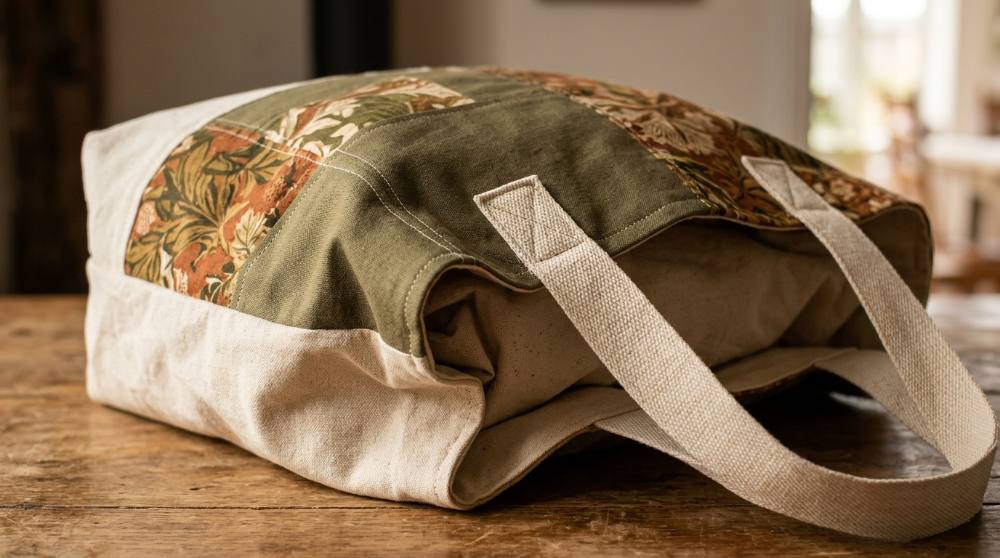
A tote that stands upContrast panels and a burlap base turn four rectangles into something sturdy.
Fabric moving under the needleBoth hands steer, the pedal sets the pace, and the machine light does the rest.
One thing worth saying before the shopping starts: this page is about a machine. If you would rather keep the work in your lap, sewing felt ornaments by hand gets you a finished object for the price of a needle and a few sheets of felt, and nothing has to be plugged in. The machine earns its table space when you want length: long seams, repeated seams, a tote that holds a week of groceries without splitting at the corner.
What Has to Be on the Table
Five things, and three of them cost less than a takeaway. The machine is the big spend and the only one worth agonising over; the rest you buy once and keep for years. Here is where the money usually goes wrong, though. People pay extra for stitch counts, and a machine with two hundred decorative stitches is not two hundred times more useful than one with ten. You will use straight stitch for everything and zigzag to stop raw edges fraying, and honestly that is it for the first year. Anyone who already keeps a crochet kit in a drawer will recognise the shape of this: the gear you reach for is always the boring gear.
Disclosure: This section may contain affiliate links to Amazon. We may earn a small commission from qualifying purchases at no extra cost to you.
01Pick 01 of 11
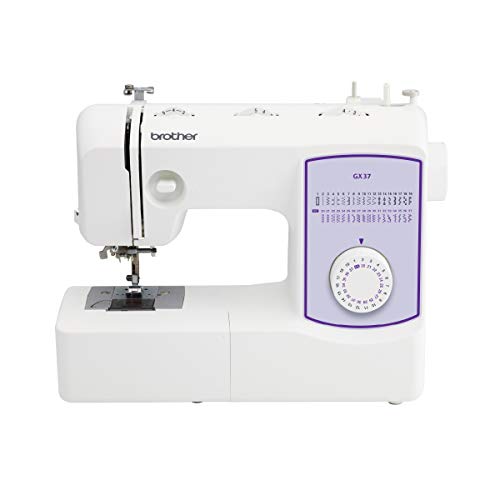
mechanical home sewing machine with straight stitch, zigzag and reverse
A mechanical sewing machine runs its settings off dials rather than a screen, so changing stitch length or width is a physical turn you can see and undo. The features that actually matter on a first machine are a free arm for sewing tubes like sleeves and bag handles, a drop-in bobbin you can watch run down, and a reverse lever for locking the ends of a seam. Look for adjustable tension and adjustable stitch length rather than a high stitch count, which is the least useful number printed on the box.
Why we picked this exact one: The Brother GX37 is the mechanical machine we would hand someone on their first evening: 37 stitches they will ignore, plus the dials, free arm and drop-in bobbin they will use constantly. It holds 4.6 stars across more than five thousand ratings, which is unusually consistent under $150. The body is plastic and it complains at four layers of canvas where a strap meets the bag, so keen bag-makers add a walking foot, but a first tote is well inside it.
all-purpose polyester sewing thread in a spread of everyday colours
All-purpose polyester is the default thread for machine sewing on cotton, canvas and most everyday wovens: strong, slightly stretchy, and stable under a hot iron. Buying a set rather than single spools matters more than it sounds, because thread is matched to the fabric and running out of the one colour you need mid-project ends the afternoon. Cheap thread is a false economy in a different way, since it sheds lint into the bobbin area, and packed lint is the usual reason stitches start misbehaving.
Why we picked this exact one: The Gutermann Sew-All set of twenty 100-metre spools is the thread most sewists settle on, and buying the set skips years of picking up single spools at full price. It holds 4.7 stars from over ten thousand ratings. Twenty colours will not match every fabric you ever buy, but they will cover a tote, a cushion and a pair of hemmed trousers without a trip to the shop.
8-inch bent-handle fabric shears for cutting cloth flat on a table
Dressmaker's shears have an offset handle so the lower blade can slide along the table while you cut, keeping the fabric flat instead of lifting it into the blades. Eight inches is the usual compromise: long enough to take a metre of canvas in a few strokes, short enough to steer round a curve. They are for cloth only, because paper blunts them fast and a blunt pair chews fabric rather than cutting it.
Why we picked this exact one: The Fiskars 8-inch bent forged shears are the standard first pair, with a true offset handle and forged blades rather than the stamped steel on most budget shears. They hold 4.7 stars from more than 1,600 ratings at under $20. The handles are moulded plastic rather than the all-steel of a $60 pair, which shows up as hand fatigue on a long cutting session and not as a worse cut.
sewing notions set with pins, pin cushion, seam ripper and tape measure
Notions are the small tools that hold cloth still and undo mistakes: glass-head pins to tack two pieces together before they reach the needle, a seam ripper to take out a wrong seam without cutting the fabric, a tape measure, hand needles and a cushion that keeps pins off the floor. One rule comes with them: pull each pin out as it reaches the presser foot, because sewing over steel breaks needles and can knock a machine's timing out. Buying them as a set is the cheapest route to a working kit, and the pins are the part you will keep replacing.
Why we picked this exact one: This Fbshicung 140-piece set covers the small tools in one go: 100 glass-head pins, two seam rippers, a tomato cushion, hand needles, thimbles and a tape measure, at a price where losing half the pins under the table is survivable. It sits at 4.7 stars from just over a hundred ratings. The little scissors in the box are not fabric shears and should not stand in for the pair above.
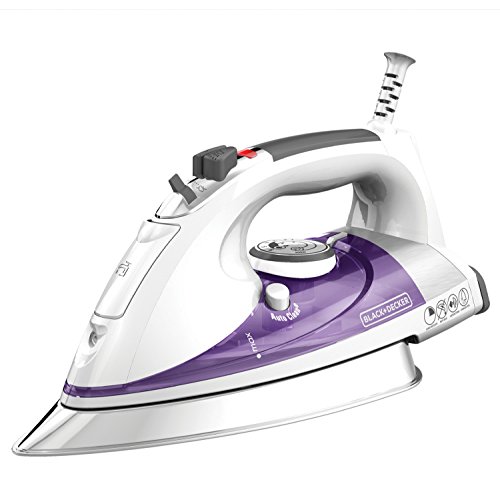
steam iron with a stainless soleplate for pressing seams flat
A sewing iron is an ordinary steam iron used differently: set down on a seam, lifted, moved along, set down again, rather than slid about like you would iron a shirt. Sliding stretches a cut edge out of shape, which is why the lifting matters. Independent steam and temperature controls earn their keep because cotton wants heat and moisture while a synthetic lining wants neither, and a stainless soleplate moves over cotton without catching.
Why we picked this exact one: The BLACK+DECKER Professional is the sensible sewing-room iron: stainless soleplate, separate steam and temperature dials, about $34. It carries 4.4 stars from over six thousand ratings. Its auto shutoff is quick by design, which is a safety feature everywhere except a sewing table, where you press in short bursts between seams and keep waking it up.
Thread it, wind a bobbin, and sew ten lines on a scrap before you touch the real fabric. That scrap is also where you find out your stitch length is wrong, because 2.5 to 3 mm suits mid-weight cotton and going shorter to make a seam stronger mostly buys you puckering. Press every seam the moment it is sewn. The first time you open one under a hot iron and it goes flat and crisp, with that faint smell of warm cotton coming off the board, the thing on your table stops looking home-made. If you would rather your stitches showed than disappeared, visible mending runs on the same muscle memory and almost none of the kit.
Or Buy It All in One Box
There is an honest gap here and it is worth naming. The five picks above come to around $237, while a compact machine that arrives with a 42-piece tin of thread, bobbins, needles, scissors and a seam ripper costs about a quarter of that. For somebody who wants to find out this week whether they even like sewing, that gap matters more than any spec on a box.
The one-box alternative
compact beginner sewing machine sold with a full set of starter notions
A one-box beginner machine pairs a small 12-stitch machine with a tin of consumables, so nothing else has to arrive before the first seam: thread, bobbins, needles, scissors, a seam ripper and a tape measure. The machine itself is lighter and simpler than a full-size one, with a free arm, two speeds, a tension dial and a foot pedal, which is enough for straight seams and zigzag edge finishing. What you give up is mass, and a light machine both walks on the table at speed and labours on thick seams.
Why we picked this exact one: This Chunara 12-stitch machine with its 42-piece kit is the best-rated one-box bundle we opened, at 4.7 stars from nearly 1,400 ratings. It has the parts that matter on a first machine, a foot pedal, free arm, tension dial and two speeds, rather than the handheld gadgets sold at the same price, which practitioners are unanimous about avoiding. It is light plastic, so a strap junction on heavy canvas will be a fight; treat it as a pillow-cover and hemming machine that can manage a light tote.
Cushion covers, hems, drawstring bags and a light tote. The small spools in the tin cover a couple of projects, not a season.
The same projects plus heavy canvas totes, and twenty full spools of thread that will outlast a year of weekends. better here
Quality of the tools
Serviceable and small: a light machine, short scissors, thin thread. Everything in the box works once.
Forged shears that stay sharp for years, a thread that does not shed lint, and a full-size machine with more weight behind the needle. better here
The first evening
Open the box, thread it, sew. Nothing else to order or wait for. better here
Five separate deliveries, and the iron and the shears may well land on different days.
Where it leads
The notions carry forward if you upgrade later. The machine usually does not, and resale on these is close to nothing.
Every item here is still in use on your tenth project, the machine included. better here
Our verdict: it depends. Buy the one-box machine if you genuinely do not know yet whether you will still be sewing in spring; build it from the picks if you already want a tote that holds a week of groceries.
The Second Wave, Once You Know You Will Keep Going
None of this is needed for a first tote. Each one removes a specific annoyance you will not believe in until you have hit it twice. Cutting canvas with shears is fine, for instance, right up until you are cutting four matching rectangles and the fabric creeps under the blade; that is the afternoon a rotary cutter earns its keep. Most of these point the same way, towards straight lines and layers and accuracy, which is why they turn up again in a beginner quilting setup.
06Pick 06 of 11
universal machine needles in assorted sizes for woven fabrics
Machine needles are consumables, sized by number, and a higher number is a thicker needle for heavier cloth. A universal point suits wovens like cotton, canvas and denim; knits want a ballpoint instead, which pushes between the loops rather than piercing them. An assorted card covers shirting weight through to bag-weight canvas without having to guess which size to stock, and a 70/11 is roughly bed-sheet weight if you need a reference point.
Why we picked this exact one: SCHMETZ Universal assorted cards are the needles most sewing rooms run on, and this two-card pack gives twenty needles across the sizes a beginner actually meets. They hold 4.8 stars from nearly 1,300 ratings. They are universal points only, so a first project in jersey will still need a separate ballpoint card.
rotary cutter, self-healing mat and ruler for cutting straight fabric pieces
A rotary cutter is a rolling blade run against a self-healing mat with a ruler held down on top as the guide. It cuts without lifting the cloth at all, which makes it faster and squarer than shears on the long straight edges every tote, cushion panel and quilt block is made of. The mat is the part that limits you, since a small one means repositioning the fabric mid-cut, and that is where accuracy leaks away.
Why we picked this exact one: This Headley Tools set bundles the 45 mm cutter, five spare blades, an A3 mat, a 6.5 by 12 inch ruler and a pack of clips for about $27, which is less than many mats cost alone. It holds 4.7 stars from over 4,500 ratings. The A3 mat is small for cutting across a full width of fabric, and plenty of people buy this set first and a larger mat a year later.
even-feed walking foot for sewing thick or layered fabric
A walking foot adds a second set of feed teeth above the fabric so both layers are pulled along at the same rate instead of only the bottom one. On thick or slippery stacks, canvas bag handles, quilted panels, oilcloth, the top layer otherwise arrives at the end of the seam short. It fits low-shank domestic machines, which covers most mainstream home models, though it is worth checking your shank type before ordering.
Why we picked this exact one: This YMXFAWO kit is a generic low-shank walking foot that fits Brother, Singer and Janome machines rather than being locked to one maker's series, which matters because the foot usually outlives the machine. It holds 4.4 stars from just over a hundred ratings at under $20. Generic feet vary in fit tolerance, so if your machine is high-shank or an unusual model, buy the manufacturer's own instead.
high-output steam iron for pressing seams and setting sharp creases
What separates a sewing-room iron from a budget one is steam volume and how fast it recovers: more holes in the soleplate and a bigger burst flatten a seam in one pass instead of three. Temperature control tends to be finer too, which matters on a project that mixes a cotton outer with a synthetic lining. Weight helps as well, since pressing is the iron doing the work while you hold it still.
Why we picked this exact one: The Rowenta Focus Excellence is the step up for anyone who has started resenting the pressing: a stainless soleplate with over 400 steam holes and 1750 watts behind it. It carries 4.4 stars from more than 800 ratings. At around $110 it only makes sense once you are pressing several seams a week, so if the machine is still in its box, buy the $34 iron above and put the difference into fabric.
Buy these one at a time, as projects ask for them, rather than in one cheerful order. The walking foot especially is a thing you understand in a single moment: your bag handles slip out of line on the fourth layer of canvas, the top piece arrives at the needle an inch short of the bottom one, and suddenly the point of a second set of feed teeth is obvious. Heavier work pulls you further along the same road, and recovering a drop-in chair seat swaps the machine for a staple gun while keeping exactly the same instinct about structure.
One Book Beats Forty Open Tabs
Video is good for watching a technique once. It is bad for the moment you are mid-seam with one hand holding the fabric and you need to check a single thing fast. A reference book opens flat next to the machine and stays on the page, and the two below are the ones sewists keep recommending to each other rather than to search engines. Both also cover the hand stitches that finish a machine-sewn project, which is where this quietly overlaps with hand embroidery.
10Pick 10 of 11Book worth reading
photo-led reference book covering machine sewing techniques step by step
A photo reference shows each technique as a run of images rather than a paragraph of instructions, which is how most people pick up a physical skill. The sections a beginner reaches for are the machine chapter, threading, tension, stitch selection, and the construction basics: seams, hems, corners and facings. It is a book to leave open beside the machine rather than one to read through.
Why we picked this exact one: Singer's The Complete Photo Guide to Sewing, 3rd edition, is the book sewists hand to beginners when the question is how to physically do a thing, with roughly 1,200 step photos. It holds 4.6 stars from over a thousand ratings. It is broad rather than deep, and the fitting and tailoring sections are summaries rather than courses, which is the trade for covering everything a first couple of years will throw at you.
comprehensive sewing reference covering techniques and home-sewing projects
A full sewing reference goes past the how into the why: several ways to put in a zip, what a seam finish is actually for, how cloth behaves along the grain. That matters the first time a project needs a decision instead of a step. It is a hardback to keep on a shelf and come back to for years, not something to work through in order.
Why we picked this exact one: The Reader's Digest Complete Guide to Sewing is the title long-time sewists on pattern forums keep naming when somebody asks for one book, and this edition is under $13. It carries 4.7 stars from more than 600 ratings. Its look is dated next to the photo guide, diagrams and line drawings rather than glossy step shots, which is exactly why some people prefer it and others bounce straight off it.
Buy one, not both. The photo-led guide suits anyone who learns by looking, while the older reference suits anyone who wants the reasoning underneath the steps. Either will still earn its shelf space in ten years. If you would rather have something to do with your hands on the sofa instead, knitting needs no table and no power socket.
Why Your Machine Suddenly Seems to Hate You
Why is there a bird's nest of thread under my fabric when the top looks fine?
Almost everybody blames the bobbin, and almost everybody is wrong. A nest underneath usually means the top thread never seated itself in the tension discs. Those discs open when the presser foot is up and clamp when it is down, so threading with the foot already lowered leaves the thread lying outside them, and sewing with the foot up does the same thing from the other direction. The fix is dull and it works: lift the foot, cut the thread, re-thread the whole path from the spool, lower the foot, sew. If it still nests, take the bobbin out and look for packed lint, which grips and releases the thread at random.
Why do my needles keep snapping?
Two causes, and the machine is not either of them. The first is sewing over pins: the needle hits steel and snaps or bends, and a bent needle will keep stitching almost normally until you speed up and it tangles, so pull each pin as it reaches the foot. The second is size. A universal 70/11 is roughly a bed-sheet needle, and pushing it through four layers of canvas where a handle meets the bag is asking it to break; mid-weight canvas wants a 14 and a thick junction wants a 16. Change the needle every eight hours of sewing regardless, because they go blunt long before they break.
Do I actually need an iron, or is that just a thing sewing people say?
You need it, and not for wrinkles. Pressing a seam open flattens the stitch line into the cloth so the next seam you sew across it lies flat instead of riding over a ridge. Skip it and a tote's side seams bulge, the corners will not square up, and the whole bag reads as amateur in a way nobody can quite point at. The habit practitioners use is press as sewn first, then open the allowance and press again, lifting the iron between positions rather than sliding it, because sliding drags a cut edge out of shape.
My first tote came out floppy and sad. What went wrong?
The fabric, almost certainly. Quilting cotton is lovely and it is thin, and a bag made from it alone slumps the moment anything goes in. A mid-weight cotton duck or canvas, roughly 8 to 10 oz, stands up by itself and still feeds through a home machine without a fight. If you have fallen for a printed quilting cotton anyway, interface both the outer and the lining and accept that it is a soft bag by design. Sew one test seam on a scrap of whatever you buy before you cut the whole thing out.
Should I spend more and get a computerised machine?
Not for this. Everything a first tote or pillow cover needs is straight stitch, zigzag, reverse, and two dials you can turn: tension and stitch length. Computerised machines automate needle position and stitch settings, which is genuinely pleasant, but they fail in a way a mechanical one does not, because when the board dies the machine is usually not worth repairing while a mechanical machine can outlast the person who bought it. Put the difference into fabric and a better iron instead.
People Worth Following Into This Hobby
Real practitioners we found while researching this setup — people who do the work, show their process, and publish on sites they run themselves. No sponsorships, no affiliations; we just think they're worth your time.
Two sisters who sew every tote, cushion and curtain they publish and photograph each construction step rather than only the finished object.
Their totes archive is a free next project for anyone who finishes the bag this setup is built around, and their machine-tips section covers the presser-foot and needle choices the essentials here take for granted.
Designs her own bag patterns and writes the tutorials with the fiddly corner and handle steps photographed instead of skipped.
Her free market bag tutorial is the natural first project for the machine and notions listed here, and its bottom construction avoids the floppy-tote problem the FAQ on this page warns about.
Writes for people coming back to a machine they already own, down to which notions end up unused in the drawer.
Her beginner-supplies list is the closest independent cross-check of the five essentials on this page, and she is blunt about which gadgets a first project does not need.
Love what you see here? Save individual picks with on any item, or copy everything to a list of your own in one click — great for coming back to later, or dropping as a not-so-subtle hint.