In January 1848 a boy named Homan Walsh flew a kite called Union across the Niagara Gorge to win a ten-dollar prize. Engineers tied his string to a rope, hauled that across, and used it to start building the first suspension bridge over the river. Kites look like toys and have occasionally been infrastructure. Mostly, though, this is a park-and-beach thing: you stand in open grass with a string in your hand and something bright climbing away from you, and setup for a delta is one rod and one knot. Worth knowing before you write it off as a children's activity - the Wright brothers' very first aircraft was a biplane kite with a five-foot wingspan, steered on lines from the ground.
The thing nobody tells you is how little of this is about the kite. Wind decides the afternoon. A $13 delta in steady air flies beautifully while a lovely $60 kite sulks on the grass twenty feet downwind of a treeline, because that treeline churns the air for seven times its own height behind it. So the real beginner skill isn't assembly, it's reading a field.
Our take: one kite, one decent line, one thing to wind it on. That's the kit. Tails and wind meters and carry bags can all wait until you've had one good afternoon and caught yourself wanting another.
Everything in the first list below costs less than a takeaway for two, which felt like the right bar for something you might try exactly once.
Where This Little Kit Can Take You
A few real moments and results from this hobby — made with tools no fancier than the ones below.
The moment the line goes tightOne delta, one raised arm, and an empty field doing the rest of the work.
A whole festival in the airBig show kites and small ones sharing the same breeze over open grass.
If you've ever stood in a field with binoculars and a field guide, you already have the temperament for this - both hobbies are largely standing still and looking up. The difference is that the kite always shows up. Pick a day with a steady breeze and you'll be flying within ten minutes of parking the car.
Pick One Kite, Then Stop Shopping
Three single-line shapes dominate the beginner shelf, and they're genuinely different animals rather than colour variants. A diamond is the kite you drew as a child: two crossed spars, a tail, and a need for that tail. A delta is a triangle held open by one spreader rod with a keel underneath, and it climbs in softer air than anything else here while needing no adjustment at all. A parafoil has no frame - it's a fabric wing that inflates when the wind hits it, so nothing can snap. Pick one. Then buy line, because the string taped to a cheap kite is the first thing you'll want to throw away.
Disclosure: This section may contain affiliate links to Amazon. We may earn a small commission from qualifying purchases at no extra cost to you.
Pick one
These 3 do the same job. You only need one of them, so pick the one that suits you better.
01Pick 01 of 11Option A
classic diamond kite for steady single-line flying
The diamond is the shape most people picture when they hear the word kite: two spars crossed inside a taut sail, with a streamer tail hanging off the bottom. That tail isn't decoration on this shape - it drags at the back end and keeps the kite from rolling over when the air turns bumpy. On a first diamond, look for a reinforced spine, a tail already in the bag, and a stated wind range rather than a vague promise.
Why we picked this exact one: The Prism Vertex Diamond is the one that arrives ready to fly: kite, 200 feet of 50 lb braided polyester, a compact winder, a 10-foot triple streamer tail, and a spare frame rod with a connector, all in one bag. Its 5-25 mph rating is wide enough that a single kite covers most usable days. At 4.6 stars it's the best-liked diamond here, but $35 is roughly triple an unbranded one - you're paying for the spares and the line.
Pros
Arrives with real braided line, a winder and a spare spar
Rated 5-25 mph, so one kite covers most days
Folds to 20 inches
Cons
Costs about three times an unbranded kite
The tail is part of how it flies, so it needs the extra room
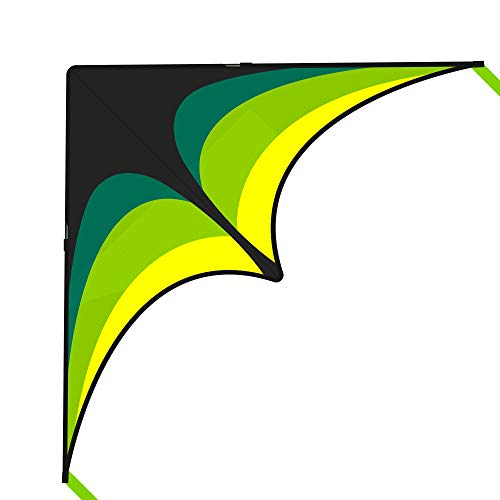
large triangular delta kite for light and moderate breezes
A delta is a wide triangle held open by one horizontal rod, with a fabric keel hanging underneath where the line attaches. Assembly is that rod into two sockets and a single knot, which is the shortest route from car boot to airborne of any sticked kite. Go for a keel rather than a loose bridle on a first delta, because a keel needs no adjustment at all.
Why we picked this exact one: The Mint's Colorful Life delta is the volume pick for a reason: 63 by 30 inches of sail for $13.59, with three long ribbons and 300 feet of line already on a handle. Close to 4,900 ratings at 4.5 stars is an unusual amount of evidence for a kite this cheap. The line and plastic grip it ships with are the weak spot, and most people replace them within a few outings.
frameless soft parafoil kite that inflates in the wind
A parafoil has no rods in it at all. It's a double-skinned fabric wing with open cells along the front edge, and the wind itself inflates it into shape once there's enough of it. Nothing can snap and nothing needs assembling, and it folds flat with nothing rigid inside, which is why these end up in suitcases.
Why we picked this exact one: The kizh octopus parafoil is the frameless option with real mileage behind it: 655 ratings at 4.5 stars for $12.78, with a 150-inch tail doing most of the visual work. It wants a bit more breeze than a delta to inflate and hold its shape, and the novelty octopus form is a matter of taste. There is, however, nothing to put together and nothing to break.
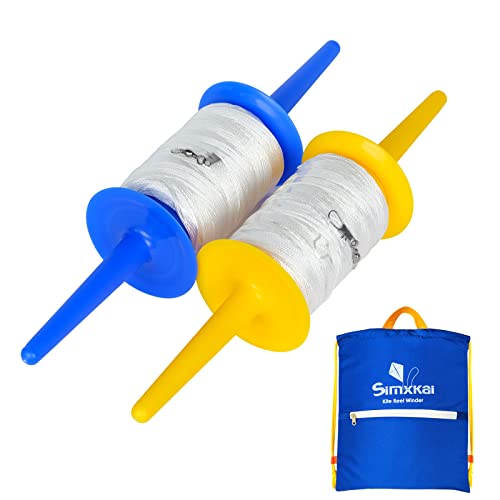
flying line on a two-handled winder for single-line kites
Flying line and something to wind it on are one purchase in practice. Fifty- to sixty-pound polyester is what commercial beginner kites ship with and it covers every shape on this list; flyers go lighter on tiny kites and much heavier on big ones, and they deliberately keep the flying line the weakest link in whatever they anchor it to. A snap swivel on the free end lets you clip onto a keel or bridle without retying every time.
Why we picked this exact one: Simxkai's two-pack puts 600 feet of 60 lb twisted polyester on each of two ABS handles for $16.99, so two people can fly at once without buying twice. The 4-inch grips suit small hands, and the snap swivel saves a knot on every launch. It's a handle rather than a geared reel, though, so winding 600 feet back in is a workout.
Of the three, the parafoil is the one I'd hand a nervous parent and the delta is the one I'd hand a nine-year-old who wants something big in the sky. The winder matters more than it sounds. Discount-store reels break, sometimes on the first afternoon, and once that happens you're hand-winding three hundred feet of line in a cold wind. If you're still working out whether this is your thing at all, how you pick a first hobby matters more than which of these you land on.
The Second Trip Out
Everything here exists because of something annoying that happened on trip one. The line tangled in the grass. You drove forty minutes to a field that turned out to be flat calm and ended up back home at the puzzle table instead. The kite rode home across the back seat with a spar poking out of a shopping bag. None of this makes a kite fly better, and I'd honestly rather you spent the money on a second kite for heavy wind than on a meter. But if you're out most weekends, these three remove the friction.
05Pick 05 of 11
lockable ball-bearing kite reel wound with braided line
A proper kite reel is a spool on bearings with a brake, so line pays out smoothly under load and then stops where you want it. The lock is the useful part: free rotation while you let line out, anti-reverse so the kite can't drag line back off, and a dead stop once it's parked. Braided Dacron is the line flyers prefer for single-line work, because its slight stretch soaks up gusts instead of passing them straight to the sail.
Why we picked this exact one: The emma kites 8.7-inch reel is the cheap reel that isn't cheap: ABS body, sealed ball bearings, a ceramic line guide and a three-position lock, with 500 feet of 120 lb braided Dacron already wound on. 584 ratings at 4.6 stars is the strongest record of any kite reel here. The 120 lb line is heavier than a small delta needs and will feel it, which is the trade for being able to anchor something big later.
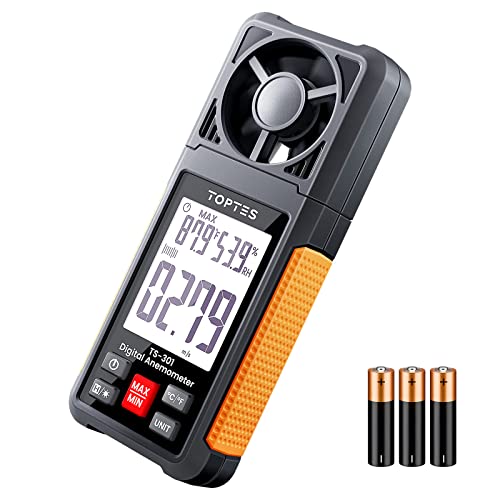
pocket wind meter that reads the breeze in miles per hour
A handheld anemometer is a small fan on a stick with a screen: hold it up, point it into the breeze and read the speed. The only unit that matters here is miles per hour, and the question it answers is whether you're inside the eight-to-fifteen band most beginner kites are happiest in. It also delivers the less welcome answer, which is to go home.
Why we picked this exact one: The TopTes TS-301 reads in six units including mph and knots, and its 2.26-inch backlit screen stays legible in the kind of glare you get on open grass. That's 1,827 ratings at 4.6 stars for $25.18. It names kite flying among its uses, which is rarer in this category than you'd think, though a $12 meter will give you a close enough number if mph is all you want.
padded 45-inch tube bag for carrying kites and spars
A kite bag is a long narrow tube with a zip, and that's the whole specification. A folded delta or diamond is about twenty inches of sail wrapped round thin spars, and the damage comes from whatever else in the boot leans on it. Water-resistant fabric earns its place because kites get packed away damp more often than anyone admits.
Why we picked this exact one: The COOLBEBE 45-inch case is the honest answer rather than the tidy one: purpose-made kite bags on Amazon have almost no review history, and this tripod-and-light-stand bag is physically the same object with 7,670 ratings at 4.6 stars behind it. That's 600 denier fabric and a metal zip for $13.46. Seven inches across swallows a folded kite, a reel and a tail together.
One caution on the reel: wind line back on under almost no tension, ideally with one person walking the kite down while the other reels. Line wound on tight while the kite is still pulling will crush a plastic spool from the inside, and that's a thing you learn once. Kids who turn out to like the building half of this more than the flying half tend to graduate to turning delivery boxes into anything, which is the cheaper hobby anyway.
When One String Stops Being Enough
Two-line kites aren't an upgrade, they're a different hobby that happens to use wind. A single-liner you launch and then watch. A dual-liner you fly, constantly, with both hands, and three seconds of inattention puts it in the grass. The learning curve is real and the first hour is mostly crashing. The advice that comes back over and over from people who compete is to buy more kite than you can currently fly, because you grow into it and a flimsy one gets outgrown in a season.
Pick one
These 2 do the same job. You only need one of them, so pick the one that suits you better.
08Pick 08 of 11Option A
entry-level framed dual-line sport kite
A framed dual-liner is a rigid delta flown on two lines, one to each hand, and steering is just pulling whichever side you want to turn toward. Beginner models are small and quick rather than powerful, which keeps the pull manageable while you learn. Look for a carbon or fiberglass frame and sockets that let the spars pop out on impact instead of snapping.
Why we picked this exact one: Prism's Jazz 2.0 is the standard first sport kite: a 62-inch wingspan on a carbon and fiberglass frame, shipping with 85 feet of 55 lb lines, wrist straps, winder and case for $55. Prism itself calls it budget and entry-level, which is fair - it's speedy and a little twitchy rather than smooth. Spars do pop out of their sockets in a bad crash, and that's the frame doing its job.
Pros
Answers a control input instantly
Packs to 26 inches with the frame apart
Cheapest route into two-line flying
Cons
Rigid spars can break in a really bad crash
Needs laying out and line-checking before every launch
frameless dual-line soft kite for two-handed flying
A soft stunt kite is a parafoil flown on two lines: no rods anywhere, so setup is unroll, clip on and go. The pull is noticeably stronger than a framed kite of similar size, because the inflated wing has more area working, and that's also what makes it a poor choice for the smallest children. There's nothing inside it to break when it hits the ground.
Why we picked this exact one: The Prism Synapse 140 is the soft-kite version of the same first step: 53 by 20 inches, 60 feet of 80 lb lines and a winder in the box, $60. It packs to roughly 10 by 5 by 2.5 inches, which genuinely does fit a glove box. At 4.4 stars it sits marginally below the framed Jazz, and the heavier pull is why - this one wrestles back once the breeze picks up.
Pros
Nothing to assemble and nothing to break
Packs small enough for a glove box
Survives hard crashes untouched
Cons
Pulls noticeably harder, so not for small children
matched pair of dual-line flying lines with wrist straps
Dual-line kites fly on a matched pair of lines of identical length, wound on one winder with a wrist strap at each end. Matching matters more than strength: uneven lines make the kite behave as though you're steering when you aren't. Colour-coded straps are worth having, because knowing which hand is which saves a crash on every launch.
Why we picked this exact one: The In the Breeze 100 lb by 80-foot set is cheap insurance: braided polyester, pre-wound, with colour-coordinated flight straps, $13.95 and 174 ratings at 4.6 stars. Eighty feet sits at the short end of the 60-to-100-foot range flyers are told to use, so reactions have to be quicker. Keeping a spare matched pair in the bag is what stops a snapped line from ending the day.
competition-geometry dual-line kite built to survive learning
A step-up sport kite carries the proportions of a competition design on a frame heavy enough to take a beating. Bigger wingspans move more slowly through the same wind than small entry kites, which sounds backwards and is exactly what makes precision learnable. The giveaway at this tier is low-stretch Dyneema flying line instead of polyester, because stretch blurs every input.
Why we picked this exact one: The Prism Hypnotist is the kite to buy once you know two-line flying is going to stick: a 94-inch wingspan, competition geometry, a frame Prism says is built for student-pilot abuse, and 85 feet of 150 lb low-stretch Dyneema with straps. At $175 it's a lot for a second kite, so wait until you've put real hours on a $55 one and can feel what that kite won't do. Its 90 ratings is a thinner record than the entry kites here.
Lay the lines out fully before you launch and check they're the same length - a kite with one short line thinks you're pulling that side and spins. Give yourself at least sixty to a hundred feet so there's time to react. And never fly a sport kite anywhere near a crowd, because the lines move faster than people do.
Where Never to Fly, and When to Just Let Go
Kite line conducts electricity. That one sentence covers most of what can go badly wrong out here, because a line draped over an overhead cable turns a toy into a conductor. If your kite ends up in the wires, leave it - walk away and ring the electricity company, and don't be the person who climbs a pole for a $13 delta. Don't fly in rain or with a storm coming. Never use wire or anything metallic as flying line.
The rest is geography and manners. Stay out of the air within five miles of an airport boundary and below 500 feet, which is the federal line for moored kites; a pocket-sized parafoil isn't legally covered by it, but the reasoning doesn't care what your kite weighs. Keep clear of roads, because a bright kite over a windscreen is a distraction you don't get to apologise for. Don't let your line cross a stranger and don't fly over people's heads. And the injury that actually sends kite flyers home early isn't a line cut at all. It's sunburn, from four hours standing in an open field staring upward.
Brief the kids before you hand over the line rather than after: both feet on the ground, let go if it pulls hard, and never wrap the string round a hand or wrist. Line under tension will slice a finger, and the cheapest kite in the shop does it just as well as an expensive one. If your child turns out to like the outdoors part more than the wind part, a first patch that actually grows runs on the same principle - go outside, do one small thing, come back tomorrow.
Why Your Kite Keeps Landing in the Same Patch of Grass
Why does running with the kite never work?
Nearly everyone's first instinct is to sprint, because that's what you've seen in films. The trouble is that running makes a short burst of fake wind and a lot of uneven tugging on the line, which is exactly what pitches a single-liner over into a dive. If you have to run to get it up, there isn't enough wind to keep it up. Stand with your back to the breeze, hold the kite by its bridle point, let a little line out and wait for a gust to arrive, then pull in as the nose comes up.
I'm in a huge field and it still won't climb. What am I missing?
Look at what's upwind of you rather than what's around you. Air that has just gone over a treeline or a building stays churned up for as much as seven times the height of that obstruction, so a thirty-foot row of trees is wrecking roughly two hundred feet of ground behind it - and that's where most people set up, because that's where they parked. Walk further out, or round to the other side of the field. If three different spots all fail, then it's worth checking the assembly and the kite's rated wind range.
How do I tell whether there's too much wind or too little?
Watch how it comes down, not how it goes up. A kite that sinks tail-first is starving for wind; one that dives nose-first or spins is overpowered. Eight to fifteen miles an hour is the comfortable band for most beginner kites, and steady beats strong every time, because a gusty fifteen is harder work than a smooth ten. If your kite has an adjustable bridle, shift the tow point nearer the nose in stronger wind and toward the tail in lighter wind, half an inch at a time.
My four-year-old lost interest almost immediately. Is that normal?
Yes, and it's a physics problem more than a patience one. A small child can't feel the kite through a long line the way an adult can, and from their eye level a kite at altitude is a dot against bright sky. Hand over the reel only once it's high and pulling steadily, so there's something solid tugging back. For the under-fours the attention generally lives elsewhere, and a first instrument basket holds them far longer than a dot in the sky does.
Two kites tangled in mid-air. Do I just pull?
Pulling is how lines part and kites get lost. The fix runs against instinct: both flyers walk toward each other, and as slack builds the tangle slides down the lines to where you can reach it and unwrap it by hand. It takes half a minute and nobody loses a kite. Same reflex on a busy beach - the moment you see another line crossing yours, stop letting line out rather than yanking.
People Worth Following Into This Hobby
Real practitioners we found while researching this setup — people who do the work, show their process, and publish on sites they run themselves. No sponsorships, no affiliations; we just think they're worth your time.
Runs a 46-lesson video tutorial series and the forum where sport-kite flyers answer beginners thread by thread.
This setup sends readers from one string to two in its specialty section, and KiteLife's beginner lessons are where that transition is actually taught, hands and kite in the same frame.
A 1964-founded nonprofit of kite flyers in 25 countries that publishes the field's safety code and runs the national convention.
The safety section here is built on their rules - power lines, the five-mile airport boundary, line burns - and their page is the source a beginner should read in full before a first outing.
Has published The Kiteflier since 1979 and keeps a free archive of its kite plans, articles and the air-law rules that govern where you may fly.
Readers outside the United States need their own version of the where-not-to-fly rules this setup covers, and the Society sets out the UK air-navigation limits plainly alongside hints for new flyers.
Nilo Velez has archived complete copies of more than 1,700 kite plans since 1998, sorted by type, because the free hosts they lived on kept disappearing.
A beginner who liked their bought delta usually wants to build the next one, and his delta section holds 124 full plans with the spar and keel geometry this setup only describes.
Love what you see here? Save individual picks with on any item, or copy everything to a list of your own in one click — great for coming back to later, or dropping as a not-so-subtle hint.