Snorkeling is the lazy route into the underwater world. You lie face-down on the surface, breathe through a bent tube, and let a reef slide past a metre below your chest while nothing about you has to work very hard. Most people meet it off a beach or a boat ladder somewhere warm, though plenty of snorkelers spend their weekends in cold kelp and clear rivers instead. Here's the odd bit of history: the first patented snorkel, in 1938, was worn on the front of the face and bracketed to the mask, and side-mounted tubes only took over in the late 1950s.
What surprises beginners isn't the fish. It's how much of the first hour goes on fighting equipment that doesn't fit. A leaking mask, a fogged lens, fins that rub a raw patch on the top of your foot: get those three wrong and you'll spend the swim treading water and emptying things, and conclude the hobby isn't for you. Get them right and you'll forget you're breathing. If you're still weighing this against other ways to spend a weekend, our guide to picking a first hobby that actually sticks is a reasonable place to start.
Our take: buy four things and a small bottle of defog, and stop. A mask that seals on your face, a tube to breathe through, fins that fit your feet, and a shirt that covers your back. Everything further down this page can wait for your second trip.
The picks lean cheap on purpose. Plenty of people try this once, decide they'd rather be on the sand with a book, and we'd rather that cost you a dinner out than a weekend away.
Where This Little Kit Can Take You
A few real moments and results from this hobby — made with tools no fancier than the ones below.
Gliding over a shallow reefThe water here is barely deeper than a room is tall.
Two sets drying on the platformShells collected between swims, laid out to dry alongside the fins.
None of this needs lessons, a licence or a certification card, which is unusual for something that shows you an entirely different set of animals. If anything, snorkeling rewards the same habit as beginner birdwatching: stop moving, keep looking, and things start appearing that were there the whole time. The gear below is what gets you to the point where you can actually do that.
What Goes in the Bag Before Your First Reef
Snorkeling has an unusually short shopping list, and it's been the same list for seventy years. The one piece of received wisdom worth ignoring is the packaged mask-snorkel-fin set. Snorkelers who have been doing this for decades say the only real advantage of a set is that it's cheap and the colours match, and buying one locks all three pieces to a single manufacturer's idea of what a face and a foot look like. Buy the pieces separately. It's one of the few hobbies where that costs barely more, and it's a common theme across the hobbies most worth starting as an adult: the cheap version of the critical piece is the one that makes people quit.
Disclosure: This section may contain affiliate links to Amazon. We may earn a small commission from qualifying purchases at no extra cost to you.
01Pick 01 of 09
Frameless Snorkel Mask
A snorkeling mask holds a pocket of air in front of your eyes so they can focus underwater. Frameless low-volume designs sit close to the face, which makes them easy to clear and small enough to fold flat in a bag. Look for tempered glass rather than plastic, and a soft silicone skirt that matches the shape of your own face.
Why we picked this exact one: The Cressi F1 is a frameless single-lens mask with tempered glass and a soft silicone skirt, and it averages 4.5 stars, which makes it the safe default when you can't try masks on in a shop. Frameless also means it folds flat for hand luggage. The catch is the one no mask escapes: if the skirt doesn't match your face, the brand name won't fix it, so run the no-strap suction test the day it arrives.
A snorkel is a bent tube with a mouthpiece that lets you breathe while your face stays in the water. Dry-top models carry a float valve that shuts the opening when a wave covers it, and a purge valve at the bottom lets you blow out whatever gets in. Beginners usually want both, while many experienced snorkelers go back to a plain open tube.
Why we picked this exact one: The Cressi Supernova Dry is the dry-top most often handed to first-timers, and it averages 4.7 stars. The float valve and the bottom purge do exactly the two jobs a nervous beginner needs. Worth knowing: freedivers dislike dry tops, because the valve adds bulk and a little breathing resistance, and once you can clear a plain tube you may not want one.
Fins turn a weak human kick into real movement, which is what lets you cover a reef without wearing yourself out. Full-foot models slide on like a shoe and suit warm water and sandy entries, while open-heel fins worn over booties make more sense over rocks or in cold water. A soft, moderately long blade is kinder to untrained ankles than a short stiff one.
Why we picked this exact one: The Cressi Agua is a full-foot fin with a flexible blade that's long enough to move you and short enough to pack, and it averages 4.6 stars. Snorkelers who have been at it for years are blunt about the stubby plastic fins in cheap sets: they barely push water. They go on bare feet and want to be snug but not tight: loose full-foot fins rub a raw patch, over-tight ones cut the circulation in your toes.
A rash guard is a close-fitting swim shirt in quick-drying synthetic fabric that blocks most UV. Snorkeling parks your back, shoulders and the backs of your arms at the surface for an hour or more while you forget the sun completely. Long sleeves and a UPF 50+ rating keep working after sunscreen has washed off.
Why we picked this exact one: The baleaf long-sleeve UPF 50+ shirt is the one people keep coming back to for this, with more than 33,000 ratings behind it. It's thin enough that it stops feeling like clothing once it's wet, and it dries on the walk back to the car. It runs slim, so go a size up if you want to pull it on over wet shoulders.
Defog is a liquid you smear round the inside of a dry lens before you get in, so condensation can't bead up and cloud the glass. It's a barrier rather than a cure, and it has to go on again every session. A brand-new mask also needs its factory film scrubbed off once before any defog will stick.
Why we picked this exact one: GEAR AID's Sea Drops is the small bottle that lives in most divers' gear bags, averaging 4.4 stars, and it cleans the glass as well as defogging it. A few drops rubbed around the dry lens and a quick rinse is the entire routine. It isn't sold as reef-safe, so rinse the mask in the shallows before you swim out over coral, and know that plain spit does work if you forget the bottle.
Put together, that's a kit you can carry in one hand and use anywhere there's a coastline. Take it into a swimming pool or a calm bay before you take it anywhere interesting, because the first fifteen minutes are always a little clumsy and you don't want to discover that over deep water. If you like being on the water as much as in it, the same trips pair naturally with a beginner kayak setup, which gets you to shorelines you can't walk to.
The Extras That Change the Day, Not the Swim
Everything in this section is skippable on your first outing and genuinely useful by the third. The one people reach for first is a camera, and I'd hold off: a phone in a cheap housing fogs, floods, or simply refuses to focus through the glass, and you spend the swim looking at a screen instead of the reef. If you do want pictures, the habits in our smartphone photography setup transfer better than any accessory does.
What's worth money instead is the boring stuff: somewhere to put wet gear, something to keep your keys dry, and something to rest on. The best souvenir from a snorkel trip is usually taken back on dry land anyway, which is where a camera like the one in our instant photography setup earns its keep.
06Pick 06 of 09
Mesh Scuba Diving Backpack
A mesh gear bag is a backpack made of open netting, so wet fins, a mask and a shirt go straight in without soaking anything else. Sand falls through instead of collecting in the seams, and the whole load dries hanging on a hook. Size matters more than features here, because fins are long and a bag that fits everything except the fins is no use.
Why we picked this exact one: The Athletico XL mesh dive backpack is sized around fins first, which is what most beach bags get wrong, and it averages 4.7 stars. Shoulder straps mean you can walk a rocky path with your hands free. The netting is open enough to drain properly, which also means anything small enough to slip through eventually will.
A snorkeling vest is a thin jacket with an oral inflation tube, so you can add air to rest at the surface and let it out again to duck under. It isn't a Coast Guard-rated life jacket and shouldn't be relied on as one. For a nervous swimmer it removes the part of snorkeling that burns the most energy, which is simply staying up.
Why we picked this exact one: The Lyuwpes inflatable snorkel vest is the plain, cheap version of this idea and averages 4.5 stars. Oral inflation means there's nothing to break or recharge, and it folds down to about the size of a hand towel. The fabric is light, so treat it as a resting aid for calm water rather than rough-water safety equipment.
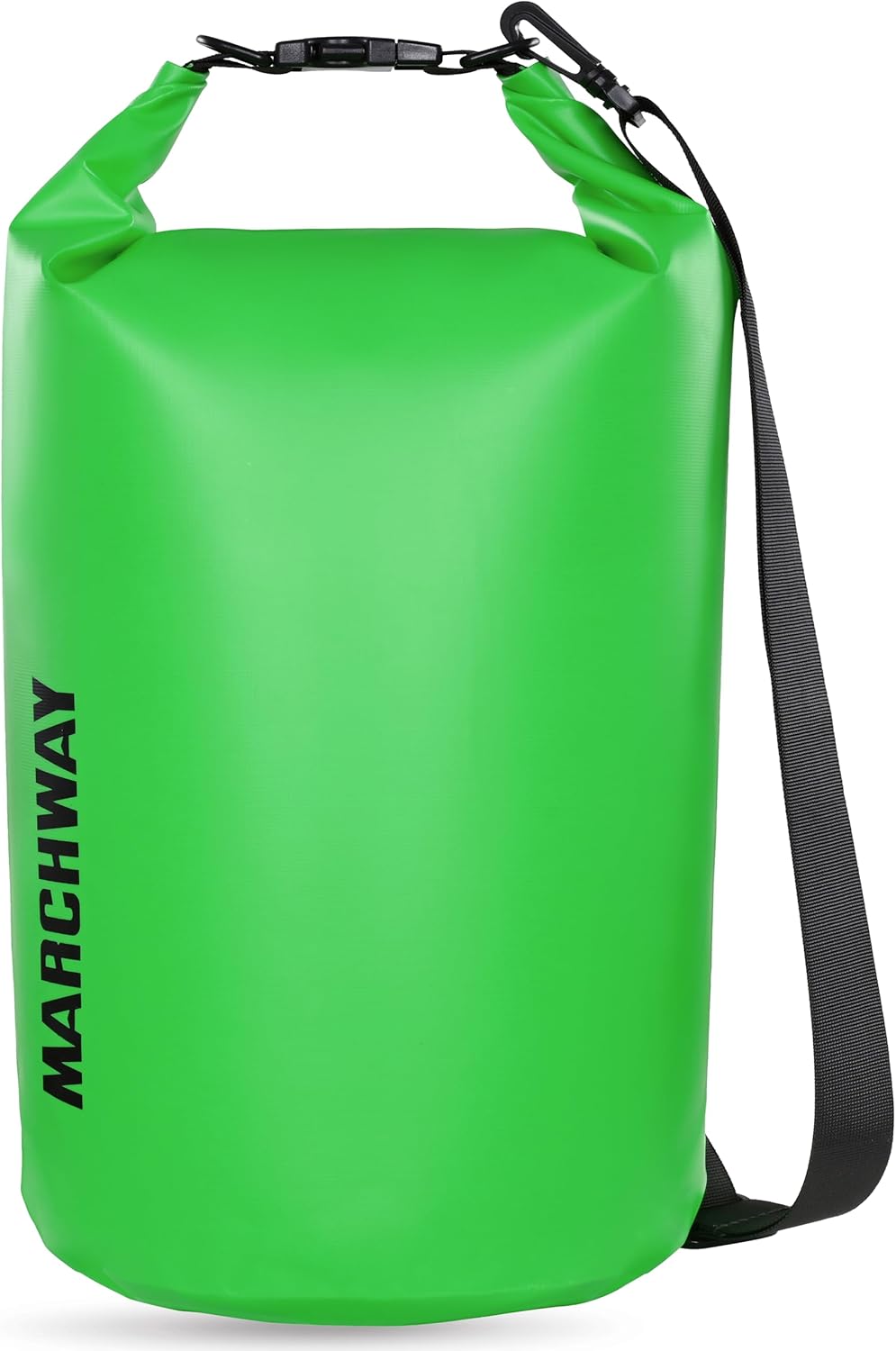
A dry bag is a welded sack you roll shut several times and clip, which keeps water out even if it goes over the side. The smallest sizes take a phone, car keys and a dry shirt; ten litres adds a towel. The floating kind matters on a boat, where a bag that sinks is a bag that's gone.
Why we picked this exact one: The MARCHWAY roll-top is the dry bag most people end up owning, with a 4.7-star average, and the welded seams survive repeated salt dunking. Rolled properly it floats, which is the feature that counts off a boat ladder. Roll the top down too few times before clipping and it seeps, which is the mistake almost everyone makes once. Check which size you are ordering, too, because the listing opens on the smallest one.
Long-blade fins extend the blade well past the foot, so one slow full-leg kick moves a lot of water instead of a fast ankle flutter moving very little. They take about an hour of swimming to get used to and then feel almost effortless. They're awkward to walk in and long to pack, which is the trade you make for the glide.
Why we picked this exact one: The WAVE long-blade full-foot fins are the step up worth taking once you know you'll keep snorkeling, with a longer soft blade that holds a slow kick for an hour. Long-time snorkelers push people toward this shape rather than the stubby set fins. Wait until you've had a few trips though: they cost about two-thirds more than the full-foot fins above, they don't fit a carry-on side pocket, and 193 ratings is a thinner track record.
Buy these in the order you feel the lack of them, not all at once. The mesh bag pays for itself the first time you drive home with wet fins, and the vest is worth having well before you think you need it. If you find yourself wanting to cover more coastline between swims, a beginner paddle board setup turns two snorkel spots into six.
Respect the Water Before You Fall in Love With It
This part isn't optional reading. Hawaii's state ocean safety service says plainly that more Hawaii visitors drown while snorkeling than during any other activity. That's not an argument against snorkeling. It's an argument for treating it as an ocean sport rather than a swimming-pool game, which is exactly the mistake the numbers describe.
Never snorkel alone. The buddy isn't there to rescue you; they're there to notice and get help, which is the thing nobody can do for themselves. Before you get in, stand and actually look at the water for a few minutes: surf height, wind, shorebreak, anything moving sideways. If it looks wrong, don't. Mornings are usually calmer and clearer, and dawn, dusk and murky water are all worth avoiding.
Once you're in, float rather than swim. Kick only to go somewhere. Exhaustion is the real hazard out there, and it arrives quietly in people who are fit enough on land. Keep checking in with yourself: dizziness, disorientation or a headache can mean carbon dioxide building up in your gear, and the official advice is to stay calm, get the equipment off and get out of the water. Don't wait to see whether it passes.
And keep your hands and feet off everything. Coral cuts infect badly, fire coral and jellyfish sting, and standing on a reef kills what you came to look at. Skip the rocky shallows where you can't rest without touching something, don't feed fish, and give turtles room. This is general hobby safety rather than medical advice, and if you have a heart or lung condition the conversation to have is with a doctor, not a dive shop.
Why the First Hour in the Water Usually Goes Wrong
Why does my mask fog up again five minutes after I defogged it?
Because a brand-new mask leaves the factory with a thin silicone film on the inside of the lens, left over from manufacturing, and no defog can grip through it. Beginners assume the defog is bad and buy a different bottle, then watch that one fail too. Scrub the inside of the glass with plain white non-gel toothpaste and a soft brush, rinse, and repeat until the fog stops returning. After that it's a drop of defog before every single session, forever, because warm breath on cool glass will always condense.
My mask passed the suction test in the shop and it still leaks. What did I miss?
Almost certainly the mouthpiece. Nearly everyone does the no-strap suction test with their mouth closed, and pushing a snorkel between your teeth changes the shape of your cheeks and upper lip enough to break a seal that held a second earlier. The other two culprits are hair trapped under the skirt, which is the single most common cause of a leak, and over-tightening the strap, which warps the silicone instead of sealing it. Test with the snorkel in your mouth, sweep every strand of hair clear, and leave the strap barely snug.
Why do I get a headache or feel woozy after a long float?
A snorkel is what's called respiratory dead space: part of every breath you take is air you already exhaled into the tube. Breathe fast and shallow, as nervous beginners do, and carbon dioxide builds up slowly without anything feeling dramatic. The result is a headache, light-headedness or a creeping sense of disorientation, which is also how people get into trouble. Breathe slowly and deeply instead of quickly, and treat any of those signs as a reason to leave the water rather than push on.
Full-face masks look far easier. Should I just buy one?
They are easier to breathe through, which is why they sell so well to people who gag on a mouthpiece. They're also under active safety scrutiny in a way ordinary masks aren't. Hawaii's health department is still studying whether they raise drowning risk, the leading theories involve rebreathing your own carbon dioxide and how hard the strap system is to rip off in a panic, and the first national standard for these masks anywhere in the world only appeared in October 2024. A separate mask and snorkel comes off in one pull. For a beginner that's worth more than easier breathing.
People Worth Following Into This Hobby
Real practitioners we found while researching this setup — people who do the work, show their process, and publish on sites they run themselves. No sponsorships, no affiliations; we just think they're worth your time.
Photographs kelp forests and reefs from the surface and writes up what the snorkeling fatality research actually says.
Our safety section tells beginners to treat dizziness and headache as a reason to get out; his Safe Snorkeling piece walks through the Hawaii study those warnings come from, with the numbers attached.
Professional dive instructors in Thailand who film and write step-by-step fixes for the gear problems their students hit on day one.
The mask fit test and the hair-under-the-skirt leak in our FAQ are exactly what they teach, with photos and a mustache workaround we only mention in passing.
Writes up every snorkel site she swims herself, 87 of them so far, starting from the trip where she panicked and quit.
Readers who are nervous swimmers will recognise her first attempt, and her fixes for fogging and a wobbly float line up with the vest and defog we recommend here.
Have spent eighteen years snorkeling reefs around the world and saying openly when one is dead, dangerous or not worth the flight.
Our safety section tells you to read the water before getting in but can't teach you how; their conditions guide breaks down surge, current and wind the way they assess them before every swim.
Love what you see here? Save individual picks with on any item, or copy everything to a list of your own in one click — great for coming back to later, or dropping as a not-so-subtle hint.