Hand a five-year-old a washing-machine box and you've lost them for the afternoon. Cardboard building is that instinct with tools attached: a child cuts a doorway, creases a fold, fastens two panels, and the box turns into a castle, a marble run, or a robot that opens at the chest. Schools and museums now build whole rooms around it and call it tinkering. It works just as well on a kitchen floor. The plain cardboard box sits in the National Toy Hall of Fame, which it managed without a single moving part, and in 2011 a nine-year-old in East Los Angeles built a whole arcade out of boxes in his dad's shop - the short film about it set off cardboard build days in 41 countries.
The thing nobody warns you about is how fast kids outgrow the box itself. A box is a box for about twenty minutes. Then they want a window, a door that actually swings, a second storey, and that's where scissors give up and the whole thing collapses into a sulk. What changes the afternoon isn't more boxes. It's being able to cut a straight line and join two panels so the join holds.
Our take: there are only four jobs to cover, and a pile of free boxes does the rest. Cut cardboard safely, crease a fold, fasten two panels together, hold things still while your hands are busy. Buy for those four and ignore the 300-piece sets.
Everything below is cheap enough that if your kid builds one robot and never touches it again, you've lost less than a takeaway.
Where This Little Kit Can Take You
A few real moments and results from this hobby — made with tools no fancier than the ones below.
A creature built from boxesEvery panel still carries the shipping marks it arrived with.
Raising a wall of cardboardPanels get cut and stacked long before anything is fastened down.
Boxes are the one craft supply that keeps arriving at your door for free, which is also why this hobby doesn't quietly drain your wallet the way most of them do. Expect the first build to be ugly. The second one is where they start measuring.
The Kit That Turns a Box Into a Build
A flat-packed box springs into a neat cube because of a crease pressed into the board at the factory. Robert Gair worked that trick out in 1879, and it's still the most useful thing to know about cardboard. Cut where you mean to cut, crease where you mean to bend, and the material does most of the work. Scissors do neither job well. They chew the edge, wander off the line, and leave you with a wall that won't stand straight.
Disclosure: This section may contain affiliate links to Amazon. We may earn a small commission from qualifying purchases at no extra cost to you.
01Pick 01 of 09
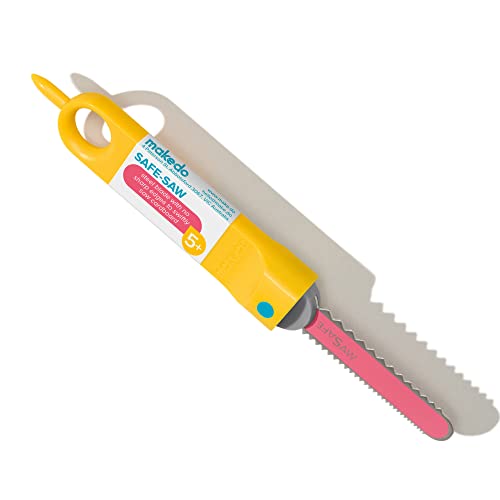
kid-safe cardboard saw for cutting doors and windows into boxes
A cardboard saw is a short serrated blade on a chunky handle, made to work through corrugated board with a back-and-forth stroke rather than a slice. The teeth are blunt enough that a hand running along them doesn't get cut, which is what separates one from a craft knife. Look for graded teeth, finer at the tip for starting a cut and coarser along the blade for long runs.
Why we picked this exact one: The Makedo Safe-Saw is the one most classrooms settle on, and at around nine dollars it costs less than the craft knife you would otherwise be standing over. Its steel blade has no sharp edges, so it saws cardboard rather than slicing it, and you can reverse the tool to punch a starter hole in the middle of a panel. It still takes real pressure - a four- or five-year-old will need a hand on the box and an adult nearby for the first few cuts.
scoring roller for creasing clean fold lines in corrugated cardboard
A scoring roller is a toothed wheel on a handle that presses a dotted line into the board without cutting through it. Run it along a straight edge and the cardboard folds on that line and nowhere else. The same perforated line doubles as a guide if you decide to saw along it instead.
Why we picked this exact one: The Makedo Fold-Roller is the tool most people skip and then go back for. It presses a perforated line you can fold on, and flipping it over gives a lighter press for thin board, which matters when a cereal box crumples under the pressure corrugated needs. It is not a cutting tool, and that catches some buyers out.
reusable plastic screw connectors for joining cardboard panels
These are short plastic screws with wide heads, made to bite into corrugated board rather than metal or wood. They twist in with a driver and twist back out again, so a wall can be moved without wrecking the panel. Packs usually mix two lengths - a short one for two or three layers and a longer one for thicker stacks.
Why we picked this exact one: The Makedo Scru Combo 160 gives you 120 standard screws plus 40 of the longer Scru+, which is the mix you actually burn through on a big build. By the maker's own guidance the short ones hold up to three layers of corrugated board and the long ones up to five. Worth knowing before anyone plans a bunk bed out of boxes: they are not structural, and practitioners use them for sculptures, models and forts rather than anything that carries weight.
chunky kid-sized screwdriver for cardboard screw connectors
The driver is a fat plastic handle with a socket that grips the head of a cardboard screw. You punch a hole first, seat the screw, then a few turns pull the panels tight. The blunt point works as the hole punch too, so it rarely has to leave the child's hand mid-build.
Why we picked this exact one: The Makedo Scru-Driver is the full-size handle rather than the little mini-tool that ships inside some kits, and retailers who sell both say the bigger handle suits small hands better. It is sold separately from the screw packs, which catches people out. One per builder is the right number - two kids sharing a single driver is how the arguments start.
wide low-tack masking tape for holding cardboard steady while you work
Painter's tape is low-tack masking tape on a paper backing, here about two inches wide. It holds a panel in position while hands are busy elsewhere, then peels off again without pulling the printed layer off the board. Width matters on this job - a narrow strip won't span the gap between two thick panels.
Why we picked this exact one: A single 1.88-inch roll of ScotchBlue Original is the cheap end of this and the right pick - its medium-strength adhesive lifts off cleanly for up to 14 days, which suits a build that changes shape every evening. Duct tape is the tempting alternative and the wrong one, because it bonds hard and then takes the paper layer with it when a wall has to move. The trade-off is that painter's tape is not a permanent join and shouldn't be treated as one.
With these five on the table a child can cut a shape, bend it where they want, and hold it together well enough to pick the whole thing up. That last part is the real test. Expect the first fort to lean, and expect the fix to be a triangle of scrap screwed across the corner - a lesson worth letting them find rather than handing over.
What to Add Once They're Hooked
The second wave is about motion and finish. A box that stands up is good. A box with wheels that actually roll, a hatch that swings and a name painted across the front is the one that gets kept. None of it is needed on day one, and buying it early is the classic mistake - the wheels sit in a drawer while the kid is still learning to cut straight. Wait until you hear "can we make it move?"
06Pick 06 of 09
low-temperature mini glue gun with matching sticks for cardboard joins
A low-temp glue gun melts adhesive at a far lower temperature than a standard craft gun, which is why it is the usual choice for projects with children. It sets in seconds, so a join only has to be held for a moment. Low-temp guns need sticks made for low-temp guns - standard sticks won't melt properly in one.
Why we picked this exact one: The Surebonder Cool Shot runs at 10 watts with a stated maximum glue temperature of 170F, and it ships with twelve matching mini sticks, so there is nothing else to buy. Low temp is not no temp - the glue stays hot for a few seconds after it leaves the nozzle, and a dropped blob lands on a bare foot. Treat it as an eight-and-up tool with an adult at the table, and do the gluing yourself for anyone younger.
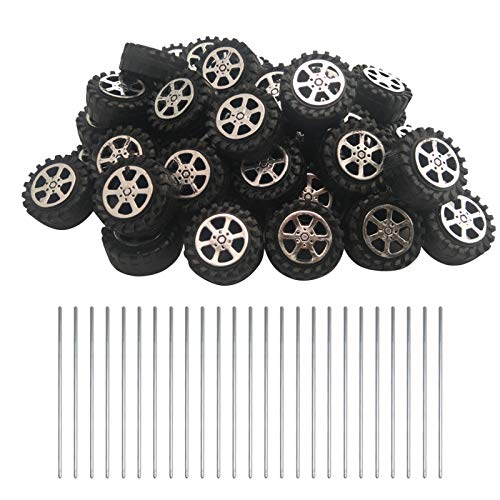
small plastic wheels and metal axle rods for cardboard vehicles
A wheels-and-axles pack is a bag of small plastic wheels sized to push onto a thin metal rod. The rod goes straight through a cardboard chassis, the wheels press on at each end, and the thing rolls. Check that the wheel bore and the rod diameter are quoted as matching before buying - mismatched sets are the usual disappointment.
Why we picked this exact one: The EUDAX wheel and axle set pairs 50 wheels with 25 matching 2mm rods, enough for a dozen vehicles and cheaper than most wheel-only packs. The wheels are 42mm across, big enough to clear a thick cardboard chassis rather than bottoming out the way tiny model wheels do. The rods are 100mm of thin metal and count as small parts, so they want a lidded tub and no toddler siblings in the room.
split-pin paper fasteners for cardboard parts that need to pivot
Paper fasteners, also called brads, are a round head on two flat legs that splay open behind the board. Pushed through two panels they make a pivot rather than a fixed join, so the parts swing. A box of a hundred costs less than a coffee and lasts through a year of builds.
Why we picked this exact one: The Charles Leonard 1-inch brass-plated fasteners have a shank long enough to pass through two layers of corrugated board, which the short scrapbooking brads don't, and wide heads that stop them pulling back through the hole. The points are genuinely sharp. This is the one item on the list an adult should hand out rather than leave loose in the supply bin.
washable broad-line markers for drawing detail onto brown cardboard
Broad-line washable markers lay down a thick, opaque stroke that stays visible on brown kraft board, where a fine tip disappears into the texture. The washable formula comes off skin and most clothes. For anything a child under about twelve will use, look for the AP seal from the Art and Creative Materials Institute on the packet rather than relying on a general non-toxic claim.
Why we picked this exact one: Crayola Broad Line Washable Markers are the default here for good reason - the 12-count pack sits under eight dollars, and Crayola is a member of the Art and Creative Materials Institute, whose AP seal is what to look for on children's art materials. The listing is graded for ages three and up. The broad nib matters: fine-tip sets vanish into the board's texture, and these do dry out if the caps go missing, which on a cardboard build they will.
Add these one at a time rather than all at once. Each one unlocks a different kind of build, and handing over all three in an evening usually ends in a pile of half-finished ideas. The markers are the exception; those can go out from day one.
The Three Things Worth Being Strict About
Cardboard building is about as low-risk as hands-on hobbies get, which is exactly why the few real hazards slip past. None of them is dramatic. All three are the kind of thing you set a rule about once and then stop thinking about.
The saw first. A kid-safe cardboard saw has no sharp edge, and the makers have theirs independently tested to a 3+ age grading, but it is still a steel blade. The rules are the same as any tool: cut away from the body, never towards a face, and keep the steadying hand behind the line of the cut. The system itself is rated from five, usable with an adult's help from four, and most children are working on their own by about seven.
Then the glue gun. Low temp is the only kind that belongs on a children's table, and even then it's an eight-and-up tool with an adult sitting there. The glue stays hot for a few seconds after it leaves the nozzle, which is where the burns come from rather than the gun body. Below that age the adult does the gluing. That isn't a compromise - a five-year-old has plenty to do with a saw and a screw.
And the small parts. Axle rods, plastic screws and brass fasteners are all fine for this age group and all hopeless around a younger sibling who still mouths things. A lidded tub and a build table a toddler can't reach solves it. On anything that gets drawn on or glued, check the packet for the AP seal from the Art and Creative Materials Institute before it comes into the house - a line saying the product conforms to ASTM D-4236 is a labelling statement, not a non-toxic claim.
None of this means hovering. Set the rules once, demonstrate each tool slowly before it's handed over - maker educators keep coming back to that same point, that modelling the tool first is what makes the difference - and then let them get on with it.
Why the First Fort Always Falls Over
Why does the wall bow outwards the moment they stand it up?
Corrugated board has a grain. The flutes inside run one way, so a panel is stiff across the flutes and floppy along them. Beginners cut panels wherever they happen to fit on the box and end up with half the walls running the wrong way. Look at the cut edge before you cut - you can see the little tunnels. Turn the panel so those tunnels run up and down the wall and the bowing stops.
They keep asking for more boxes. Is a cereal box as good as a delivery box?
Not for structure. Single-wall corrugated board, the kind almost every delivery arrives in, is the useful stuff, because that fluted layer inside is what makes it rigid. Cereal and shoe boxes are flat board with no flute, so they sag under their own weight once a panel gets bigger than a hand. Keep the thin board for detail work - dials, signs, curved trim. A scoring roller can be flipped over for a lighter press on it.
Why does everything fall apart the moment they try to carry it?
Because nearly every beginner joins panels edge to edge, like a picture frame, and a butt join in cardboard has almost nothing to grip. Build a tab instead: cut a flap on one panel, fold it flat, and fasten it to the face of the other panel. The join is suddenly carrying load across a whole flap rather than across a few millimetres of edge. Slot joints, where matching notches slide into each other, work the same way and need no fastener at all.
Should we just buy one of the big 300-piece kits instead?
The big kits are mostly more screws, and screws are the thing you run out of last. What runs out first is patience with a blunt tool, and hands to hold a panel still. A saw, a scoring roller, a driver, one pack of screws and a roll of tape covers every build a child under ten will attempt, and you can top up the screws when they genuinely run low. If there's money left, a second saw so two kids can work at once beats another hundred fasteners.
Is eight really old enough for a glue gun?
Eight with an adult at the table is where most guidance lands, though sources genuinely disagree and some wait until the early teens. The hazard isn't the gun body. It's that the glue stays hot for a few seconds after it leaves the nozzle, and the fingers pressing the join are right there. Stand the gun on a tray so drips land somewhere predictable, use only sticks made for a low-temp gun, and do the gluing yourself for anyone younger rather than hovering over them.
People Worth Following Into This Hobby
Real practitioners we found while researching this setup — people who do the work, show their process, and publish on sites they run themselves. No sponsorships, no affiliations; we just think they're worth your time.
Builds, photographs and tests every cardboard challenge she publishes, either with her own children or in a school.
Her cardboard challenges are the obvious next step after this kit - sculptures, a slingshot and marble runs that use exactly the cutting and joining a beginner has just learned.
Runs STEAM classes and camps and documents each build step by step, including the versions that collapse.
Her cardboard city is the open-ended, keep-adding-to-it project this toolkit is for, and it shows a beginner what a box becomes once it stops being a box.
Love what you see here? Save individual picks with on any item, or copy everything to a list of your own in one click — great for coming back to later, or dropping as a not-so-subtle hint.