Yes, the Glass Is Whole. The Masts Were Lying Down.
A ship in a bottle is a complete sailing ship, rigging and all, standing inside glass whose neck is narrower than the hull. It goes in flat, and you don't see that part. The oldest one anyone can point to was built in Italy in 1784 and still sits in a Lübeck museum, in an egg-shaped bottle stood upside down on a wooden base. The romantic story of bored sailors whittling through a long voyage is one the craft's own historians keep poking holes in: those bottles were more likely made ashore for money, or by prisoners of war. Things in bottles are older than ships in bottles too, and one of the earliest builders anyone has traced was Matthias Buchinger, a man born without hands or feet.
Here's what actually happens. The ship is built on the table, right way up and fully rigged, with one difference: every mast sits on a tiny hinge at the deck, and the stays that would hold it upright are left long and trail out past the bow. Fold the masts back along the deck and the whole ship flattens into something that will slide through a bottle neck. Push it in, settle it on its sea, then pull the trailing threads one at a time. The masts swing up. You glue each stay where it sits, cut the tails off with a razor taped to a stick, and the first time it works you'll probably say something out loud.
Our advice: buy as little as you can get away with on the first one. A kit with the hull and the bottle already matched, a long pair of tweezers, and thread fine enough to vanish at arm's length will get a ship standing upright. Everything else can wait until you know whether the fiddliness delights you or drives you mad.
Nothing on this page costs enough to sting if your first ship ends up snapped in half at the bottom of a bottle, which is roughly how most first ships end.
Where This Little Kit Can Take You
A few real moments and results from this hobby — made with tools no fancier than the ones below.
Every sail set behind glassA full square rig standing inside a bottle whose neck is narrower than the hull.
Bent wire and folded mastsHand-made hooked tools beside three hulls caught at different stages of raising.
One thing worth knowing before you look at finished bottles and start forming opinions: the people who make the jaw-dropping ones have usually made several that went wrong first. Nobody photographs those. If you're still weighing this against the other ways of building something small, our comparison of the miniature formats lays out what each one actually asks of you, and this is the one that asks for patience rather than space.
The Short List That Makes the Trick Possible
Start from a kit. Not because carving a hull from a basswood blank is beyond you, but because a kit has already solved the problem that kills most scratch first attempts: the hull is guaranteed to fit the neck of the bottle it came with. Measure that yourself and get it wrong, and you find out three evenings in, when the ship jams halfway through and you have to choose between forcing it and starting over. Beyond the kit the list is short and oddly specific. Every item here does something your fingers physically can't do through a hole the width of a thumb, which is a stricter test than it sounds, and much the same test you'd apply to the tools for building a whole scene to scale.
Disclosure: This section may contain affiliate links to Amazon. We may earn a small commission from qualifying purchases at no extra cost to you.
01Pick 01 of 11
Ship In A Bottle Model Kit
A boxed starting point that supplies the pre-shaped hull parts, masts, printed sails, rigging thread and the bottle itself, sized so the folded ship clears the neck. The masts are set up to hinge at the deck and the stays run out of the bow, which is the mechanism the whole craft turns on. Look for a kit that names the bottle it ships with rather than one that expects you to find your own.
Why we picked this exact one: The Cape Shore USS Constitution Build Your Own Boat In A Bottle kit is the best-reviewed of the handful of genuine bottle-ship kits on Amazon, with 458 ratings behind it. The ship is a three-master, which is more rigging than a schooner would be, and the instructions are terse enough that reading a guide alongside them helps. Its 4.0 average reflects that: people who expect a snap-together model are disappointed, people who expect a fiddly craft project are not.
A matched pair of 12-inch stainless tweezers, one straight and one angled, with fine points rather than the flat serrated jaws sold for kitchens. The length is the point: the working end has to reach the far wall of a bottle while your hand stays outside it. The angled pair earns its keep against the curve of the glass, where a straight tip can only approach head-on.
Why we picked this exact one: The SE TW2-403 pair gives you both a straight and an angled 12-inch tweezer for about fifteen dollars, which matters because experienced builders work with one in each hand. They are fine-pointed rather than serrated, so they grip thread and tiny spars instead of mashing them. The steel is springy rather than stiff, so a heavy grip will cross the tips, and that is worth knowing before you clamp down on a mast.
A spool of fine beige rope made for model ship rigging, thin enough that at arm's length it reads as a line rather than a string. Diameter is the whole specification here: anything much thicker looks like rope on a ship the size of a finger. It is also what you use for the long control lines that trail out of the bottle neck and get pulled to raise the masts.
Why we picked this exact one: The GAWEGM beige rope sold for wood ship models comes in the 0.35 mm roll, which is at the fine end of what builders use for standing rigging at this scale. It is a small listing with only 28 ratings, so it is chosen on specification rather than popularity, but the diameter is stated plainly and the colour is the unbleached tone rigging actually had. Kits do include thread, and it is usually just enough, which is why a spare spool is on this list at all.
A low-viscosity instant adhesive that wicks into a joint rather than sitting on top of it, supplied with fine extension tips. Thin grades are what you want for stiffening thread and fixing a stay once the masts are up, because the drop has to be small enough to disappear. Thicker gel grades have their uses on the hull, but they bead visibly on a line.
Why we picked this exact one: The INSOIA 20g super thin CA glue holds a 4.3 average across more than 2,600 ratings and ships with the needle tips you would otherwise buy separately. The thin grade is the right call for rigging work, though it will not fill a gap, so a hull repair still wants something thicker. The tips clog if you leave them on between sessions, which is annoying and easily avoided.
A scalpel-style craft knife with replaceable pointed blades, bought in a pack that includes far more spares than you think you need. The blade shape matters more than the handle: a fine point lets you pare a hull edge or cut a sail to shape without crushing the material. Blades dull quickly on wood, and a dull blade tears instead of cutting.
Why we picked this exact one: The JTIEO 74-piece hobby knife set pairs four handles with seventy spare blades for seven dollars, which suits a craft that eats blades on basswood and bamboo. It carries a 4.7 average across more than 3,700 ratings. The handles are aluminium and lighter than a branded original, so they roll off a sloped desk given the chance, which is a good reason to keep the cap on.
With these on the table you can get a ship built, loaded and standing. Fine thread has a way of clinging to anything faintly damp, your fingertips included, so work dry and keep the spool away from the glue. The one habit worth forming early is the dry run: push the folded ship through the neck before any glue goes near the bottle, because a hull that fits about right doesn't fit. It's the same checking instinct behind building a tiny world inside a walnut shell, where the shell decides the scale and you don't get a vote.
What You'll Want by the Second Ship
None of this is needed to finish a first bottle, and buying it all up front is the classic way to sink a hundred dollars into a hobby you try twice. There's a pattern to what people add, though, and it's almost always about seeing better, reaching further, or making a tool that doesn't exist in shops. Builders who've been at this for decades still bend their own hooks and probes out of brass wire and umbrella spokes, which is the same bend-it-until-it-does-what-you-want instinct that drives wire art.
06Pick 06 of 11
Pin Vise With Micro Drill Bits
A small chuck you turn with your fingers, paired with twist drills that run down below half a millimetre. Holes this size are drilled through masts and spars so rigging passes through rather than being tied around the outside. Mark the spot with a sharp point first, because an unmarked bit skates along a round spar and snaps.
Why we picked this exact one: The Mudder 57-piece set runs from 0.1 mm to 3 mm, which covers the 0.5 mm and below that bottle-ship rigging actually calls for, and it holds a 4.4 average across more than 4,000 ratings. The pin vise is the cheap kind with a little play in the chuck, so the tiniest bits wobble slightly, but at this price you can afford to snap a few while learning the touch.
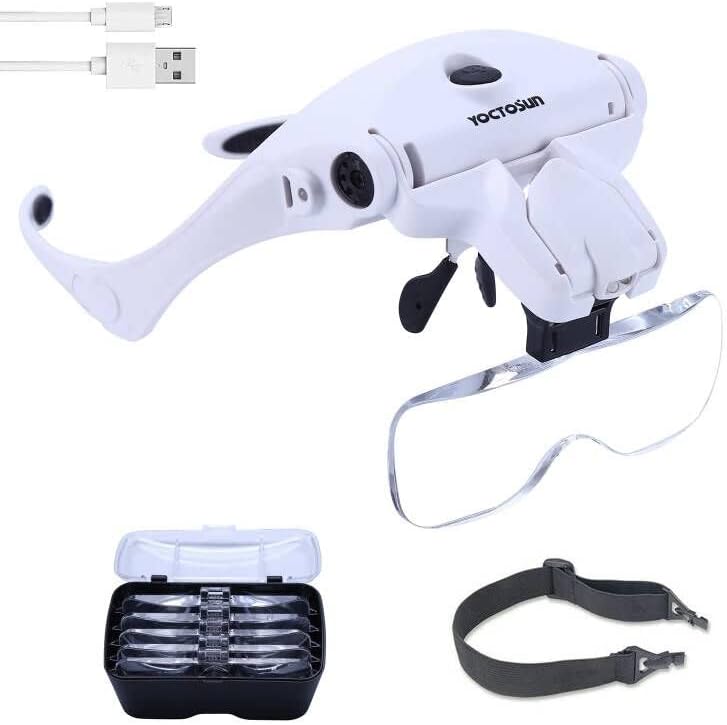
A visor that straps to the head and carries interchangeable lens plates plus a small built-in lamp, leaving both hands free. Magnification ranges matter less than being able to swap plates, because insertion work and rigging work want different working distances. The light is as useful as the lens, since a bottle casts its own shadow over whatever you are doing inside it.
Why we picked this exact one: The YOCTOSUN five-lens head magnifier has a 4.5 average across nearly 17,000 ratings and swaps between plates from 1.0X to 3.5X, which is the useful range for this kind of work. The headband is plastic and the rechargeable lamp is modest rather than bright. It is not a precision optical instrument, but the lower lens plates are genuinely comfortable for long rigging sessions.
A set of slim steel shafts ending in hooks, right angles and fine points, in both long and short lengths. Inside a bottle these do the jobs tweezers cannot: catching a thread that has drifted, nudging a yard level, holding a sail clear while glue sets. Builders routinely bend them further or lash them to a stick to reach a particular corner.
Why we picked this exact one: The Doaho 12-piece set holds a 4.7 average across 659 ratings and mixes long shafts with short stubby ones, which is the combination that matters here. These are sold for pulling o-rings out of engines, so the steel is stiffer than a craft tool and holds a bend you put in it. Long-time bottle-ship builders make their own hooks from brass wire and umbrella spokes anyway, so treat this set as a stock of shapes to modify.
A rack of twenty acrylics in small bottles, mixed for model work rather than canvas. Quantity is irrelevant on a ship this size; what matters is having a hull black, a deck tan, a white and a red without mixing them from primaries every session. Thin them slightly, because a thick coat buries the detail you just carved.
Why we picked this exact one: The Smallbudi 20-colour model paint set carries a 4.6 average across 182 ratings and gives you the hull and deck tones already mixed, in bottles small enough that they will not dry out unused. One honest caveat: superglue can bite through acrylic, so let painted parts cure properly and keep glue off finished surfaces. Builders who use enamels instead do so for exactly that reason.
A handheld motor tool with a collet that takes small cutters, sanding drums and drill bits, run at a speed you choose. In this craft its two real jobs are rough-shaping a hull far faster than a knife will, and spinning a bamboo skewer against sandpaper to taper it into a mast. Low speed is the setting that matters; high speed turns small wooden parts into projectiles.
Why we picked this exact one: The Dremel 3100-1/15 is the entry model in the range at around fifty dollars, with a 4.6 average across 867 ratings, and it is the step up worth taking once you know you want to build a second and third ship rather than one. Someone building from a kit should wait, since kit hulls arrive pre-shaped and the tool would sit unused. If you have moved to carving your own hulls from basswood blanks and tapering your own spars, it turns an evening of filing into ten minutes.
Add these one at a time, as a specific frustration turns up. The visor usually comes first, because squinting gets old faster than you expect and a bottle throws its own shadow over the work. The drill comes the day you want to rig something the kit never pre-drilled. And if you find yourself painting a cannon barrel four millimetres long and enjoying it, you've quietly become a miniature painter, which means furnishing tiny rooms is the next door along the corridor.
One Book Worth the Shelf Space
This craft has an odd information problem. Most of what's online is the same short explanation of the hinge trick copied from site to site, and the forum where the serious build logs lived crashed in early 2026 and took its archive down with it. A printed guide gives you the sequence in order, which is the part a photograph of a finished bottle can never show. People assembling scenes trapped behind glass end up wanting the same thing: one reference that covers the whole order of operations rather than the pretty result.
11Pick 11 of 11Book worth reading
Ship in a Bottle Building Manual
A British builder's guide to the whole sequence, from choosing the glass through carving and rigging to the moment the masts go up. The value of a printed manual here is ordering: it tells you which lines to tie off before insertion and which to leave trailing, in the order you will need them. Expect drawings and worked examples rather than a glossy gallery.
Why we picked this exact one: Leon Labistour's Making Ships in Bottles holds a 4.5 average, and it is one of very few titles in this genre that is both genuinely instructional and currently in stock rather than an out-of-print collector's listing. It is a niche book with only 15 ratings, because the whole category is niche. It is also dearer than its page count suggests, which is the honest trade-off for a specialist manual that nobody reprints at scale.
One book is plenty. Read the chapter on raising the rig before you start, not while you're sitting there with a ship already glued to the glass and three loose threads in your hand.
Why the Masts Won't Come Up, and Other Evening-Enders
I pulled the thread and only one mast stood up. What did I do wrong?
You almost certainly pulled everything at once. Each mast and each set of yards has its own control line, and they are meant to be raised in sequence, not together: pull them as a bundle and one hinge binds while another over-rotates past vertical. The consequence is a rig that looks drunk and can't be straightened once the glue is on. Raise one line at a time, gently, finishing each before you touch the next, and level the yards afterwards with a bent wire. Expect this to take several minutes of small adjustments rather than one confident tug.
The inside of my bottle has gone cloudy and I can't reach it to clean it.
That haze is almost always the superglue, and it is the most common beginner mistake in the craft. Thin cyanoacrylate gives off vapour as it cures; the vapour reacts with moisture in the air and settles as a fine white film on the nearest cool surface, which inside a bottle is the glass itself. Still air makes it worse, and a generous bead makes it much worse. Use drops small enough to look stingy, delivered on the tip of a wire, and leave the bottle open and airing between glue steps instead of corking it straight away.
I measured the bottle mouth and the finished ship still won't go in.
The mouth is not the narrowest point. Glass often thickens an inch or so inside the neck, so the real constriction sits below where you measured, and a hull that slid past the opening stops dead against it. Measure the narrowest internal point, take a couple of millimetres off that for clearance, and build the hull narrower than the plan shows even though it feels wrong. Then dry run the folded ship through the neck before any glue is involved. Builders who hit this problem late sometimes split the hull lengthwise and insert it in two pieces, but that is a rescue, not a plan.
Should I choose the ship first or the bottle first?
The bottle, and it isn't close. A design can be changed to suit a bottle; a bottle can't be changed to suit a design. There's a composition problem underneath this too: a single small sloop in a tall wine bottle reads as mostly empty glass, while a three-masted ship wants a taller, broader bottle to sit in without looking crammed. Pick up the glass first, hold it sideways, and decide what belongs inside it.
Isn't a wide neck the thing to look for?
It helps a little, and it is the wrong thing to optimise for. Clarity is the property you cannot fix later: hold a dry bottle up to the light and look for haze, scratches, iridescence or the ring left by liquid that once stood in it, because every one of those stays forever and sits directly between a viewer and your work. Blown bottles with no mould seam are the ones experienced builders hunt for, bubbles and slight asymmetry included. A wide neck cut into thick wavy glass buys you easier access and then distorts the thing you spent weeks on.
None of these are rare problems. Every one of them shows up in build logs written by people who now produce bottles good enough to sell, which is the most encouraging thing about this craft: the failures are standard, documented, and survivable.
People Worth Following Into This Hobby
Real practitioners we found while researching this setup — people who do the work, show their process, and publish on sites they run themselves. No sponsorships, no affiliations; we just think they're worth your time.
Photographs every stage of his own builds, including the kit parts that arrived missing and the glue choices he had to reverse.
His bottle-ship log shows the exact raising sequence this setup describes, line by line, including the razor-on-a-stick tool used to cut the stays once the masts are up.
Builds bottled ships from traditional scrap wood and twine, and designs each one around a bottle he picked off a shelf and turned sideways.
He answers the bottle-first question this setup's FAQ raises, and his work shows what happens when the glass is chosen before the ship rather than after.
Wrote and published a free illustrated manual covering five different methods of getting a rigged ship through a bottle neck.
His chapter on the traditional method explains the mast hinge and the trailing stays in more detail than anything else available free, and it is where the advice to start with a simple fore-and-aft schooner comes from.
Documents three complete from-scratch bottle ships built out of craft-store wood, mistakes left in and captioned.
One of the builds hits the exact failure this setup's FAQ warns about, a finished hull too wide for the neck, and shows what recovering from it actually involves.
Love what you see here? Save individual picks with on any item, or copy everything to a list of your own in one click — great for coming back to later, or dropping as a not-so-subtle hint.