Americans have been at this for a century. Soon after the Model T reached ordinary driveways, families started sleeping beside their cars, and by the 1920s somewhere between three and six thousand auto camps had appeared across the country — a few of them so busy that towns shut them because the plumbing couldn't cope. One group of these travellers formed a club in Tampa in 1919 and called themselves the Tin Can Tourists. The arrangement hasn't changed much. You drive to a site, unload the boot, and sleep in a tent a few steps from the bumper, and because nothing goes on your back, you get to bring the comfortable version of everything.
The gap between a good first night and a miserable one is almost never the tent. It's the couple of inches under your hip, and whether you guessed the overnight low correctly. Plenty of people try camping once and never repeat it, not because they disliked being outside but because they lay awake cold from 3am. If you're still working out which hobby to commit to, camping is a forgiving place to experiment, since the gear holds its resale value and a bad trip only lasts one night. The cold is solvable, and you solve most of it at home.
Our take: buy five things, not fifteen. A tent, a bag, an insulated pad, something to cook on and something that makes light will see you through a weekend anywhere mild. The camp table and the pop-up canopy can wait until you know you'll go again.
Everything below is cheap enough that one washout weekend won't feel like a loss.
Where This Little Kit Can Take You
A few real moments and results from this hobby — made with tools no fancier than the ones below.
Two tents lit from withinThe car is parked just out of frame, which is the whole point of car camping.
A mess tin over a small burnerDinner on a forest floor, cooked well away from anything made of nylon.
For the first trip, pick a campground with a tap and a toilet block. You'll have enough to think about without rationing water. A lot of the better sites sit at trailheads too, so if you've also been eyeing a first proper day hike, both fit into one weekend from the same parking space.
What Actually Goes in the Boot
Here's the buying order that matters, and it isn't the order most people shop in. The tent gets all the attention and does the least work — it keeps rain and insects off, and that's roughly the extent of it. Your pad and your bag are what stand between you and a ground that quietly drains heat out of you all night. Get those two right and a cheap tent is perfectly fine. The cold that comes up through a thin mat at around 3am doesn't feel like cold air; it feels like lying on a stone floor, and no amount of zipping the bag tighter fixes it. If you're weighing other low-commitment hobbies to take up as an adult, note that camping is one of the few where buying the cheap version of the wrong item genuinely ruins the experience rather than just slowing you down.
One more thing beginners get backwards: tent capacity. A "four-person" rating describes four adults lying flat, shoulder to shoulder, with no room for a single rucksack. Practical advice from people who camp a lot is to buy one size up from your group, and two sizes up if you're bringing an air mattress — a queen mattress is 60 by 80 inches, about 33 square feet, which is more than the entire floor of a tent rated for two.
Disclosure: This section may contain affiliate links to Amazon. We may earn a small commission from qualifying purchases at no extra cost to you.
01Pick 01 of 11
Three-Season Dome Camping Tent
A freestanding three-season dome tent with a separate rainfly that clips over the mesh body. The person rating on any tent describes sleeping bodies laid flat and nothing else, so a beginner should read the floor dimensions rather than the number on the box and allow room for packs, boots and anything that has to come in out of the rain.
Why we picked this exact one: The Coleman Sundome in its 4-person size is the one to buy for two people and their gear. It has been in production long enough that 23,000 reviewers broadly agree it keeps water out, and the fly-and-pole layout goes up in about ten minutes without a second pair of hands. The fibreglass poles are the weak point and will crack if you force them in cold weather, so seat them gently.
A rectangular synthetic bag cut roomier than a mummy, which most people find easier to sleep in when weight is not a concern. Synthetic fill keeps some warmth when damp and washes at home. Read the temperature figure carefully: it describes a tested limit rather than the point at which an average sleeper is comfortable.
Why we picked this exact one: The Coleman Brazos is rated 20°F, which in practice makes it a comfortable bag down to roughly freezing and a sensible margin for ordinary spring and autumn nights. It is rectangular, so there is room to move, and the oversized zipper does not catch on the lining the way cheaper bags do. It packs down badly compared with a mummy bag, which matters not at all when the car is carrying it.
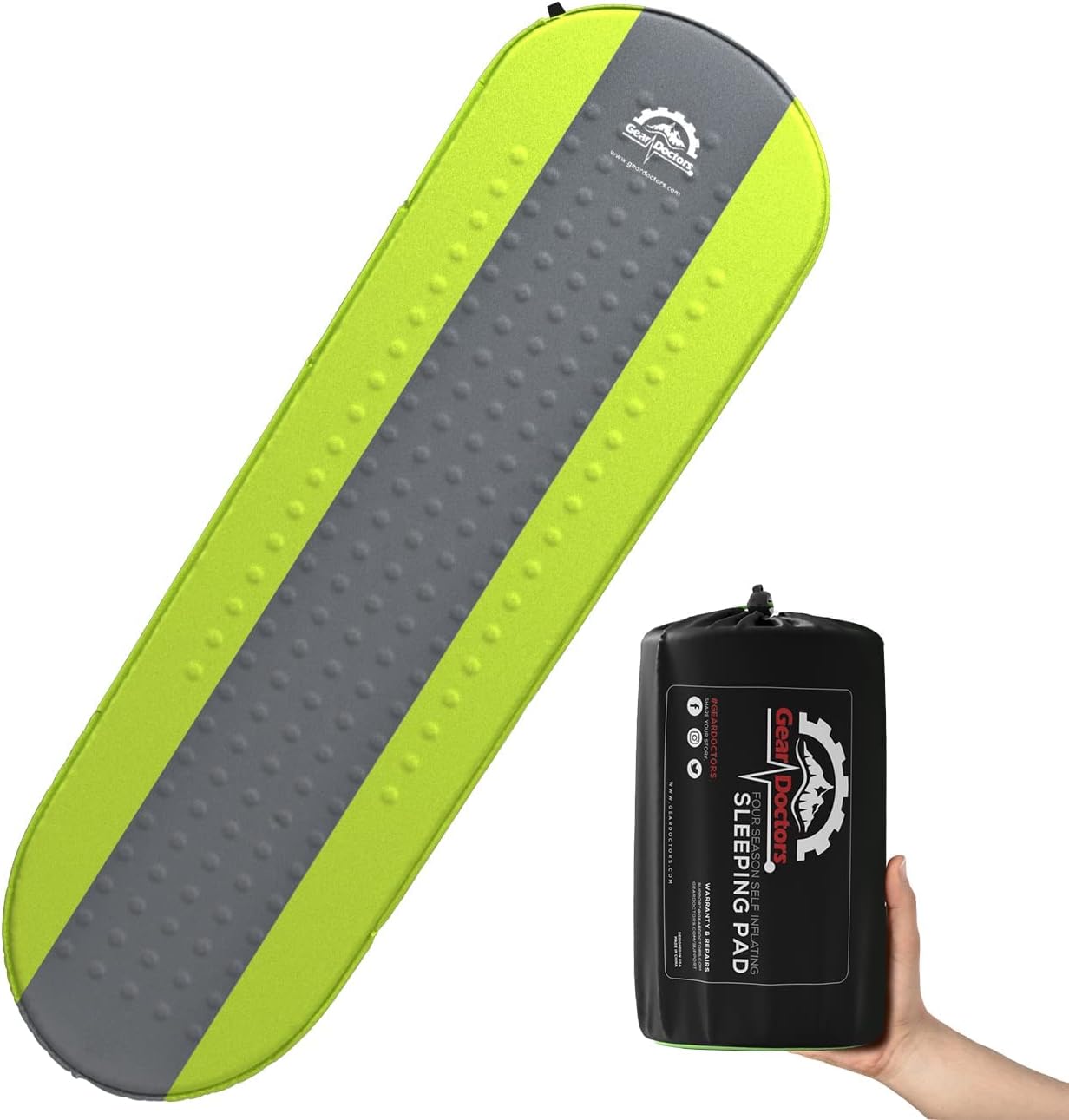
A self-inflating pad combines open-cell foam with air, so opening the valve does most of the inflating for you. The number that matters is the R-value, which measures how well the pad resists heat draining into the ground. Thickness alone tells you about comfort; R-value tells you whether you will be warm.
Why we picked this exact one: The Gear Doctors Oxylus publishes an R-value of 4.3, which is the useful thing about it — plenty of budget pads print a thickness and stay quiet about insulation. At 72 by 20 inches and 1.5 inches thick it is a modest pad rather than a luxurious one, and side sleepers with sharp hips will feel the ground through it on stony pitches. For 4,700 reviewers it has held air, which is the other thing that matters.
A folding two-burner stove that threads onto a standard disposable propane cylinder. Two burners let you boil on one side and keep something warm on the other, which is the whole argument for the format. Look for a wide pan support, wind panels on three sides and an ignition that does not depend on finding a lighter in the dark.
Why we picked this exact one: The Coleman Fold 'N Go puts out 20,000 BTUs across two burners, takes two 10-inch pans and runs over an hour on a single 16.4-ounce cylinder with both burners wide open. Its real advantage is fuel: the green cylinders turn up in every hardware store and gas station near a campground. Wind is its weakness — the side panels help, but on an exposed pitch you will be building a shelter out of the cooler lid.
A rechargeable LED lantern throws light in all directions rather than in a beam, which is what you want over a table or hanging from a tent loop. Useful things to check are the battery capacity, whether it has a low setting that lasts all night, and whether it can charge a phone in an emergency.
Why we picked this exact one: The ZMNT rechargeable lantern runs to 1000 lumens off a 6,700mAh cell, and on its lowest setting it will outlast several evenings rather than one. Its hook and magnetic base mean it can hang from the tent ceiling or stick to the car's tailgate. The brightest mode is far more light than a campsite needs and drains the battery quickly, so treat it as a find-the-dropped-tent-peg setting.
Pitch the tent once in the garden or the living room before you leave. Ten unhurried minutes at home beats twenty in the dark with a torch between your teeth and one pole sleeve threaded backwards. And a campground far enough from town for a quiet night is usually also far enough for a proper look at the night sky, which is worth walking a little way from the lantern for.
The Things You'll Buy After Trip Two
None of this is needed to go camping. All of it gets bought anyway, usually within a month, and usually in the same order. Chairs come first, because the realisation that there is nowhere to sit arrives about forty minutes after the tent is up and you're perched on a cooler lid with a mug balanced on your knee. Then the cooler itself, once you've tried keeping milk cold in a supermarket bag. The cookware tends to be last, bought the week after a good frying pan came home from a trip with a burnt ring on the base. I'd add one more thing that costs nothing to pack and transforms an evening: an instrument. A ukulele is small enough to live in the footwell and forgiving enough that three chords are genuinely sufficient round a fire.
06Pick 06 of 11
Pair of Folding Camping Chairs
Standard quad-fold camp chairs with a fabric seat, armrests and a carry bag. The things worth checking are the weight rating, the height of the seat off the ground and whether the frame wobbles on uneven ground. Chairs live in the boot between trips, so a carry bag that survives more than one season is worth something.
Why we picked this exact one: The ALPHA CAMP two-pack lands at a reasonable price for a pair, with lumbar padding and a side cooler pocket that holds a few cans. The frames are steel, so they are heavy to carry far — irrelevant when the chair travels in a boot, and a nuisance if you ever want to walk it to a lake. They fold flat enough to slide down the side of a packed car.
A hard-sided insulated chest for food and drinks. Capacity in quarts is the headline figure, but ice retention depends more on wall thickness, a sealing lid and how often it gets opened. Block ice lasts considerably longer than cubes, and a cooler packed full stays cold longer than a half-empty one.
Why we picked this exact one: The Coleman Classic in the 52-quart size holds a weekend of food for two with ice to spare, and the lid seals well enough that ice survives a warm night. It is a plain polyethylene cooler, not a rotomoulded one, so it will not match a premium chest for multi-day retention — which is the right trade at a sixth of the price for trips that end on Sunday.
A nesting set of lightweight pots, a frying pan, a kettle and the small utensils that otherwise get forgotten, all packing inside one another. The point of a dedicated set is that everything stores together and nothing from the kitchen goes missing. Check the handles fold and that the pan actually fits your stove's burner spacing.
Why we picked this exact one: The Odoland 19-piece set for two is the sensible starting point: pot, pan, kettle and the small spoons and spatulas that always get left in a drawer at home, all nesting into one bag. The non-stick coating is thin and will not survive metal utensils, so use the plastic ones it comes with. At this price it is a kit you can replace rather than baby.
A deep self-inflating mattress built for sleeping beside a vehicle, where bulk costs you nothing. Vertical side walls keep the usable surface close to the full width, and a high R-value means the insulation is doing real work rather than just adding softness. Separate valves for inflating and deflating make packing up much faster.
Why we picked this exact one: The Therm-a-Rest MondoKing 3D is the step up worth making once you know you will keep going: 4.25 inches thick with an R-value of 7.0, against the 1.5 inches and R-4.3 of the budget pad above. Buy it if you are a side sleeper, camp into the shoulder seasons, or have already spent one bad night on the ground. Wait if you have camped twice — it costs more than the tent, bag and pad combined.
Resist buying any of this before your first trip. You'll learn more about what you actually want from one damp weekend than from a fortnight of reading, and half the gear people buy up front never leaves the garage. If your campsite happens to sit on water, a basic rod and tackle setup is the other thing worth throwing in the boot, because mornings at a campsite are long and quiet.
The Two Things That Actually Hurt Campers
Most camping risk is dull and manageable. Two things are not, and both involve burning fuel near fabric you are sleeping inside.
The first is carbon monoxide. Every fuel-burning stove, lantern and heater produces it, and a tent that is good at keeping weather out is equally good at holding it in. The US Consumer Product Safety Commission's position is plain: never use a fuel-burning heater, lantern or stove inside a tent, camper or other enclosed space, and never while anyone is sleeping. Their data counted at least 26 deaths from carbon monoxide linked to camping equipment across a five-year span, and a CDC report on two incidents in Georgia records six people killed. What makes it dangerous is that the early symptoms — headache, dizziness, nausea — read like a cold, so people lie down instead of getting out. Cook in the open air. Not in the porch, not in the vestibule with the door unzipped, not in the back of the car with the tailgate up. Mountaineers do cook in vestibules, and they do it because they are pinned down by weather at altitude, not because it is safe.
The second is the fire itself. Tent fabric is nylon or polyester, and it doesn't catch so much as melt and drip, which is why a stray ember does more damage than you'd expect. Keep the fire in the provided ring, keep it small, and site chairs and the tent upwind of it. Check whether fires are permitted at all before you go — seasonal bans are common and arriving with a bag of firewood and no legal way to burn it is a normal part of learning this. Drown the fire properly at the end of the night: water, stir, water again, until you can hold a hand over the ashes. Coals stay hot enough to reignite for far longer than they look like they should.
The rest is housekeeping. Food goes back in the car overnight rather than in the tent, which is as much about mice and raccoons as it is about anything larger. Leave No Trace puts it simply enough: watch wildlife from a distance and never feed it, deliberately or by leaving scraps behind. That same habit of sitting still and looking rather than approaching is most of what birdwatching with a pair of binoculars asks of you, and a campsite at first light is an unusually good place to practise it.
Two Books Worth the Boot Space
Camping skills pass around by word of mouth, which means most beginners inherit whatever their one camping friend happens to believe. A short reference book fixes the two areas where that goes wrong most reliably: fire, and what to do about waste when there's no toilet. Both read better at a picnic table than on a phone, which is also true of keeping a nature journal — another thing a slow camp morning is unexpectedly good for.
10Pick 10 of 11Book worth reading
Outdoor Human Waste Disposal Guide
A short, frank handbook on the one camping subject nobody explains in advance: what to do when there is no toilet. It covers catholes, depth and distance from water, what happens to buried paper, and the places where packing it out is the only acceptable answer. Written with enough humour that people actually read it.
Why we picked this exact one: Kathleen Meyer's How to Shit in the Woods has been the standard reference on this for decades, and the fourth edition brings the guidance in line with current pack-it-out rules for fragile areas. The blunt title puts people off, which is a shame: the content is careful, practical and specific about distances and depths. A good deal of it concerns backcountry trips rather than serviced campgrounds.
A field guide to the traditional outdoor skills that sit underneath camping: building and managing a fire, choosing and sharpening a cutting tool, reading a site, rigging shelter and cordage. Written as a working reference rather than a narrative, with the fire and cutting-tool chapters being the parts a camper uses most.
Why we picked this exact one: Dave Canterbury's Bushcraft 101 is the most widely recommended entry point to woodcraft, and the chapters on fire lays, tinder and knife and axe handling are the ones that transfer directly to a campground fire ring. Be clear about what it is: a wilderness survival book, so a fair amount of it concerns trapping and shelter-building you will never need beside a car. Read it for the fire craft.
Read the relevant chapter before you go rather than at the campsite. Both of these are reference books, not page-turners, and their value is in having already read the bit you need at the moment you need it.
Questions You'll Have at 2am, Answered Now
I bought a bag rated for the exact temperature forecast, so why was I freezing?
Because that number almost certainly isn't a comfort rating. Bags tested to the EN/ISO standard carry three figures — comfort, lower limit and extreme — and the one printed on the label is usually the lower limit, which describes the point at which a warm sleeper survives curled up, not the point at which anyone rests. Comfort typically sits around ten degrees Fahrenheit warmer than the lower limit, and brands that don't test at all tend to publish something closer to the optimistic end. Buy a bag rated roughly ten degrees below the coldest night you expect, and treat the printed figure as a floor rather than a target.
Why does a warm sleeping bag still leave me cold from underneath?
A sleeping bag works by trapping loft, and the half you're lying on is crushed flat and insulating almost nothing. The ground does the rest, pulling heat out of you by direct contact all night. That job belongs entirely to the pad, measured by R-value. The detail that surprises people: the laboratory test that produces a bag's temperature rating is run on a pad rated around R-5, so the bag's number quietly assumes you already own decent insulation underneath. If you're camping cold, stacking a cheap closed-cell foam mat under your inflatable adds the two R-values together.
Where am I actually allowed to have a fire, and what counts as putting it out?
Assume no unless the campground says yes. Fire restrictions change week to week with conditions, they're posted locally rather than nationally, and plenty of sites permit fires only in the metal ring provided. Leave No Trace's guidance is to use a stove where you can and keep fires small, contained and legal — which is the real argument for owning a stove rather than relying on a fire you may not be permitted to light. Putting a fire out means water, stirring the ashes, more water, and repeating until nothing hisses and the ashes are cool to a hand held just above them. Burying a fire doesn't extinguish it; it insulates it.
What do I do about going to the toilet if the site has no facilities?
Plan it before you arrive, because improvising is how damage gets done. Where there's no toilet, the standard is a cathole dug six to eight inches deep and at least 200 feet from water, trails and camp, with everything filled in afterwards. Used paper goes into a bag and comes home with you, as do wipes, which do not break down whatever the packet says. Some fragile and heavily used areas now require packing out solid waste entirely. Check the land manager's rules rather than assuming a cathole is always acceptable.
Everything was fine until it rained and the tent got wet inside. Did it leak?
Probably not. Most "leaks" on a first trip are condensation: two people breathing overnight put out a surprising amount of water vapour, and it settles on the coldest surface available, which is the inside of the fly. Sealing every vent to stay warm makes it dramatically worse. Leave the vents open and a gap at the top of the door, keep wet gear in the porch rather than in the sleeping area, and don't let bedding touch the tent walls, because contact wicks moisture straight through. If water is coming in at the floor seams instead, that's a genuine leak — and usually a sign the tent was pitched in a dip.
People Worth Following Into This Hobby
Real practitioners we found while researching this setup — people who do the work, show their process, and publish on sites they run themselves. No sponsorships, no affiliations; we just think they're worth your time.
Writes first-hand outdoor guides and tent-life advice from her own trips across Britain, and photographs them herself.
Her family camping guide covers the practical side this setup's essentials only hint at — keeping children warm overnight and managing a pitch in bad weather, which is where most first trips go wrong.
Cooks and photographs every recipe at actual campsites, after a year living out of a hatchback across North America.
Her guide to washing up at camp answers the question the cook kit in this setup creates and the Leave No Trace rules make awkward: where the dirty water is supposed to go.
Runs a magazine, podcast and writing team of outdoor parents publishing first-hand accounts of taking small children outside.
Their first-camp write-up is honest about how little gear a family actually needs, which is a useful counterweight to a page that lists five things to buy before you start.
Teaches wilderness bushcraft professionally and publishes detailed campcraft tutorials, from pot hangers to fire lays, with his own photos.
The fire craft in the safety section of this setup is exactly what he teaches step by step, and it is the skill a camper is most likely to learn badly by guessing.
Love what you see here? Save individual picks with on any item, or copy everything to a list of your own in one click — great for coming back to later, or dropping as a not-so-subtle hint.