Urban Sketching for Beginners: Capture the City on Paper
Catch the Street Before It Moves On
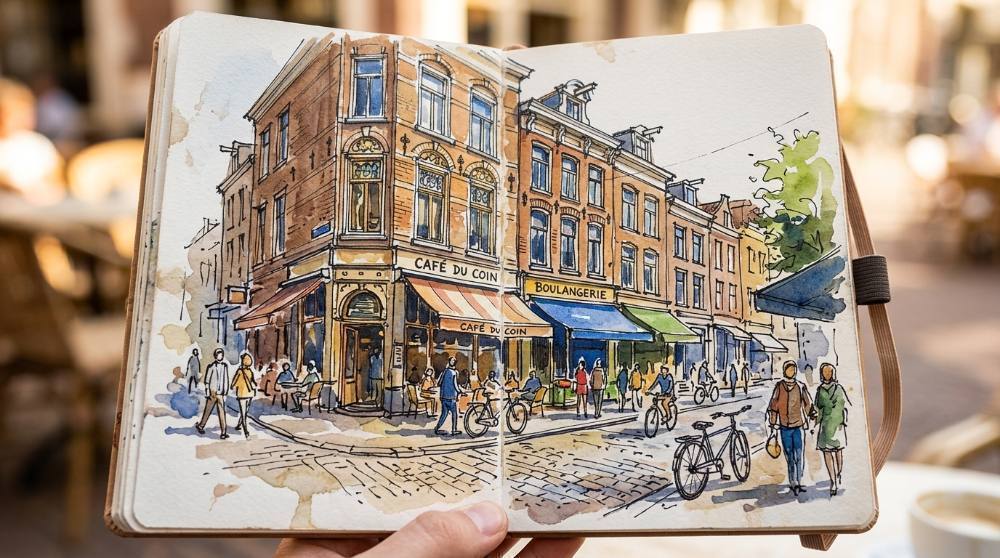
Urban sketching is just this: you park yourself on a real street and draw what's actually in front of you, right then, before the light shifts or the bus pulls away. It's done on café chairs, park benches, the edge of a fountain — wherever you can sit for twenty minutes. The whole thing's younger than it feels; it started in 2007 as a photo-sharing group a Seattle newspaper illustrator set up, and snowballed into a worldwide crowd that now holds sketching gatherings from Lisbon to Singapore. The one rule they all signed up to is a strange one: draw the scene honestly, scaffolding and parked delivery vans included. Sit there long enough and strangers start talking to you — one sketcher famously got handed a free coffee mid-drawing.
Here's the good news for anyone the word “art” makes nervous: the starting kit fits in a jacket pocket. You don't need color, an easel, or any gift for straight lines. A pen that won't smear, some paper that can take a bit of water later, and a pencil to rough things in, done the same way you would when learning to pencil sketch. That's the whole starting setup. Most people overbuy on day one and then lug half of it around untouched for a month.
My advice: start with the smallest kit that can make a mark. Keep it light. One waterproof pen, a pad that shrugs off a light wash, a pencil, and an eraser will get you drawing today — color and gadgets can wait until the habit sticks.
Everything below is cheap enough that if urban sketching turns out not to be your thing, you're out the price of a couple of lunches, not a hobby's ransom.
Where This Little Kit Can Take You
A few real moments and results from this hobby — made with tools no fancier than the ones below.
Pick 01 of 11
Waterproof pigment fineliners for pen-and-wash sketching


These are fine-tipped pens filled with pigment ink that dries permanent and waterproof, so a watercolor wash laid over the lines won't lift or blur them. A set usually spans several nib widths, from a hair-thin 0.2mm for texture to a broader tip for outlines and shadows. When choosing one, the detail that matters most is that the ink reads “pigment” or “archival” — dye-based ink smears the moment water touches it.
Skip the waterproof part and you learn it the hard way: your careful ink drawing dissolves into grey sludge the second a wet brush touches it.
Pick 02 of 11
Mixed-media pad that takes both pen and watercolor


A mixed-media pad uses paper that's heavier and more absorbent than plain sketch paper, so it can take pen lines and a light wash without buckling into waves or bleeding through to the next page. It sits between thin drawing paper and dedicated watercolor stock — enough tooth for graphite, enough body for a bit of water. For a first book, pick a size small enough to balance on your knee, since you'll be perched or standing more often than sitting at a table.
Regular sketchbook paper cockles and pills the instant you add water, so every wash you try looks like a mistake even when the drawing underneath was fine.
Pick 03 of 11
Graphite pencils for roughing in the scene


A small range of graphite pencils lets you block in the big shapes lightly before you commit to ink. Harder grades like 2H leave a faint line that barely shows and erases clean; softer grades like 4B or 6B give you dark, quick shading. For urban sketching you mostly live in the middle, using an HB or B to rough out the scaffolding of a building before inking over it.
Inking straight onto blank paper with no guide is how beginners end up with a cathedral that runs off the edge of the page — a couple of light pencil marks first save the whole drawing.
Pick 04 of 11
Kneaded eraser for lifting the pencil under-drawing


A kneaded eraser is a soft, putty-like rubber you shape with your fingers. Instead of scrubbing, it lifts graphite off the page by dabbing, so it won't rough up the paper or smear your ink lines once they're dry. You can pull it to a fine point to pick out a single stray mark or flatten it to gently knock back an area that's gone too dark.
A normal eraser drags and pills mixed-media paper, and if your ink isn't bone-dry it'll smear the lines you just drew; a kneaded one lifts the pencil away without touching either.
With just these four, you can walk out the door today and come back with a real drawing — ink over a light pencil rough, the pencil then rubbed away with a dab. There's a particular satisfaction to that first clean pen line landing on a building you're actually looking at. Once ink alone starts feeling flat, you'll want color. It's a smaller leap than it sounds.
Adding Color Without Lugging a Studio Around
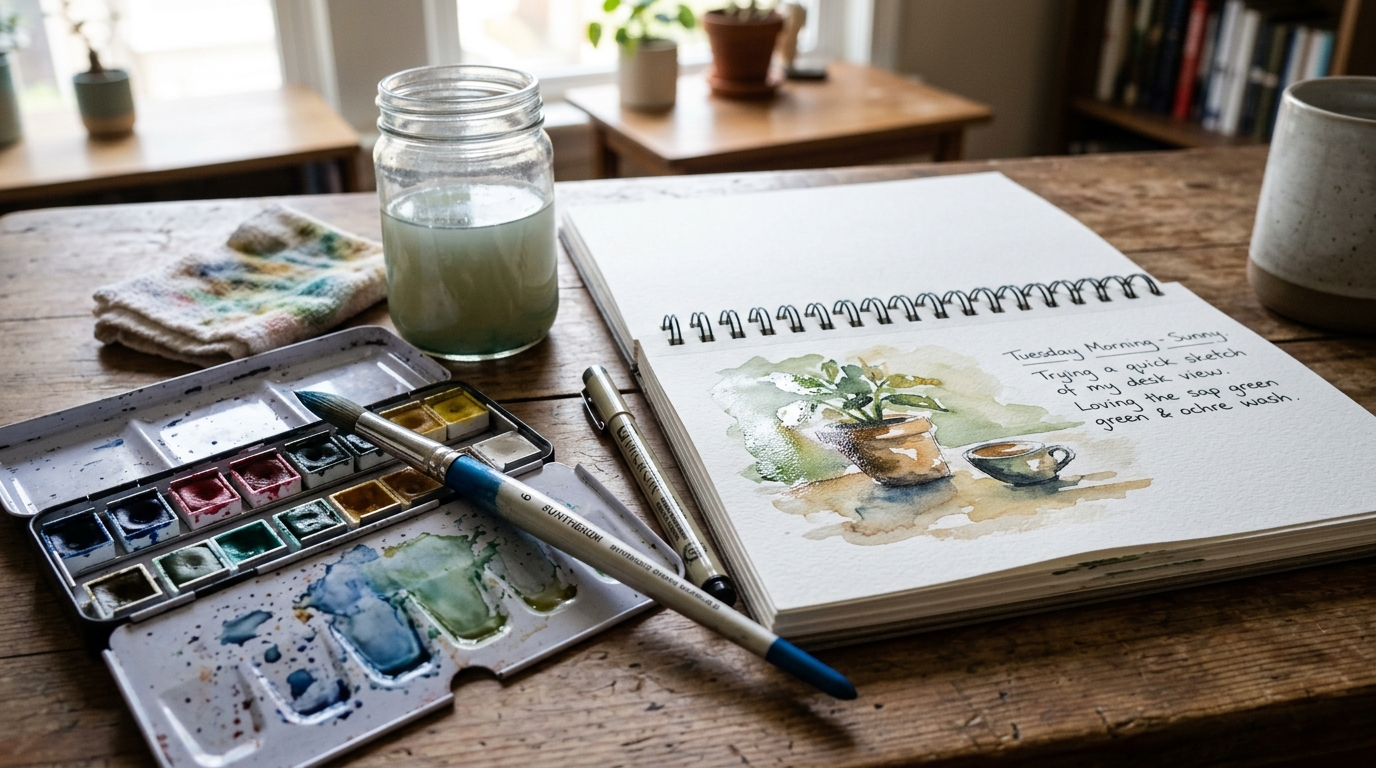
Color is where most people expect urban sketching to get complicated. It's the opposite. A tiny pan set, a brush that carries its own water, and a lid to mix on will fit in one hand — no jars, no easel, no mess. The move that keeps it portable is working small and fast: a few washes dropped over dry ink, not a painting you fuss over. If loose color on the page appeals to you more than the linework, keeping a watercolor journal covers these same tools from another angle.
Pick 05 of 11
Compact watercolor pan set for on-the-go color


A pan set is a little tin of solid watercolor cakes you wet with a brush — no tubes to squeeze, nothing to spill. A beginner set of around a dozen colors is plenty, since watercolor is built on mixing rather than owning every shade. Look for one that leans on strong, mixable colors instead of a rainbow of pre-mixed pastels, and don't fret over the black and white pans; you'll mix better darks yourself and rarely touch the white.
Tube paint and a big palette anchor you to a table, which is the one thing urban sketching is trying to get you away from; a pan set is what lets you paint standing at a railing.
Pick 06 of 11
Water brush pens that carry their own water


A water brush is a brush with a hollow handle you fill with water. Squeeze gently and a little water feeds into the bristles, so you can wet and blend a wash without a separate jar at your side. It rinses with a squeeze and a wipe on a cloth, which is what makes painting on a park bench realistic instead of a juggling act.
Without one, painting outdoors means finding a flat spot for an open cup of water and hoping nobody knocks it; a water brush takes the cup out of the equation entirely.
Pick 07 of 11
Refillable travel palette tin with mixing room


An empty metal palette tin holds a row of paint pans and gives you flat lid space to mix colors on. As your starter set's built-in tray starts feeling cramped, this is where you move your paints and add new ones. The half-pan slots are a standard size, so pans from most watercolor brands drop straight in.
The mixing area on a pocket paint set is tiny, and once you're mixing real washes you run out of room fast; a dedicated tin gives you space to build a color before it hits the paper.
Pick 08 of 11
White gel pens for highlights and sparkle


A white gel pen lays opaque white ink on top of dry watercolor and ink, so you can add the bright bits that paper alone can't give you. Think window reflections, a string of lights, the glint on a car roof. It works because the ink sits on the surface rather than soaking in, staying crisp over darker washes.
You can't paint white back in with watercolor once an area is dark, so without an opaque white pen those final sparks of light are simply lost.
Add color and the same street scene suddenly reads as a time of day — the warm grey of morning, the long blue shadows of late afternoon. Leave some white. Beginners tend to fill every inch, but the bare paper is doing more work than you'd guess. Some sketchers fall harder for the ink than the color and start chasing the perfect line; if that's you, a beginner fountain pen writing setup scratches the same itch. Next come the small bits of gear that make sitting on a curb for an hour bearable.
The Little Things That Keep You Sketching Outside
None of this will make you draw better. That's fine. What it does is remove the small annoyances that end a session early — the breeze flipping your page, nowhere to rinse a brush, a bag that swallows your pen. Sketchers who draw outdoors a lot converge on the same handful of cheap fixes. The same gear works anywhere green, too, so if you drift toward trees and creeks over storefronts, nature journaling uses nearly the identical kit.
Pick 09 of 11
Small binder clips to tame pages in the wind


Small metal binder clips hold your sketchbook pages flat and pinned down. Outdoors, even a light breeze will lift and flip a page mid-stroke, and a freshly painted page can stick to the one facing it when the book closes. A couple of clips on the open edge keep everything where you put it.
The first gust that flips your page across a wet wash, smearing an hour of work, is the moment you understand why every outdoor sketcher carries a clip or two.
Pick 10 of 11
Collapsible silicone cups for rinsing brushes


These are small silicone cups that fold flat to pack and pop open to hold rinse water. Even with a water brush, having a cup to swish a dirty brush in keeps your colors from turning muddy. They collapse down to the depth of a coaster, so they don't eat real room in a bag.
A water brush alone slowly muddies every color you mix, because there's nowhere to actually rinse it out; a collapsible cup fixes that without adding a rigid jar to carry.
Pick 11 of 11
Waxed canvas roll to carry the whole kit


A waxed canvas roll keeps your pens, brushes, and pencils in one padded bundle that ties shut and drops into any bag. The waxed finish shrugs off a light drizzle and the odd paint splash. Rolling your tools instead of loosing them in a tote means you grab everything in one motion and lose nothing at the bottom of the bag.
Loose pens migrate to the bottom of a bag and go missing, and an uncapped fineliner rolling around will bleed onto whatever it touches; a roll keeps the kit together and the caps on.
None of this is required to start. Honestly, a pen and a pad are enough for your first month. But once you're sketching regularly, these small comforts are the difference between packing up after ten minutes and staying for an hour. If you're piecing together a bag for a trip, our guide to what actually fits in a travel art kit is worth a look before you overpack.
What Nobody Tells You Until Your Fifth Sketch
Why do my colors go muddy right where two washes meet?
It usually means you dropped a second color into a wash that hadn't dried, or you kept brushing the same spot. Wet paint flowing into wet paint blooms and blends where you didn't want it to, and overworking lifts the pigment back up as a dull grey. The fix is patience you won't feel like having: let the first wash dry completely before you touch the area next to it. Mix the color you want once, lay it down in a stroke or two, then leave it alone. Watercolor rewards the confident single pass and punishes fiddling.
Everyone says draw on location, but I freeze up with people watching. Is that normal?
Completely normal, and it stops a lot of beginners before they start. The fear is that strangers are judging your unfinished drawing, so you rush — and rushing is exactly what makes an outing go badly. Put your back to a wall or a café window so nobody can peer over your shoulder, and draw buildings before you draw people, because buildings don't look back. In practice passersby are either oblivious or quietly impressed, and the occasional chat turns out to be part of the appeal. Sketching with a local group, which exists in most cities, takes the edge off fastest.
My drawing runs off the edge of the page before I finish. How do I stop that?
This happens because you started drawing detail in one corner with no map of where the rest goes. Ten minutes in, the cathedral is gorgeous and there's no room left for half of it. Before any ink, spend thirty seconds marking the top, bottom, and sides of your scene lightly in pencil, then block the biggest shapes inside that box. It also helps to draw less — pick one interesting building or corner rather than the whole street. A cropped scene you finish beats a panorama you abandon.
Why does my pen ink smear when I add water, even though it wrote fine?
Almost every fountain pen ships with water-soluble ink, and most bottled inks, even ones labeled “permanent,” smear under a wash. The result is heartbreaking: a clean drawing turns to grey mush the instant your brush crosses it. You need ink specifically labeled waterproof or pigment, like a carbon-based black, and even then give it a full minute to dry before washing over it. Test any new ink on a scrap first — draw a line, wait, then run a wet brush across it. Thirty seconds of testing saves a whole sketch.
Love what you see here? Save individual picks with on any item, or copy the whole list to your own wishlist in one click — great for coming back to later, or dropping as a not-so-subtle hint.