Watercolor Journaling: Beautiful Pages, No Skill Needed

Watercolor Journaling: Beautiful Pages, No Skill Needed

Daria AparinaCurated by Daria Aparina

Start Here: The Four-Piece Core Kit

The biggest surprise for most people is how little watercolor journaling actually asks of you. Four things get you painting a page tonight: a book whose paper can survive water, a small set of paints, one decent brush, and a pen whose ink won't smear when a wash runs over it. Almost every beginner I've watched starts by buying a sprawling forty-color set and a stack of loose paper, then never touches half of it. The items below are the ones you'll reach for in every single session.

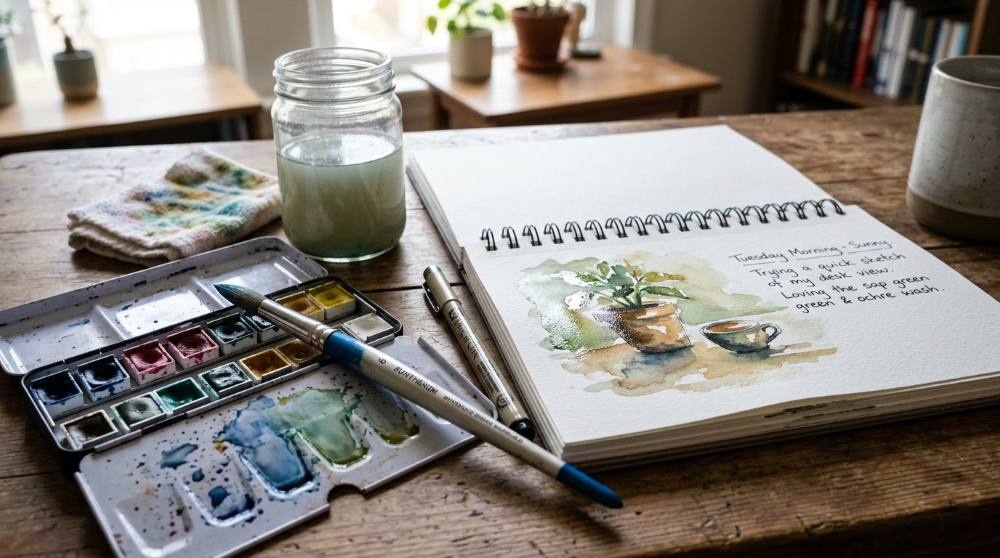
My approach is to keep the kit small enough to fit in one hand. A watercolor-ready journal, a compact pan set, a single round brush, and one waterproof liner are genuinely all you need to fill your first dozen pages — extra colors, specialty brushes, and gadgets can wait until you actually feel their absence.

I worked through the supplies that show up again and again in beginner journaling kits and kept only the ones that are easy to find, forgiving to use, and priced so a false start won't sting.

Hardcover cold-press watercolor journal for daily painting

Hardcover cold-press watercolor journal for daily paintingHardcover cold-press watercolor journal for daily painting

A bound book of heavyweight cold-press watercolor paper, usually around 140 lb (300 gsm), that can absorb washes without pilling or soaking through. The hardcover and stitched binding let it lie reasonably flat and survive being carried around. Beginners should look for genuine watercolor or mixed-media paper rather than standard sketch paper, and a page size small enough that finishing a spread feels achievable.

Why is this important?

The paper is the one thing you can't fake in watercolor journaling — thin or non-absorbent pages buckle, pill, and bleed, which discourages people faster than any lack of skill.

Why this choice?

The Strathmore 400 Series Hardcover Watercolor Journal pairs a trusted paper maker with true 140 lb cold-press sheets at under $20, and its 4.7-star rating across more than 1,300 reviews makes it the most consistently recommended bound option for beginners.

Compact student-grade watercolor pan set for journaling

Compact student-grade watercolor pan set for journalingCompact student-grade watercolor pan set for journaling

A pocket tin of solid half-pan watercolors with a built-in mixing lid and a small travel brush. Student-grade pans like these rewet instantly, cost a fraction of artist-grade paint, and still hold enough pigment for a beginner to learn color mixing. Look for a set with a manageable number of colors and a lid that doubles as a palette so you can work anywhere.

Why is this important?

Pan watercolors are the most practical format for journaling because they need no setup, dry quickly between layers, and travel without spilling, unlike tube paint that has to be squeezed out in advance.

Why this choice?

The Winsor & Newton Cotman Complete Pocket Set is the benchmark student set, with a self-contained palette and brush, a price near $19, and a remarkable 4.7-star average from over 50,000 reviews — reassurance that the colors behave predictably.

Round and flat watercolor brush set for washes and detail

Round and flat watercolor brush set for washes and detailRound and flat watercolor brush set for washes and detail

A set of synthetic-bristle brushes in assorted round and flat shapes sized for both broad washes and fine linework. Synthetic hair holds enough water for journaling, cleans easily, and costs far less than natural sable. A beginner mostly needs one mid-size round, so a varied set is a low-risk way to discover which shapes you actually reach for.

Why is this important?

A brush made for watercolor releases water in a controlled way and springs back to a point, which is what lets you move from a loose sky wash to a thin branch without constantly swapping tools.

Why this choice?

The Arteza Watercolor Brush Set of 12 covers every shape a beginner might try for around $22, holds a 4.5-star rating, and comes from a brand known for consistent, giftable art supplies rather than one-off imports.

Waterproof pigment fineliner pens in assorted nib sizes

Waterproof pigment fineliner pens in assorted nib sizesWaterproof pigment fineliner pens in assorted nib sizes

A set of fineliner pens filled with archival, waterproof pigment ink in a range of nib widths from hairline to bold. Because the ink is waterproof once dry, you can ink a sketch and then lay washes over it without the lines dissolving. Beginners benefit from having a few sizes so a single page can carry both delicate detail and confident outline.

Why is this important?

Line and wash is the backbone of journaling, and only waterproof pigment ink survives a brush passing over it — ordinary pens smear into gray and contaminate the paint.

Why this choice?

The Sakura Pigma Micron 6-pack is the standard against which other liners are judged, offering several nib sizes of genuinely waterproof ink for about $18, backed by a 4.8-star rating across nearly 8,000 reviews.

Together these four cover paper, color, application, and line — the full loop of a journaling page. Expect your first washes to dry lighter than they looked wet, which catches everyone off guard, so build color in thin layers rather than chasing intensity in one pass. If you find yourself drawn more to opaque, matte color than to translucent washes, the related beginner gouache painting setup covers a close cousin of this hobby.

Tools That Make Daily Pages Easier

Once the daily habit sticks, a few small additions remove the friction that makes people skip a day. None of these change what you can paint — they change how quickly you can sit down and start, and how easily you can finish a page. A waterbrush, for instance, lets you paint on a train without a sloshing water jar. If you already keep lists and trackers, folding small washes into that practice overlaps neatly with a beginner bullet journaling setup. I'd add these one at a time, not all at once, so each earns its place.

Refillable water brush pens for painting without a water cup

Refillable water brush pens for painting without a water cupRefillable water brush pens for painting without a water cup

Brushes with a squeezable barrel you fill with water, so a gentle press feeds the bristles and removes the need for a separate rinse jar. They make quick washes and travel painting far simpler, and assorted tips cover fine to broad strokes. Look for a leak-resistant barrel and a tip that holds a point when wet.

Why is this important?

A waterbrush removes the single biggest obstacle to painting away from a desk — carrying water and not spilling it — which is what turns a journal into something you'll actually use on the go.

Why this choice?

The Pentel Arts Aquash Water Brush set is the most trusted waterbrush among urban sketchers, with assorted tip sizes, a leak-resistant design, and a 4.7-star rating from over 5,600 reviews that few competing brushes match.

Opaque white gel pens for highlights over dried washes

Opaque white gel pens for highlights over dried washesOpaque white gel pens for highlights over dried washes

A set of pens that lay down opaque white ink visible on top of dried watercolor. They add the final sparks a wash can't make on its own — catchlights in eyes, snow, stars, the edge of a wave. Beginners should look for genuinely opaque ink and a few tip sizes so highlights can be both fine and bold.

Why is this important?

Watercolor can't paint white over color because it's transparent, so an opaque white pen is the only easy way to put back the brightest accents after the paint has dried.

Why this choice?

This VIKAVAS White Gel Pens for Dark Paper set delivers reliably opaque white in several widths for under $7, and at a 4.5-star rating it is the cheapest low-risk way to add highlights without committing to a single premium pen.

Low-tack masking tape to hold pages flat and mask borders

Low-tack masking tape to hold pages flat and mask bordersLow-tack masking tape to hold pages flat and mask borders

A low-tack masking tape that sticks well enough to anchor a page while you paint but peels away without tearing the paper surface. It is used to hold a journal page flat against buckling and to mask crisp, clean borders around a painting. The key feature for paper is a gentle, delicate-surface adhesive rather than standard masking tape.

Why is this important?

Taping a page down is the simplest defense against the warping that ruins beginner spreads, but only low-tack tape does it safely — aggressive tape lifts the paper fibers when removed.

Why this choice?

Scotch Delicate Surfaces Painters Tape is formulated specifically for fragile surfaces, peels cleanly off journal paper, and its 4.7-star rating over 1,800 reviews reflects how dependably it avoids tearing pages.

Water-soluble colored pencils for drawing that blends into washes

Water-soluble colored pencils for drawing that blends into washesWater-soluble colored pencils for drawing that blends into washes

Colored pencils with water-soluble cores that you draw with dry and then dissolve into soft washes with a wet brush. They give a beginner precise control over where color goes before it spreads, which feels safer than a loaded brush. Look for smooth, well-pigmented cores and a color range you'll actually mix rather than the largest possible count.

Why is this important?

Water-soluble pencils bridge drawing and painting, letting a nervous beginner build an image line by line and then loosen it with water — a gentler on-ramp than committing to washes immediately.

Why this choice?

The Staedtler Watercolor Pencils box of 36 comes from a long-established stationery maker, lays down smoothly, and holds a 4.6-star rating across more than 2,400 reviews at a mid-range price, making it a dependable first set.

With these on hand, a page goes from blank to finished without you hunting for the right tool mid-stroke. The one habit worth building now is taping or clipping your page flat before the first wash; thin journal pages cup and warp the moment they get wet, and a buckled page is the most common reason beginners abandon a spread. If your interest leans toward sketching what's growing and moving around you, the beginner nature journaling setup pairs naturally with these tools.

Taking Your Journal Out Into the World

Watercolor journaling earns its keep when you paint on location — a cafe table, a park bench, a hotel windowsill. The catch is that water is heavy and messy to carry, and a loose kit turns into a scavenger hunt at the bottom of a bag. The items here solve the logistics of working away from a sink, and they are also where the choice between paint types starts to matter; the watercolor versus gouache comparison for beginners is worth a look if you're still settling on a medium. Keep this layer light — the goal is a kit you'll actually carry.

Collapsible silicone rinse cups for painting on the go

Collapsible silicone rinse cups for painting on the goCollapsible silicone rinse cups for painting on the go

Soft silicone cups that fold nearly flat for packing and pop open to hold rinse water. Some have ridged interiors that help scrub pigment from bristles. For travel journaling, look for a stable base and a size that balances capacity against how much room it takes in a bag.

Why is this important?

Clean rinse water is what keeps colors from turning muddy, and a packable cup means you can change your water anywhere instead of painting with an increasingly dirty jar.

Why this choice?

This AddLotLot 3-pack of collapsible silicone washers folds down for travel, includes brush-scrubbing ridges, and earns a 4.7-star rating over 200 reviews while costing under $10 for three.

Empty refillable palette tin with half pans for custom colors

Empty refillable palette tin with half pans for custom colorsEmpty refillable palette tin with half pans for custom colors

A metal tin with a mixing surface and a stack of empty half pans you fill with your own paint. It lets you build a personalized, compact palette and expand your color range a pan at a time. Beginners should look for pans that sit securely, often on magnetic strips, and a lid roomy enough to mix on.

Why is this important?

A refillable palette is how you grow beyond a starter set thoughtfully, adding only the colors you find yourself wanting instead of buying another bulky pre-made box.

Why this choice?

The FCLUB empty watercolor tin includes 40 half pans and magnetic squares for around $10, and its 4.6-star rating from over 1,500 reviews shows the pans stay put and the tin survives being carried.

Canvas roll-up case to carry brushes, pens, and pencils

Canvas roll-up case to carry brushes, pens, and pencilsCanvas roll-up case to carry brushes, pens, and pencils

A canvas wrap with rows of slots that holds brushes, pens, and pencils in place, then rolls up and ties shut for transport. It keeps brush tips from getting crushed and stops a kit from scattering through a bag. Look for enough slots for your tools and a tie or flap that secures the contents.

Why is this important?

A roll case is what makes a travel kit grab-and-go: everything has a place, brush tips stay protected, and you're not assembling supplies from across your bag each time you sit down.

Why this choice?

The U.S. Art Supply Deluxe Canvas Roll-Up Case offers 24 slots and a protective wrap design for under $10, with a 4.7-star rating across nearly 2,000 reviews confirming the canvas and stitching hold up to regular carrying.

Pack these once and your whole setup lives in a single pouch you can grab on the way out the door. A realistic expectation: outdoor light shifts fast, so most location pages get finished in fifteen or twenty minutes rather than fussed over, and that mild time pressure is part of what makes them feel alive. For help paring the kit down to what fits a daypack, the guide to building a travel art kit that fits in a bag is a useful next step.

The Quiet Reasons a Promising Page Falls Apart

Why does my page buckle into waves even when the paper is thick?

Beginners assume heavy paper won't warp, then watch it cockle anyway because the fibers swell unevenly when water lands on only one side. A wavy page won't lie flat for the next spread, and the texture pools paint in the valleys. The fix is to wet or tape the page down before painting and let it dry fully under tension, or to simply accept light cupping in a bound journal and work with slightly less water. Bound cotton journals warp less than loose wood-pulp sheets, which is why the book itself matters more than people expect.

Why did my ink lines smear into a gray mess when I painted over them?

Most everyday pens use dye-based ink that stays water-soluble after it dries, so the first wash drags it across the page. The result is muddy outlines and dirty color you can't lift back out. Use pigment-based waterproof ink, and let the lines sit for a minute before adding water, because even waterproof ink can lift while it's still fresh. This is also why the safe order is pencil, then ink, then paint — not paint over wet ink.

Why do my colors turn flat and chalky instead of glowing?

This usually comes from overmixing on the palette and overworking the paper. Watercolor gets its luminosity from light passing through thin transparent layers and bouncing off white paper, so scrubbing many colors together or reworking a wet area kills the glow and the paint goes dull. Mix two colors at most for a given passage, leave some paper untouched, and stop fiddling once the water starts to lose its shine. Going back into a half-dry wash is also what creates those blotchy 'cauliflower' blooms.

Why does half of a big color set never get used?

Large sets tempt beginners into reaching for a ready-made green or purple instead of mixing one, and those premixed colors often look artificial beside what you could blend yourself. You end up with a cluttered palette and pages that feel garish. A compact range of six to twelve colors forces you to mix, which teaches color relationships far faster and keeps a page harmonious. When you do want more range, adding a few single pans to an empty palette beats buying another full box.

Love what you see here? Save individual picks with on any item, or copy the whole list to your own wishlist in one click — great for coming back to later, or dropping as a not-so-subtle hint.

Disclosure: Some product links may be affiliate links. If you make a purchase through one of these links, we may earn a small commission at no extra cost to you.