Stand-up paddling is what it sounds like: you stand on a floating board and move yourself along with one long paddle, usually on water flat enough to see the bottom. It began as a camera trick. In 1940s Waikiki the surf instructors known as beach boys stood up on their longboards with canoe paddles so they could see over the swell and photograph the tourists they were teaching, and the style picked up the name Beach Boy Surfing. One of them, John "Zap" Zapotocky, was still paddling upright at 91. Most people today never meet a wave at all, and are instead out on a reservoir at seven in the morning watching their own shadow slide across the weed beds.
The first ten minutes are wobblier than anyone admits. You'll start on your knees, and that's the right call. Standing arrives once you stop staring at your feet and look at the far shore instead, which takes most people about one session. What catches beginners out isn't the balance, though. It's how much of this hobby happens on dry land: unrolling, pumping, screwing in a fin, then rolling the whole wet thing back up at the end.
Our take: the board, a vest, something dry to put your phone in, and a whistle. That's the whole list. Everything else here can wait until you've been out three or four times and know what actually irritates you.
We kept the picks cheap enough that a couple of soggy Sundays won't feel like money thrown at the water.
Where This Little Kit Can Take You
A few real moments and results from this hobby — made with tools no fancier than the ones below.
First light on a still lakeThe whole sport in one frame: one person, one paddle, and water flat enough to mirror the hills.
A board waiting in the shallowsDeck pad, leash plug and a fin box, resting where every paddle actually begins.
None of this assumes you'll be any good at it. A board that floats you easily forgives a great deal, and the water you pick matters more than anything you buy. One unexpected side effect: herons and grebes tolerate a silent board far better than they tolerate a person on a towpath, so an early paddle doubles as surprisingly good beginner birdwatching from the water.
What Actually Has to Be in the Car
An inflatable board package covers most of what you need in one box, which makes this list shorter than people expect. The gaps are the same every time. Nothing in a board box will hold you up when you're tired, keep a car key dry, or make a noise a motorboat can hear over its own engine, and those three gaps are the rest of the list. If standing turns out not to suit you, the same water works beautifully from a seat, and a beginner kayak setup covers that route instead.
Disclosure: This section may contain affiliate links to Amazon. We may earn a small commission from qualifying purchases at no extra cost to you.
01Pick 01 of 08
inflatable all-around paddle board package for flat water
An all-around inflatable board is a wide, thick drop-stitch slab that pumps up rigid and rolls into a backpack when you are finished. For a first board, look for a length around 10'6" and a width of at least 32 inches, because width is what stops the board tipping while you find your feet. Check that the fin drops into a US standard fin box, so a chewed-up fin is a cheap replacement instead of a dead board.
Why we picked this exact one: The Roc 10'6" is the most-reviewed inflatable paddle board on Amazon, with more than 18,000 ratings. It carries a 350 lb capacity and a detachable main fin that sits in a proper fin box, plus a valve wrench in the bag. The honest catch is the kit around it: the three-piece paddle is aluminium and the pump is a manual dual-action one, and those are the two parts owners replace first.
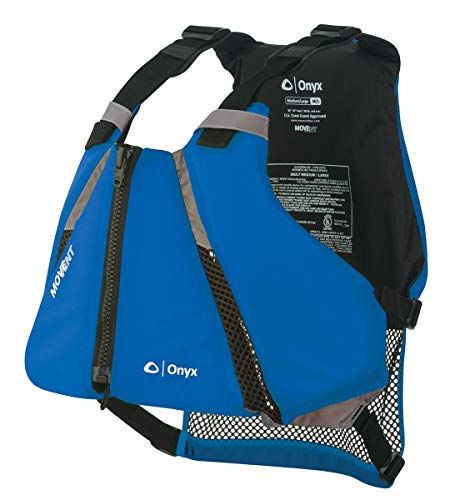
paddle-sports life vest cut for standing and reaching
A paddling life vest is cut short at the waist and left open under the arms so a full stroke is not blocked, which is the difference between wearing one and carrying one strapped to the nose of the board. Mesh low on the back keeps it clear of a seat if you ever paddle sitting down. Fit matters more than the flotation number: a vest that rides up past your ears in the water is not doing its job.
Why we picked this exact one: The Onyx MoveVent Curve is the paddle-cut vest that instructors tend to wear rather than stow. Its 4.7-star average is unusually high for a life jacket. The mesh lower back and open sides genuinely do let a full stroke through, though the foam sits high on a short torso and plenty of owners size down.
A roll-top dry bag is a welded sack you fold over three times and clip, which traps air inside and keeps the contents dry even if the whole thing goes in the lake. Twenty litres swallows a towel, a fleece, lunch and a car key with room to spare, and the trapped air makes it float. Clip it to a deck D-ring rather than leaving it loose on the nose.
Why we picked this exact one: Earth Pak's 20L roll-top has the longest track record of any dry bag here, carrying over 33,000 ratings. The 500D PVC shrugs off being dragged across gravel, and a small waterproof phone case ships in the same box. It is stiffer and bulkier than a lightweight packraft bag, which is exactly what that abrasion resistance costs.
A pealess whistle has no cork ball rattling inside, so it still sounds when it is soaked or freezing. It clips to a life vest zip on a short lanyard and lives there, because a whistle in a dry bag is a whistle you cannot reach. It weighs almost nothing and costs less than a coffee.
Why we picked this exact one: The LuxoGear pealess whistle is the cheapest thing on this page and has more than 13,000 ratings behind it. It comes as a two-pack with lanyards and carabiners, so one lives on the vest and one stays in the dry bag. The body is plastic rather than metal, which is what you want against bare skin in cold weather.
With those four in the car you can launch anywhere public and be both legal and sensible about it. The first inflation takes longer than you expect and leaves you faintly out of breath before you're even wet. Copy one habit from people who've owned boards for years: let the pressure back down before you roll it away, and never leave it pumped hard in full sun. If the hour out there suits you, the next thing worth adding is a way to bring the view home, which is where a beginner smartphone photography kit starts to make sense.
Or Buy One Box and Be Done
The list above lands a little over two hundred dollars once the vest, the bag and the whistle go in, and plenty of people would rather make one decision than four. This board turns up with the pump, paddle, fins, leash, repair kit, a phone case and a clip-in seat already in the bag. It also costs about two and a half times the board above does on its own, so it's worth being plain about what that buys and what it doesn't. If you're genuinely still deciding whether any of this is for you, our guide to choosing your first hobby is a better first read than either listing.
The one-box alternative
all-in-one inflatable board package with pump, paddle, seat and repair kit
An all-in-one iSUP package puts the board and everything that attaches to it in a single box: pump, paddle, fins, leash, repair kit and a backpack to carry it in. Some add a clip-in seat so the board doubles as a sit-down craft when your legs have had enough. The construction to look for is dual-layer fused PVC, which handles heat better than glued seams.
Why we picked this exact one: The Retrospec Weekender Plus 10'6" is built from dual-layer fused PVC, the construction that stands up best to a board left out in the sun. It arrives with a pump, paddle, fins, leash, repair kit, phone case and a clip-in kayak seat. Its 275 lb capacity is the lowest figure on this page, so a heavier paddler or anyone taking a dog aboard should size up rather than buy this one.
Flat water for one paddler up to 275 lb, standing or sitting on the clip-in seat. The pump, leash and repair kit are already in the bag.
Flat water for one paddler up to 350 lb, standing only. Everything that is not the board is chosen by you.
Quality of the tools
Dual-layer fused PVC, the construction that copes best with heat. Fins, pump and paddle are the usual mid-range package parts.
A higher-capacity board with a detachable fin and a valve wrench, plus a paddle-cut life vest and a 500D dry bag. The bundled paddle is still aluminium. better here
The first evening
One box, one delivery, nothing missing. You could be on the water the day it lands. better here
Four separate orders that may not arrive together, and a vest size to get right before you can launch.
Where it leads
The seat, repair kit and phone case cover things you would otherwise buy later. You still need a life vest and a whistle, which the box does not include.
The vest, dry bag and whistle carry straight over to kayaking, snorkelling and anything else on the water. The paddle is the first upgrade either way. better here
Our verdict: it depends. Buy the kit if you want one box, a seat to rest in and a repair kit you would never have bought separately; build it from the picks if you would rather put the difference into a vest you will actually wear and a board that carries more weight.
Give it three or four outings before spending anything else. The complaints that survive that long are the real ones, and they're nearly always the same two: the pump and the paddle. Everything here fixes something a beginner has actually felt rather than something a spec sheet implies they should want. If the water keeps pulling you under rather than across, a beginner snorkeling setup scratches a related itch for a lot less.
05Pick 05 of 08
coiled ankle leash that keeps the board within reach on flat water
A coiled leash is a springy cord between your ankle and the board's tail that stays up out of the water instead of dragging behind you. On lakes, canals and sheltered bays a coiled ankle or calf leash is the type paddlers are advised to wear; a straight leash is mainly a surfing tool. Moving water changes the answer entirely, and rivers and tidal estuaries call for a quick-release waist belt rather than anything fixed to your leg.
Why we picked this exact one: The Santa Barbara Surfing 10 ft coiled leash is a straight upgrade on the thin cord most board packages include. It holds a 4.8-star average. The padded ankle cuff is the part owners mention most often, though like every coiled leash it eventually loses some of its spring and starts trailing in the water.
lighter adjustable three-piece paddle for longer flat-water sessions
A SUP paddle is chosen by length rather than strength: for flat water, set it roughly 8 to 10 inches above your own height. Three-piece shafts break down to fit inside the board's backpack and adjust across a range, so two people of different heights can share one. Shaft weight matters more than it sounds, because you lift the blade clear of the water about once a second for the whole paddle.
Why we picked this exact one: The Overmont carbon fibre paddle adjusts from 69 to 85 inches, which covers most adults under the height-plus-ten-inches rule for flat water. It is noticeably lighter in the hand than the aluminium paddle that ships in board packages. With 89 ratings it has the thinnest review history on this page, and at this price the carbon is a surface layer rather than a full lay-up.
rechargeable electric pump that inflates the board while you get changed
An electric SUP pump runs off its own battery and shuts itself off at a pressure you dial in. Dual-stage models shift a lot of air at low pressure first, then switch to a slower, higher-pressure stage for the last few PSI, which is the part that hurts by hand. They deflate as well, which saves most of the fight at the end of the day.
Why we picked this exact one: The AIRBANK Puffer Pro reaches 20 PSI and stops itself there, so the board cannot be over-pumped. It weighs 2.78 lb and fits inside the board's own backpack. Buy it once you have been out four or five times and know the hand pump is the bit you dread; before that it is a hundred dollars aimed at a problem you have not met. Anyone paddling alone or with kids should move it up the list.
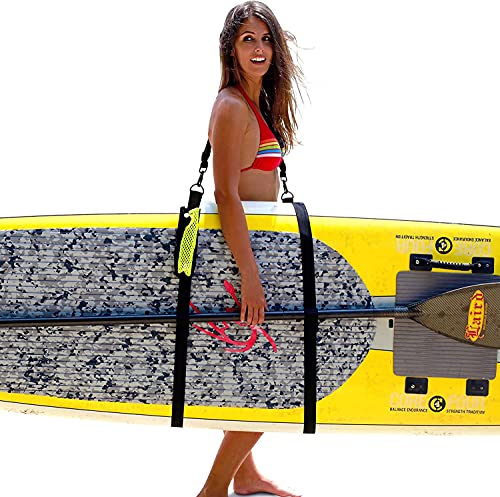
shoulder sling for carrying an inflated board down to the water
A carry sling is an adjustable webbing strap that loops under the board and over one shoulder, leaving a hand free for the paddle. Most of them double as a roof tie-down. It only earns its place once the board is inflated, because a rolled board already travels in its own backpack.
Why we picked this exact one: The SUP-NOW carry sling is the one that turns up in paddlers' car boots, with more than 1,500 ratings behind it. It takes the paddle under the same strap, which is really the point of it. Its 4.3-star average is the lowest here, and the recurring complaint is consistent: on very thick boards the strap slips unless you cinch it hard.
None of this makes you better at paddling. It shortens the forty minutes either side of the paddle, and in practice that's what decides whether the board comes out again next weekend. One to keep in the back of your mind: a fair number of people end up sitting still on the board with a pencil rather than paddling it anywhere, and beginner nature journaling travels perfectly well in the same dry bag.
The Wind Is the Thing That Catches People Out
Flat water doesn't look dangerous, and that's precisely the problem. An offshore wind, one blowing from the land outwards, smooths the surface in front of you and makes the conditions look ideal while it quietly does the work of pushing you away from shore. The RNLI launched lifeboats to paddleboarders 155 times in 2023, and nearly half of those launches went to people blown or swept out by offshore winds and tides. Paddling out into it feels effortless. Paddling back does not.
Cold water is the other one, and it doesn't wait for winter. Instructors use a rough check called the 120 rule: add the air temperature to the water temperature in Fahrenheit, and if the total comes under 120 you want a wetsuit, because the gasp reflex from cold-water shock arrives long before your swimming does. Match the leash to the water as well. Lakes, canals and sheltered bays take a coiled ankle or calf leash; rivers, tidal estuaries and anything with a current need a quick-release waist belt instead, because a cuff fixed to your leg is the wrong thing to be wearing if the cord snags on something in moving water. If you're weighing this against other ways to spend a Saturday, our list of starter hobbies for adults has gentler options.
None of that should keep you off a lake on a still morning. Tell someone where you're going, keep the phone on you rather than in the car, and stay close enough to shore that you could swim it while towing the board. That last one is the entire safety plan for a first season.
Things Nobody Tells You Until Your Board Is Already Wet
Why does the board feel squishy underfoot when I thought it was full?
Because a hand pump turns genuinely unpleasant in the last few PSI, which is exactly where the pressure you need lives, and most people stop early without realising it. Under about 12 PSI a drop-stitch board flexes in the middle and your feet settle into a shallow dip, which feels like a balance problem when it is an air problem. Pump to the figure printed next to the valve, usually somewhere between 12 and 20, and push through the part where your arms start complaining. The difference under your feet is immediate.
Can I just leave it pumped up all summer?
Not in the sun. Heat raises the pressure inside an already-tight board and works on the seams at the same time, and owners regularly post photographs of three-year-old boards that have split along a seam after an hour face-up on a hot beach. Experienced owners drop the pressure right down between sessions and top it back up before they paddle, which costs a couple of minutes. If it has to stay inflated at a campsite, keep it shaded or keep it wet.
Everyone says to fall off on purpose. Why?
Because your first unplanned fall is also the first time you find out whether you can climb back on, and finding that out two hundred metres from shore is a bad plan. Instructors teach it deliberately: fall to the side rather than diving, don't stick a hand out to break it or you'll sprain a thumb against the rail, and keep hold of the paddle. Getting back on is a kick rather than a pull. Grab the carry handle, kick hard enough to splash, let your body come to the surface, then slide on. In any wind, climb on facing downwind, or the board flips straight back at you.
Do I really need a leash on a lake I can see across?
Yes, and not for the reason most people assume. It isn't about your swimming. An empty board has an enormous surface and almost no weight, so a light breeze carries it away faster than anyone can swim in clothes, and the board is the thing keeping you afloat. Wear a coiled ankle or calf leash on still water. Save the quick-release waist belt for rivers and estuaries, where anything fixed to your leg is the wrong choice.
People Worth Following Into This Hobby
Real practitioners we found while researching this setup — people who do the work, show their process, and publish on sites they run themselves. No sponsorships, no affiliations; we just think they're worth your time.
Publishes the UK's paddlesport safety guidance and runs the coaching awards that paddleboard instructors are certified under.
Their leash information sheet is the source of the rule this setup repeats: coiled ankle or calf on lakes and bays, quick-release waist belt on rivers and estuaries.
Runs surf and paddleboard lessons on the north Cornwall coast and publishes the falling and recovery drills they teach beginners in person.
The FAQ here tells readers to practise falling off; this is the instructor breakdown of how to do it and how to climb back on without wearing yourself out.
A Southern California SUP instructor who has written a wiki-style library covering board sizing by weight, PSI, fin boxes and paddle length, with no products attached.
This setup tells beginners to want 32 inches of width and a US standard fin box; his inflatable guide is where both rules are worked through with charts.
An independent SUP magazine run since 2012 by two paddlers, with hundreds of technique videos arranged into beginner progression pathways.
Once a beginner is standing comfortably, foot position is the next thing that confuses them, and this piece answers it without assuming any surfing background.
Love what you see here? Save individual picks with on any item, or copy everything to a list of your own in one click — great for coming back to later, or dropping as a not-so-subtle hint.