A Boat That Fits in Your Boot, a Lake That Doesn't
The word kayak comes from the Inuktitut qajaq, which means something close to “hunter's boat”. These are at least 4,000 years old, stitched from sealskin stretched over frames of driftwood or whalebone. Here's the part that gets me: each one was built by the man who would paddle it and measured off his own body, so a cockpit came out as wide as the builder's hips plus two fists. Almost nobody could swim in water that cold. Rolling the boat back upright wasn't a stunt, it was the entire recovery plan.
Modern recreational kayaking asks very little of you. You sit down, push off, and within a few minutes you're moving at about walking pace. There's no balance skill to learn the way there is with standing up on an inflatable paddle board — you're already sitting in the most stable position the boat has. What catches beginners out is their shoulders, not their balance: paddle an afternoon with your arms instead of your torso and you'll know about it the next morning.
Our take: buy four things and stop. A boat, a paddle that fits that boat, a life jacket you'll actually keep on, and a dry bag for your phone. Everything further down this page can wait until you've been out three or four times and know what annoys you.
Nothing below is the fancy version. We went looking for the cheapest gear that people who paddle every weekend wouldn't roll their eyes at.
Where This Little Kit Can Take You
A few real moments and results from this hobby — made with tools no fancier than the ones below.
Mirror water from the cockpitThe bow sits still enough that the pines reflect unbroken either side of it.
Following the others outBare feet on a warm deck, two boats ahead, nobody in a hurry.
If you've never paddled anything, rent before you buy. An hour in a rental boat tells you more than any spec sheet, and the staff at the dock will usually let you try two or three paddle lengths while you're there. It's also the cheapest way to find out whether this is your thing, or whether you'd rather be working through a shortlist of other hobbies first.
Four Things, and You're Floating
This is the whole list. A boat, something to push water with, something that floats you, and something that keeps your phone dry. Beginners routinely spend more than this, and routinely regret the order they bought in — the classic version is a cheap boat paired with an even cheaper paddle, when the paddle is the thing your hands are on for every single stroke. As a first grown-up hobby it lands in the same bracket as most starter hobbies worth taking up as an adult, just with more of the money sitting in one object.
Disclosure: This section may contain affiliate links to Amazon. We may earn a small commission from qualifying purchases at no extra cost to you.
01Pick 01 of 12
one-person inflatable kayak for calm lakes and slow rivers
An inflatable kayak packs into a bag you can carry one-handed and pumps up at the launch, which is the whole reason people buy them: no roof rack, no garage wall. Look for three-ply laminated PVC rather than thin single-layer vinyl, a floor that takes enough pressure that the hull doesn't sag under your weight, and removable skegs, the small fins underneath that stop the boat wandering off line. Most sets arrive with a paddle, a hand pump and a patch.
Why we picked this exact one: The Intex Excursion Pro K1 is the step up from the cheap vinyl duckies, built from three-ply laminated PVC instead of single-layer sheet, and it averages 4.2 stars across more than 1,200 ratings. Two removable skegs help it hold a line, which thin inflatables are poor at. The paddle in the box is aluminium with thin blades, and paddlers rate bundled kit paddles poorly across the board, so treat it as the spare rather than the one you use.
two-piece kayak paddle sized to the width of your boat
Paddle length is set by how wide your boat is first and how tall you are second. Roughly: 220 cm for boats 23 to 28 inches across, 230 cm for 28 to 32 inches, and 240 cm for anything wider. Blades with a ridge down the centre, called a dihedral, let water split evenly off both halves so the blade doesn't flutter mid-pull. A two-piece shaft comes apart for the car and can usually be set flat or feathered.
Why we picked this exact one: The Bending Branches Whisper is a real paddle company's entry model rather than an anonymous shaft, made in the USA, and it holds 4.7 stars over 668 ratings. The 230 cm length covers most recreational boats in the 28 to 32 inch range. The shaft is aluminium, so it runs cold in your hands in spring and hot in full sun, and the 240 cm size drifts in and out of stock.
paddling-cut life jacket with high armholes and a ventilated back
A paddling vest differs from a general boating life jacket in two ways that matter in a kayak: the armholes are cut high and wide so foam never jams your shoulders mid-stroke, and the lower back is thinned or meshed so it doesn't ride up against a seat. US federal rules require one wearable Coast Guard approved device on board for every person, and children under 13 must wear theirs whenever the boat is underway. Buy by the weight and chest range on the label rather than by S, M or L alone.
Why we picked this exact one: The Onyx MoveVent Dynamic is the paddling cut rather than the generic orange boating vest, with mesh ventilation and a high back that clears a kayak seat, and it carries 4.8 stars across more than 3,800 ratings. It is approved by both the US Coast Guard and Transport Canada. Its pockets are not waterproof, whatever the product photos imply, so your phone still needs a bag.
roll-top dry bag for the phone, keys and wallet you take on the water
A roll-top dry bag closes by folding the open end over itself several times and clipping it, which traps air inside and makes the bag float if it goes over the side. Ten litres is the usual size for a phone, keys, wallet and a thin jacket. Heavier PVC shrugs off scuffing against a hull better than thin nylon, and a clip-in loop matters more than you would expect, because anything loose in a kayak slides somewhere you can't reach.
Why we picked this exact one: The Earth Pak 10L is the dry bag most paddlers end up owning, at 4.7 stars across more than 33,000 ratings, and it ships with a separate clear phone sleeve you can still tap through. The 500D PVC handles the rubbing that thin nylon sacks pick up against a hull. It is a sack rather than a backpack, so packing it tidily takes a minute you won't always want to spend.
With these four you can launch, paddle for a couple of hours and get home again. Give yourself a flat, boring first outing on a small lake with no wind; the gap between “calm” and “a breeze that pushes you sideways the whole way back” is wider than it looks from shore. Take binoculars on the second trip, though. Sitting low and silent is the best thing that has ever happened to my casual birdwatching.
The Water Is Colder Than the Day Is
This is the part of kayaking that genuinely deserves your attention, and none of it is about skill. Water pulls heat out of a body roughly 25 times faster than air at the same temperature, so a warm afternoon over a cold lake is the classic trap. The rule paddlers repeat to each other is blunt: dress for the water, not for the weather.
Below about 70°F it's worth wearing thermal protection, and the 50 to 60°F band is the genuinely dangerous one, because that's where cold shock peaks and breathing control goes completely. The American Canoe Association's commonly quoted line for calling the season over is 60°F water. Wear the life jacket rather than stowing it. Tell someone your route and when you'll be back, and take a friend for the first few trips, because a capsize is a far less interesting event when there's a second boat an arm's length away.
Check the forecast for wind rather than rain, and read it for the hour you plan to come back, not the hour you leave. Offshore wind is the one to respect: easy to paddle out on, hard to paddle home against. If open water appeals to you generally, the same habit of reading conditions first carries straight over to getting started with snorkelling gear.
None of this is a reason to be nervous on a calm lake in July. It's a reason to choose your first few days carefully, stay inside a distance you could swim if you had to, and treat the forecast as part of the kit list.
What You'll Want by the Fourth Trip
None of this is needed to go paddling. All of it exists because of something small and annoying that happens once and then keeps happening. Water pools round your heels and never quite goes away. You set the paddle down to take a photo and watch it slide off the deck. The hand pump is fine on trip one and tedious by trip ten. Buy these when the annoyance is real, not in advance.
05Pick 05 of 12
hand bilge pump for clearing water out of the footwell
A bilge pump is a hand-worked syringe that lifts water out of a boat far faster than a sponge or a cup. In a recreational kayak you use it for the slop that gathers around your heels from paddle drips and wet feet, and after a capsize to empty the boat before climbing back in. A hose long enough to clear the side stops you pouring the water straight back where it came from.
Why we picked this exact one: The Better Boat manual bilge pump pairs the pump body with a 39-inch hose, which is what you want on a sit-on-top where you're emptying across a wide deck, and it holds 4.3 stars over roughly 1,900 ratings. The marine-grade build feels sturdier than the plastic kayak pumps. That long hose also makes it bulkier to stow than the stubby floating ones.
coiled paddle leash that tethers the paddle to the boat
A paddle leash is a coiled cord with a clip at each end: one goes round the paddle shaft, the other onto a deck fitting. It stretches out of the way while you paddle and pulls the paddle back towards the boat the moment you let go. They're usually sold in pairs, so the second one can hold a water bottle or a rod.
Why we picked this exact one: The MOPHOEXII coiled paddle leash comes as a two-pack and averages 4.7 stars across about 1,065 ratings. The coil reaches a deck fitting behind the seat without trailing in the water. Cheap leashes lose their spring over a season, so give the clips a look each spring.
rechargeable electric pump that inflates and deflates the boat
A cordless electric pump inflates to a set pressure, shuts itself off, then reverses to suck the air back out for packing. Twenty psi is far more than an inflatable kayak needs, since standard ones run under three psi and stiffer drop-stitch floors go to eight or ten, so the useful parts are the speed and the automatic cut-off rather than the headline number. Check the nozzle set covers your boat's valve type before you buy.
Why we picked this exact one: The anoutway 20 PSI pump runs off its own battery rather than a car socket, so it works at a launch with nowhere to park beside the water, and it carries 4.3 stars over just under 700 ratings. The deflate mode is the half people underrate. It's a no-name brand, and on this kind of pump the battery is usually the first thing to go.
PVC patch kit for sealing a puncture in an inflatable hull
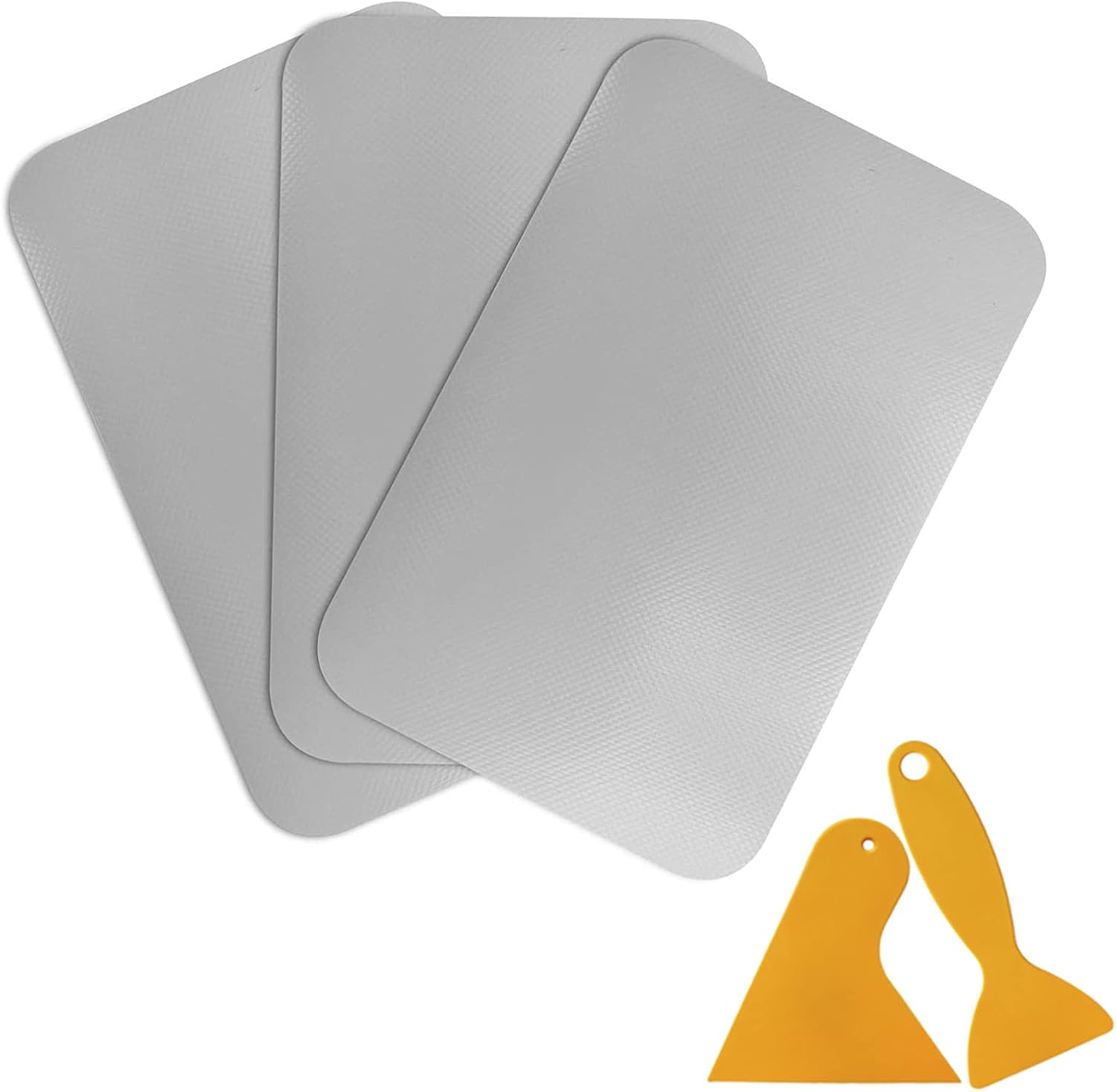
A repair kit for an inflatable is a set of PVC patches plus adhesive that bonds to the hull fabric. Most leaks aren't dramatic punctures; they're slow seepage round a seam or a valve that shows up as one soft tube after an hour on the water. Clean and dry the area, patch it at home rather than at the launch, and give the adhesive the full cure time printed on the instructions.
Why we picked this exact one: The CLIO three-piece set is specified for rafts and kayaks rather than pool inflatables, and it averages 4.2 stars over 189 ratings. Three patches comfortably cover the scrapes a first season produces. Check it matches your hull, since inflatables are built from several different fabrics and the glue is matched to the material.
Add them one at a time, as the irritation actually shows up. There's a version of this hobby where you keep buying until the boat takes longer to prepare than to paddle, and that's the version people quietly abandon — the same drift that turns any simple beginner routine into a chore.
Getting the Boat to the Water Is the Real Hobby
Here's what nobody mentions before you buy: the paddling is easy and the logistics are what you'll be solving for years. An inflatable mostly sidesteps this, since it rides in the boot and you carry it to the shore in a bag. A hard-shell doesn't, and if you want one, the advice from people who paddle every weekend is to buy used and local after a demo paddle, rather than having a boat you can't lift alone delivered to your door. Either way, what you're really planning around is a car and a short walk, in much the same way that nature journaling is mostly a question of where you can comfortably sit for an hour.
09Pick 09 of 12
foam block roof carrier kit for a car with no crossbars
A rack-free carrier is a pair of V-notched foam blocks that sit between the hull and the car roof, plus straps that run through the open doors and cinch the boat down. It works on a bare roof with no crossbars, which is where most first-time owners are. Treat it as a short-trip solution: over distance the boat shifts a little, and grit caught between the foam and the paint will scour it.
Why we picked this exact one: The Attwood Universal Rack-Free kit is the long-running cheap answer, bundling the blocks, the cinch straps and bow and stern tie-downs in one box, and it holds 4.2 stars over roughly 1,460 ratings. Attwood is a marine-hardware brand rather than an anonymous seller. Its included straps are the weakest part of the kit, which is exactly why the next item is on this list.
cam-buckle tie-down straps for strapping a boat to a roof
Cam-buckle straps tighten by hand and hold with a spring-loaded cam, and that's the difference that matters here. A ratchet multiplies your pull several times over and can press a dent into a plastic hull or squash an inflatable's tubes, while a cam buckle stops when your arms stop. Twelve feet goes over a boat and back under a bar with slack left to tie off.
Why we picked this exact one: The Ayaport 1-inch cam-buckle straps come four to a pack at 4.7 stars over more than 3,300 ratings, enough for two boats or one very well-secured single. Twelve feet suits a roof carry with room spare. They are general cargo straps rather than paddlesport-branded ones, so the webbing starts stiff and takes a season to soften up.
bonnet and boot anchor loops for bow and stern lines
Hood loops are short webbing tabs that bolt under the bonnet or boot lid and hang out when it's shut, giving you somewhere to tie bow and stern lines. Modern cars mostly have no exposed tow hooks, which is the real reason the bow line is the step people skip. They stay on the car permanently and cost nothing in fuel or noise.
Why we picked this exact one: The LE KAPMOZ Quick Hood Loops hold 4.8 stars across about 1,570 ratings, the best-rated thing in this section, and they answer the specific problem of a car with nothing to tie to. Fitting is two bolts under the bonnet catch. The tabs stay visible when the bonnet is closed, which some people don't want on a newer car.
wheeled trolley for rolling a loaded kayak to the launch
A kayak cart is a short axle with two wheels and a padded cradle that straps under the hull, so you tow the boat behind you instead of carrying it. The wheels are the thing to compare: airless solid tyres never go flat in storage, while pneumatic ones roll better across soft sand. Most carts fold down small enough to ride in the boat once you're afloat.
Why we picked this exact one: The Bonnlo Universal Kayak Carrier rolls on no-flat airless tyres, which matters on a cart that spends ten months a year in a shed, and it holds 4.4 stars across nearly 2,900 ratings. It folds flat and comes with two straps. Solid tyres dig into dry sand, so a beach launch is noticeably more work than a boat ramp.
Work out the transport before you choose the boat, not afterwards. Plenty of hard-shells get sold on a year old with barely a scratch, and the reason is almost never the paddling.
What Nobody Mentions Until You've Already Bought the Boat
Everyone calls sit-on-tops self-bailing. Does that mean the boat can't fill with water?
It means less than it sounds like, and the wording trips up nearly every first-time buyer. The scupper holes drain the deck you sit on; the sealed hull underneath you is a separate space and does not drain at all. Water works its way in there around hatches and deck fittings, and because you can't see it, a boat can gradually get heavy and sluggish without any obvious cause, and a hull with a real split in it will fill and sink. Open the hatches after every trip and let the inside dry out, and press round the deck fittings now and then to see if anything weeps.
I'm short. Doesn't that mean I want a short paddle?
Height is the second input, not the first. Paddle length is driven by how wide your boat is, because a wide hull puts the water further away from your hands, and recreational kayaks are wide. Get it too short and you'll crack your knuckles on the side of the boat on a relaxed low-angle stroke, then unconsciously paddle with the shaft too steep to avoid it, which is tiring and sloppy. Measure the boat's beam and use that: around 220 cm for 23 to 28 inches, 230 cm for 28 to 32 inches, 240 cm beyond that. Between two sizes, go shorter unless you have a short torso.
Is the cheapest inflatable actually a kayak, or a pool toy?
The price gap between the bottom-end vinyl boats and the laminated ones looks like branding, and it isn't. Thin single-layer boats flex under load, and a hull that bends in the middle ploughs water instead of gliding over it, so on any day with a bit of wind you work much harder to get nowhere. The floor is the tell. Standard inflatables sit under three psi, stiffer drop-stitch floors take eight to ten and stay genuinely rigid, and three-ply laminated PVC is the sensible middle ground for a first boat.
Should I buy a spray skirt?
Probably not, and it's on almost every kayak accessory list, which is why people buy one anyway. A spray skirt seals the cockpit rim of a sit-in boat. It does nothing at all on a sit-on-top and nothing on most inflatables, so for either of the boats on this page it's money parked in a drawer. If you do move to a sit-in hull with a proper coaming later, buy the skirt then, and practise releasing it and swimming out in water you can stand up in before you ever need to do it for real.
People Worth Following Into This Hobby
Real practitioners we found while researching this setup — people who do the work, show their process, and publish on sites they run themselves. No sponsorships, no affiliations; we just think they're worth your time.
Films sea kayaking lessons in 4K with drones and underwater cameras, and gives subscribers written feedback on videos of their own paddling.
This setup tells beginners the forward stroke comes from the torso rather than the arms but cannot show it; their lesson library does, in the conditions where the difference is visible.
Bryan Hansel publishes free canoe and kayak building plans, lightweight-travel how-tos and trip reports, and readers send back photos of the boats they built.
The transport section here ends with the advice to buy a hard-shell used and local; this is where a reader who gets hooked goes next, right up to building their own.
A volunteer paddling club that publishes free basic-skills pages with video, covering posture, the four phases of the forward stroke and the mistakes instructors keep correcting.
Their forward stroke page is the fix for the sore shoulders this setup warns about in its opening section, written by the instructors who teach it.
Love what you see here? Save individual picks with on any item, or copy everything to a list of your own in one click — great for coming back to later, or dropping as a not-so-subtle hint.