Everything a First-Time Knitter Needs to Get Started

Everything a First-Time Knitter Needs to Get Started

DariaCurated by Daria

What You Actually Need to Cast On

The thing that surprises most people about knitting is how little it takes to make real fabric: two needles and a ball of yarn, and within an evening you have rows you can hold up to the light. What decides whether those first stitches cooperate or fight you is a handful of small choices in this opening list. Smooth, light-colored yarn, needles with enough surface grip to keep loops from sliding off, and a blunt needle for tidying ends will let the craft teach itself. If you are still weighing the two big yarn crafts against each other, it pays to glance at a beginner crochet kit first, because the starting tools differ more than newcomers expect.

Pick 01 of 12

Complete Bamboo Knitting Needle Set

Single-point bamboo knitting needles in a full range of beginner sizes

Single-point bamboo knitting needles in a full range of beginner sizesSingle-point bamboo knitting needles in a full range of beginner sizes

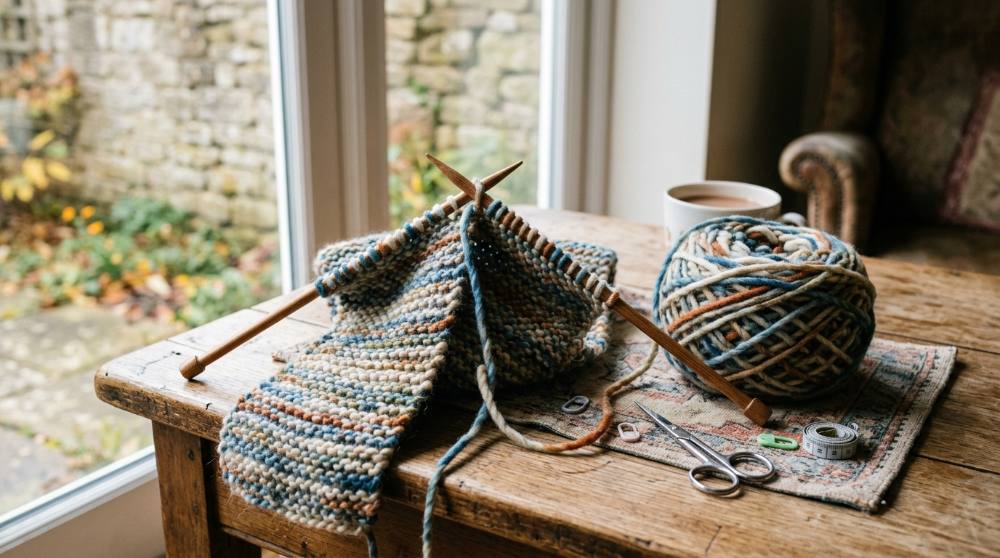
A set of straight, single-pointed bamboo needles spanning many diameters, from fine to chunky. The light wood has a slight surface grip that keeps loops from sliding off while you find your rhythm. A beginner should look for a smooth, splinter-free finish and sizes in the US 7 to 9 range to pair with medium-weight yarn.

Needles are the one tool you cannot improvise; without a pair sized to your yarn you cannot form an even stitch at all, and the wood's grip is what stops new knitters' loops from escaping the tip.

Why we picked this exact one

At 4.5 stars across more than 4,000 ratings, it covers nearly every size a beginner will reach for at a price lower than a single premium pair, with a smooth bamboo finish that resists snagging.

Pick 02 of 12

Soft Premium Acrylic Yarn Bundle

Smooth worsted-weight yarn for learning your first stitches

Smooth worsted-weight yarn for learning your first stitchesSmooth worsted-weight yarn for learning your first stitches

A large skein of medium, worsted-weight yarn that sits in the easiest gauge band for new knitters. It is smooth and machine washable, so practice pieces survive everyday handling. Choose a light, solid shade rather than a dark or variegated one, because you need to see each individual stitch while you learn.

Worsted weight on mid-sized needles produces stitches big enough to read at a glance, which is how a beginner spots and fixes a mistake before it travels down the fabric.

Why we picked this exact one

It carries 4.6 stars over 1,400-plus ratings, offers generous yardage for the price, comes in a wide run of solid colors, and washes without special care.

Pick 03 of 12

Compact Bent-Tip Needle Set

Bent-tip tapestry needles for weaving in yarn ends

Bent-tip tapestry needles for weaving in yarn endsBent-tip tapestry needles for weaving in yarn ends

A set of blunt, large-eyed needles with a slightly bent tip that scoops cleanly under stitches. They handle the final job of every project: threading loose tails back into the fabric and seaming pieces together. Look for a genuinely blunt point so it slides between strands instead of splitting them, and an eye wide enough to take worsted yarn.

Every finished piece leaves loose tails, and without a blunt large-eyed needle there is no way to secure them invisibly; knotted ends show on the front and work loose in the wash.

Why we picked this exact one

It holds 4.8 stars from a long-trusted needlework brand, the bent tips make weaving noticeably easier, and the included case keeps such small tools from disappearing.

Pick 04 of 12

Precision Embroidery Scissors Set

Small sharp scissors for clean yarn cuts

Small sharp scissors for clean yarn cutsSmall sharp scissors for clean yarn cuts

Compact stainless-steel scissors with short, finely pointed blades. The sharp tips cut yarn cleanly at the exact spot you want, which matters when you are leaving a tail to weave in. Look for forged blades that stay sharp and a tip cover so they travel safely in a project bag.

Dull household scissors crush and fray the yarn end, which then frays further and resists threading through a tapestry needle; a clean cut keeps the tail tidy enough to finish neatly.

Why we picked this exact one

With 4.7 stars across more than 2,400 ratings, the forged tips are sharp out of the package, two come in the pack, and the small size suits cutting yarn rather than fabric.

Pick 05 of 12

Complete Beginner Knitting Guidebook

Step-by-step beginner knitting instruction book

Step-by-step beginner knitting instruction bookStep-by-step beginner knitting instruction book

A beginner-focused printed guide that walks through casting on, the core stitches, and binding off, then offers simple starter patterns to practice on. A book you can prop open and follow at your own pace fills the gaps that scattered videos leave. Look for one with clear photos or diagrams of hand and needle positions, which moving footage often blurs past.

A structured reference lets a beginner work in order and, crucially, look up how to fix a specific mistake, something a linear video tutorial makes frustratingly hard.

Why we picked this exact one

It earns 4.3 stars over 700-plus ratings, lays the craft out in a logical A-to-Z progression, and bundles fifteen practice patterns at a modest price.

With these five items you can cast on, work garter and stockinette, and bind off a finished scarf without buying anything else. One honest caution: skip dark or fuzzy novelty yarn at the start, since you cannot see individual stitches in it and nearly every beginner who tries ends up unpicking in frustration. If you are genuinely torn about which needlecraft suits you, reading how knitting compares with crochet for newcomers can save you a wasted first purchase. Once the basics feel steady, a few small tools make the work far less fiddly.

The Small Tools That Quietly Save Your Project

None of these are required to knit a stitch, yet each one answers a specific moment of confusion that ambushes beginners. The classic case is losing your place: you set a project down, pick it up two days later, and have no idea which row you stopped on or where the pattern repeat begins. Markers and a counter exist for exactly that gap between sessions, which stretches longer and happens more often than anyone admits when they start. If you are still feeling out whether this is your craft at all, thinking through how to settle on a first hobby is worth doing before you spend on extras.

Pick 06 of 12

Locking Ring Stitch Markers Set

Locking stitch markers for tracking pattern points

Locking stitch markers for tracking pattern pointsLocking stitch markers for tracking pattern points

Small rings that clip onto a stitch to flag a repeat, an increase, or the start of a round. The locking style opens and closes, so you can clip one onto the fabric mid-row, unlike a solid ring that only slides on the needle. A useful marker is easy to open one-handed and small enough not to stretch the stitch it sits on.

Marking key points in a pattern is how you keep from miscounting a repeat; without markers, beginners typically discover an error several rows after it happened, when it is harder to undo.

Why we picked this exact one

At 4.8 stars across 1,100-plus ratings, the locking design works on both knitting and crochet, and the count is generous enough to mark a whole project.

Pick 07 of 12

Compact Row Counter for Knitters

Mechanical row counter for keeping your place

Mechanical row counter for keeping your placeMechanical row counter for keeping your place

A small click-style counter you advance by one after finishing each row. The large dial and firm click make it easier to trust than a tally scratched on paper. Look for a clear, readable display and a positive click so you can feel that the number moved.

Patterns are measured in rows, and across a project that spans several evenings your memory will not reliably hold the count; a counter removes that guesswork entirely.

Why we picked this exact one

It holds 4.8 stars over more than 4,000 ratings, runs on a single press with no setup, and the mechanism is durable enough to outlast many projects.

Pick 08 of 12

Dual-Sided Retractable Tape Measure

Retractable soft tape measure for sizing your projects

Retractable soft tape measure for sizing your projectsRetractable soft tape measure for sizing your projects

A flexible push-button tape marked in both inches and centimeters that retracts into a small case. Because it bends, it follows the curve of a knitted piece in a way a rigid ruler cannot. A retractable housing is worth having so the tape does not tangle loose in your bag.

Knitted fabric stretches and curves, so a soft tape that wraps around the work gives a truer length and width reading than any straight ruler, which matters the moment you knit to a target size.

Why we picked this exact one

It earns 4.7 stars, retracts cleanly into its case, shows both units, and costs very little for a tool you will reach for constantly.

Pick 09 of 12

Organized Yarn Storage Tote

Project bag for organizing yarn and tools

Project bag for organizing yarn and toolsProject bag for organizing yarn and tools

A structured tote with grommets that feed working yarn from inside and pockets that hold needles and small tools. It keeps one active project contained and ready to pick up. Look for yarn-feed holes and a closure that keeps dust out, which is the practical point of a dedicated bag.

A contained project stays clean and portable, while loose balls of yarn pick up pet hair and tangle around themselves, a small chaos that interrupts beginners more than they expect.

Why we picked this exact one

With 4.9 stars across 1,000-plus ratings, it offers several compartments and yarn-feed holes in a sturdy build that stands up on its own.

Add these gradually rather than in one haul, because the most common money mistake here is buying gadgets whose purpose you will not understand for months. A counter and a few markers earn their place by your second project, while a dedicated bag is less about technique and more about keeping crumbs and pet hair out of your yarn. Knitting also sits comfortably beside other approachable hobbies adults tend to take up, so nothing you learn to organize here goes to waste if you branch out later.

Going Past the Flat Scarf

At some point a straight scarf stops being enough and you want a hat, a cowl, or a pair of socks, things worked in a continuous round instead of back and forth. That single change, from two straight needles to a circular needle joined in a loop, unlocks most of what people picture when they imagine knitting. The other two items here are about rescue and finishing: a hook is the fastest way to catch a stitch that has dropped and begun to run, and blocking is the step that turns a slightly lumpy hand-knit into something that looks shop-bought. If you enjoy that final polishing stage, a beginner embroidery setup scratches a very similar itch.

Pick 10 of 12

Complete Bamboo Knitting Needle Set

Bamboo circular knitting needles for working in the round

Bamboo circular knitting needles for working in the roundBamboo circular knitting needles for working in the round

Pairs of bamboo tips joined by a flexible cable, sold across a range of sizes with a storage case. The cable lets you knit a continuous tube for hats and cowls, and it also holds the wide stitch counts that a blanket demands. The detail that matters most is a smooth join between tip and cable, so stitches glide across without catching.

Circular needles are the only comfortable way to knit seamless rounds or to hold the hundreds of stitches a wide piece needs; straight needles simply cannot do either job well.

Why we picked this exact one

It carries 4.5 stars over 1,400-plus ratings, supplies the full size range in one case, and uses light bamboo at a fraction of the cost of an interchangeable metal set.

Pick 11 of 12

Ergonomic Crochet Hook Set

Crochet hooks for catching and fixing dropped stitches

Crochet hooks for catching and fixing dropped stitchesCrochet hooks for catching and fixing dropped stitches

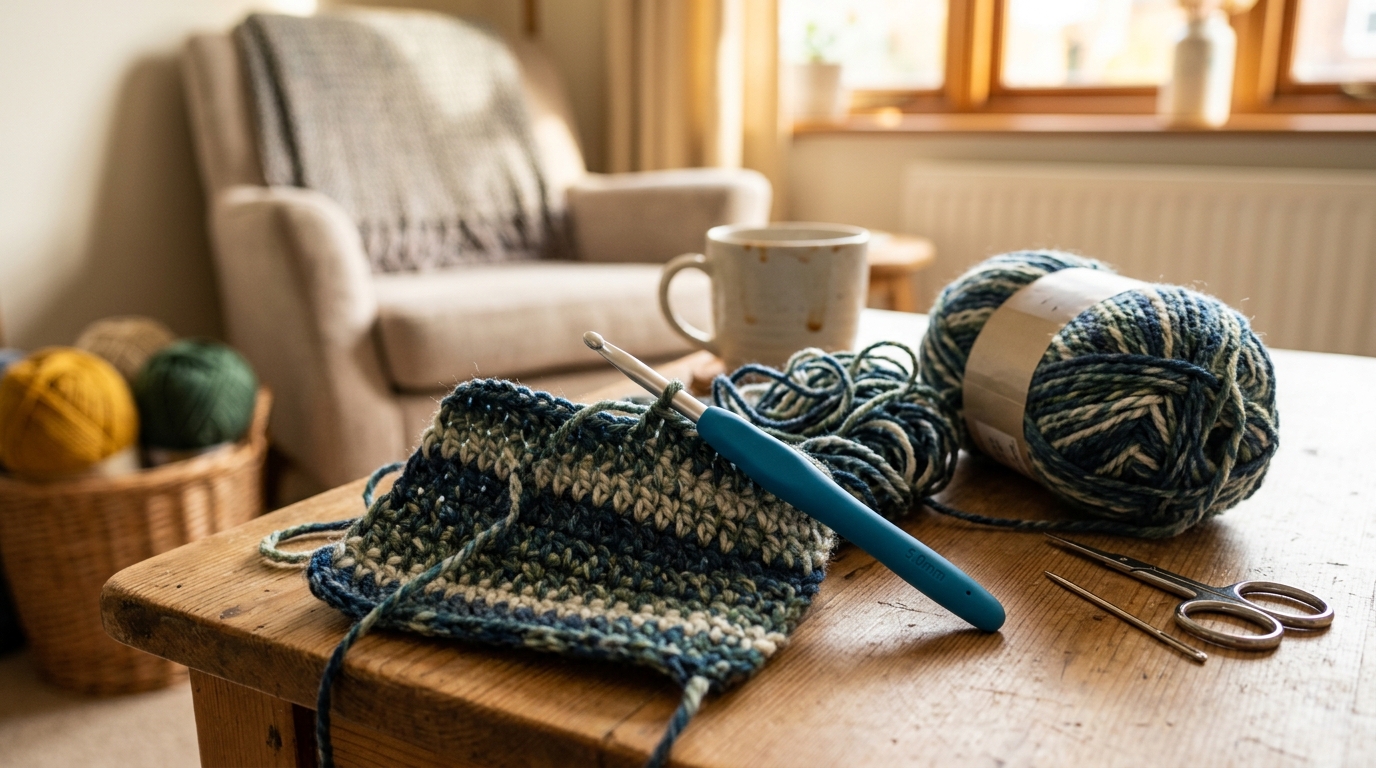
A graded set of crochet hooks with cushioned handles. In knitting their main use is rescue: the hook catches a stitch that has slipped off and ladders it back up the fabric. Pick a hook close to your needle size so the recovered stitch matches the tension of its neighbors.

A dropped stitch runs straight down the fabric and unravels rows; a crochet hook is the fastest way to ladder it back up without ripping out everything above it.

Why we picked this exact one

It holds 4.7 stars across more than 27,000 ratings, the cushioned handles ease hand fatigue, the size range is wide, and it costs little for how often a knitter reaches for it.

Pick 12 of 12

Heavy-Duty Craft Cutting Mats

Foam blocking mats with pins for finishing knits

Foam blocking mats with pins for finishing knitsFoam blocking mats with pins for finishing knits

Interlocking foam squares printed with a measuring grid, supplied with T-pins. You pin a damp finished piece into shape and let it dry flat so the stitches settle. The grid lines are the useful part, letting you keep edges straight and matching pieces the same size.

Blocking relaxes uneven tension and sets a piece's final shape; an unblocked hand-knit tends to curl at the edges and looks rougher than the actual knitting deserves.

Why we picked this exact one

It earns 4.6 stars, includes the T-pins and gridded mats you need in one box, and the foam is thicker than many competing sets at a moderate price.

You will not need any of this in your first month, and buying it early tends to leave it gathering dust. Add a circular needle when you have a specific round project in mind, keep a hook within reach the moment you try anything past a scarf, and treat blocking as the reward at the end rather than a chore.

Why Does My Knitting Keep Getting Wider, and Other Things Nobody Warns You About

Why does my scarf keep getting wider when I never added a stitch on purpose?

Beginners almost always create accidental stitches by carrying the yarn over the needle between stitches or knitting into the gap before one, usually without noticing. Each stray loop reads as a new stitch on the next row, so a rectangle slowly spreads into a triangle. The fix is to count your stitches every few rows and learn to recognize the little bar a yarn-over leaves, so you can drop it on purpose before it multiplies.

Why do my stitches feel almost impossible to slide along the needle?

This is knitting too tightly, and it comes from gripping out of nervousness and giving the yarn an extra tug after every stitch. The result is stiff fabric, sore hands, and needles that suddenly feel a size too small. Stop pulling each stitch snug, let it rest at the widest part of the needle, and if the habit sticks, move up one needle size rather than blaming your hands.

Everyone says to knit a gauge swatch first, but can I just skip it?

For a scarf you can; for anything that has to fit, skipping it is how you end up with a hat sized for a melon. Beginners skip swatches because they feel like homework standing between you and the fun part. When size matters, knit the swatch, then wash and measure it the way you will treat the finished piece, since many yarns relax or shrink after their first wash.

Why does the yarn keep splitting every time I push the needle in?

Splitting happens when the tip slides through the middle of the plies instead of under the whole stitch, and sharp metal points on softly spun yarn make it worse. The stitches come out fuzzy and weak, and the work feels like a fight. Use blunter wood or bamboo tips while you learn, aim to scoop the entire loop, and favor a smooth plied yarn over a loosely spun single.

Do I actually need to weave in the loose ends, or can I just tie a knot?

Knots feel secure, so beginners tie off their tails and move on, but knots in knitting work loose over time, poke through to the front, and leave a visible lump. In anything you wear or wash, they can come undone entirely. Thread each tail onto a blunt needle and run it through several stitches on the back, reversing direction once so it locks; it holds far better than a knot and disappears into the fabric.

Love what you see here? Save individual picks with on any item, or copy the whole list to your own wishlist in one click — great for coming back to later, or dropping as a not-so-subtle hint.

Disclosure: Some product links may be affiliate links. If you make a purchase through one of these links, we may earn a small commission at no extra cost to you.