Develop Your Own Film at Home in a Changing Bag

Develop Your Own Film at Home in a Changing Bag

DariaCurated by Daria
Jump to the 10 picks

Your Whole Darkroom Fits in a Zipped Bag

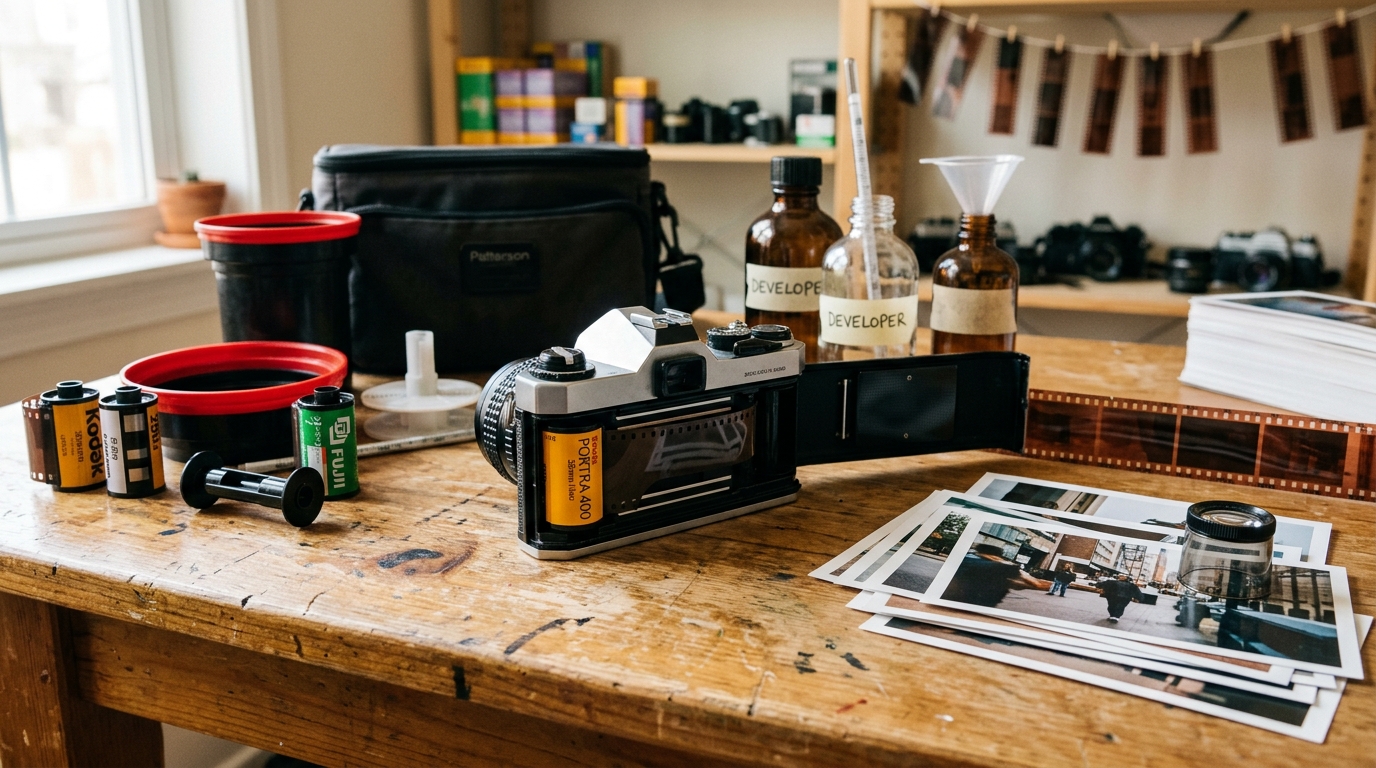
Here's the bit nobody believes at first: you don't need a darkroom to develop film. The one step that needs true darkness happens inside a zipped fabric bag, your hands working by feel through two snug sleeves. Everything else — pouring, timing, rinsing — plays out at the kitchen sink in ordinary light, in about twenty minutes. The chemistry is forgiving enough that people famously develop black-and-white film in instant coffee and vitamin C, a home-brew recipe called caffenol. And at the end you crack open the tank and there they are: your pictures, tiny and gleaming, on a wet strip.

The full shopping list here is shorter than most hobbies manage: five pieces, and two of them are chemicals. Black-and-white runs at 68°F, close enough to room temperature that a jug of tap water and some patience get you there. No heater, no plumbing, no spare room. If you're still building the shooting side — the camera itself, film to run through it — the beginner film photography setup covers that half of the hobby.

Our philosophy is stubbornly minimal: a tank, a bag, developer, fixer, and a thermometer, and you're developing. Everything else on this page is comfort, not requirement.

Each pick below costs about what a lab charges for two or three rolls of developing, so even a completely botched first attempt won't sting much.

Versatile Tank with Dual ReelsVersatile Tank with Dual Reels

Pick 01 of 10

Versatile Tank with Dual Reels

A developing tank holds your film on spiral reels inside a light-proof cylinder, so all the chemistry happens in daylight once the lid is on. The funnel-shaped opening lets you pour solutions in and out without ever exposing the film. Look for adjustable reels that take both 35mm and 120 film, and a lid that seals well enough to survive agitation upside down.

Why we picked this exact one: The Paterson Universal Tank #115 is the default answer when film communities are asked which tank to buy, holding two 35mm rolls or one 120 roll at a time. It carries a 4.7-star average across more than a thousand ratings, and its auto-load reels are noticeably kinder to beginners than stainless steel spirals. The lid can be stiff to press on when you're racing a timer, but that same tight seal is why it doesn't leak mid-agitation.

See it on Amazon
Double Layer Film Changing BagDouble Layer Film Changing Bag

Pick 02 of 10

Double Layer Film Changing Bag

A changing bag is a double-layered black fabric pouch with elasticated arm sleeves, so you can handle undeveloped film in total darkness anywhere in your home. You zip the film, tank, reels, and scissors inside, then do the loading entirely by touch. A double zipper and a generous working area matter more than anything else — a cramped bag makes the job harder than it needs to be.

Why we picked this exact one: The eTone changing bag in the medium 22-inch size uses a double-layer construction with a double zipper, which is what keeps stray light off your film. At roughly the price of two rolls of film, it costs less than the shots you'd sacrifice to a 'mostly dark' closet. The elastic sleeves grip snugly — awkward for the first minute, reassuring after that.

See it on Amazon
Black and White Film Developer PowderBlack and White Film Developer Powder

Pick 03 of 10

Black and White Film Developer Powder

Developer is the chemical that turns the invisible latent image on exposed film into visible silver. Powder developers get mixed with warm water once to make a stock solution, which you then dilute for each session; a gallon of stock goes a long way. Development time depends on the film, the dilution, and the temperature, so beginners should read times off a development chart rather than guess.

Why we picked this exact one: Kodak D-76 has been the reference black-and-white developer for decades — it's the formula film students learn on, and published development times exist for practically every film stock you can buy. Buyers rate it 4.7 stars, unusually high for a chemical product. The trade-off is that you mix the whole gallon of stock up front and need to shoot enough to use it before it expires, which is exactly why it suits someone planning to develop regularly.

See it on Amazon
Photo and Film Fixer SolutionPhoto and Film Fixer Solution

Pick 04 of 10

Photo and Film Fixer Solution

Fixer dissolves the unexposed silver left in the film after development, which is what makes negatives permanent and safe to view in daylight. It's the step that turns a fragile, light-sensitive strip into something you can handle, scan, and store for decades. Unlike developer, a working batch of fixer gets reused across many rolls before it's exhausted.

Why we picked this exact one: Kodak's classic powder fixer mixes into a full gallon of working solution that handles both film and darkroom paper, so it stays useful if you later try printing. It holds a 4.6-star rating from a couple hundred users. Follow the packet's mixing and fixing times exactly and it simply works, roll after roll — just track how many rolls a batch has fixed, because exhausted fixer fails quietly.

See it on Amazon
Accurate Digital Liquid ThermometerAccurate Digital Liquid Thermometer

Pick 05 of 10

Accurate Digital Liquid Thermometer

Black-and-white developing times are published for 68°F, and warmer or cooler solutions develop faster or slower, so a trustworthy thermometer is what keeps your timing honest. A digital probe reads in seconds and works equally well in a jug of tempering water or in the chemistry itself. Look for a long probe and a readout in tenths of a degree.

Why we picked this exact one: The Yacumama digital water thermometer is built for liquids rather than food, with a long stainless probe that reaches into a mixing jug without dunking your fingers. It's one of the most-reviewed liquid thermometers on Amazon, holding a steady 4.5-star average. For under ten dollars there's no reason to trust a roll of photos to guesswork.

See it on Amazon

That's the whole pipeline — from rewound cassette to negatives hanging over your bathtub. A realistic warning before you shop: this hobby attracts a lot of suspiciously cheap gear, and a leaky tank or mystery-brand chemistry is the kind of bargain that costs you a roll of irreplaceable photos, which is exactly the catch with cheap supplies. Mix your chemicals away from food, wear gloves, and label every bottle the moment you fill it.

Small Extras That Save Your Negatives

None of this is needed for roll number one. What these bits do is remove the small aggravations that make people quit: chemistry that's fiddly to measure, film that dries streaky, finished negatives collecting scratches in a drawer. And hold off on buying a film scanner — plenty of shooters photograph their negatives against a bright screen with the phone already in their pocket, and a beginner smartphone photography setup is enough kit for that job. Spend on the boring plastic first.

Lab Measuring Cylinders and PipettesLab Measuring Cylinders and Pipettes

Pick 06 of 10

Lab Measuring Cylinders and Pipettes

Developing runs on precise small volumes — a splash of stock solution here, a few hundred millilitres of working mix there — and kitchen measuring cups aren't graduated finely enough for it. A set of plastic lab cylinders and beakers covers every dilution a film recipe asks for. Plastic beats glass around a wet sink and slippery hands.

Why we picked this exact one: This moveland set bundles four graduated cylinders from 10 to 100 ml with five beakers up to a full litre, which maps neatly onto film work — small cylinder for the stock, big beaker for the working mix. It holds a 4.7-star average across more than a thousand reviews. The plastic is shatterproof, which matters more than it sounds the first time you knock a cylinder into the sink.

See it on Amazon
Darkroom Chemical Storage BottlesDarkroom Chemical Storage Bottles

Pick 07 of 10

Darkroom Chemical Storage Bottles

Once developer and fixer are mixed, air and light are what slowly kill them, so working solutions keep longest in opaque, tightly capped bottles. A litre is the batch size most development routines assume. Dedicated darkroom bottles are dark, clearly labelled, and impossible to mistake for anything drinkable.

Why we picked this exact one: These eTone bottles come as a set of three one-litre containers, matching the classic developer, stop, and fixer lineup on a shelf. Around five hundred darkroom users rate them 4.4 stars. Honestly, rinsed-out soda bottles work too — practitioners use them all the time — but purpose-made bottles pour cleaner and won't be mistaken for a drink in the fridge.

See it on Amazon
Heavy Duty Film Clip SetHeavy Duty Film Clip Set

Pick 08 of 10

Heavy Duty Film Clip Set

Fresh film comes off the reel soaking wet and spends an hour or two drying somewhere dust-free — for most people, the shower stall. One clip hangs the strip; a weighted clip at the bottom stops it curling into a tube as it dries. Curl matters more than beginners expect, because a curled negative fights you at sleeving and scanning.

Why we picked this exact one: This eTone four-pack of stainless clips puts lead weights in the bottom pair specifically to pull drying film straight. Reviewers rate the set 4.5 stars, and four clips means two rolls drying at once. Clothespins do work in a pinch — the difference shows up an hour later, in how flat the strip lies.

See it on Amazon
Archival 35mm Film Negative SleevesArchival 35mm Film Negative Sleeves

Pick 09 of 10

Archival 35mm Film Negative Sleeves

Developed negatives get cut into strips and slid into clear archival pages, which then live in any ordinary ring binder. Acid-free sleeves protect the film from fingerprints, dust, and scratches for decades. It's the difference between a negative archive and a shoebox of loose curls.

Why we picked this exact one: Print File pages are the archival standard most film shooters eventually land on, and this pack of 25 sheets holds seven strips of four frames per page. Six hundred reviewers put them at 4.6 stars. A binder isn't included, so grab any standard three-ring one — the pages themselves are the part worth being fussy about.

See it on Amazon
35mm Film Leader Retriever Tool35mm Film Leader Retriever Tool

Pick 10 of 10

35mm Film Leader Retriever Tool

When a 35mm roll is fully rewound, the leader disappears inside the cassette, and this thin three-tongued tool fishes it back out through the felt lips. With the leader out in daylight, you can trim the film and start it onto the reel before anything goes into the dark bag, which shortens the blind part of the job. It's equally handy for rescuing a half-shot roll wound in too far.

Why we picked this exact one: The JJC film retriever is the best-selling take on the classic three-tab picker, rated 4.5 stars by close to two hundred users. The practitioners' cruder alternative is popping the cassette open with a bottle opener, which works but wrecks the cassette and has to happen inside the bag. Ten dollars keeps the ritual civilized — and your reusable cassettes intact.

See it on Amazon

With these on the shelf, a developing session settles into a calm rhythm — mix, pour, agitate, rinse, hang, then leave the bathroom door shut while the strips drip. Don't panic when the negatives look odd at first: tiny, tonally reversed, sometimes tinted purple before a long final wash. If you're still torn on whether film or your phone deserves this year of your attention, it's worth reading a straight phone versus camera comparison for beginner photography before you commit fridge space to chemistry.

Why Did My First Roll Come Out Blank?

Why does everyone tell me to sacrifice a roll before my first real one?

Because the reel-loading step happens blind, and doing it for the first time on photos you care about is how frames get ruined. Film forced onto a jammed reel creases, and where it creases or touches itself the developer can't work evenly — you get bald patches and ruined shots. Buy the cheapest roll you can find, waste it on purpose, and practice loading in daylight, then with your eyes shut, until it's boring. Only then do it inside the bag with film that matters.

Do I actually need stop bath, or is water fine?

This is the hobby's oldest argument, and honestly both camps produce fine negatives. A plain water rinse for a few minutes does halt development, and plenty of home developers never buy stop bath at all. The case for it is simple: it's dirt cheap, it ends development on the second, and it helps your fixer last longer. Pick one approach, write it into your routine, and stop worrying — inconsistency hurts your negatives more than either choice does.

Why do my dried negatives have white streaks all over them?

Those are drying marks — minerals left behind as tap water evaporates on the film. They sit right in your frames, show up in every scan, and are stubborn to remove once the strip is dry. The fix costs pennies: add a few drops of wetting agent to the final rinse, or make that last rinse distilled water, then hang the film and leave it alone until fully dry. The hour or two of ignoring it completely is part of the recipe.

My film came out completely blank — what actually went wrong?

Blank film is the classic first-roll heartbreak, and the strip itself usually tells you which mistake happened. If it's totally clear, including the edges where the manufacturer prints frame numbers, the developer never did its job — dead or mis-diluted chemistry, or fixer poured in first. If the edge markings came out fine but your frames are empty, development worked and the camera simply never put images on the film, usually because it wasn't winding properly. Triple-check which bottle you're pouring at every step; mixing up the order is more common than anyone admits.

Love what you see here? Save individual picks with on any item, or copy everything to a list of your own in one click — great for coming back to later, or dropping as a not-so-subtle hint.

Disclosure: Some product links may be affiliate links. If you make a purchase through one of these links, we may earn a small commission at no extra cost to you.