Crepe paper flower making is sculpture, not folding. You stretch a strip of crinkled paper between your thumbs until it cups the way a real petal does, wire the petals on one at a time, and keep going until a peony the size of your palm sits where a flat sheet used to be. People have been at this since the 1890s, when crepe paper arrived as a novelty fabric rather than a craft supply; Dennison sold it for party costumes and, during the First World War, for surgical dressings. By the late 1920s you could order booklets with patterns for sixty-eight different flowers. And here's the part nobody guesses: the heavier the crepe, the more it stretches, so the thick expensive-feeling paper is the one that bends most willingly to your fingers.
What fools people isn't skill. It's the paper. Hand someone a bloom made from party streamer and they've clocked it in half a second, because streamer won't take a curve and the petal stays flat. Hand them one made from heavyweight florist crepe and they lean in. That's why this page spends more time on paper weight than on technique, and why I'd put the whole budget into the paper before anything clever.
Our philosophy: buy for one flower, not for a hobby. A roll of heavy crepe, a bundle of stem wire, a tube of tacky glue and scissors you already trust will get you a finished peony tonight. Everything else is a decision for later.
Nothing below costs enough to sting if your first peony comes out lopsided and you never make a second one.
Where This Little Kit Can Take You
A few real moments and results from this hobby — made with tools no fancier than the ones below.
Giant poppies that never wiltEach petal was stretched by hand from a flat sheet before it was wired.
A peony built petal by petalThe crinkle running through every petal is the paper's own grain, not a texture added later.
A table mid-flowerScissors, glue and offcuts everywhere, and one finished bloom standing in a bottle.
The first flower takes an evening and looks about eighty percent right, which is a much better ratio than most crafts offer on day one. Expect your fingers to end up tacky and faintly green from the tape. If you'd rather the paper stayed flat, folding a single sheet into shapes without cutting it is the quieter neighbour to this craft.
The Five Things Standing Between You and a Peony
Every one of these gets used in the first hour, and none of them is interesting on its own. The paper is the only choice that really changes the result; the rest is plumbing. Beginners routinely spend forty dollars on shaping tools and five on paper, then wonder why the flowers look like decorations. Flip that. The same stem wire and tape show up again if you ever get into building a door wreath from scratch, so nothing here is single-use.
Disclosure: This section may contain affiliate links to Amazon. We may earn a small commission from qualifying purchases at no extra cost to you.
01Pick 01 of 16
heavyweight florist crepe paper for sculpting petals
Heavyweight crepe paper is the thick, ribbed kind sold by the roll, not the thin party streamer. The weight is printed in grams per square metre, and anything from roughly 90 up to 180 has enough body to hold a cupped petal. Buy one petal colour and one green, and check that the roll stretches along the grain without splitting.
Why we picked this exact one: The Mverse Premium Heavy Crepe Paper rolls are 150 gsm, which sits squarely in the range paper florists use for full-sized blooms. They stretch roughly 300 percent, enough to cup a petal deeply before it gives. At well under the cost of genuine Italian crepe the trade-off is honest: colour and thickness wander a little from roll to roll, and for a first peony that hardly matters.
18-gauge paper-wrapped floral wire for flower stems
Floral stem wire is straight lengths of wire wrapped in green paper so that glue and tape grip it. Gauge numbers run backwards, so the smaller the number the thicker the wire, and 18 gauge is the usual choice for a full-sized stem. A pack of fifty lasts a long winter.
Why we picked this exact one: DECORA's 18 gauge dark green wire is the one that turns up in most paper florists' supply lists, and the paper wrap is the reason. Bare wire shrugs floral tape straight off; this grips it on the first turn. The dark green reads as stem even in the gaps the tape misses.
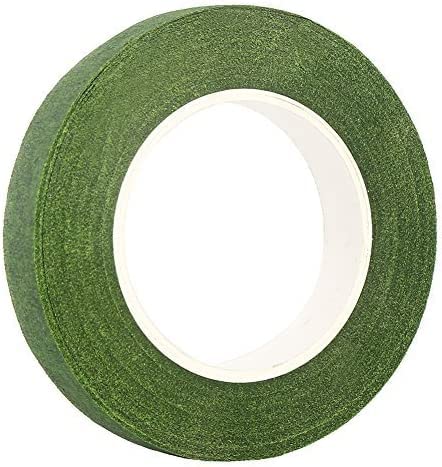
Floral tape isn't sticky straight off the roll. It's a waxed paper strip that bonds only once you stretch it, which is why it feels dead in your fingers until it suddenly doesn't. Half-inch dark green is the default width for flower stems.
Why we picked this exact one: DECORA's half-inch dark green floral tape is the cheap workhorse of this craft, with a matte finish that doesn't catch the light like the shiny supermarket sort. Pull it taut as you wrap and it seals to itself and to paper-wrapped wire. It does snap if you yank, so wrap with steady tension rather than speed.
Tacky glue is a thickened white craft glue that grabs almost on contact and dries clear. It stays where you put it on a vertical petal edge, which ordinary school glue won't do. One eight-ounce bottle outlasts a great many flowers.
Why we picked this exact one: Aleene's Original Tacky Glue is the bottle paper florists name when somebody asks what to use on small blooms, and it has been the answer for decades. It dries clear enough that a smear on a pale petal vanishes. It skins over in the nozzle, so cap it between sessions.
sharp all-purpose scissors for cutting crepe petals
One sharp pair of 8-inch scissors does most of the cutting in this craft. Dull blades chew crepe rather than slicing it and leave a fuzzy edge on every petal. Whichever pair you buy, keep it away from wire and cardboard.
Why we picked this exact one: The Fiskars 8-inch Original orange-handled scissors are the default sharp pair in most craft drawers, and they go through several folded layers of crepe without crushing the fold. The blades hold an edge well for what they cost. They're not detail scissors, so a fringed centre will want something smaller eventually.
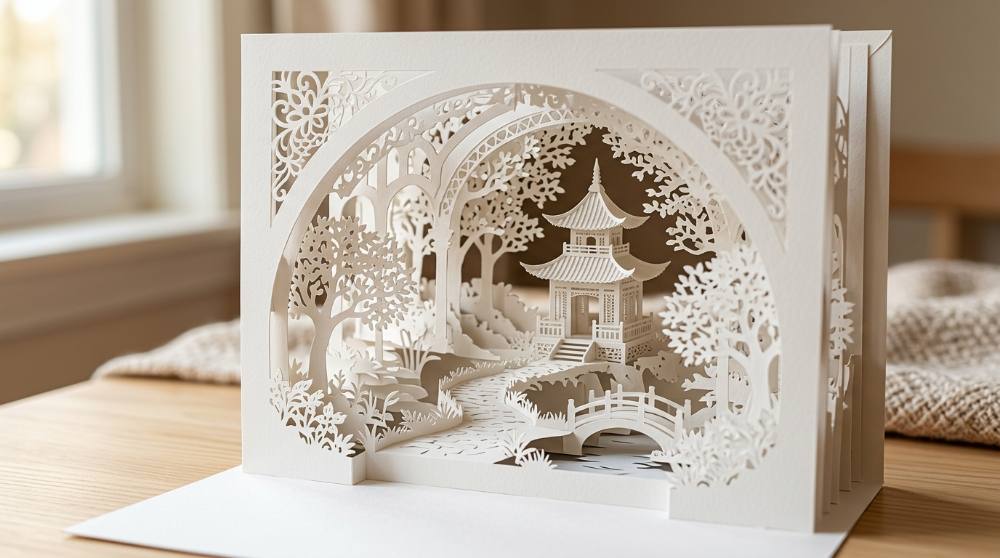
With these five you can make a peony, a rose, an anemone and a poppy, all from the same pile. Give yourself more paper than you think you need for the first one, because the first six petals are practice and you'll want to throw them away. Crepe also smells faintly of nothing at all, which is the one sense this craft leaves out, and it's a small shock after working with cutting and folding paper into pop-up scenes where the paper is stiff and loud.
What You'll Want By Flower Number Four
Three of these fix annoyances and one of them changes how the flowers look. I'd buy the cutters first and the colour last, which is the opposite of what the photos make you want to do. Shading before you can reliably build a petal just gives you a beautifully coloured lopsided flower. If you find you like the wire side of this more than the paper side, bending wire into standalone sculpture runs on the same pliers.
06Pick 06 of 16
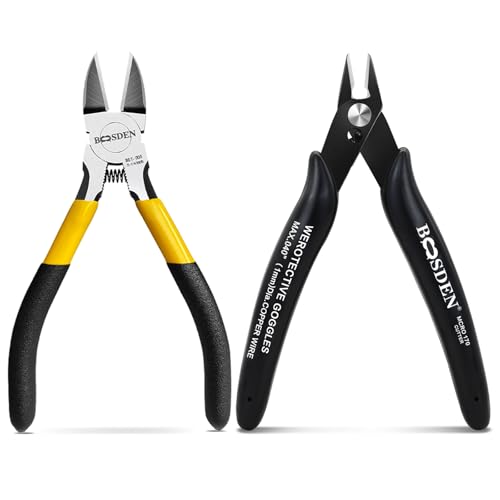
mini flush cutters for trimming floral wire
Flush cutters are small spring-loaded nippers that leave a flat cut end instead of a sharp diagonal spike. They go through 18-gauge floral wire without effort and sit in one hand. Five inches is the usual size for craft work.
Why we picked this exact one: The BOOSDEN mini flush cutter set costs about what a mediocre pair of kitchen scissors does and spares your good blades completely. The spring reopens them for you, which matters by the fiftieth stem. The jaws are small, so anything heavier than floral wire isn't their job.
spun cotton ball centres for building flower cores
Spun cotton balls are light paper-pulp spheres that push onto a wire and get wrapped in crepe to form the heart of a bloom. Roses and anemones are built outward from a core like this. Fifteen millimetres suits an ordinary garden-flower scale.
Why we picked this exact one: The Zonon 100-piece spun cotton balls are paper rather than polystyrene, so hot glue won't melt a crater into one and crepe sits on them without that squeaky plastic feel. A hundred is far more than you'll need, which is rather the point at this price. They're a little irregular, though that disappears under the wrap.
These are dry soft pastels pressed into shallow pans and applied with small sponges rather than drawn with sticks. You lift a little colour and wipe it on, which darkens a flower's throat or blushes an edge without wetting the paper. Wet media warps crepe; this leaves it alone.
Why we picked this exact one: The PanPastel ten-colour set by Golden is the step up from rubbing chalk pastel on with a cotton bud, and it's the shading medium paper florists mention most often. Buy it once you've made a few flowers and know you want them to look real rather than merely pretty; before that, a cheap box of chalk pastels scraped with a knife gets you most of the way less comfortably. It needs fixative over the top or the colour walks off onto your fingers.
workable fixative spray for sealing pastel shading
Workable fixative is a light aerosol varnish that locks loose pigment down while still letting you add more colour over the top. Pastel on crepe stays powdery until something holds it. Several light passes from a distance beat one heavy one.
Why we picked this exact one: Krylon Workable Fixatif is the standard choice for pencil, chalk and pastel work and behaves predictably on crepe. Spray outdoors with the can well back, because one wet pass darkens the paper and flattens the crinkle. It arrives as a two-pack, which is more than most people will get through in a year.
None of this makes the flower; it makes the flower convincing. The pastel especially is a slow change, since you'll overdo the shading for a few blooms before your hand learns how little colour it takes. Work over a sheet of scrap paper, because the dust travels.
Poppies and Ranunculus Play by Different Rules
A peony forgives you. You stack enough ruffled petals and the eye stops auditing any one of them. A poppy has four or five petals and nowhere to hide, so each one has to be cupped properly and the centre has to be right. Ranunculus goes the other way: dozens of tiny, almost flat petals wrapped tight around a green heart, which needs thinner wire and more patience than strength. Both are worth attempting early, because they teach you what the heavier paper is actually for.
10Pick 10 of 16
180 gram Italian crepe paper for deeply cupped petals
Italian crepe at 180 grams is the heaviest weight in common use for flowers, and it behaves unlike the middleweights. It stretches further, resists tearing while you work a petal deep, then keeps the shape. The machine lines show more at this weight, which reads as petal texture rather than a flaw.
Why we picked this exact one: Cartotecnica Rossi has made crepe in Italy since 1873, and the 180 gram roll is the paper practitioners name when a flower has to hold a deep shape. One roll covers a surprising number of petals at this width. It's sold a single colour at a time, so treat it as paper bought for one particular flower rather than general stock.
double-sided crepe paper for two-tone petals and leaves
Double-sided crepe carries a different colour on each face of the same sheet, so a cut leaf shows colour from both sides. Single-sided crepe has a pale reverse that announces itself the moment a petal curls back. This type is fine and light with modest stretch.
Why we picked this exact one: The Lia Griffith double-sided crepe folds come in paired greens, which is exactly what leaves and calyxes want. It's an extra fine weight with around 130 percent stretch, so it curls readily but won't hold a deep cup. Use it for foliage and petal edges, not for the main petals.
24-gauge fine floral wire for small petals and buds
Fine floral wire is the thin counterpart to stem wire, used inside individual petals, leaves and buds. At 24 gauge it bends under finger pressure and vanishes beneath a wrap of tape. Thinner gauges exist for very small work.
Why we picked this exact one: DECORA's 24 gauge paper-wrapped wire shares the wrap and colour of their stem wire, so the two tape together without a visible join. It's thin enough to curve a petal edge by hand and still spring back. Go thinner than this and the wire starts to kink rather than bend.
Artificial stamens are short fibre stalks with a small head at each end, folded over a wire to build the centre of a bloom. Matte heads suit realistic flowers, while pearlised ones read as cake decoration in daylight. A thousand pieces is a hobbyist's lifetime supply.
Why we picked this exact one: The Sorrento Crafts matte double-headed stamens avoid the pearl finish that looks wrong against crepe, which is the detail that matters here. The mixed pack means you don't have to guess a shade before you know which flowers you'll be making. The heads sit on fine fibre and will bend if you're rough with them.
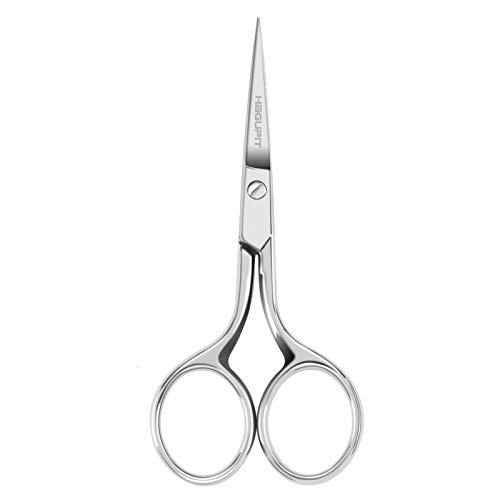
fine-tipped detail scissors for fringing flower centres
Small embroidery-style scissors with pointed tips cut into a folded strip without crushing it. A fringed centre is dozens of narrow parallel cuts a few millimetres apart along a strip of crepe. Full-sized blades can't stop cleanly at the line.
Why we picked this exact one: The Hagupit four-inch forged detail scissors have the pointed tips a fringe needs and enough blade weight to take several crepe layers at once. Being short, they give you control right up against the fold. They'll dull quickly on anything but paper and thread.
Work these two and you'll start noticing real flowers differently, which is the slightly embarrassing side effect everyone in this craft reports. Cut the grain of the paper running the length of the petal, always, because that's the only direction crepe stretches in. If narrow strips of paper and tight curves appeal, coiling paper strips into flat designs scratches a similar itch with a tenth of the bench space.
Two Books Worth Owning Before You Buy More Paper
This is a craft where the order of operations matters more than dexterity, and that's the thing videos are worst at showing. A book lets you keep a thumb in the page while your other hand is sticky. Both of these come up constantly when makers recommend reading to each other, and between them they cover the first flower and the hundredth. If you're buying one as a present, it slots neatly next to the question of which Christmas craft is worth starting with.
15Pick 15 of 16Book worth reading
beginner crepe paper flower project book
A project book for people starting out, organised flower by flower with templates and step photographs. Each project names the paper and the order the pieces go together in. It's a paperback, so it stays open on a work surface.
Why we picked this exact one: Lia Griffith's Crepe Paper Flowers is the title most often handed to newcomers, and the projects are sized for papers a beginner can actually get hold of. The step photography is specific about where the glue goes, which written instructions always fudge. It leans decorative rather than botanical, so strict realism comes later.
A larger guide to building botanically accurate flowers, including the oversized blooms its author exhibits. It spends its pages on colouring, petal anatomy and construction rather than on quick projects. Hardcover, photographed rather than diagrammed.
Why we picked this exact one: Tiffanie Turner's The Fine Art of Paper Flowers is the book paper florists cite in community threads when someone asks what to read next, and she works almost entirely in German doublette crepe. The projects are harder than a first-weekend flower, which is why it's worth owning early. Think of it as the book you grow into.
Buy the beginner one first and read it cover to cover before you cut anything; it'll save you a roll of paper. The second one is better bought early and read slowly, a project at a time, as the flowers you want to make get harder.
Why Your First Peony Looked Like a Cabbage
Why do my petals keep tearing exactly where I'm stretching them?
Almost always because the stretch happened too fast. Crepe gives along the grain in a slow, even way, and a quick pull concentrates all of it in one spot until the paper gives up there. Start with a light pull and increase the tension gradually, feeling the paper thin out under your thumbs. You can always stretch a petal further; there's no way to unstretch one that has gone too far, so stop earlier than feels right.
My petals came out stiff and flat even though I bought the heavy paper. What happened?
You cut across the grain. Crepe only stretches in one direction, perpendicular to the fine machine lines running through it, and a petal cut the wrong way round simply cannot be cupped no matter how hard you push. Hold the paper up and find the lines before you cut, then lay every template so the petal's length runs with them. It's the oldest instruction in the craft, and it's the one beginners skip.
Why does the colour rub off my finished flower onto everything?
Pastel and chalk sit on the surface of crepe instead of soaking into it, so nothing is actually holding the pigment down. The flower looks perfect until someone picks it up and leaves fingerprints in the shading. A couple of light passes of workable fixative from a good distance locks it, and you can still add more colour afterwards. Keep the can far enough back that the paper never goes damp, because a wet pass flattens the crinkle permanently.
My stems flop over once the flower head goes on. More tape?
Tape won't fix it; the wire is too thin. Thin craft wire is fine inside a petal but it can't carry a full head, and the flower spends the rest of its life nodding at the table. Build full-sized stems on 18 gauge wire, and for a heavy bloom tape two lengths together before you wrap. The weight sneaks up on you, because a finished peony is much heavier than the paper it started as.
Everyone online uses a hot glue gun, so why does mine look lumpy?
Hot glue is the right tool for large flowers and the wrong one for small overlapping petals. It sets in a bead, and under a single thin layer of crepe that bead shows as a ridge from the front. Use tacky glue wherever petals overlap at normal flower scale, and save the glue gun for big heads and for attaching a finished bloom to a stem. It's also genuinely hot through one sheet of paper, which beginners discover the hard way.
People Worth Following Into This Hobby
Real practitioners we found while researching this setup — people who do the work, show their process, and publish on sites they run themselves. No sponsorships, no affiliations; we just think they're worth your time.
Quynh builds large paper flower installations and writes a running 'Back to the Basics' series on how each crepe weight behaves under the hand.
This setup tells a beginner to spend their money on paper weight before anything else, and her breakdown of 180, 140, 90 and 60 gram Italian crepe is the clearest explanation of why that advice exists.
Jessie Chui sculpts botanically exact crepe paper flowers in Canada and publishes the technical tests behind them, down to which floral tape wins.
The specialty section here sends beginners at poppies and ranunculus, and her Icelandic poppy course is a full walkthrough of exactly that flower by someone who photographs every stage.
Jennifer Johnston films herself making crepe paper peonies and roses at Nostalgia Handmade Designs, including the attempts that go wrong.
Her peony walkthrough with pan pastels covers both the flower a beginner starts with and the shading step this setup lists as the thing that makes a paper flower convincing.
Eileen has been cutting and sculpting crepe paper flowers and insects by hand in Singapore since 2015, and publishes free video tutorials alongside her book.
Her side-by-side comparison of crepe brands and weights answers the question this setup's first purchase forces, and her free videos show the stretching motion that written instructions never quite capture.
Love what you see here? Save individual picks with on any item, or copy everything to a list of your own in one click — great for coming back to later, or dropping as a not-so-subtle hint.