Beginner Brush Calligraphy Setup: Pen, Paper, and Practice

Beginner Brush Calligraphy Setup: Pen, Paper, and Practice

Daria AparinaCurated by Daria Aparina

The Core Kit: Pens, Paper, and a Pencil

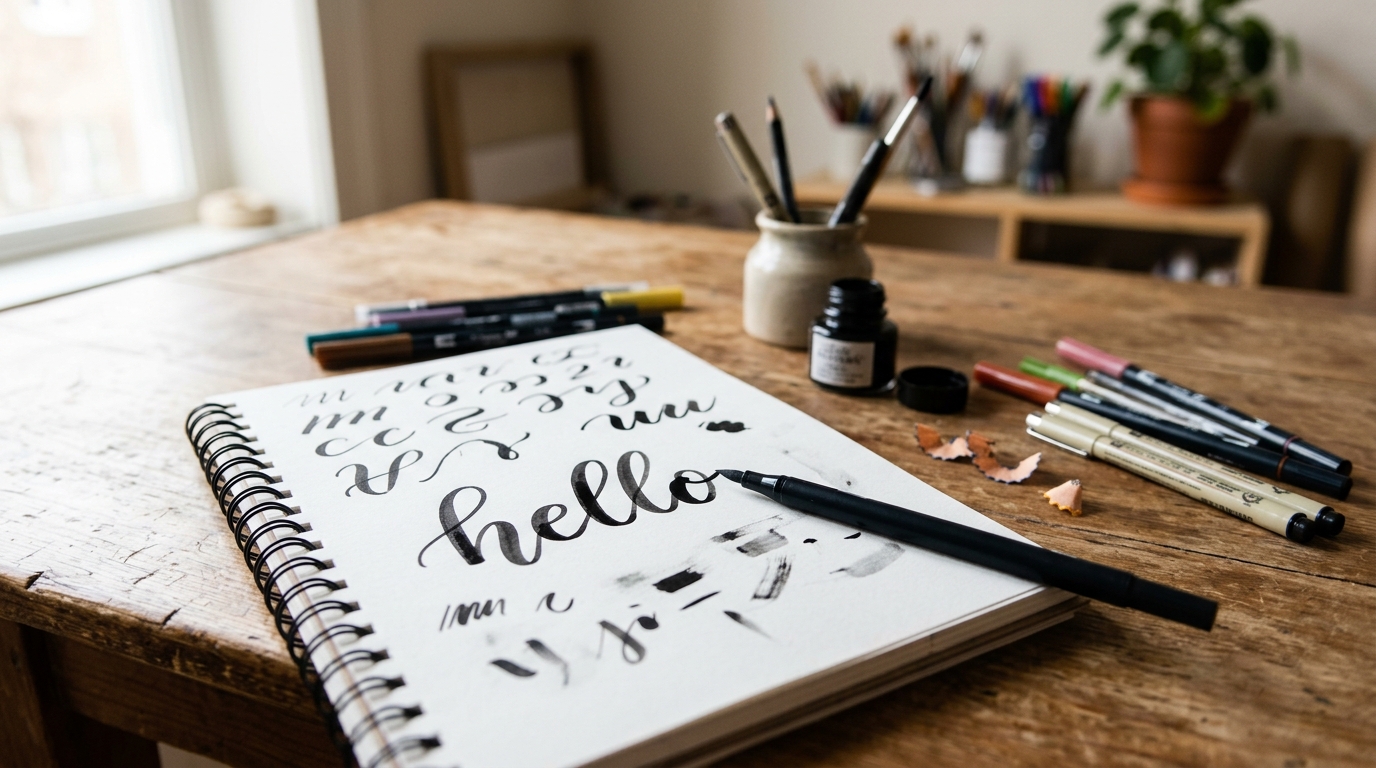
The first thing that surprises most people about brush calligraphy is how fast the tool punishes the wrong paper. Drag a brush pen across ordinary printer paper a few dozen times and the felt tip starts to splay and fuzz, and crisp hairlines turn ragged. So the starting kit is really a pairing problem: a flexible pen that bends under pressure to give you thick downstrokes and thin upstrokes, and a surface smooth enough to keep that tip intact. Add a pencil for ruling guidelines and you can write your first letters the same afternoon. I keep this separate in my head from the difference between calligraphy and drawn hand lettering, because the two get muddled constantly — brush calligraphy is written in single, pressure-controlled strokes rather than built up outline by outline.

My rule for starting is to buy the smallest pile of supplies you can and then practice until something actually runs out. For brush calligraphy that bare minimum is one firm-tipped brush pen, a pad of smooth paper, and a pencil with an eraser for guidelines. Color, blending tools, and watercolor brushes are all genuinely fun, but none of them will teach you the basic strokes any faster.

The picks below were chosen after weighing the supplies beginners get steered toward most often, keeping only the ones that are easy to find, forgiving to learn on, and priced so a frayed tip or a ruined page never feels like a real loss.

Firm-tip brush pen for controlled calligraphy strokes

Firm-tip brush pen for controlled calligraphy strokes

A pen with a small, firm brush nib that flexes just enough under pressure to switch between thin upstrokes and thick downstrokes. The compact, springy tip gives beginners more control and steadier lines than a large soft brush, which is why it is the standard tool for learning the basic strokes. Look for a water-based ink that resists bleeding and a tip that keeps its point rather than splaying.

Why is this important?

Pressure-controlled stroke contrast is the entire foundation of brush calligraphy, and a firm tip is the most forgiving way to learn it. A beginner who starts on a too-soft brush usually develops shaky, inconsistent strokes that take months to unlearn.

Why this choice?

The Tombow Fudenosuke hard-tip pen is the one instructors reach for first, and this 10-color pack holds a 4.7-star rating across more than 41,000 reviews while staying near a dollar a pen, so a worn tip is never a setback.

Large flexible brush pen set for learning letterforms

Large flexible brush pen set for learning letterforms

Bigger marker-style pens with a long, flexible brush tip on one end and a fine bullet tip on the other. Writing large with a soft, expressive tip helps beginners feel the shape of each letter and the swell of a downstroke, and the blendable water-based inks invite early color work. The two-ended design also doubles as a detail pen for smaller pieces.

Why is this important?

Practicing letters at a large scale exaggerates your strokes so mistakes are obvious and easier to correct, which makes a big brush pen the natural partner to a small firm one. A varied color set also keeps practice engaging, which matters more than beginners expect.

Why this choice?

The Tombow Dual Brush Pens in the Galaxy set blend smoothly, carry a 4.7-star rating across tens of thousands of reviews, and bundle ten coordinated colors, giving more range than single-color packs for a modest price.

Smooth bleedproof marker paper for brush pens

Smooth bleedproof marker paper for brush pens

A pad of thin, very smooth, semi-translucent paper made to take marker and brush-pen ink without feathering or readily bleeding through. The slick surface is what protects brush tips from fraying and keeps your hairlines crisp. Beginners should weigh smoothness and a generous sheet count over paper weight, since practice burns through pages quickly.

Why is this important?

The wrong paper ruins both your strokes and your pens, which makes a smooth, ink-friendly surface as essential as the pen itself. Rough paper frays tips and makes clean lines impossible no matter how good your technique is.

Why this choice?

The Canson XL Series Marker pad offers 100 smooth sheets for well under twenty dollars at a 4.6-star rating, cheap enough to fill page after page without flinching over a wasted sheet.

Graphite pencils and erasers for ruling guidelines

Graphite pencils and erasers for ruling guidelines

A set of graphite pencils paired with a kneaded eraser, a vinyl eraser, and a sharpener. In brush calligraphy the pencil rules light baseline, x-height, and slant guides, and the erasers lift those marks once the ink has dried. A kneaded eraser is especially handy because it removes graphite without scuffing the paper or smearing the ink.

Why is this important?

Guidelines are the difference between letters that march evenly and letters that drift and lean, and a clean eraser lets you remove them without harming finished work. Most beginners skip ruling lines entirely and then wonder why their words look crooked.

Why this choice?

This Aenir sketch set pairs a full range of graphite pencils with both a kneaded and a vinyl eraser for under ten dollars at a 4.8-star rating, covering every guideline-and-cleanup need in one inexpensive package.

With these four things on the desk you have everything you need to drill the basic strokes and write your first words. Expect your early downstrokes to wobble and your spacing to drift; that is normal, and a pencil baseline corrects far more of it than any pen upgrade will. If the meditative feel of ink moving across smooth paper hooks you, it often spills over into related pursuits like getting started with fountain pen writing, which shares the same fussiness about paper and ink.

Tools That Make Practice Stick

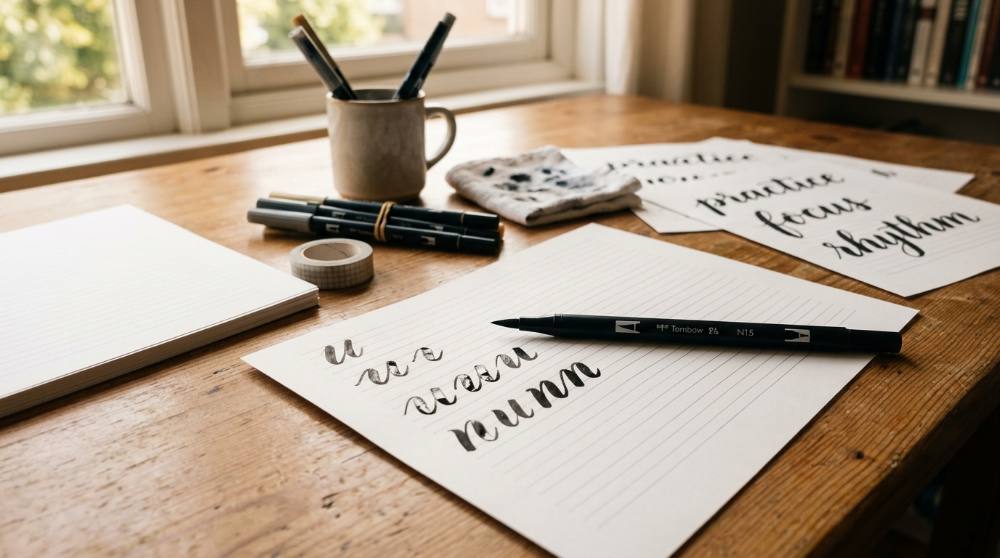
Once the basic strokes stop feeling alien, the thing that slows most beginners is inconsistency — letters that lean at different angles, baselines that sag, words that crowd together at the end of a line. The supplies in this group all attack that problem rather than adding new abilities. Guide sheets, a dot grid, a ruler, and a stack of see-through tracing paper turn vague practice into measurable practice, which is where steady progress actually comes from. Much of this gear overlaps with a beginner hand lettering kit, so if you drift between the two styles nothing here goes to waste.

Modern calligraphy practice workbook with guide sheets

Modern calligraphy practice workbook with guide sheets

A beginner workbook that walks through the basic strokes, shows the alphabet broken into numbered pen movements, and supplies ruled pages to trace and practice on. Working through structured drills builds the muscle memory that aimless doodling never quite does. The better ones separate each letter into its component strokes and leave room to repeat them many times.

Why is this important?

Brush calligraphy is a motor skill, and guided repetition of the basic strokes is the fastest route to consistent letters. Without a structured guide, beginners tend to rehearse their mistakes instead of correcting them.

Why this choice?

June & Lucy's The Ultimate Guide to Modern Calligraphy & Hand Lettering for Beginners covers strokes, drills, and projects in one inexpensive paperback with a 4.6-star rating across more than 30,000 reviews.

Smooth dot grid pad for spacing and slant practice

Smooth dot grid pad for spacing and slant practice

A pad of smooth, ink-friendly paper printed with a faint dot grid in place of solid lines. The dots act as quiet guides for letter height, spacing, and slant, then mostly disappear in a finished piece. The smooth surface also keeps brush tips happy, so it serves for both planning and practice.

Why is this important?

A dot grid gives consistent reference points without the heavy printed lines of standard ruled paper, helping fix the uneven spacing that plagues early work. It bridges the gap between rigid guide sheets and a blank page.

Why this choice?

Rhodia's dot pad is known for unusually smooth, bleed-resistant paper and holds a 4.8-star rating, making it a dependable practice surface that won't chew up your pen tips.

Transparent graph ruler for ruling baselines

Transparent graph ruler for ruling baselines

A clear plastic ruler printed with a grid so you can rule parallel baselines, x-height lines, and angled slant guides accurately. Its transparency lets you align against marks or letters underneath. For calligraphy you want fine, evenly spaced guide lines, which a gridded ruler makes quick to lay down.

Why is this important?

Consistent guidelines depend on spacing and angling them precisely, and a gridded transparent ruler makes that fast and repeatable. Eyeballing lines is the quiet cause of much beginner wonkiness.

Why this choice?

The Westcott B-70 graph ruler costs just a few dollars, carries a 4.6-star rating across thousands of reviews, and its printed grid makes ruling evenly spaced guides far quicker than a plain edge.

Translucent tracing paper for layering over guides

Translucent tracing paper for layering over guides

A pad of thin, see-through paper smooth enough for brush pens. Laid over a guide sheet or a piece you admire, it lets you trace letterforms repeatedly until the shapes feel natural, then move to blank paper. Tracing is one of the most effective and least glamorous ways to absorb good letter structure.

Why is this important?

Tracing well-formed letters trains your hand to the correct shapes faster than copying them freehand from across the page. It removes the guesswork so you can focus purely on the stroke motion.

Why this choice?

This SuFly tracing pad supplies 75 smooth, highly translucent sheets for under ten dollars at a 4.8-star rating, transparent enough to read a guide sheet through while still taking brush ink.

None of these are mandatory, and I would resist buying all of them at once. A common trap is hoarding more practice material than you will ever fill — pick the workbook or the dot pad first, work through real pages of it, and add the rest only when you feel the specific need. Layering tracing paper over a guide sheet is the single habit that improved my own letterforms fastest, and it costs almost nothing.

Adding Color, Blends, and Finishing Touches

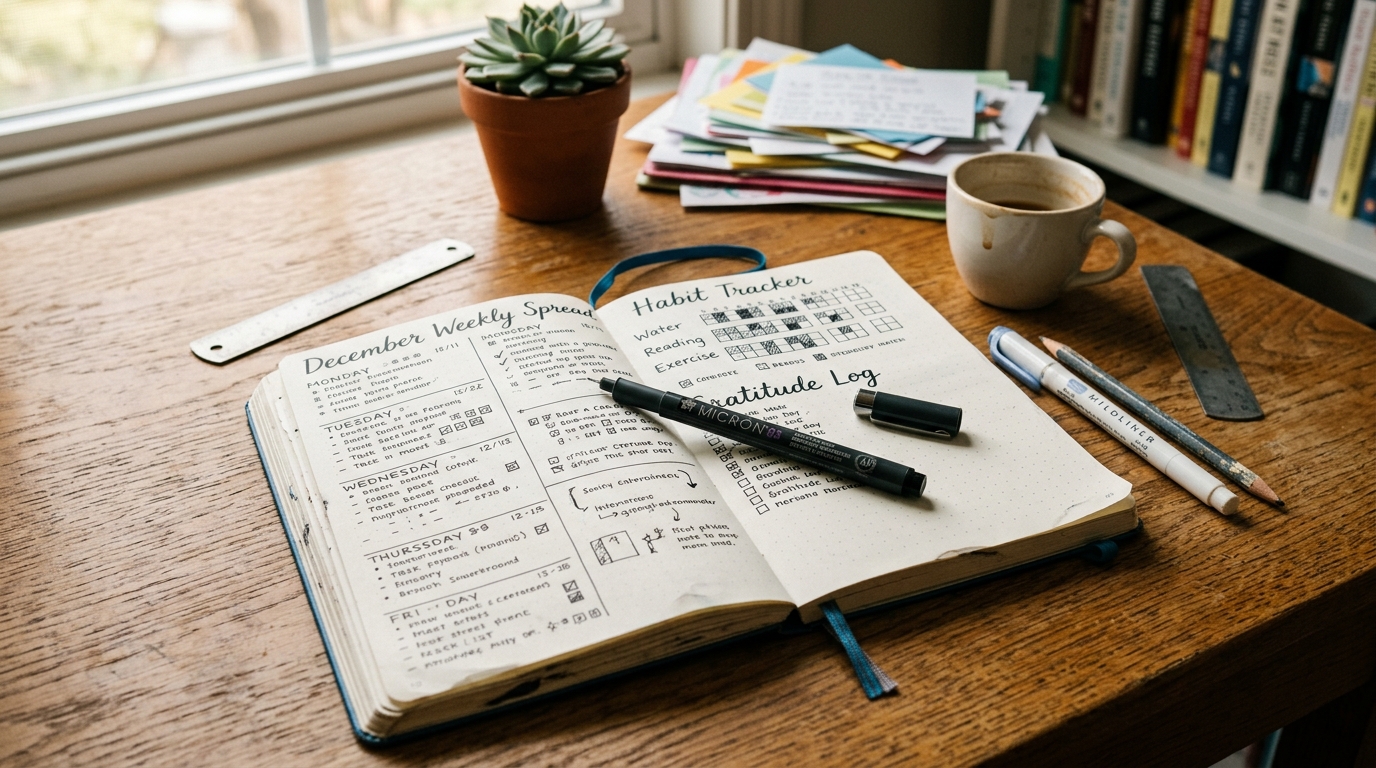
Color is where brush calligraphy starts to look like the pieces that probably drew you in — a smooth gradient inside a single word, a soft watercolor wash behind a quote, a crisp white flourish on dark paper. These tools unlock that look, but they reward a steady hand, so they are worth adding only once your strokes are reliable. Decorative lettering like this is also what gives a beginner bullet journaling setup its headers and accents, so the skill carries straight over into everyday pages.

Watercolor brush pens with real flexible bristles

Watercolor brush pens with real flexible bristles

Brush pens fitted with soft, real-style nylon bristle tips and water-based dye ink that behaves like watercolor, so you can blend colors, fade them with water, and build gradients. They bridge brush lettering and painting, letting you letter and wash color with one tool. Beginners should expect a steeper control curve than felt-tip pens, since a bristle brush is far more flexible.

Why is this important?

Bristle-tip watercolor pens unlock the blended, painterly lettering that defines a lot of finished brush calligraphy. They introduce color and water control without the setup of a full watercolor kit.

Why this choice?

KINGART Pro Brush Pens supply 24 blendable colors with genuine flexible nylon tips at a 4.5-star rating, delivering real-brush behavior for around twenty dollars instead of the price of premium sets.

Refillable water brushes for blending and washes

Refillable water brushes for blending and washes

Pens with a barrel you fill with water and a soft brush tip that releases it as you squeeze. They soften and blend brush-pen ink, pull a color into a gradient, or lay a light wash without dipping into a jar. A range of tip sizes handles everything from fine detail to broad fills.

Why is this important?

A water brush is the simplest way to turn solid brush-pen color into the soft blends and ombre effects beginners want, with no separate water pot to knock over. It is the key tool for moving from flat color to gradients.

Why this choice?

Arteza's water brush set includes six refillable brushes in assorted tip sizes at a 4.6-star rating across thousands of reviews, covering fine-to-broad blending for the cost of a couple of single brushes.

Blending palette and colorless blender for gradients

Blending palette and colorless blender for gradients

A small kit with a non-porous palette, a colorless blender pen, and a fine mister. You scribble brush-pen ink onto the palette, pick it up with a blender or wet tip, and create smooth two-tone blends within a single word. It is purpose-built for the ombre lettering look without full watercolor gear.

Why is this important?

A dedicated blending surface and a colorless blender make controlled gradients far easier than improvising on scrap paper. They turn the fiddly trick of blending two brush-pen colors into a repeatable technique.

Why this choice?

The Tombow Blending Kit pairs a palette, colorless blender, and mister with a quick guide for about ten dollars at a 4.6-star rating, giving beginners every piece of the blending workflow in one box.

Opaque white gel pen for highlights on lettering

Opaque white gel pen for highlights on lettering

A gel pen that lays down thick, opaque white ink that shows up on dark or colored paper and over dried ink. Letterers use it for fine highlights along downstrokes, dots, and flourishes that make a finished piece pop. Look for a broad point and genuinely opaque ink, since thin or translucent white just reads as gray.

Why is this important?

A bright, opaque white is the standard finishing touch that adds dimension and contrast to a completed piece, especially on dark backgrounds. It is the small detail that separates practice scribbles from polished work.

Why this choice?

The Uni-ball Signo Broad in white is the go-to highlight pen for letterers, with thick, reliably opaque ink and a 4.6-star rating, sold as a three-pack for under ten dollars.

With color pens, a water brush, a blending palette, and a white gel pen you can move from plain practice strokes to finished, framable pieces. Go slowly here — beginners almost always over-saturate their blends and end up with muddy puddles before they learn how little water it actually takes. Brush calligraphy is also one of the gentler entries on most lists of good starter hobbies for adults, precisely because the results look rewarding long before the technique is polished.

The Questions Every Brush Letterer Asks by Week Two

Why do my downstrokes look shaky no matter how slowly I go?

Most beginners try to write brush calligraphy with finger movements, the way they hold a normal pen, which makes long downstrokes jittery and cramped. The fix is to move from the whole arm and shoulder and to slow down even further, because brush lettering is closer to controlled drawing than to fast handwriting. Lift the pen between strokes instead of writing each letter in one continuous motion, and the wobble usually settles within a few practice pages.

My brush pen suddenly writes scratchy and pale — did I get a dud?

Almost always the pen is fine and the paper did the damage. Practicing on rough or uncoated paper frays the felt tip and drinks the ink, so the pen feels dry and the fine lines go feathery. Once a tip has splayed it rarely fully recovers, which is why smooth paper matters from day one; keep a frayed pen for rough scribbles and start fresh ones only on the good paper.

How hard should I actually press to get the thick part of the stroke?

Beginners tend to mash the pen flat hoping for a bold downstroke, and instead they crush the tip and get blobby, uneven lines. Pressure should change gradually within a single stroke — light on the way up, easing into firmer on the way down — not slammed on all at once. Treat it as a dial you turn rather than a switch you flip, and let the tip's natural flex do most of the work.

Why does my lettering look crooked even when each letter looks fine?

This is almost always spacing and consistency rather than the letters themselves. New letterers concentrate so hard on forming each character that they ignore the rhythm between them, leaving uneven gaps that read as messy. Lightly ruled guidelines and a consistent slant angle fix this faster than more letter drills, so rule your lines before you write and watch the spaces between letters, not just the strokes.

Should I learn on the big flexible pen or the small firm one first?

People often assume the large, very flexible pens are the easy beginner choice because they look impressive, but their soft tips are harder to control and exaggerate every mistake. A small, firm tip gives steadier lines and clearer feedback while you learn the strokes, and the larger pen becomes far easier once your pressure control is in place. Starting big is the most common reason beginners decide they have no natural talent when they have really just picked the harder tool.

Love what you see here? Save individual picks with on any item, or copy the whole list to your own wishlist in one click — great for coming back to later, or dropping as a not-so-subtle hint.

A Few More Beginner Setups We Carefully Put Together

Beginner Polymer Clay Setup

Beginner Polymer Clay Setup

View Setup
Beginner Gouache Painting Setup: Core Supplies Checklist

Beginner Gouache Painting Setup: Core Supplies Checklist

View Setup
Paint by Numbers Relaxation Setup

Paint by Numbers Relaxation Setup

View Setup
Disclosure: Some product links may be affiliate links. If you make a purchase through one of these links, we may earn a small commission at no extra cost to you.