Punch Needle: Plush Loop-Pile Wall Art You Punch in an Evening

adjustable punch needle tool for yarn loop-pile work

Start here · pick 01 of 13

adjustable punch needle tool for yarn loop-pile work

See it on Amazon

Affiliate link: we may earn a small commission, at no extra cost to you.

DariaCurated by Daria
Jump to the 13 picks

Thirty Minutes In, It Starts Looking Like Carpet

You hold a hollow tool like a fat pen, push it straight through a stretched cloth, and lift it just enough to slide to the next hole. On the other side, a loop of yarn stands up. Then another. Do that a few hundred times and you have a dense, springy pile that feels like a small rug, because it basically is one. The strange part is that nothing is knotted: loops stay put because they are packed tight and the weave grips them, a trick an Ohio man named Ebenezer Ross patented back in 1881 and sold as The Griffin.

Plenty of people arrive here from hand embroidery with a hoop and floss and assume punch needle is a branch of the same craft. It isn't, and that assumption costs money. The tool is hollow rather than sharp, the cloth is an open cotton weave called monk's cloth rather than the aida most stitchers start on, and you work on the reverse of the piece the entire time. Order the embroidery version of any of those three and your loops will fall out before you finish a row.

Keep the first order small. A punch needle, a square of monk's cloth, something that holds it drum-tight, yarn, and a pen you can draw the design with: that is the lot. Everything else on this page can wait until you have actually finished something.

Nothing below costs enough to haunt you if the craft turns out not to be your thing.

One thing worth hearing before you shop: the first piece almost always looks worse from the front than you expected, with stray tails poking through and loops leaning at odd angles. That's normal, and it's fixable with sharp scissors and five minutes of nudging. If you want a sense of how beginners trip over the sister craft, the same honesty applies to the mistakes new embroiderers make.

Five Buys and You're Punching

The kit is short. Every piece of it does one specific job, and two of them are where beginners quietly go wrong: the cloth, and the thing holding the cloth. Craft shops sell a wide-weave monk's cloth at around 7 holes per inch that looks right and isn't, and loops slide straight back out of it. You want roughly 12 to 13 holes per inch instead. A standard embroidery hoop, the kind that suits counted cross-stitch on aida, loosens every single time you punch, so punchers reach for frames with gripper teeth.

Disclosure: This section may contain affiliate links to Amazon. We may earn a small commission from qualifying purchases at no extra cost to you.
adjustable punch needle tool for yarn loop-pile work

Pick 01 of 13

adjustable punch needle tool for yarn loop-pile work

A punch needle is a hollow tube set in a handle: yarn feeds down the shaft and out of the eye at the tip, and each push leaves a loop standing on the far side of the fabric. Adjustable versions let you change the loop height and swap between needle diameters, so one tool covers both thin threads and bulky yarn. Check that the largest tip in the set takes the yarn weight you plan to use, because yarn thicker than the shaft will jam.

Why we picked this exact one: The Cheloment adjustable punch needle covers the widest useful range for the money, with five interchangeable tips from 1.6 mm up to 5 mm in one beechwood handle. That 5 mm tip is the one that matters here, since it takes the bulky and rug-weight yarn most pen-style punches cannot feed. Its 4.2-star average is the softest number on this page, and the recurring complaint is bent threaders, so treat the spare as a consumable rather than a backup.

See it on Amazon
open-weave monk's cloth foundation fabric for punch needle

Pick 02 of 13

open-weave monk's cloth foundation fabric for punch needle

Monk's cloth is a soft, open-weave cotton that a punch needle can part without breaking threads, and whose weave then closes around the yarn to grip each loop. The useful version runs about 12 to 13 threads per inch; the wider weave sold in general craft shops looks similar and lets loops drop straight back out. Many precut pieces carry woven guide lines every couple of inches, which help you square a design up and stretch the cloth evenly.

Why we picked this exact one: The Oxford Company's precut monk's cloth states the number most listings leave out, 13 double threads per inch, which is the count punch needle actually wants. The 24-inch square is the sensible first buy: wide enough to clamp onto a 10-inch frame with margin to spare, small enough that you are not paying for yardage you will never punch. It costs more per square inch than unbranded tufting cloth, and stock on the precut sizes runs thin.

See it on Amazon
gripper-strip frame that holds punch needle fabric drum-tight

Pick 03 of 13

gripper-strip frame that holds punch needle fabric drum-tight

A gripper frame is a wooden square edged with rows of fine angled teeth that bite into the foundation fabric and hold it under high tension. You lay the cloth over the teeth and pull outward from the middle of each side, and the angle of the teeth stops it creeping back. Most ship with a padded cover, because the strips are genuinely sharp to lean a forearm on.

Why we picked this exact one: The JQSH 9.8-inch gripper strip frame is the cheapest version of the right tool, and it includes the flannel cover that usually costs extra. It arrives flat-packed with screws and a screwdriver, so budget ten minutes before your first session. Its 4.6-star average sits on a modest review count, and a few buyers mention pine that splits if the corner screws are overtightened.

See it on Amazon
multi-colour acrylic tufting yarn for punch needle pile

Pick 04 of 13

multi-colour acrylic tufting yarn for punch needle pile

Tufting yarn is spun thicker and tighter than knitting yarn so that it fills the weave and stands up as pile. For punch needle it has to pass freely through the needle shaft, which rules out anything lumpy, very hairy, or slippery enough to slide back out of the cloth. Multi-colour packs of small balls suit beginners, who usually want many shades in small amounts rather than a kilo of one colour.

Why we picked this exact one: The BESGEER 42-roll kit gives a first project an absurd colour range, with 25 g each of 8-ply acrylic spun for rug work. Acrylic is the honest choice for wall pieces and cushion fronts, since it holds colour, costs little and nobody is walking on it. For a floor rug or a chair pad you would want wool instead, which is why a wool ball appears further down this page.

See it on Amazon
water-soluble fabric marking pen for transferring punch needle designs

Pick 05 of 13

water-soluble fabric marking pen for transferring punch needle designs

Punch needle is worked from the back, so the design has to be drawn on the back of the cloth, mirrored if it contains any lettering. A water-soluble marking pen puts a visible line on pale cotton and lifts away afterwards. A fine tip suits outlines, and the line only has to survive being punched over once.

Why we picked this exact one: Dritz's 693 Mark-B-Gone is the needlework standard for this job, and its extra-fine tip stays legible on the ridged surface of monk's cloth. The ink is water-soluble, so a damp cloth lifts it rather than needing a full wash, which matters once a piece is mounted. The maker notes it is not recommended for dry-clean-only fabrics, which is irrelevant on cotton but worth knowing if you ever punch onto wool.

See it on Amazon

With those five on the table you can finish a coaster or a small hoop piece in an evening, which is exactly the size I'd start at. Expect the cloth to go slack once or twice in the first hour; restretch it rather than fighting it. The needle makes a soft thunk going through taut cotton, and once you've heard that sound change pitch you'll know the fabric has loosened before you even look down.

The Bits That Make the Second Piece Easier

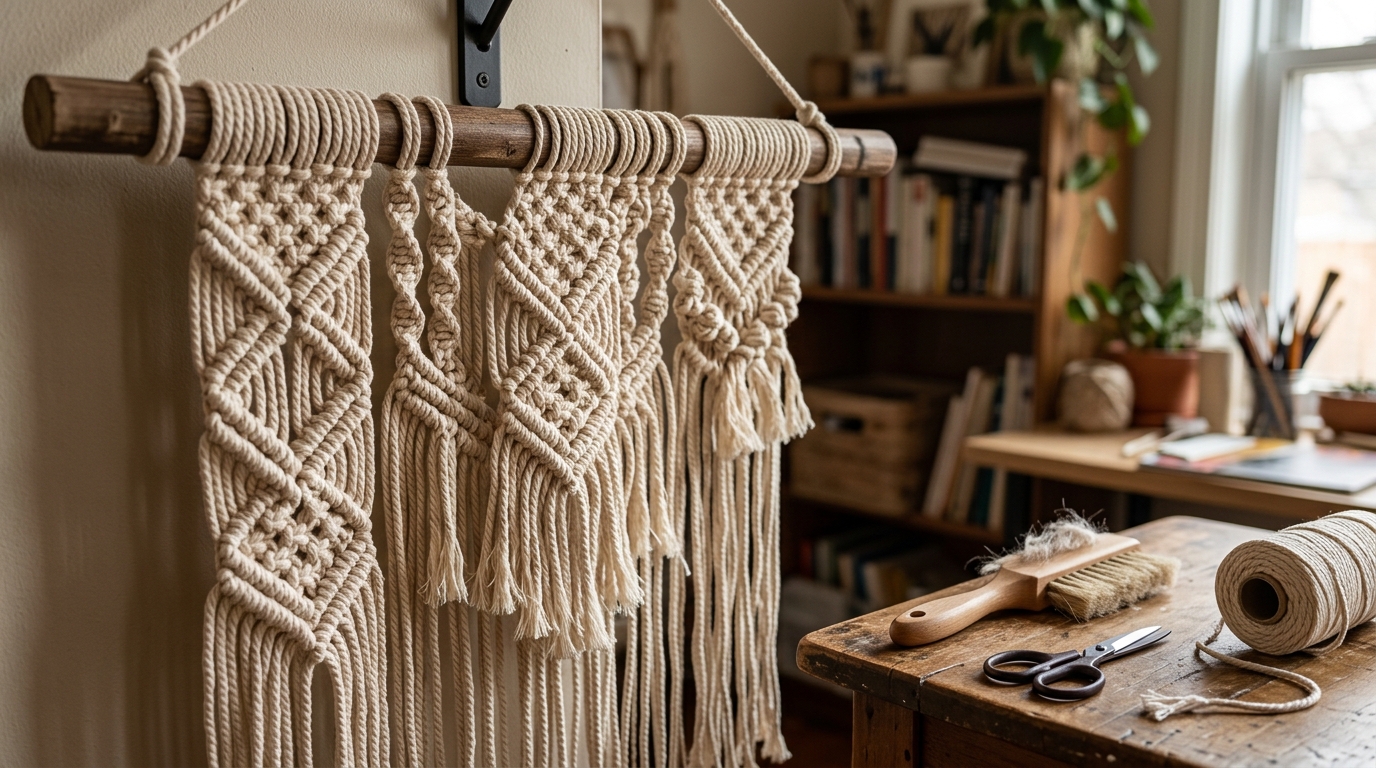
None of this is needed for a first punch, which is why it sits down here. It's what you reach for once there's a finished rectangle in your hands and no obvious idea what to do with it. Mounting it, trimming it, stopping the yarn knotting itself into a nest under your elbow: small problems, but they're the ones that actually turn up. A punched panel hung from a dowel sits happily beside a knotted macrame wall hanging if you're building a wall of soft things.

flexible fabric glue for sealing the back of a punched piece

Pick 06 of 13

flexible fabric glue for sealing the back of a punched piece

A thin coat of flexible fabric adhesive brushed across the reverse of finished punching locks the yarn into the weave. It dries clear and stays bendable, so the piece still drapes instead of turning into a board. This is a finishing step rather than a rescue: glue over slack, badly formed loops and you simply preserve the mess.

Why we picked this exact one: Aleene's Fabric Fusion is the washable, dries-flexible option in a crowded glue aisle, and the one most often reached for on cotton. Its 4.2-star average is mid-pack for craft adhesives. The recurring complaint is a nozzle that clogs between projects, so decant a little onto a scrap and brush it on rather than squeezing it straight onto the work.

See it on Amazon
small pointed embroidery scissors for trimming loop ends flush

Pick 07 of 13

small pointed embroidery scissors for trimming loop ends flush

Short, sharp, finely pointed scissors let you cut a single yarn tail level with the surrounding pile without catching its neighbours. The same closed tips double as a poking tool for nudging loops back into line. Kitchen scissors are too blunt at the point for either job.

Why we picked this exact one: The AQUEENLY stork scissors come two to a pack for under ten dollars, so one can live in the project bag and one on the desk. The tips are fine enough to slide between loops without snagging them. They are stamped rather than forged, so they dull faster than a German-made pair, which at this price is a fair trade.

See it on Amazon
wooden hoops for mounting and displaying finished punch needle pieces

Pick 08 of 13

wooden hoops for mounting and displaying finished punch needle pieces

A plain wooden hoop is the simplest way to finish a round punched piece: stretch the cloth into the hoop, trim the excess at the back, and the hoop becomes the frame. A range of sizes helps, because the hoop you display in is rarely the size you punched on. These are display hoops rather than working ones, and they will not hold enough tension to punch against.

Why we picked this exact one: The Caydo seven-piece set spans 4 to 12 inches for roughly the price of two hoops bought singly, which covers almost any small piece made in a first year. The bamboo is light and the brass screws tighten without stripping. The wood is unfinished, so a coat of oil or wax is worth ten minutes if the hoop is going on a wall.

See it on Amazon
100% wool worsted yarn for punched pieces that get handled

Pick 09 of 13

100% wool worsted yarn for punched pieces that get handled

Wool behaves differently in a punched loop than acrylic does: the scaled fibres grip each other and the weave, so loops seat tighter and stay put. It also wears far better under feet and elbows. Worsted weight suits a fine-point punch needle, or can be doubled through a larger one.

Why we picked this exact one: Patons Classic Wool is the easiest 100% wool worsted to find and the cheapest honest one, which is why it turns up in so many first rug projects. A 3.5-ounce ball runs to 210 yards, which covers a surprising amount of ground at a short loop height. It felts in the wash, so anything made with it is hand-wash-only in cold water, and that is worth deciding before you punch a tea towel.

See it on Amazon

I'd skip all of it on the first order and then buy whichever one annoys you most. If you end up punching ornaments and small gifts in December, the glue earns its place quickly, because little pieces get handled constantly and a sealed back takes that handling better. Punch needle is one of the easier crafts to pick up for the holidays, partly because a coaster takes an evening and a matching set of four looks deliberate.

Going Small: The Fine-Needle Branch

There's a second, quieter version of this craft that uses a much narrower needle and embroidery floss instead of yarn. The loops come out tiny, close to needlepoint, and you can punch lettering and fine detail that a yarn needle would smear into mush. It's slower. It also wants a closer-woven foundation than monk's cloth, so the fabric changes too. If you already like working small with fibre, it sits near sculpting shapes out of loose wool in how fiddly and absorbing it gets.

fine-point punch needle for short, dense loops and lettering

Pick 10 of 13

fine-point punch needle for short, dense loops and lettering

A fine-point punch needle has a narrower shaft and a shorter travel, so it forms small, tightly packed loops that read close to needlepoint. It takes worsted, sport and sock-weight yarns rather than bulky rug yarn. Fixed-length needles make one loop height and nothing else, which is exactly why the result comes out so even.

Why we picked this exact one: The Oxford Punch Needle #14 Fine, nicknamed the Mini, makes a 1/8-inch loop and is the tool punchers name when a design needs crisp edges. Its handle is the shaped maple one Amy Oxford patented, and it threads through an open slot instead of needing a wire threader. It does one loop height only, which is the trade: no adjustment to set, and none to lose mid-row.

See it on Amazon
miniature embroidery punch needle set for floss-scale detail

Pick 11 of 13

miniature embroidery punch needle set for floss-scale detail

Miniature punch needles are sized for embroidery floss and fine threads rather than yarn, with interchangeable tips for different strand counts and a sliding gauge for loop height. They want a close-woven foundation such as weaver's cloth, not open monk's cloth. The scale is completely different, and a piece the size of a postcard can carry recognisable detail.

Why we picked this exact one: The Ultra Punch three-needle set is the long-standing default for floss-scale punching, with a 4.5-star average across more than 800 reviews. Its three tips cover roughly two to six strands, and the sliding gauge gives a dozen loop heights from one handle. Threading does need the supplied wire threader, which is fiddly and easy to lose, so keep the spare taped inside the box.

See it on Amazon
cotton embroidery floss in a 36-colour pack for fine punch work

Pick 12 of 13

cotton embroidery floss in a 36-colour pack for fine punch work

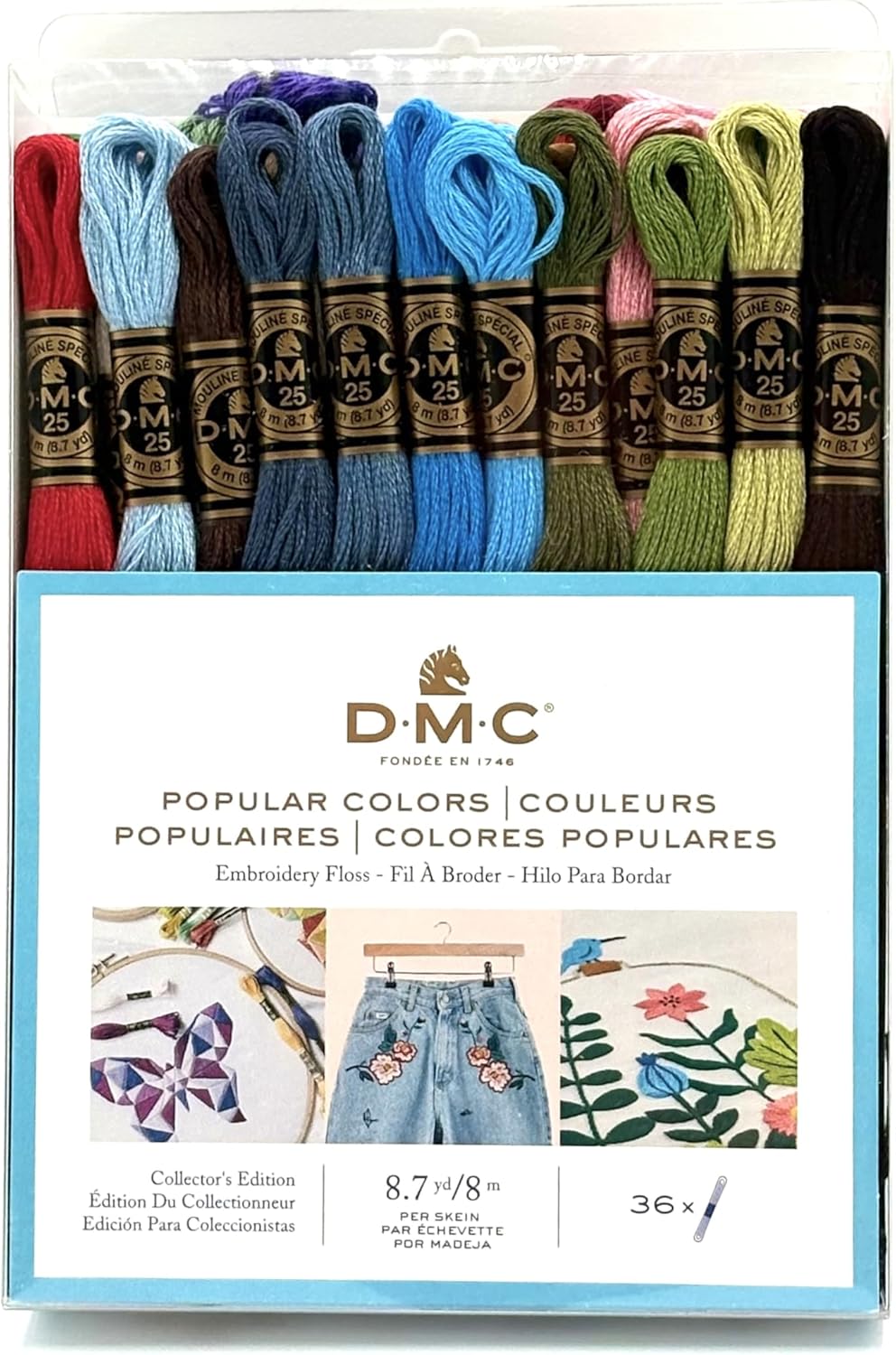
Six-strand cotton floss is the thread a miniature punch needle is built around, split down to whatever strand count the tip takes. A broad colour pack matters more here than in yarn work, because shading at this scale comes from swapping hues rather than from texture. Mill-spun floss also tends to be colourfast, which hand-dyed threads frequently are not, so check the label before punching anything that will be washed.

Why we picked this exact one: The DMC popular-colours pack puts 36 of the most-used shades in one box at well under single-skein prices. DMC is the reference range most punch needle and embroidery patterns are numbered against, so a pattern calling for a specific colour will usually match. The skeins arrive loose and tangle easily, so wind them onto bobbins the day they turn up or accept the knot.

See it on Amazon

Don't buy into this branch until the big needle feels automatic. The two tools punch differently enough that learning both at once mostly teaches you to be mediocre at each. When you do switch, start with lettering, because short deliberate lines show you instantly whether your loop height is holding steady.

One Book Worth Owning

Most of what you need is free online, honestly. A book earns shelf space here for one reason, and that reason is finishing. Edges, backings, how to shift a large piece across its frame without dragging out what you've already punched: that's where printed instructions with step photographs beat scrubbing back and forth through a video.

a beginner's reference book on punch needle technique and finishing

Pick 13 of 13 · Book worth reading

a beginner's reference book on punch needle technique and finishing

A full-length punch needle reference covers the parts that short tutorials skip: how to move a piece on its frame, how to bind an edge, how to plan colour across a large design. Step photographs matter more than video here, because the page stays open beside the work. Look for a book written by someone who teaches the craft rather than a round-up of projects.

Why we picked this exact one: Amy Oxford's Punch Needle Rug Hooking: Your Complete Resource is the title the punch needle community points beginners toward, written by the person who designed the needle most of them use. Its 4.8-star average across roughly 300 reviews is unusually consistent for a craft book. It is hardcover only, so it costs more than a project paperback and is less willing to lie flat on the table.

See it on Amazon

Read the finishing chapters before you start rather than after. How a piece will be mounted changes how much bare cloth you need to leave around the design, and that is not a margin you can add once the punching is done.

Why Your Loops Keep Walking Back Out

My loops pull out the moment I move to the next stitch. What am I actually doing wrong?

Almost always it's the lift. Beginners raise the needle clear of the cloth between stitches because it feels tidier, and the loop they just made comes up with it. Keep the tip grazing the surface and slide it to the next hole instead of lifting, and push all the way down to the handle on every stitch. Nothing holds these loops in but friction and the weave, so any upward tug undoes the last one.

Does it matter which way I point the tool?

Yes, and this one stays invisible until it bites. The needle has an open slot down one side, and that side has to face the direction you are travelling. Turn a corner without turning the tool and the yarn drags against the closed edge, loops come out short, and the row suddenly looks thin. Rotate the whole tool in your hand as the line curves rather than twisting your wrist.

Why does the front look like a hairy mess when the back looks fine?

Because you are working on the back, so the front is where every starting and finishing tail ends up. Everyone's first piece looks like this and most people assume they have ruined it. You clean it up afterwards: snip each loose tail level with the surrounding loops, one at a time rather than in clumps, then push stray loops into place with the closed tips of your scissors. Ten minutes of that changes the piece completely.

Can I pull out a mistake, or have I wrecked the cloth?

You can pull it out, and the cloth recovers. Monk's cloth is woven to take that abuse, so tug the yarn back through the same holes and scratch the weave closed with a fingernail. What you should not do is carry a long yarn across the back to a new area instead of cutting and restarting. Jumped threads like that sit under tension and work their way out over time, taking neighbouring loops with them.

How much yarn does a small piece actually eat?

More than feels reasonable. Beginners budget by area and forget that loop height is the real multiplier. One ounce of worsted yarn, which is about 40 yards, covers roughly a five-and-a-half-inch square at the shortest loop setting, and a taller loop burns through it faster. Buy extra of your background colour, because running out halfway and matching a dye lot later is a worse problem than leftover yarn.

Love what you see here? Save individual picks with on any item, or copy everything to a list of your own in one click — great for coming back to later, or dropping as a not-so-subtle hint.

Disclosure: This section may contain affiliate links to Amazon. We may earn a small commission from qualifying purchases at no extra cost to you.