Picture a folded card city block on a kitchen table, a handful of figures creeping between pipes, and one person leaning over all of it with a tape measure. That's a solo miniature skirmish. Nobody sits opposite you, because the rules carry their own behaviour tables and the raiders deploy, advance and shoot on dice you roll yourself. People have been doing this far longer than you'd guess - the Solo Wargamers Association has run since March 1976 and still puts out a quarterly journal called Lone Warrior. The family tree runs the other way too, since the original Dungeons and Dragons was sold as rules for medieval wargames campaigns playable with paper, pencil and miniature figures.
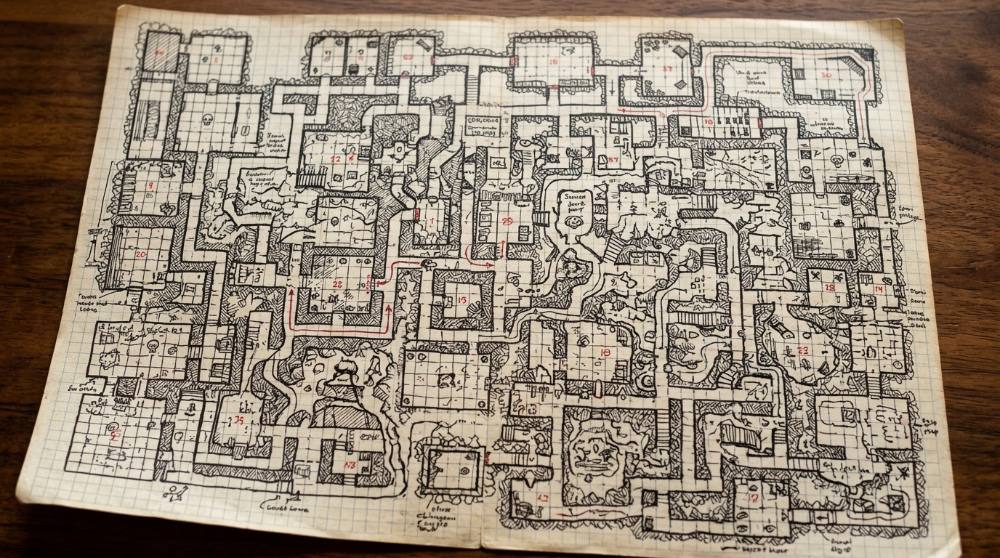
If you've already met solo tabletop gaming, this is the branch where the fight physically exists in front of you. A solo dungeon crawl run from one book and two dice happens in your head and on graph paper. Here you measure three inches, squint along the table to work out whether your scout can actually see the thing shooting at her, and push a lump of plastic forward. That difference costs money and it costs table space. It's also why people stay: when the evening ends there's an object sitting there that didn't exist before.
Our philosophy is to buy as little as you can get away with. One rulebook, one box of figures, dice, something to measure with and a surface to play on - that's a complete game, and bare grey plastic fights exactly as well as a prize-winning paint job.
The picks below are the cheapest honest version of each job, so if you bounce off this in a month you haven't lost much. One item breaks that rule, and we say so when we get to it.
Where This Little Kit Can Take You
A few real moments and results from this hobby — made with tools no fancier than the ones below.
Two troopers, freshly paintedShallow focus on a pair of finished 28mm figures holding a pipe run, the result of one evening with a brush.
A whole mission on one tableThe entire battlefield fits inside three feet square, which is the footprint these games are written around.
The crew walks into troubleSix figures against whatever the enemy tables rolled up, the moment the dice stop being arithmetic.
One thing before the shopping, because it's the mistake that costs new players most. A core book is not a snack. One blogger took a single Five Parsecs rulebook through a nineteen-game campaign, and the standard edition of Rangers of Shadow Deep ships seventeen scenarios on its own. The fight itself runs about forty-five minutes; the travelling, job-hunting and post-battle rolls either side push a full campaign turn past the hour. So buy one book. Play it until it's nearly used up and you know what you actually enjoy, then buy the next thing. Order three supplements alongside the core book and you'll open the parcel to a stack, with no idea which one comes first or what it's meant to follow, and that stack is where a lot of people quietly stop. If playing a whole tabletop campaign alone is new to you, the solo tabletop hobby in general is worth reading up on first.
The Smallest Pile That Gets a Mission on the Table
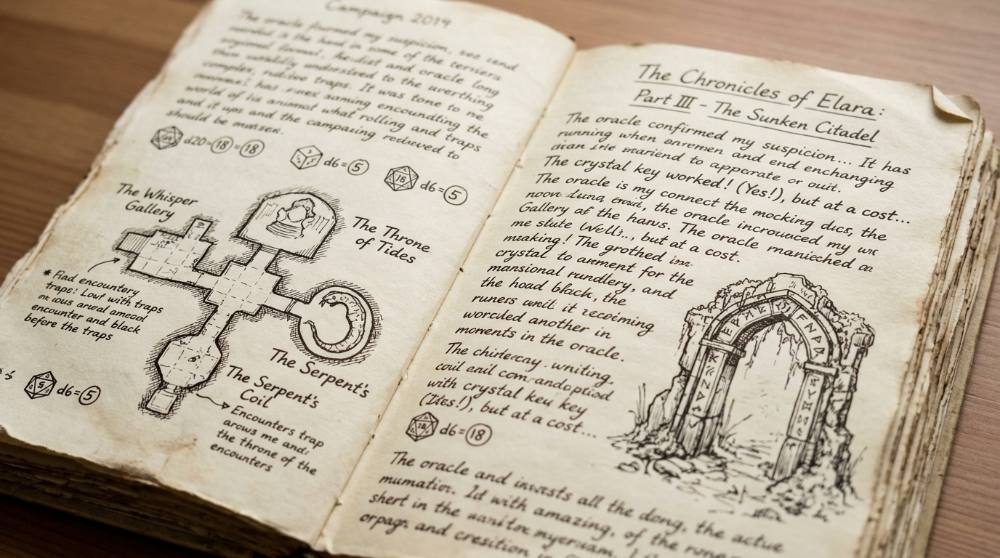
Five things and you can play tonight. The list stays short because these games were written for people without a gaming club - the publisher says outright that the game works with any miniatures you have lying around and needs only a few six-sided dice and a couple of ten-sided ones. What you can't fudge is the measuring and the surface. Movement is in inches, and "about three inches" isn't a rule, it's an argument you'll have with yourself and lose. If you'd rather test the idea of a solo campaign before buying any plastic, solo roleplaying with an oracle does the storytelling half for the price of a notebook.
About the table: you need less of it than you think. Three foot square is the recommended area and two foot square genuinely plays, so a dining table or a big desk is fine. Beginners routinely assume they need a dedicated board in the garage and put the whole hobby off for a year over it.
Disclosure: This section may contain affiliate links to Amazon. We may earn a small commission from qualifying purchases at no extra cost to you.
01Pick 01 of 10
solo sci-fi skirmish rulebook with built-in enemy behaviour and a linked campaign
A solo wargame rulebook does two things an ordinary one doesn't. It decides what the enemy does, using written behaviour rules and dice tables instead of a person, and it strings one battle to the next so your squad carries injuries, loot and grudges forward. Look for a book that generates its own missions rather than printing a fixed set, because that is what gives it a long life on a small shelf.
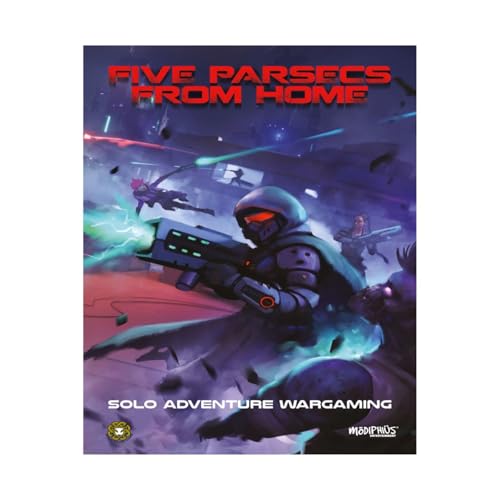
Why we picked this exact one: Modiphius's Five Parsecs from Home is the third edition of Ivan Sorensen's sci-fi campaign game, and it's the one solo players name first - 4.8 stars across 338 ratings. The enemy behaviour rules and the procedurally rolled missions mean no two games set up the same, which is the whole argument for it. The honest catch is how much rolling happens before a figure moves; some evenings you're operating the game more than playing it.
box of multipart 28mm plastic figures to build both your crew and its enemies
Multipart hard plastic figures arrive on sprues as separate bodies, arms, heads and weapons, so one box builds a squad where nobody looks like anybody else. Two dozen figures is roughly what a whole campaign needs: your own handful, plus enough bodies to stand in for raiders, hired guns and whatever else gets rolled up. They come as bare grey plastic and play perfectly well that way.
Why we picked this exact one: The Wargames Atlantic Death Fields Les Grognards box gives 24 multipart 28mm figures for the price of a boxed board game, and holds 4.8 stars over 75 ratings. Multipart matters more than it sounds here: swapping heads and arms is how you tell your own six apart at a glance mid-game. Budget an evening with clippers and plastic cement before the first mission, because 24 figures do not assemble themselves.
bulk polyhedral dice so every roll has its own die to hand
Solo wargames lean hard on dice, because every decision the enemy makes is a roll. The publisher of this style of game asks for a few six-sided dice and a couple of ten-sided ones, with pairs of ten-siders read together for percentage tables. Buying in bulk rather than one pretty set is the practical move.
Why we picked this exact one: The BABEJIA 49-piece set stacks seven full polyhedral sets into one bag at 4.8 stars over 673 ratings, which puts seven six-siders and seven ten-siders in the tray for about the price of lunch. Seven colours also lets you give a colour to each crew member and read a whole group's rolls at once. These are plain acrylic rather than the heavy resin dice people photograph, and they'll chip if you drop one on tile.
pocket tape measure marked in inches for movement and weapon ranges
Every distance in a skirmish game is measured in inches: how far a figure moves, how far a weapon reaches, how close you can creep before something notices you. A short retractable tape beats a ruler because it bends around scenery and rolls out of the way. Six feet is far more than any table needs.
Why we picked this exact one: The WORKPRO 6-foot mini keychain tape comes two to a pack and holds 4.8 stars across 484 ratings, which is a lot of agreement about an eight-dollar object. Inch and metric markings sit on the same blade, so you can read whichever side the rulebook uses. The lock is stiff out of the box and the printed scale is small, so it's worth checking you can read it under your actual table lamp.
3x3 foot neoprene gaming mat that fixes the playing area and keeps figures steady
A gaming mat does an unglamorous job: it marks where the battlefield ends. Neoprene lies flat without curling, grips figures so a knocked table doesn't scatter the game, and rolls up when dinner needs the surface back. Three foot square is the standard skirmish footprint and two foot square still plays.
Why we picked this exact one: The Battle Systems Grassy Fields mat is exactly 3x3 feet, which is the footprint this kind of game is written around, and it sits at 4.6 stars over 75 ratings. The printed grass reads as open ground on almost any world, so it doesn't lock you into one setting. It arrives rolled and wants a day or two under a stack of books before the corners stop lifting.
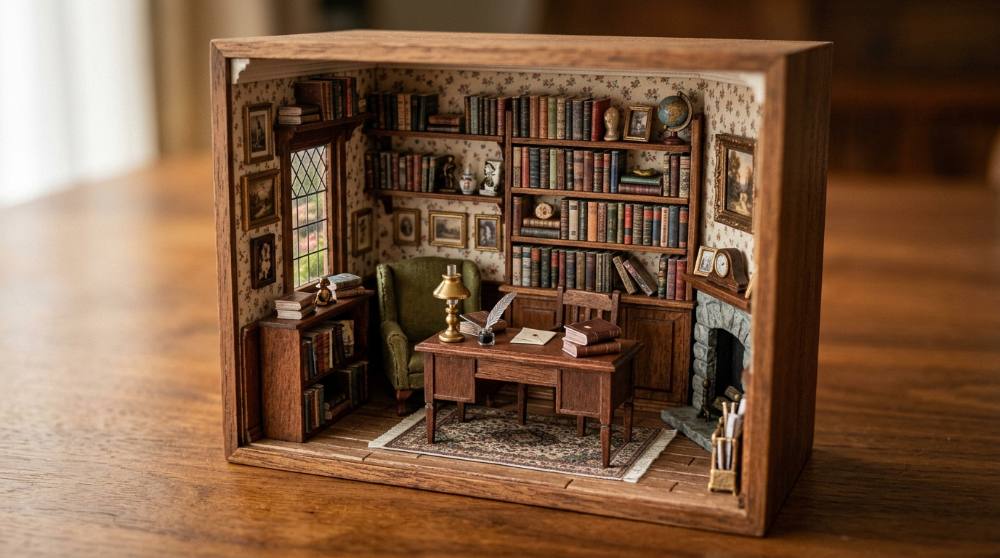
Those five get you to a first mission with nothing left to improvise. Expect that first game to run long and feel clumsy - you'll be flipping between the battle chapter and the main rules for most of an hour, and it settles down by about the third game. Twenty-eight millimetre figures are also smaller in the hand than photographs suggest; if you like things at that scale for their own sake, whole scenes built inside a walnut shell is the same instinct taken somewhere stranger.
What You Add Once You Know You'll Keep Playing
None of this is needed for a first mission, and I'd genuinely wait. Terrain is the one that changes the game rather than the photographs: on a bare mat everyone can see everyone from turn one, and the fight resolves itself before anybody has moved. Paint is the opposite - it changes nothing mechanically, and grey plastic plays fine for months. The evening you do decide you want your squad to look like somebody's, a beginner-friendly acrylic setup covers the paints and brushes side of it.
Then there's paper, which nobody warns you about. Crew logs, mission records, reference tables and free print-and-play scenery all want printing, and the log sheets bound into the back of a rulebook are famously too small for everything a crew has accumulated by game five. So there are two printers below, a normal laser and an inkless thermal one, and you want one of them rather than both. Dice handling splits the same way. A tray is a quiet bounded surface you roll into; a tower is a chute with baffles that does the randomising for you on the way down, which plenty of solo players prefer precisely because the tower decides and they don't. If building the scenery yourself appeals more than buying it, the different ways people build tiny worlds lays the options out side by side.
06Pick 06 of 10
modular printed card scenery that breaks up the table and blocks line of sight
Terrain turns a flat mat into a place with corners to hide behind. Printed card scenery is the cheap route into it: the pieces ship flat, slot together without glue, and come printed on both sides so there is nothing to paint. A three-foot table wants about three large pieces that genuinely block sight, not a scatter of small bits.
Why we picked this exact one: Battle Systems' Sci-fi Terrain Gothic Ruins builds a multi-level ruined city block out of high-density card, printed in colour on both faces so no painting is required. It matches the mat above and the pieces rearrange into a different table every game. At 4.2 stars over 72 ratings it's the weakest-rated thing on this page and also the priciest - if money is tight, stacked books under a cloth block line of sight for nothing while you decide.
These 2 do the same job. You only need one of them, so pick the one that suits you better.
07Pick 07 of 10Option A
felt-lined rolling tray that keeps dice off the battlefield
A rolling tray is a bounded surface you roll into instead of onto the table. The felt lining deadens the noise and stops dice skating, and the raised wall stops them reaching the figures. Most of them fold flat when you're done.
Why we picked this exact one: The RERIVER octagon tray is felt-lined PU leather at 4.8 stars over 525 ratings, and the eight-sided shape tucks into a table corner better than a round one. It's the quieter of the two options here and the quicker to scoop dice back out of. The leather smell takes about a week to fade.
Pros
Flat and quiet, which matters for late-night games
Dice stay in one spot and are quick to scoop up again
Cons
You still roll by hand, so a lazy roll stays a lazy roll
Takes up a corner of a table that is already short on room
folding dice tower that randomises the roll on the way down
A dice tower is a chute with angled baffles inside it. You drop the dice in at the top, they clatter down off the baffles and land in the tray at the bottom already rolled. Plenty of players prefer one to a tray because the tower, rather than your wrist, decides the result.
Why we picked this exact one: The Cusdie bamboo tower folds flat into its own catch tray and holds 4.5 stars over 289 ratings, which is unusual in a category full of flimsy laser-cut kits. Bamboo handles the rattle better than thin ply and it packs down to about the size of a hardback. It is the louder choice of the two, so think about who else is in the room.
Pros
The baffles do the randomising, so every drop is a genuine roll
Catches dice that would otherwise bounce into the scenery
Cons
Noticeably louder than a tray - the rattle carries through a flat
Dice land where it drops them, not where you want them
These 2 do the same job. You only need one of them, so pick the one that suits you better.
09Pick 09 of 10Option A
compact mono laser printer for record sheets, reference tables and paper figures
Paper is a bigger part of this hobby than the figures suggest. Crew logs, mission records, quick reference tables and free print-and-play scenery all want printing, and most of it gets written on in pencil and reprinted when a campaign ends. A mono laser suits that pattern: cheap per page, and toner doesn't dry out between bursts of use the way ink does.
Why we picked this exact one: The Brother HL-L2405W is the small mono laser most people end up with, and at around 140 dollars it's the single biggest line on this page. Be aware its rating is 4.0 across 2,575 ratings, lower than anything else listed here - cheap mono lasers sit low as a whole category. What you get for it is full-size sheets you can write on, erase and keep, at a page cost close to nothing.
Pros
Full letter and A4 sheets you can write on in pencil and erase
Toner lasts thousands of pages, so a reprinted crew log costs nothing
Prints paper figures and fold-up scenery as well as record sheets
Cons
Needs a permanent spot and a toner cartridge eventually
inkless thermal printer that prints letter-size sheets with no cartridges at all
Thermal printers burn the image into heat-sensitive paper, so there is no ink, no toner and no cartridge to replace - only the paper itself. They are small enough to live in a drawer and print straight from a phone, which suits someone printing one reference table at a time rather than a whole campaign's worth at once.
Why we picked this exact one: The Phomemo M08F prints full 8.5 by 11 inch sheets without ink, at 4.2 stars across 3,881 ratings. It's sixty dollars cheaper than the laser and takes up about as much room as a rolled-up mat. The trade is real, though: thermal output is black only and it fades with heat and light, so treat anything it prints as this campaign's paperwork rather than a keepsake.
Pros
No ink or toner to buy, ever
Small enough to keep in a drawer with the dice
Cons
Prints fade in heat and sunlight, so a crew log will not survive a year
Add these one at a time, in the order the game actually annoys you. Most people reach for terrain first, then whichever dice solution matches how late at night they play, and leave the printer until a crew log finally runs out of margin. A warning on the card terrain, though: it stores flat but it doesn't love being packed away damp, so give it a dry shelf rather than the floor of a cupboard. People who catch the scenery bug properly tend to end up building tiny rooms by hand and never finishing another campaign.
The Bits Nobody Tells You Until Game Three
Do I have to paint the figures before I'm allowed to play?
No, and the idea that you do stops more people than any price tag. Bare plastic has exactly the same stats as a painted figure. The real problem with an unpainted squad isn't that it looks unfinished, it's that six grey figures are genuinely hard to tell apart halfway through a firefight, and you'll lose track of which one is carrying the heavy weapon. Fix it in ten minutes with a dab of coloured paint on each base, or by giving every figure a visibly different head and arm while you're assembling the box.
If the rules play the enemy, what stops me just playing them badly?
Nothing except your own discipline, which is why this trips up thoughtful people hardest. The book tells you how each enemy type behaves - who advances, who holds cover, who runs for the objective - and the temptation is to glance at the table, decide what they'd probably do, and nudge it toward a better story for your crew. Do that twice and the campaign stops meaning anything, because you can no longer lose. Roll first, read what the table says, then resolve it, in that order and without looking at your own position while you do it.
Why does a forty-five minute battle eat my whole evening?
Because most of this game happens off the table. Before a figure moves you roll for where you've travelled, what job you picked up, who's hunting you and what the battlefield looks like; afterwards you roll for injuries, pay, loot and who turns up next time. New players sit down expecting to play and spend the first forty minutes doing admin with a pencil. Split it instead: do the post-battle and next-mission rolls at the end of the previous session, and game night starts with figures already on the mat.
Should I start with the sci-fi game or the fantasy one?
Pick by the dice as much as the setting, because underneath they aren't the same machine. Five Parsecs runs on six-siders with a pair of ten-siders for its big random tables, and generates its missions procedurally, so it never runs dry. Rangers of Shadow Deep is fantasy, uses a twenty-sided die, shares its mechanics with Frostgrave, and gives you seventeen written scenarios in the standard edition - a planned path rather than an endless one. Want surprise, take the first. Want someone else to have designed the missions, take the second. Buying both at once is the classic beginner's mistake.
How many more figures am I going to end up buying?
Fewer than the hobby's reputation suggests, which is the genuinely good news here. Players who have run a full campaign put the whole requirement at roughly two dozen figures: your own handful, plus enough bodies to cover the recurring enemy types the tables keep throwing at you. That's one or two boxes, not an army. The trap is buying a third box because a new enemy got rolled up, when the honest answer is to use a figure you already own and write down what it's standing in for.
People Worth Following Into This Hobby
Real practitioners we found while researching this setup — people who do the work, show their process, and publish on sites they run themselves. No sponsorships, no affiliations; we just think they're worth your time.
Writes and publishes free solo conversions of wargames, including a complete solo ruleset with its own terrain and enemy-army procedures.
Our FAQ warns that the hard part of solo play is not quietly steering the enemy yourself; his free solo rulesets show the machinery that stops you, written out step by step.
Designs solo and co-operative miniatures games, and keeps a public index of every supplement listed in the order he thinks you should play them.
Our intro tells beginners to finish one book before buying the next; his own page for the fantasy game in our FAQ is literally that list, in suggested order of play, straight from the designer.
Runs a worldwide association of people who wargame without opponents and has published the quarterly journal Lone Warrior since 1976.
Our intro opens on solo wargaming being fifty years old rather than a lockdown invention; this is where that history actually lives, alongside free sample articles on solo technique.
Played a complete nineteen-game solo campaign and published every battle report, including the deaths, with a one-line epitaph for each crew member lost.
This is the clearest picture of what a beginner is actually buying: one rulebook turned into nineteen linked games, with the forty-five minute battle length and the cramped crew-log problem both named from experience.
Love what you see here? Save individual picks with on any item, or copy everything to a list of your own in one click — great for coming back to later, or dropping as a not-so-subtle hint.