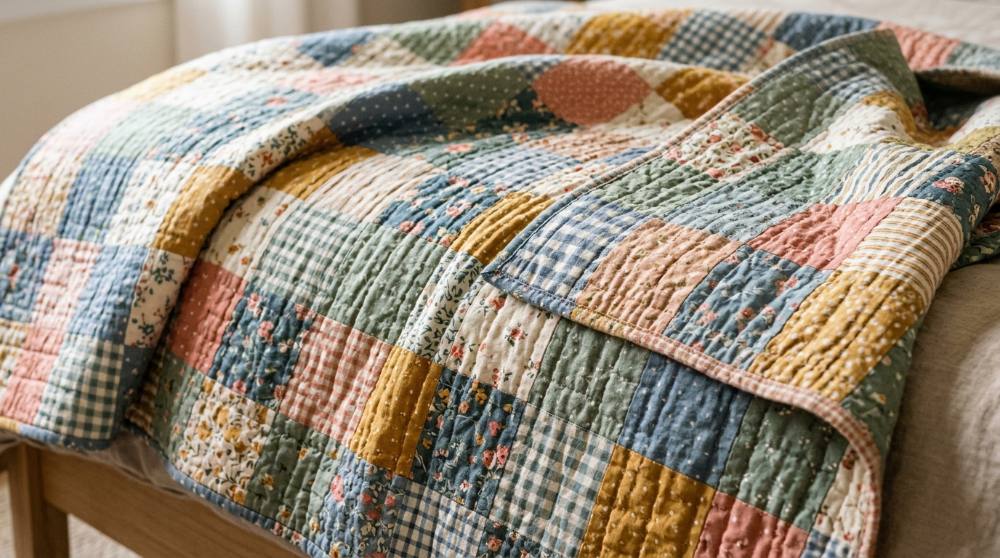
Quilting takes whole cloth, slices it into squares and triangles, and stitches those pieces back into one layered blanket. People do it at kitchen tables, in guild halls on a Thursday evening, and increasingly in spare bedrooms with a laptop propped against the wall. The craft is genuinely old. One of the earliest quilts still in existence was made in Sicily somewhere between 1360 and 1400, a linen bedcover over three metres tall carrying fourteen scenes from the Tristan legend in stuffed stitching. Here is the part that surprises people: the rolling blade that makes modern patchwork quick only appeared in 1979, invented in Japan for garment makers, and before that every single piece was traced around a template and cut out with scissors.
If you already own a sewing machine and have run a few straight seams through it, you are most of the way here. This page assumes exactly that, so it is the list of what you add on top of a first sewing machine setup rather than a second lesson in threading a bobbin. What is actually new in quilting is precision. You are cutting pieces that have to match within a thread or two, then sewing them with a seam allowance you can repeat four hundred times without drifting.
Our philosophy: buy the five things that make accurate cutting possible and stop there. A cutter, a mat, one long ruler, some cotton and a spool of thread will carry you to a finished top. Specialty rulers, clever feet and pretty notions can wait until you know which part of this you actually enjoy.
Nothing on this list costs enough to sting if the quilt bug never bites.
Where This Little Kit Can Take You
A few real moments and results from this hobby — made with tools no fancier than the ones below.
Diamond blocks in worn cottonEvery diamond here started life as a square cut off a flat piece of fabric.
One ruler, one clean stripThe blade never wanders because the ruler decides where it goes.
None of this is hard, exactly. It is fussier than it looks, in roughly the way counting squares on cross-stitch fabric is fussier than it looks from the outside. Pick a plain patchwork design for the first quilt and save the clever pattern for number three.
The Five Things That Make Your Pieces Match
Almost every quilting frustration a beginner posts about traces back to the same root: pieces that were not quite the same size. Accuracy here is not a personality trait, it is equipment. A blade that rolls instead of chews, a mat that grips, a ruler that will not slide, and fabric pressed properly flat before you touch it with a blade. That last one gets skipped constantly, and you can read it in the finished block. If you have come from making a first crochet project, this is the adjustment: yarn forgives you, cotton does not.
Disclosure: This section may contain affiliate links to Amazon. We may earn a small commission from qualifying purchases at no extra cost to you.
01Pick 01 of 11
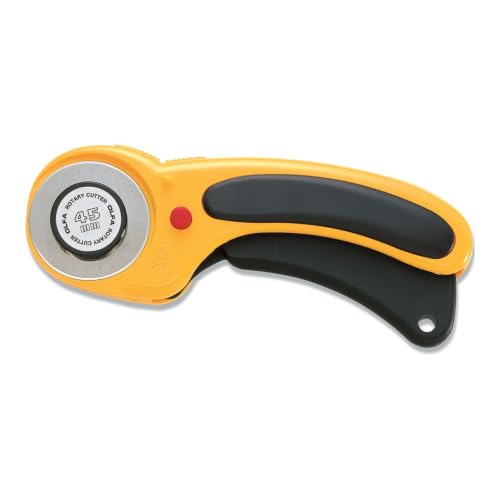
Rotary Cutter for Quilting
A rotary cutter is a circular blade on a handle that rolls along the edge of a ruler, slicing through two or three layers of cotton at once. The 45mm size is the standard for quilting: small enough to steer accurately, wide enough to cross a folded width of fabric in one pass. Look for a model whose blade retracts on its own, because the blade is as sharp as a scalpel and lives on a table where hands go.
Why we picked this exact one: The OLFA RTY-2/DX is the squeeze-handle model, and the handle is the whole point: the blade only comes out while you are gripping it and pulls back in the moment you let go. Quilters who have worked through several brands keep naming this one as the safest thing on the table. Changing the blade takes a moment longer than on a quick-change cutter, which is the trade you make for the safety catch.
A self-healing mat is a layered plastic surface that closes back up after a blade passes through it, so the cutting line stays smooth and your table survives. Most carry a printed grid plus 30, 45 and 60 degree angle lines, which lets you square a piece against the mat as well as against the ruler. An 18 by 24 inch mat takes a fat quarter flat and a full width of fabric folded; bigger mats are lovely and awkward to store.
Why we picked this exact one: The Fiskars 18 by 24 inch self-healing mat is the sensible starting size, and it carries a full lifetime warranty. The grid and bias lines stay easy to read against most cottons. Worth knowing before you buy: mats dry out and quietly stop healing after a few years even when they still look fine, so this is a part you replace rather than inherit.
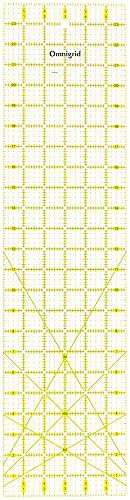
A quilting ruler is a thick clear acrylic rectangle marked in a grid, used as the straight edge your rotary blade runs against. The 6 by 24 inch size spans a folded width of fabric, so a full strip comes off in one pass. The versions worth owning have a gripping backing, since the whole job depends on the ruler not creeping while you lean on it and cut.
Why we picked this exact one: The Omnigrip 6 by 24 inch ruler from Omnigrid puts its non-slip backing along the yellow guide lines, and that high-visibility yellow over black stays readable on dark prints where plain etched markings disappear. It reads from the left or the right edge, so you are not spinning it around for every other cut. One caution that applies to any acrylic ruler: corners wear and drift out of square over the years, and quilters do quietly lose accuracy to an old favourite.
A fat quarter is a quarter yard of quilting cotton cut as an 18 by 22 inch rectangle instead of a long narrow strip, which makes it far more useful for cutting blocks. Bundles arrive as a coordinated set of prints, so the colour decisions are already made. Check that a listing states 100 percent cotton and gives real fat quarter dimensions, because plenty of craft bundles are smaller squares sold under the same name.
Why we picked this exact one: This newamishquilt bundle gives ten paisley prints at a true 18 by 22 inches in 100 percent quilting cotton, which is the format most beginner patterns are written around. It has a far deeper review history behind it than most fat quarter listings in this price range. The trade-off is that the prints are chosen for you, so anyone with a specific colour scheme in mind will be happier buying yardage.
Piecing thread is finer than general sewing thread, and the weight matters more than it sounds. A 50-weight cotton takes up almost no room inside the seam, so blocks finish at the size the pattern promised instead of growing a fraction at every join. Cotton is the usual choice because it moves and shrinks like the fabric around it. One neutral grey or cream covers nearly everything you will piece.
Why we picked this exact one: Aurifil's Mako 50-weight in Dove is the spool that keeps turning up when quilters talk about what they actually piece with, and Dove is the mid-grey that vanishes against light and dark fabric alike. The large spool holds 1,422 yards. It costs more than supermarket thread, and what you get back is less lint building up around the bobbin over a long project.
With these five you can cut a stack of strips, sew them into blocks, and press a finished top over a weekend. Expect the first few cuts to feel slow and faintly alarming, because the blade really is that sharp against your fingertips. Close the guard every time you put the cutter down, even for a second. Next come the things that turn a flat top into an actual quilt, and if hand stitching appeals more than machine work, stitching a first embroidery piece scratches a similar itch with a fraction of the gear.
Turning a Flat Top Into an Actual Quilt
A pieced top is a lovely thing and it is not a quilt yet. It becomes one when you sandwich it over batting and a backing and stitch through all three at once. This is where layers slide, where puckers show up on the back that you never saw coming, and where a lot of first quilts get folded away in a cupboard forever. You will also meet the one real fork in the road here, which is spray or pins for holding the sandwich still. Quilters split on it about as firmly as they do when weighing knitting against crochet, and both camps finish plenty of quilts.
06Pick 06 of 11
Even-Feed Walking Foot for Quilting
A walking foot adds a second set of feed teeth above the fabric, so the top layer travels at the same speed as the bottom one. Without it the machine's feed dogs pull the backing forward while the top lags, and that mismatch is what produces tucks on the underside. Most come with an adjustable guide bar for keeping stitch lines evenly spaced. The thing to check before buying is whether your machine is low shank or high shank.
Why we picked this exact one: The HONEYSEW open-toe walking foot fits low-shank models from Singer, Brother, Janome, Husqvarna Viking, Pfaff and several others, which covers most home machines a beginner is likely to own. The open toe leaves the needle area visible, so you can see exactly where a stitch line lands. Generic walking feet are a known gamble among quilters, and if yours is a high-shank machine or you want a guaranteed fit, your machine maker's own foot is the safer buy.
These 2 do the same job. You only need one of them, so pick the one that suits you better.
07Pick 07 of 11Option A
Temporary Fabric Basting Spray
Basting spray is a light repositionable adhesive misted onto the batting to tack the top and backing in place before quilting. It holds firmly enough that the layers do not shift under the needle, then washes out of the finished quilt. Work in a ventilated space and spray in sections, folding half the fabric back at a time, because a little goes a long way.
Why we picked this exact one: Odif's 505 Spray and Fix is the can quilters name by number in basting threads, and because it stays repositionable, a backing that lands crooked can be peeled up and smoothed down again. Quilters who switched from pins to this one tend to describe the change as a revelation rather than an improvement. It is an aerosol, so anyone sensitive to sprays or working in a small closed room is better served by pins.
Pros
Far faster than pinning a whole quilt
Nothing to work around while you stitch
Layers peel up and reposition if they land crooked
Curved basting pins are safety pins bent in the middle so the point comes back up through thick layers without you having to lift and fight the sandwich. You set them across the quilt roughly a hand's width apart and pull each one as your stitching reaches it. They cost almost nothing and last forever. Size 1 and size 2 are the usual quilting sizes.
Why we picked this exact one: This TSHD pack of 100 curved pins in size 2 covers a baby quilt comfortably at the four-to-five-inch spacing quilters actually use, at a price that makes pinning the cheap option by a wide margin. The curve genuinely matters, because straight safety pins through three layers are miserable. The honest downside is time: pinning a large quilt is a floor-crawling job that eats an evening.
A square ruler is used to trim a finished block down to its exact size, lining the printed grid up with the block's seams rather than its raw edges. Quilters who cut slightly oversized and trim afterwards depend on it completely. The 12.5 inch size handles the block sizes most beginner patterns use, and the non-slip backing matters as much here as on a long ruler.
Why we picked this exact one: The Omnigrid 12.5 inch non-slip square carries the same high-visibility markings as the long rulers, so a block edge stays readable against busy prints. It is sized to match the finished blocks in most beginner patterns. It is one more ruler to find space for, and if your first pattern uses small blocks you can skip it for now and buy a smaller square instead.
Batting is the middle layer that gives a quilt its warmth and the soft relief around every stitch line. An 80 percent cotton, 20 percent polyester blend is the usual starting point: enough body to feed smoothly through a machine, and only slight shrinkage in the wash. The package states a maximum quilting distance, which tells you how far apart your stitch lines can sit before the batting starts shifting inside. A twin-size piece is generous for a throw and leaves trim to spare.
Why we picked this exact one: The Hobbs Heirloom Premium Cotton Blend is the 80/20 quilters name on forums when someone asks what to put inside a first quilt, and it is scrim-stabilised, which stops it pulling apart while you wrestle a sandwich through a domestic machine. It allows quilting lines up to four inches apart, so a dense grid is optional rather than required. It shrinks three to five percent in the wash, which gives the crinkled look some people love and others plan around.
Buy the walking foot before you buy anything decorative. It is the difference between stitch lines that lie flat and a back covered in small tucks you only discover at the very end. And keep your offcuts. Quilting throws off a startling volume of small scraps, and they are exactly the right weight for patching worn denim later on.
The Reference Worth Owning on Paper
Video is wonderful for watching somebody bind a corner. It is useless at the moment your hands are full of fabric and you need to know how wide to cut binding strips. A book stays open on the table. Quilting also comes with a long list of small errors that cost fabric rather than time, much as the usual beginner slips in acrylic painting cost paint, and a decent reference heads most of them off before you cut anything.
11Pick 11 of 11Book worth reading
Quilting Reference Book
A general quilting reference walks the whole process in order: choosing and cutting fabric, piecing blocks, layering and basting, quilting the sandwich, and binding the edge. The useful ones carry cutting charts and block diagrams you can work straight from. A paperback that lies open beside the machine beats scrolling with fabric-covered hands.
Why we picked this exact one: Marianne Fons and Liz Porter's Quilter's Complete Guide is the title quilt teachers hand students who want a single book, and it runs the full arc from rotary cutting through binding rather than chasing one project. The block diagrams and cutting charts are the parts you will keep coming back to. It is a traditional reference rather than a modern-pattern book, so it is far stronger on technique than on current design trends.
One good general reference beats a shelf of project books in the first year. Read the cutting and pressing chapters before you start, then let the rest of it sit until a project makes you need it.
The Quarter Inch Nobody Warns You About
My blocks keep finishing a little too small. Am I cutting them wrong?
Probably not. Most beginners sew an exact quarter-inch seam, which sounds right and is not. Once the fabric folds over the stitching line, that fold eats a sliver of width out of every seam, so a block with six seams in it finishes noticeably shy of the number on the pattern. Quilters call the fix a scant quarter inch, a thread or two narrower than a true quarter. Shift your needle position a notch or clip a magnetic guide to the bed, then sew two scraps together and measure the result before you trust it on a real block.
Do I actually have to pre-wash my fabric?
This one genuinely divides quilters, and anyone who tells you there is a single correct answer has not sat through the argument. Washing removes shrinkage and any dye that might bleed, at the cost of frayed edges and an afternoon of pressing. Skipping it keeps the cotton crisp and gives the finished quilt that soft crinkle after its first wash. Where it does matter is a deeply saturated red or navy sitting against a pale background, because one bleed ruins the whole top. Pick a lane and stay in it for a given quilt, since mixing washed and unwashed fabric in one top is a reliable way to get a wavy finish.
Why has my rotary cutter suddenly stopped cutting cleanly?
Two causes, and people usually blame the wrong one. Blades dull far faster than beginners expect, and quilters routinely report getting only a quilt or two out of one, so a cutter that skips threads very often just needs a fresh blade. But if a new blade still will not bite, look at the table. A mat resting on a surface with even a slight bow in it flexes away under pressure, and quilters have moved the same mat to a different table and had it cut perfectly straight away. Mats themselves also dry out and stop healing after a few years even when they look untouched.
Can I use any walking foot, or does it have to be my machine's own brand?
It has to match your machine's shank height, which is the detail nobody mentions until you have bought the wrong one. Home machines are either low shank or high shank, and a foot built for the other kind will not sit correctly no matter how you fit it. Past that, generics are a real gamble: plenty of quilters run cheap ones happily for years, while others have watched two fall apart before buying the branded version. Check whether the part that clamps around the needle screw is metal or plastic, because the plastic ones are what break first.
How big should a first quilt actually be?
Smaller than you want it to be. A baby or throw size teaches you cutting, piecing, basting and quilting without swallowing a month of evenings. The real constraint is your machine's throat space, since everything to the right of the needle has to hold the rolled-up bulk of the quilt while you stitch down the middle of it. A full-size top in a domestic machine is a wrestling match beginners rarely enjoy and often abandon. Finish a small one and you will know whether you want to size up.
People Worth Following Into This Hobby
Real practitioners we found while researching this setup — people who do the work, show their process, and publish on sites they run themselves. No sponsorships, no affiliations; we just think they're worth your time.
Designs modern quilt patterns and writes week-by-week quilt-alongs that stop to explain the technique behind each step.
Her strip-piecing post takes apart the scant quarter-inch seam this setup's FAQ names as the reason beginner blocks finish small, and shows how to test yours before cutting a whole quilt.
Writes beginner-friendly quilt patterns built around precut fabric and films the slow steps most pattern instructions skip over.
Her spray-basting video walks through the layering step where first quilts most often go wrong, and her patterns are written for the fat quarters in this setup's essentials.
Builds quilts almost entirely from scraps and has published two decades of free patterns and cutting tips on her own blog.
Her free pattern library is where a beginner goes after the first quilt, and it is built around exactly the strip cutting the rotary cutter and long ruler in this setup make possible.
Love what you see here? Save individual picks with on any item, or copy everything to a list of your own in one click — great for coming back to later, or dropping as a not-so-subtle hint.