What You Need to Draw a Real Likeness From the Start

What You Need to Draw a Real Likeness From the Start

DariaCurated by Daria
Jump to the 14 picks

The Moment the Face on the Page Looks Back

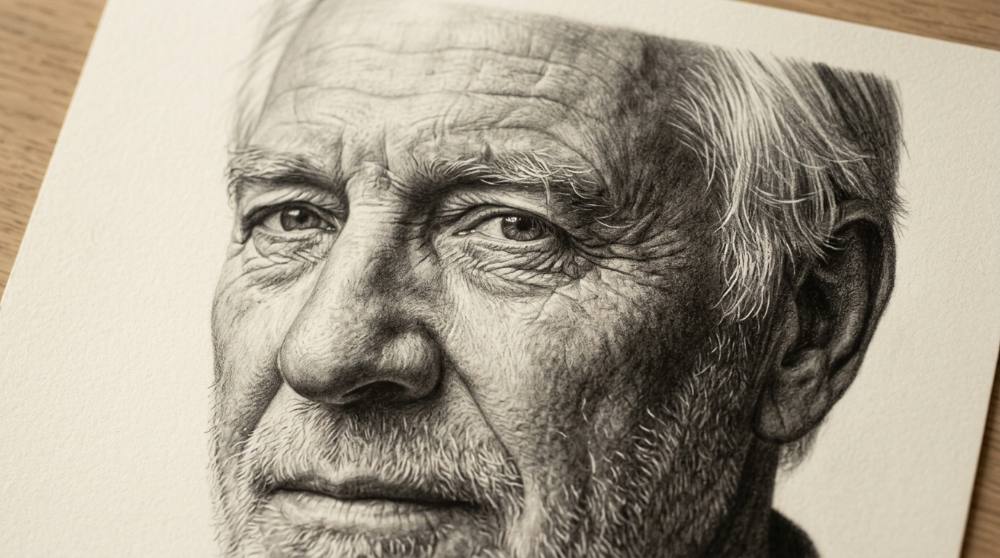
Before photography, having your likeness taken could mean climbing into a wooden frame and letting a machine do it. The physiognotrace, invented in France in the 1780s, ran a pantograph around your profile and produced a traced silhouette in a few minutes; Charles Willson Peale had one working in his Philadelphia museum by 1802, and one travelling operator turned out thousands of profiles with his between 1803 and 1812. Portrait drawing is the slow version people kept doing anyway — one specific face, not a face in general, worked out by hand. You'll find it in life-drawing rooms, at street stalls in tourist squares, and at kitchen tables well after midnight. Your brain has a patch of cortex that does little except recognise faces, and it's ruthless: nudge one eye a fraction too high and everyone who knows your subject will say something's off without being able to name it.

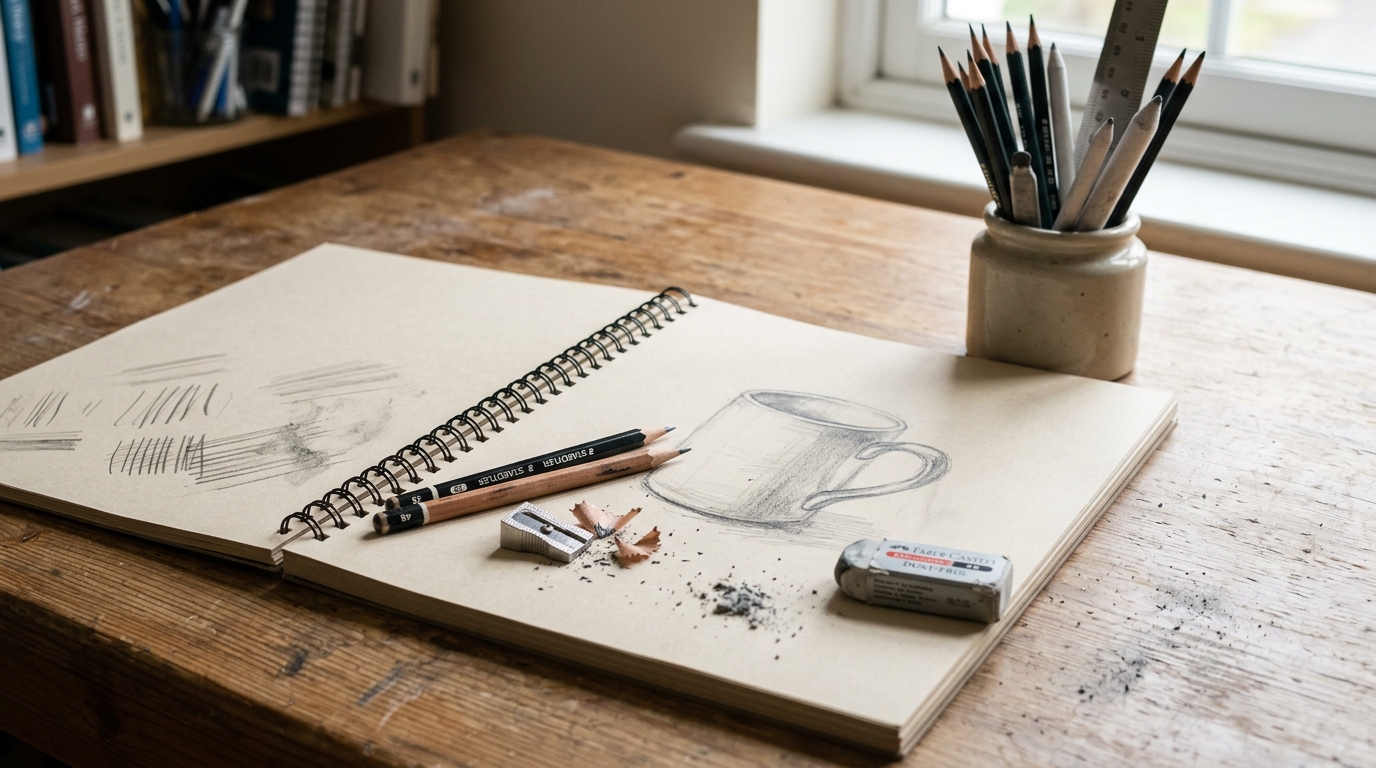
Here's what surprises most people. Almost nothing that goes wrong in a first portrait is a shading problem — it's placement. Post any early attempt to a drawing forum and you'll get forty replies about the eyes and maybe two about technique. So the kit below isn't built for rendering pretty skin texture. It's built for measuring and for pushing values dark enough to read, which makes it a close cousin of a beginner pencil sketching setup with a few portrait-specific additions.

My advice: buy fewer pencils than the big sets tempt you with. A hard one to lay the shapes in lightly, a soft one for the shadows, a paper stump, an eraser you can pinch into a point — that's a real kit. One 2B pencil and a kneaded eraser will genuinely get you a portrait. Everything else is comfort.

Nothing on this list is a commitment. The whole essential row lands somewhere near forty dollars, which felt like the right ceiling for something you might try twice and shelve.

graded graphite pencils for building portrait shadows and halftonesgraded graphite pencils for building portrait shadows and halftones

Pick 01 of 14

graded graphite pencils for building portrait shadows and halftones

A graded set runs from hard, pale leads through to soft, dark ones, and each grade lays down a different band of grey at the same pressure. For faces you mostly work with three or four of them: a hard grade for the light lay-in, a middle grade for skin halftones, and a soft grade for hair and the deep shadow shapes. Look for a set that reaches at least 6B at the soft end, since that is where the darks that make a face read three-dimensional come from.

Why we picked this exact one: The Faber-Castell 9000 set spans 8B to 2H, which covers the whole range a portrait actually asks for without leaving you to buy singles later. It holds a point better than most student-grade wood, so the hard grades stay usable for the light construction lines. At this price the case is cardboard rather than tin, which is the only real corner cut.

See it on Amazon
heavyweight vellum-surface bristol pad for layered graphite portraitsheavyweight vellum-surface bristol pad for layered graphite portraits

Pick 02 of 14

heavyweight vellum-surface bristol pad for layered graphite portraits

Bristol is a stiff, heavy drawing paper sold in two surfaces: a plate finish that is glassy smooth, and a vellum finish with a faint tooth to it. The vellum side grips graphite, so you can build skin and hair up in several light layers instead of forcing the tone in one heavy pass. A 100 lb sheet also survives repeated erasing, which matters more in portrait work than in almost anything else.

Why we picked this exact one: The Strathmore 300 Series bristol pad in the vellum surface is the version to get, not the smooth one — the extra tooth is what lets skin tones layer instead of skidding. Twenty sheets at this price works out to about fifty cents a portrait. The tape binding means you tear sheets off rather than working in the pad, which some people dislike.

See it on Amazon
mouldable kneaded eraser for lifting graphite and shaping highlightsmouldable kneaded eraser for lifting graphite and shaping highlights

Pick 03 of 14

mouldable kneaded eraser for lifting graphite and shaping highlights

A kneaded eraser is a soft putty rather than a rubber. It lifts graphite off the sheet by pressing and pulling rather than by abrading, so it leaves no crumbs and does not rough up the paper. Pinch it into a point for a catchlight in an eye, flatten it to knock a whole cheek back a shade, then knead the grey back in and carry on.

Why we picked this exact one: The Faber-Castell kneaded erasers come four to a pack in the large size, and large matters here because a small one saturates with graphite within a single portrait. They stay pliable rather than going crumbly in a cold room. In summer they can go slack and sticky, which is worth knowing before you leave one on a sunny windowsill.

See it on Amazon
paper blending stumps in graded sizes for smoothing skin tonepaper blending stumps in graded sizes for smoothing skin tone

Pick 04 of 14

paper blending stumps in graded sizes for smoothing skin tone

Blending stumps are sticks of tightly rolled paper with a point at each end, and tortillions are the thinner, softer version. Dragged over graphite they push the particles into the paper's tooth and turn a hatched patch into a smooth gradient. Sizes matter: a fat stump does a forehead, a fine one does the crease under a lower lid, and the tips are refreshed by rubbing them on a sanding block.

Why we picked this exact one: This N NOROCME twelve-piece set of stumps and tortillions covers the whole size range and throws in the sanding block you need to clean loaded tips, which most cheaper packs leave out. The paper is dense enough that the points do not mush after one session. They are not as tightly wound as artist-grade stumps, so the largest ones soften faster than the small ones.

See it on Amazon
two-step long point sharpener for exposing extra graphite leadtwo-step long point sharpener for exposing extra graphite lead

Pick 05 of 14

two-step long point sharpener for exposing extra graphite lead

A long point sharpener works in two stages: the first hole cuts the wood back at a shallow angle, the second sharpens only the exposed lead. The result is a needle of graphite far longer than a normal sharpener leaves. That length lets you draw on the side of the lead for broad tone and roll onto the tip for a lash without stopping to re-sharpen.

Why we picked this exact one: The KUM AS2M is the classic magnesium two-step sharpener and it ships with spare blades, which is the part people forget — a dull blade splinters soft leads rather than cutting them. It also has pointers for 2 mm and 3.2 mm clutch leads if you move that way later. The body is small enough to lose, so keep it in the pencil case rather than loose on the desk.

See it on Amazon

Five things on a table and you can start tonight. Expect the first few faces to come out looking like someone else entirely — that's the standard experience, not a sign you picked the wrong hobby, and it's why twenty sheets disappear faster than you'd guess. If you'd rather work in a bound book you can carry around than tear sheets off a pad, our roundup of the best sketchbooks for beginners covers that trade-off.

Tools That Argue With Your Own Eyes

After an hour on the same face, your brain quietly stops seeing it. This is the strangest part of portrait work. You'll sit back happy with a drawing, photograph it, and the photo will show you an eye parked visibly too high — an error every stranger spots in a second. People who draw faces regularly deal with this by breaking the spell on purpose: they look at the work in a mirror, turn it upside down, or walk away for twenty minutes and come back. Everything in this section is one of those tricks made physical. If you'd rather stylise faces than chase an exact likeness, most of it still earns its place, though a beginner comic and manga drawing setup would suit you better.

pen-style precision eraser for catchlights and single hair strandspen-style precision eraser for catchlights and single hair strands

Pick 06 of 14

pen-style precision eraser for catchlights and single hair strands

This is an eraser built like a mechanical pencil: a slim refillable stick that advances a couple of millimetres at a time inside a barrel. You hold it the way you hold a pencil, which means you can draw with it. The round tip is the one to pick for portraits, since a rectangular tip is better suited to straight-edged work.

Why we picked this exact one: The Tombow Mono Zero in the 2.3 mm round tip is the standard choice here and the refills are sold separately and cheaply, so the barrel outlasts the hobby. It erases cleanly down to a hard edge instead of smearing the surrounding tone. The plastic clip snaps if you clamp it onto a thick pad cover.

See it on Amazon
small flat desk mirror for reversing a drawing to check proportionssmall flat desk mirror for reversing a drawing to check proportions

Pick 07 of 14

small flat desk mirror for reversing a drawing to check proportions

A plain flat mirror on a folding stand, angled to sit next to your paper. Its job in portrait work is to show you your own drawing reversed, which resets the way your eye reads it. Buy a flat one rather than a magnifying one, since magnification distorts exactly the proportions you are trying to judge.

Why we picked this exact one: The YEAKE eight-inch folding desk mirror is flat rather than magnifying, which is the whole point for this job, and the metal stand tilts far enough to catch a drawing lying on the table. It also doubles as your reference for self-portraits. It is sold as a makeup mirror, so the packaging says nothing about drawing.

See it on Amazon
adjustable wooden drawing board that tilts your paper toward verticaladjustable wooden drawing board that tilts your paper toward vertical

Pick 08 of 14

adjustable wooden drawing board that tilts your paper toward vertical

A hinged wooden board that props your paper up at a chosen angle on an ordinary table, usually with a ledge along the bottom to stop everything sliding off. The angle is the feature. Working closer to vertical means you see the sheet straight on instead of foreshortened, and it takes the hunch out of long drawing sessions.

Why we picked this exact one: The U.S. Art Supply A3 board gives six locking angles and a pencil ledge, which covers everything from a shallow writing tilt to something near an easel. Beech-faced ply rather than the softwood used on cheaper boards, so it does not dent under a hard pencil line. It is the most expensive thing on this page by some distance, and a stack of books under a clipboard does part of the same job for nothing.

See it on Amazon
printed grey scale card with cut-out holes for judging portrait valuesprinted grey scale card with cut-out holes for judging portrait values

Pick 09 of 14

printed grey scale card with cut-out holes for judging portrait values

A stiff card printed with a graded strip of greys, each swatch pierced by a small hole. You hold it against your reference, slide it until a swatch disappears into the tone underneath, and read off the value. The holes are what make it work, since grey looks lighter or darker depending on whatever sits next to it.

Why we picked this exact one: The Color Wheel Company grey scale card is the cheap, sturdy version of this tool — laminated stock that survives being carried around in a pad. Nine steps plus the isolating holes is all the tool needs to be. The colour wheel printed on the reverse is dead weight for graphite work.

See it on Amazon
adjustable proportional divider for transferring facial measurementsadjustable proportional divider for transferring facial measurements

Pick 10 of 14

adjustable proportional divider for transferring facial measurements

Two crossed arms joined by a sliding pivot, with points at both ends. Set the pivot and one end measures a distance on your reference while the other end reports it, scaled, on your paper. It turns eyeballing into arithmetic for the handful of distances that decide whether a face reads correctly.

Why we picked this exact one: The Accurasee eleven-inch divider is aluminium with a knurled locking screw, so the setting holds instead of drifting as you work. Longer arms reach across a full sheet, which the pocket-sized versions cannot do. The points are genuinely sharp, so it is not a thing to leave lying in an open pencil case.

See it on Amazon

None of this makes you draw better on its own; it shortens the gap between making a mistake and spotting it. If the budget only stretches to one, buy the board — a portrait drawn flat on a table comes out stretched long, and you genuinely won't see it until you hold the sheet upright. If you find yourself missing colour by this point, a beginner colored pencils setup is the natural next shelf.

When Grey Paper Does Half the Drawing for You

Graphite has a ceiling and you'll hit it fast. It's a grey mineral, so its darkest black is really a very dark grey, and leaning harder on the pencil only flattens the paper fibres until the shadow throws back a silvery sheen under a lamp. There are two honest ways round that. One is a carbon-blend pencil, which reaches deeper matte tones than ordinary graphite at the same pressure; the other is to stop defending white paper altogether and work on tan stock, dropping the darks in with pencil and pulling the highlights back out in white. Toned paper is where a lot of people fall for portrait drawing properly, and it's the doorway to a beginner charcoal drawing setup, where the blacks go somewhere graphite can't follow.

warm tan toned paper pad for three-value portrait drawingwarm tan toned paper pad for three-value portrait drawing

Pick 11 of 14

warm tan toned paper pad for three-value portrait drawing

Toned paper is dyed a mid value throughout rather than printed, so the sheet itself supplies the halftone. You draw the shadows down from it in graphite and lift the highlights up from it in white, which is a different way of thinking than shading onto white. Tan warms skin tones in a way grey stock does not.

Why we picked this exact one: The Strathmore 400 Series toned pad in tan is the one most people start on, and fifty sheets at this price makes the experiment cheap enough to be worth making. The wire binding lets it fold flat against a board. At 80 lb it is lighter than bristol, so it will not take the same punishment from an eraser.

See it on Amazon
white charcoal pencils for lifting highlights on toned paperwhite charcoal pencils for lifting highlights on toned paper

Pick 12 of 14

white charcoal pencils for lifting highlights on toned paper

Wood-cased pencils with a white chalk or compressed-charcoal core instead of graphite. On toned stock they do the job the paper does on a white sheet: the brightest planes of the face, the rim along a nose, the shine on a lower lip. They sit on top of pencil work rather than mixing into it, so they go on last.

Why we picked this exact one: The MARKART five-pencil set is soft enough to deposit properly on toned stock rather than scratching across it, which is the usual failing of cheap white pencils. Five in a pack means you can sharpen aggressively without rationing. The cores are brittle, so a dropped pencil will need re-sharpening several times before it holds a point again.

See it on Amazon
carbon-blend black pencils for the deepest matte portrait shadowscarbon-blend black pencils for the deepest matte portrait shadows

Pick 13 of 14

carbon-blend black pencils for the deepest matte portrait shadows

These look like ordinary drawing pencils but the core blends carbon into the graphite. That changes the mark: darker at the same pressure, and matte rather than reflective. They are aimed squarely at the places standard graphite gives up — pupils, nostrils, the shadow inside a parted mouth.

Why we picked this exact one: The Staedtler Mars Lumograph Black set runs HB through 8B, so you can drop it into a drawing already started in ordinary graphite rather than committing the whole sheet. The matte surface photographs far better than standard soft graphite, which matters if you share work. This listing bundles a small sharpener and eraser you probably already own.

See it on Amazon
spray fixative for sealing finished graphite and white-chalk drawingsspray fixative for sealing finished graphite and white-chalk drawings

Pick 14 of 14

spray fixative for sealing finished graphite and white-chalk drawings

Fixative lays a thin binder over a finished drawing so loose particles stop moving. It is worth the trouble mainly on soft, powdery media, which smudge from a sleeve brushing past. Spray it in light passes from a distance in a ventilated room; one heavy coat darkens the paper and can lock in a shine.

Why we picked this exact one: SpectraFix uses a milk-casein and alcohol formula rather than the usual solvent aerosol, so it can be used indoors without clearing the room. It ships as a pump bottle instead of a can, which gives a coarser spray than an aerosol and takes practice to keep even. It is also easily the priciest item here, and skipping fixative entirely is a defensible choice if your drawings go straight under glass.

See it on Amazon

Tan paper feels backwards for about ten minutes and then it clicks: you're not building a face onto white any more, you're finding it between the dark and the light. Fair warning, white charcoal is chalkier than graphite and it lifts if you so much as drag a sleeve over it, which is the one place in this setup where the fixative earns its keep.

The Things Nobody Mentions Until Your Portrait Is Already Wrong

Why does my portrait come out long-faced when the reference isn't?

You're almost certainly drawing on a flat table. Lying down, the sheet is seen at a slant, so your eye foreshortens it while you work and you compensate by stretching everything downward; stand the drawing up and the whole head has grown. This is one of the most common corrections people give on drawing forums, and beginners rarely guess it because the drawing looks correct from the chair. Tilt the surface toward vertical, or lift the sheet and look at it straight on every few minutes.

Everyone says one eye is too high. Why can't I see it?

Your visual system has been staring at that face long enough to start confirming it rather than checking it. The cost is that the single most obvious error in the drawing is the one you're blind to, while every fresh viewer names it instantly. The fix is to reverse the image: hold the sheet up to a window and look through the back, view it in a desk mirror, or simply turn it upside down. Walking away for twenty minutes does the same job more slowly.

My proportions are right but it still isn't the person. What's missing?

Almost always values, and almost always the hair. Beginners keep an entire portrait inside a narrow band of mid-grey, so a head of dark hair ends up the same tone as a cheek shadow and the face reads as generic. Squint hard at your reference until the detail collapses and only blocks of light and dark remain, then compare that to your drawing squinted at the same way. Push the hair and the deep shadow shapes considerably darker than feels comfortable, and leave the lit planes genuinely light rather than filling them in.

Can I just add charcoal on top for the really dark bits?

It's the obvious shortcut and it doesn't work well. Graphite and charcoal don't blend into each other, so you get a visible seam where the two meet, and charcoal will barely take on an area of paper already burnished shiny with pencil. Beginners try it exactly at the point where graphite runs out of darkness, which is the worst possible place for a seam. If you need blacks that deep, either start the drawing in a carbon-blend pencil or commit to charcoal from the first mark.

Love what you see here? Save individual picks with on any item, or copy everything to a list of your own in one click — great for coming back to later, or dropping as a not-so-subtle hint.

Disclosure: Some product links may be affiliate links. If you make a purchase through one of these links, we may earn a small commission at no extra cost to you.