Work Big and Bold: Charcoal Drawing for New Artists

Work Big and Bold: Charcoal Drawing for New Artists

DariaCurated by Daria

Black Fingers, Big Shadows

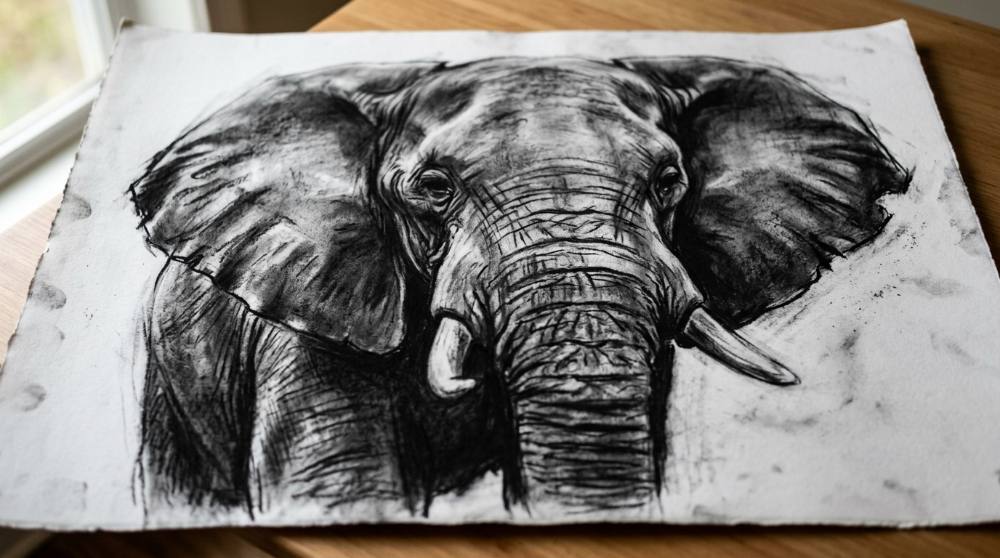
The black animals on the walls of Chauvet cave were drawn in charcoal, and they are the only cave pigments that can be dated directly, because the drawing material is itself carbon. Roughly thirty-six thousand years old. It is still made the same way, too: willow or grapevine charred in a kiln with the air shut out. You will meet it in art-school foundation rooms, in life-drawing sessions, and on kitchen tables where somebody just wanted to make a mess. Drag a stick sideways and half a page goes dark in one motion.

Here is what nobody warns you about: charcoal doesn't stay where you put it. It travels onto your sleeve, your chin, the edge of the table. Beginners arriving from a graphite pencil sketching setup usually spend their first hour fighting that, trying to draw thin careful lines with a material that wants to cover ground. The medium rewards the opposite instinct. Block in the big dark shapes first, then dig the light back out.

Our philosophy: buy less than you think you need. A few sticks of vine charcoal, one compressed stick for the darks, a pad with some grit to it, and a kneaded eraser will carry you through months of drawing. The rest is decoration.

Nothing on this list costs more than a couple of coffees, so if charcoal turns out not to be your thing, you're not out much.

Pick 01 of 12

Soft Charcoal Drawing Sticks

soft vine charcoal sticks for blocking in broad tonal shapes

soft vine charcoal sticks for blocking in broad tonal shapessoft vine charcoal sticks for blocking in broad tonal shapes

Vine charcoal is made by charring thin willow or grapevine sticks, and it leaves a soft grey mark that sits on the paper surface rather than sinking into it. That makes it almost completely erasable, which is why it is used for the searching, correcting stage of a drawing. Look for soft grades and a box with enough sticks that snapping one mid-drawing does not matter.

Without a stick that erases cleanly, every wrong line becomes part of the drawing, and beginners stop taking the risks that teach them to see.

Why we picked this exact one

The Winsor & Newton Artist Vine Charcoal in the soft grade holds a 4.6-star average across more than 800 reviews, which is unusual for a consumable this cheap. Soft is the right grade to start on, because it lays down tone with almost no pressure and you are less likely to snap sticks while you learn the grip. They do arrive fragile and a few usually break in transit, which is why a box of twelve rather than a box of three is the sensible buy.

Pick 02 of 12

Soft Compressed Charcoal Drawing Sticks

compressed charcoal sticks for the deepest darks in a drawing

compressed charcoal sticks for the deepest darks in a drawingcompressed charcoal sticks for the deepest darks in a drawing

Compressed charcoal is ground charcoal held together with a binder and pressed into a stick, which makes it far denser and darker than natural vine. It grips into the paper instead of sitting on it, so marks are hard to remove once made. A soft assorted set gives a beginner the range to push shadows properly black without jumping straight to the hardest grade.

Vine charcoal has a grey ceiling it cannot pass, so without a compressed stick the darkest shadow in a drawing stays a middling grey and the whole image reads flat.

Why we picked this exact one

General's 957ABP compressed charcoal comes as a four-stick soft assortment and carries 4.6 stars from over 1,600 reviews. The sticks are consistent from box to box, which matters more than it sounds when you are still learning how much pressure each grade needs. The square profile chips if you drop it on a hard floor, though the broken pieces still draw perfectly well on their sides.

Pick 03 of 12

Premium Charcoal Pencil Drawing Set

charcoal pencils in a range of grades for edges and detail work

charcoal pencils in a range of grades for edges and detail workcharcoal pencils in a range of grades for edges and detail work

A charcoal pencil is compressed charcoal in a wooden barrel, which keeps your fingers clean and lets you sharpen to a point. It handles the places a stick is simply too blunt for: eyelashes, the edge where two shapes meet, a small dark accent. A set spanning hard through extra-soft covers both crisp lines and rich dark passages.

A stick of charcoal cannot make a small controlled mark, so without pencils a drawing has no way to resolve at the edges and every detail stays approximate.

Why we picked this exact one

The Brusarth six-piece charcoal pencil set spans hard through extra-soft and rates 4.7 stars from over 1,100 reviews. It is a pure charcoal set rather than one of the bundled kits that pad the piece count with graphite pencils and accessories you already own. The barrels are soft wood and can splinter in a cheap rotary sharpener, so a blade or a sandpaper block treats them better.

Pick 04 of 12

Premium Wire Bound Charcoal Sketch Pad

textured charcoal paper pad with enough tooth to hold heavy tone

textured charcoal paper pad with enough tooth to hold heavy tonetextured charcoal paper pad with enough tooth to hold heavy tone

Charcoal paper has a raised surface texture, called tooth, that catches and holds charcoal particles as you drag a stick across it. Smooth paper lets the charcoal skate off, so tone will not build and blending goes muddy. A laid-surface pad in a mid weight is the standard beginner surface, and a wire binding lets you fold sheets back flat while you work.

Tooth is what physically holds charcoal on a page, so drawing on smooth paper caps how dark you can go and makes layering impossible no matter how good your technique is.

Why we picked this exact one

The Strathmore 300 Series wire-bound charcoal pad is the pad experienced artists point beginners toward, and it holds 4.8 stars across more than 1,500 reviews. Its 64 lb laid surface has a visible ribbed texture that grabs charcoal on the first pass. At 9 by 12 inches it is smaller than the newsprint most people practise on, which is deliberate: this is the pad you move to when a drawing is worth keeping.

Pick 05 of 12

Soft Kneaded Drawing Erasers Pack

kneaded erasers for lifting highlights back out of charcoal tone

kneaded erasers for lifting highlights back out of charcoal tonekneaded erasers for lifting highlights back out of charcoal tone

A kneaded eraser is a soft mouldable putty that lifts charcoal by absorbing it rather than abrading it off the paper. You can press it flat to pull a broad highlight or pinch it to a point for a thin bright line. Because it fills with charcoal as you use it, the normal practice is to stretch and fold it to bring a clean surface back to the outside.

Charcoal drawing runs backwards from pencil work: you cover the page first and then take the light back out, and the eraser is the tool doing the drawing in that second half.

Why we picked this exact one

This Faber-Castell four-pack of large grey kneaded erasers averages 4.8 stars from nearly 12,700 reviews. Buying four at once matches how charcoal actually consumes them, since one eraser saturates within a session or two and having spares stops you working with a dirty one that smears instead of lifting. The grey ones show their dirt less clearly than white, which is a small annoyance when you are judging whether one is still usable.

With those five things you can make a finished drawing today. Not a study, an actual drawing. One warning though: go too dark too fast and you'll find you can't erase your way back out, because compressed charcoal grips the paper in a way vine never does. Start light, stay light longer than feels natural, and save the blackest blacks for last. If you're putting together a first art kit more broadly, it's worth knowing which art supplies beginners waste the most money on.

The Stuff You'll Want by Week Three

Once you've filled a few sheets the gaps start showing. You burn through paper faster than you expected, your fingertips turn out to be too blunt for small areas, and the drawing you liked keeps smudging every time you shift it on the desk. None of that is urgent on day one. It becomes urgent around the point where you start caring how a drawing looks after you've stopped working on it. If you're keeping the whole kit deliberately cheap, a sketching setup under twenty euros covers a surprising amount of this ground.

Pick 06 of 12

Heavyweight Newsprint Sketch Pad

large newsprint pad for high-volume charcoal practice

large newsprint pad for high-volume charcoal practicelarge newsprint pad for high-volume charcoal practice

Newsprint is thin inexpensive paper sold in big pads, meant to be used up rather than saved. Its rough finish takes charcoal well enough for gesture work and value studies, though it will not hold the deep layered tone that textured charcoal paper will. Large sheets suit the medium, because charcoal wants arm movement rather than wrist movement.

Cheap paper is what lets a beginner draw badly a hundred times, and drawing badly a hundred times is the only thing that produces the hundred-and-first.

Why we picked this exact one

The Strathmore 300 Series newsprint pad in 18 by 24 inches gives 50 sheets and rates 4.7 stars. That size is the standard easel format in foundation drawing classes, and it pushes you into the loose full-arm marks charcoal is good at. It is tape-bound rather than wire-bound, so sheets tear off cleanly but the pad will not fold back on itself.

Pick 07 of 12

Essential Blending Stump Set

paper blending stumps for smoothing charcoal in small areas

paper blending stumps for smoothing charcoal in small areaspaper blending stumps for smoothing charcoal in small areas

A blending stump is tightly rolled paper with a tapered point at each end, used to push charcoal particles around and soften an edge. Fingers work for large areas but leave skin oil on the paper, and they are far too blunt for anything small. Assorted sizes matter, because the right stump for a nostril is not the right stump for a cheek.

Fingertips leave oil on the paper that shows up as shiny patches under later layers, so anything smaller than a palm-sized area wants a paper tool instead.

Why we picked this exact one

The Staedtler blending stump set gives four assorted sizes at 4.6 stars from nearly 1,900 reviews. These are wound tightly enough to keep their point instead of mushrooming after a few minutes, which is the usual complaint about bargain stumps. They load up with charcoal quickly and need sanding back, so plan on cleaning them rather than replacing them.

Pick 08 of 12

Professional Art Fixative Spray

artist fixative spray for stopping a finished charcoal drawing smudging

artist fixative spray for stopping a finished charcoal drawing smudgingartist fixative spray for stopping a finished charcoal drawing smudging

Fixative is a fine spray that binds loose charcoal particles to the paper so a finished drawing survives handling and storage. Charcoal is barely attached to the page and will transfer onto anything it touches, including the sheet stacked above it. A workable formula lets you spray and then keep drawing over the fixed layer.

An unfixed charcoal drawing degrades a little every time it is moved, so the piece you were proudest of gets quietly ruined by the act of filing it away.

Why we picked this exact one

SpectraFix is the fixative experienced artists name when the question comes up, and it rates 4.4 stars from nearly 800 reviews. It is non-toxic enough to use indoors without clearing the room, which is not true of most solvent aerosols. It costs considerably more than a hardware-store can, and it is a pump bottle rather than a propellant one, so even coverage takes a little more patience.

Pick 09 of 12

Soft Absorbent Artist Chamois Pads

leather chamois for spreading charcoal into broad soft tone

leather chamois for spreading charcoal into broad soft toneleather chamois for spreading charcoal into broad soft tone

A chamois is a piece of soft leather used to smear charcoal across large areas into an even atmospheric grey. It is the fastest way to tone a whole sheet before you start drawing into it. Because it holds a lot of charcoal dust, it also works in reverse, knocking a drawing back several values without erasing anything.

Toning a whole sheet by hand is slow and comes out blotchy, and that friction is enough to stop most beginners ever trying the dark-to-light approach at all.

Why we picked this exact one

The Jack Richeson artist chamois comes as a two-pack of 5 by 7 inch pieces at 4.6 stars from over 550 reviews. Two is the right number, because one stays relatively clean for lightening while the other becomes your dedicated dirty one for laying tone. It is leather and it gets genuinely filthy, with no washing it back to new, so treat it as a consumable rather than a tool.

Here's a tip that costs nothing: slide two or three spare newsprint sheets under the page you're actually drawing on. That bit of cushion lets the charcoal bed down evenly instead of skating over the hard spots, and it shows up most on thin paper. Fixative I'd use sparingly, honestly. It locks a drawing down, but it can also flatten the gradations you worked hardest on, so spray the finished piece rather than every layer along the way. Most of this carries straight over if you ever try a beginner soft pastels setup, which leans on the same toothed papers and the same lift-out habits.

Turning the Lights Back On

There's a moment charcoal people talk about. You tone a whole sheet grey, start pulling light out of it with an eraser, and a face appears where a minute ago there was nothing but fog. Working that way, from dark toward light, is closer to sculpting than to drawing, and it's the thing graphite can't really do. The items here exist to support that, and none of them belong in your first week. A beginner portrait drawing setup leans on the same idea, since a face is mostly a problem of working out where the light lands.

Pick 10 of 12

White Charcoal Sketch Pencil Set

white charcoal pencils for adding highlights on toned paper

white charcoal pencils for adding highlights on toned paperwhite charcoal pencils for adding highlights on toned paper

White charcoal pencils lay down opaque white on a mid-tone surface, letting you draw the light directly instead of only erasing toward it. On white paper they do almost nothing; on grey or tan paper they carry the brightest values in the drawing. They behave more like chalk than like charcoal and will not blend into black charcoal cleanly.

On toned paper the sheet itself is your mid-value, which means highlights have to be added as marks; there is no white underneath left to erase back to.

Why we picked this exact one

The MARKART five-piece white charcoal pencil set rates 4.6 stars from over 2,500 reviews and costs less than a single artist-grade pencil from a specialist brand. Five is more than most people get through in a year, so a set at this price removes any reason to ration highlights while you are learning where they belong. White charcoal is chalkier than the black kind by nature, so expect to sharpen more often as the tips crumble.

Pick 11 of 12

Premium Wire Bound Sketch Pad

mid-grey toned sketch pad for working toward black and white at once

mid-grey toned sketch pad for working toward black and white at oncemid-grey toned sketch pad for working toward black and white at once

Toned paper starts at a middle value, so the surface itself does the work of your mid-greys and you build outward toward black and white from there. It shortens a drawing considerably and makes value relationships easier to judge than staring at white. Grey suits charcoal better than tan, which pushes everything warm.

Starting on white means spending the first half of every drawing simply covering the paper, and the value judgements you make while doing it are guesswork until the white is gone.

Why we picked this exact one

The Strathmore 400 Series toned sketch pad in grey holds 4.8 stars from more than 11,000 reviews, and this 11 by 14 wire-bound version gives room to work loosely. The 80 lb sheet takes charcoal and white pencil without buckling. It is a sketch surface rather than a true charcoal paper, so the tooth is finer and deep blacks take more layers than they would on laid charcoal stock.

Pick 12 of 12

Sketch Pencil Sharpener and Pointer

sandpaper sharpening block for shaping charcoal points and making powder

sandpaper sharpening block for shaping charcoal points and making powdersandpaper sharpening block for shaping charcoal points and making powder

A sandpaper block is a small pad of bound abrasive sheets used to shape a charcoal pencil or stick into a chisel or a fine point. Rotary sharpeners tend to break charcoal cores, so abrading the tip is the safer method. The dust it produces is usable in its own right, picked up on a cloth or a soft brush and spread as tone.

Charcoal cores are brittle enough that a rotary sharpener snaps them again and again, and the visible cost of that is a pencil eaten in a week.

Why we picked this exact one

This Demissle sandpaper pointer rates 4.7 stars from 174 reviews and holds nine tear-off sheets, so it lasts well past the point where the first sheet has clogged with charcoal. Shaping a pencil on it leaves a small pile of charcoal powder, which you can lift with a chamois or a soft brush and use to tone an area. The sheets are stapled at one end and tearing one off is fiddlier than it ought to be.

None of this makes you better at drawing. It widens what you can say once you already know how to look. If I had to pick one, it'd be the toned paper, because starting from a mid-grey spares you the tedious business of covering white before the drawing even begins. Keep the white charcoal for genuine highlights, though. Used everywhere, it turns a drawing chalky and flat.

Why Your Charcoal Drawing Turns to Mud

Why does my drawing look grey and flat no matter how hard I press?

Vine and willow charcoal physically cannot reach a deep black, and pressing harder does not change that. What pressing harder does do is crush the stick and burnish the paper's tooth flat. Once an area's tooth is flattened it stops accepting charcoal at all, so you are stuck under a grey ceiling with no way back. Block in with vine, then switch to compressed charcoal or a charcoal pencil for the darkest passages, late in the drawing when you know where they belong.

I put compressed charcoal down early and now I can't erase it. What happened?

Vine sits on the surface and lifts off almost completely, but compressed charcoal carries a binder that grips into the paper fibres and largely stays put. Beginners reach for it early because it makes such satisfying dark marks, then discover their whole under-drawing is permanent. Do your searching and correcting in vine, which forgives nearly everything. Bring compressed in only once the structure of the drawing is settled.

My kneaded eraser stopped picking anything up. Is it worn out?

It is saturated, not worn out. A kneaded eraser works by absorbing charcoal, so after a few minutes its surface is as black as the paper and all it does is move dust around. Stretch and fold it several times to bury the dirty face and bring clean putty back to the outside. Only when the whole lump is uniformly black through and through is it actually finished.

Can I just use hairspray instead of buying real fixative?

You can, and it will hold charcoal down for a while. The problem shows up later: hairspray yellows the paper and eventually turns tacky, which is why it survives as an art-class habit for getting a piece as far as being graded and no further. Proper fixative costs more per can and does not discolour. If you are spraying a drawing you actually intend to keep, that difference is visible within a few years.

Why does my paper look fine but the charcoal still goes on patchy?

Usually the problem is not the paper, it is what is underneath it. Working on a single sheet laid on a hard table means every hard spot in that surface resists the stick, and the tone breaks up into blotches. Slide two or three spare sheets of cheap paper under your working sheet and the charcoal beds down evenly. It is most obvious on thin paper, and it costs nothing to fix.

Love what you see here? Save individual picks with on any item, or copy the whole list to your own wishlist in one click — great for coming back to later, or dropping as a not-so-subtle hint.

Disclosure: Some product links may be affiliate links. If you make a purchase through one of these links, we may earn a small commission at no extra cost to you.