Pickleball exists because somebody lost a shuttlecock. On a Saturday afternoon in 1965, two fathers on Bainbridge Island came home from golf to bored families, couldn't find the birdie for the badminton set, and started improvising on the badminton court with table-tennis paddles and a perforated plastic ball. They dropped the net to hip height, and the court has kept the badminton footprint ever since: 20 by 44 feet, with the net sitting 34 inches high in the middle. Nobody has ever settled the name either, and the sport's own official history admits it cannot tell whether the game was named after the Pritchards' dog Pickles or the dog was named after the game. Sixty years on, 24.3 million Americans played it in 2025.
Here's the part that actually surprises people: the rallies start on day one. The ball moves slowly enough that your eyes can follow it, the court is small enough that you barely have to run, and your first game involves real back-and-forth rather than chasing. That's rare. Most racket sports make you earn a rally over weeks, which is why pickleball keeps showing up on every list of ways to pick a first hobby that someone will still be doing in March.
Our philosophy: buy the smallest pile of gear that gets you onto a court. One composite paddle, a sleeve of balls and shoes that grip sideways will do it, and the net only matters if your court is a driveway.
Everything below is cheap enough that quitting in three weeks costs less than a night out.
Where This Little Kit Can Take You
A few real moments and results from this hobby — made with tools no fancier than the ones below.
Set and ready at the baselineThe low, knees-bent stance that a pickleball rally actually lives in.
Paddle parked against the netA scuffed face and a yellow ball at the end of a session.
Two warnings before the shopping. Paddle models churn hard - brands refresh lines yearly, and a roundup written eighteen months ago is quoting paddles you can't buy. And the gear ceiling in this sport is genuinely low; nobody at your local courts will notice what you're holding. If you're still weighing this against the other things you could take up this winter, the wider list of starter hobbies worth an adult's time is worth a look first.
The Four Things That Stand Between You and a Game
A paddle, a few balls, something to hit over and shoes that won't betray you sideways. That's the whole list. The trap is the paddle wall in any sporting goods shop, where forty options sit between $20 and $250 and none of the labels mean anything yet. Two numbers do most of the work: core thickness and weight. Go with a 16mm core and stay between 6.5 and 9 ounces, and you've already dodged most of the bad outcomes. If you've played table tennis at home, the paddle will feel absurdly heavy for about ten minutes and then feel normal.
Disclosure: This section may contain affiliate links to Amazon. We may earn a small commission from qualifying purchases at no extra cost to you.
01Pick 01 of 09
Composite Pickleball Paddle
A pickleball paddle is a stringless face on a short handle, built as a honeycomb core sandwiched between carbon fibre or fibreglass skins. Core thickness is what a beginner should read first: a 16mm core soaks up pace and widens the forgiving part of the face, while thinner cores fire the ball back faster than a new player can aim. Look for a standard or wide shape rather than a long narrow one, and a grip circumference around four and a quarter inches.
Why we picked this exact one: The Selkirk SLK Helix Pro is the pick here: a 16mm thermoformed carbon-fibre paddle from the best-known brand in the sport, priced like a no-name import. It's built around a wide face with a large sweet spot, which is the shape that forgives off-centre contact while you're learning where the middle is. It carries 4.6 stars from a modest 149 ratings, a smaller sample than the generic paddles that flood search results, and I'd still take it over them.
These 2 do the same job. You only need one of them, so pick the one that suits you better.
02Pick 02 of 09Option A
Outdoor Pickleballs
Outdoor pickleballs are hard, single-piece plastic spheres with roughly 40 small holes drilled through the shell. The tighter hole pattern is what keeps the ball on line in a breeze, and it is the whole reason outdoor and indoor versions are different objects. On rough hard courts they eventually crack rather than go soft, so treat them as a consumable rather than a purchase.
Why we picked this exact one: The Franklin Sports X-40 is the straightforward pick: it's the official ball of USA Pickleball and the US Open, so it's what you'll meet on most public courts anyway. Forty machine-drilled holes, 26 grams, 74 millimetres - it's the reference other outdoor balls get measured against. It also cracks in cold weather the way every hard outdoor ball does, so buy more than one.
Pros
Holds its line in wind, which indoor balls can't
The ball most public outdoor courts already use
Hard enough for asphalt and concrete
Cons
Cracks rather than softening, especially in the cold
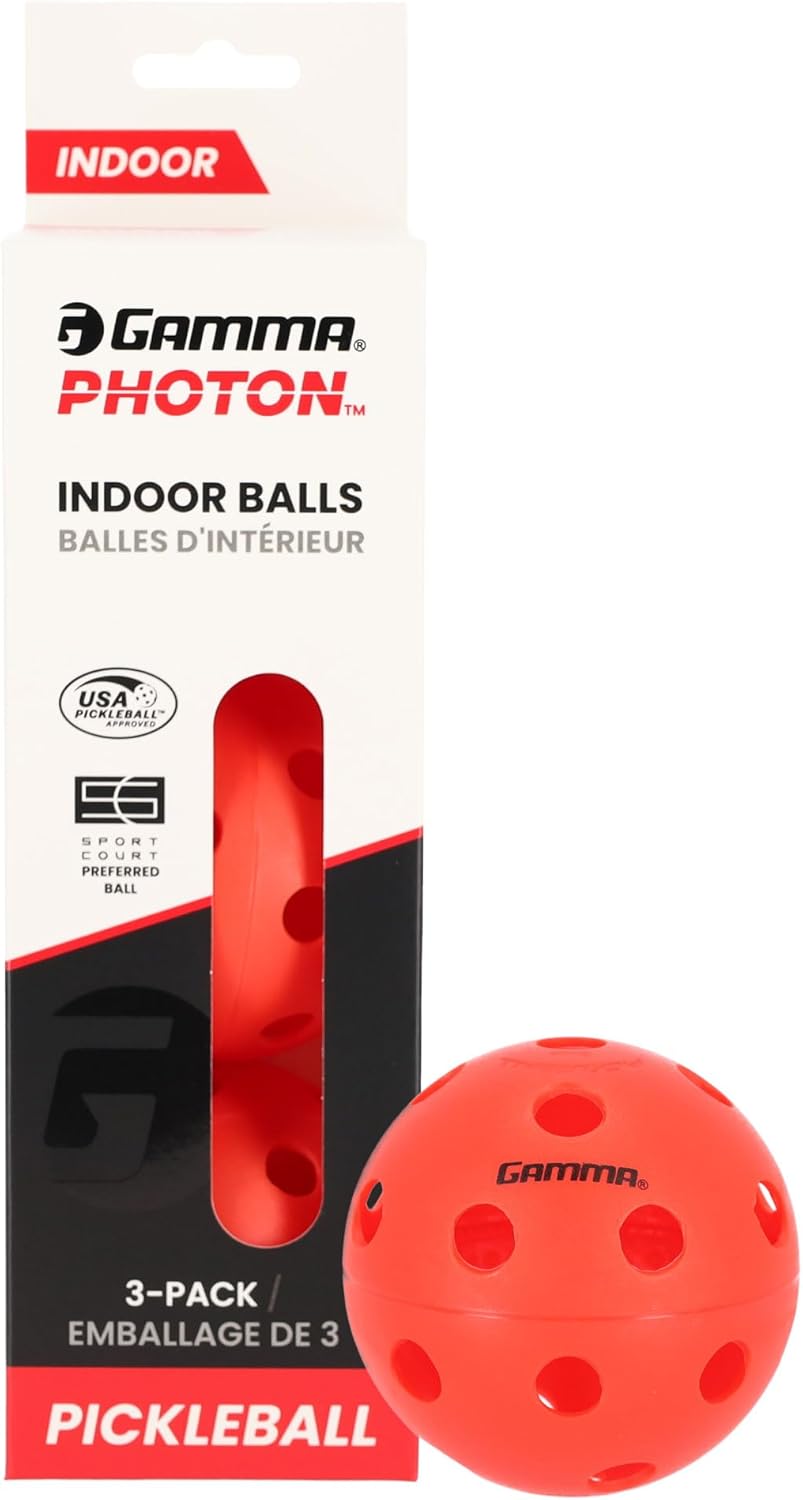
Indoor pickleballs carry around 26 larger holes and a softer shell than their outdoor counterparts. That makes them quieter off the paddle and slower through the air, which suits a gym floor where there is no wind to fight. They tend to go out of round before they ever crack, and a ball that has lost its shape starts curving in ways nobody hit on purpose.
Why we picked this exact one: The Gamma Photon is the indoor pick - 26 holes, USA Pickleball approved, from a brand that has been making racket-sport grips and strings for decades. Its 4.2-star average sits below the outdoor ball's, which is ordinary for indoor balls given how they deform rather than break. It's also the cheapest line in this whole setup, so buy more than you think you need.
Pros
Slower and quieter, much easier to track on day one
A portable net is a metal frame that assembles in a few minutes and packs into a bag about the size of a camping chair. The measurement that matters is 34 inches at the centre and 36 at the posts, because every shot practised over the wrong height trains the wrong margin. A centre support and angled feet are what keep it honest once there's any wind about.
Why we picked this exact one: The Fostoy portable net set is the pick largely because it states its dimensions plainly - 22 feet wide, 36 inches at the posts, 34 at the centre - which a surprising number of listings never do. It ships with a half-court 11-foot net as well, which is genuinely useful for short-court dinking practice. It holds 4.7 stars across 794 ratings; the wheels are a carrying convenience and do nothing for stability in wind.
Court and tennis shoes carry extra material along the sides of the midsole, exactly the part that running shoes strip out to save weight. That bulk is what stops a foot sliding off its own sole on a sideways push. The outsole matters too: a flat gripping tread for gym floors, a tougher tread for outdoor hard courts, which chew through soft rubber fast.
Why we picked this exact one: The ASICS Gel-Dedicate 9 is the pick: an entry-level tennis shoe from the brand pickleball coaches name more than any other, at well under what a dedicated pickleball model costs. It bends at the toe rather than folding in the middle, which is the quick test for whether a shoe belongs on a court at all. The line comes in men's and women's fits; it's a hard-court shoe, so if you'll mostly play on gym wood, look at an indoor court shoe instead.
Those four get you onto any court in the country, and the only one you'll replace within a year is the balls. Set the net up once in the garden before you drag it to a park - the first assembly takes twenty minutes and the fifth takes four. It's gear with the same quiet appeal as a beginner birdwatching kit: a small, finite pile of things that gets you out of the house.
Or Just Buy the Box
There's an honest alternative to the list above and it costs about thirty dollars. A boxed set puts two paddles, four balls and a carry bag in one package, which quietly solves the real flaw in the shopping list: pickleball needs two people and you've only bought one paddle. It won't cover shoes or a net, and the paddles inside are thinner than the one above. Same instinct as picking up a first jigsaw puzzling setup - one box, one evening, no research.
The one-box alternative
Pickleball Paddle Starter Set
An all-in-one pickleball set holds two paddles, a handful of balls and a bag in a single box. The paddles are usually fibreglass over a honeycomb polypropylene core, the same basic construction as a standalone budget paddle but thinner and lighter. Check which balls are included, because many sets ship a single dual-use ball that compromises in both directions.
Why we picked this exact one: The JOOLA Pickleball Paddles Set of 2 is the kit to take if you take one. JOOLA has made racket-sport equipment since 1952 and is the official equipment partner of the PPA Tour, and this set is USA Pickleball approved rather than vaguely 'tournament ready'. It runs 4.5 stars across more than a thousand ratings, which is unusual at this price. The paddles are thinner and less forgiving than the standalone pick above, and that's the trade you're making.
Two people can play a full game straight out of the box, and four balls covers an afternoon. better here
One paddle and a sleeve of balls, so your second player has to own a paddle already.
Quality of the tools
Thin fibreglass faces that pop the ball back rather than absorb it, which is fine while you're learning where the lines are.
A 16mm core takes the sting out of off-centre hits, and the balls match the court you actually play on. better here
The first evening
Open the box, find a driveway, play. Nothing left to decide. better here
Shoes and a net both have to arrive before the first game feels like a real one.
Where it leads
The bag and the balls stay useful; the paddles get retired once you can feel what they're missing.
Paddle and shoes carry straight into a second season without a thought. better here
Our verdict: it depends. Take the kit if you want two people hitting this weekend and aren't sure pickleball will stick; build from the picks if you already know you'll be on a court every week by spring.
Nothing here decides whether you can play. These are the things that show up after a few sessions, once the factory grip has gone slick under your palm, the balls are rolling loose in the boot of the car, and hauling everything in a supermarket bag has started to feel silly. One of them is a second paddle, which sounds daft until you've spent a month working out what you actually want from one. It's the same arc as a first speedcubing setup, where the upgrade only makes sense once your hands know what to ask for.
06Pick 06 of 09
Pickleball Backpack With Shoe Compartment
A pickleball backpack differs from an ordinary daypack in two ways: a padded outer sleeve shaped to hold paddle faces, and a vented compartment at the bottom for shoes. The paddle sleeve keeps the face away from keys and zips, which is where most surface scratches come from. Two bottle pockets are worth having, because this sport makes you drink more than it looks like it should.
Why we picked this exact one: The Athletico 35L Pickleball Backpack suits a beginner because it holds two paddles rather than the six a tournament player hauls, which keeps it the size of a normal backpack. The vented shoe compartment is the feature that earns its place - court shoes sealed in a bag overnight get unpleasant quickly. It sits at 4.4 stars over 486 ratings, and the included ball holder is a simple mesh drawstring bag rather than anything clever.
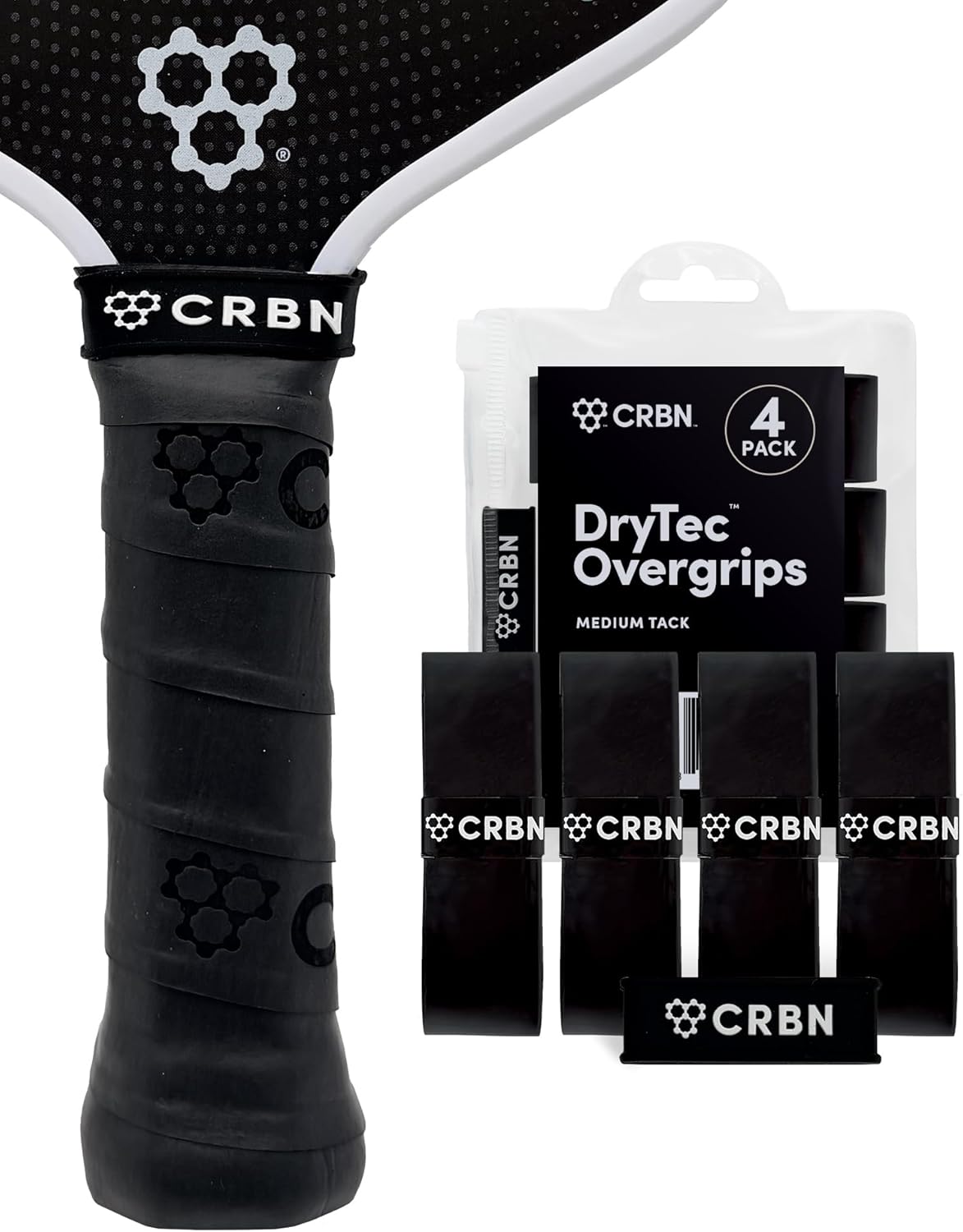
Overgrip is a thin strip of tacky tape wound over a paddle's factory handle. It does two jobs at once: it adds grip when your hands sweat, and it builds the handle circumference up a notch if the stock grip is too small for your hand. A wrap lasts a few weeks of regular play and peels off without leaving residue behind.
Why we picked this exact one: The CRBN DryTec overgrips are the pick: at 0.6mm each, a single wrap nudges the handle up a notch without turning it into a baseball bat. They hold 4.6 stars across 973 ratings. A four-pack is the sensible starting quantity, since one wrap lasts a few weeks once you're playing properly, and the white ones show every bit of court dust.
A retriever tube is a lightweight pole with a sprung opening at the bottom: press it down onto a ball and the ball pops up inside. It stores a whole stack, so a court's worth of balls comes back in one walk. The sections unscrew, so it packs flat enough to live in a bag rather than the garage.
Why we picked this exact one: The SELMOR pickleball retriever holds 17 balls and builds from three sections, so you can set it to your own height instead of stooping over something too short. It sits at 4.7 stars across 321 ratings. The tube-and-connector fit is deliberately tight and needs a firm shove on assembly; the reviews that call it flimsy mostly describe skipping that step.
A step-up paddle changes what happens on soft shots. Foam-filled perimeter walls and a raw carbon face hold the ball on the paddle a fraction longer, which is what lets a player drop it gently into the non-volley zone instead of popping it up for a smash. The construction costs more, and the benefit only appears once you can reliably find the middle of the face.
Why we picked this exact one: The Vatic Pro Prism Flash is the step up worth making - 16mm, raw carbon face, foam-injected walls, at around eighty dollars when comparable builds run double. It's the paddle recreational players on racket-sport forums keep recommending to each other rather than one a brand is pushing. Wait for it, though: buy this in your first month and you're paying for control you can't yet use, and if you're still popping every third ball up, the paddle isn't the problem.
Buy these in the order your annoyances arrive rather than all at once. The grip tape is the one nobody regrets and everybody puts off, usually until the paddle slips mid-rally on a warm evening. If you want the sessions to actually stack up rather than fizzle out by February, it helps to hang them off a fixed slot in the week, the same way a beginner's creative routine gets built.
The Stuff Nobody Tells You Until You've Already Bought It
Why does my brand-new net sag lower than the one at the park?
Most portable nets hang off a straight top rail, and with nothing supporting the middle the net droops below the 34 inches it's supposed to sit at. Beginners don't notice, then wonder why drives that clear a public net keep getting stuffed by it. Measure the centre with a tape the first time you set the thing up. If it's low, a centre post or strap pulls it back to height, and some sets include one while plenty don't.
I bought one set of balls. Why do they feel completely different at the gym?
You almost certainly bought outdoor balls, and they're a different object. Forty small holes and a hard one-piece shell make them fast and loud on wood, where a 26-hole indoor ball is softer and slower through the air. Nothing about it is dangerous, it just makes everything arrive before you can move. Buy the type that matches wherever you play most, and don't bother owning both until you genuinely split your time.
Everyone says buy light. So why does my light paddle feel worse?
Weight is the first number people fixate on and the wrong one to lead with. Drop under about 6.5 ounces and there's nothing to swing against, so any ball landing off-centre twists the face in your hand. Core thickness matters more: a 16mm core absorbs pace and widens the forgiving part of the face, which is exactly what a beginner needs. Pick the thickness first, then stay anywhere between 6.5 and 9 ounces and stop thinking about it.
Is a wooden paddle really that bad for twenty dollars?
The price is real and so is the catch. A wooden paddle can run up to 20 ounces where a composite one sits near 7.5 - not a small difference, closer to three times the mass hanging off the end of your arm. Half an hour in, your forearm is done and your overheads are flying past the baseline, and you'll blame your swing rather than the plank. Wood paddles survive because they're what the game was invented with and because schools buy them by the crate. If twenty dollars is genuinely the ceiling, buy one; if thirty-five is possible, don't.
People Worth Following Into This Hobby
Real practitioners we found while researching this setup — people who do the work, show their process, and publish on sites they run themselves. No sponsorships, no affiliations; we just think they're worth your time.
Runs pickleball clinics and private lessons across North America from Collingwood, Ontario, and publishes a steady stream of coaching and technique articles.
This setup tells a beginner which paddle and shoes to buy but nothing about what to do with them; his article library is where the positioning and footwork behind the lateral movement these shoes exist for gets explained.
A former Division 1 tennis player turned 5.0 pickleball player and IPTPA-certified coach who publishes free video lessons sorted by shot type.
Her lessons are organised by the shot a beginner is struggling with, including the dinking that the soft-faced paddle in this setup is chosen to make possible.
Writes long, plain-spoken pickleball guides at Pickleball Kitchen and runs an online training membership, having started the site the year he learned the game.
His paddle and shoe guides go further into the core, face and weight decisions this page only summarises, and he is blunt about wooden paddles for exactly the reason the FAQ here gives.
Head coach at Better Pickleball, running camps and online classes aimed squarely at players over 50, especially women returning to sport.
A good share of people buying their first paddle are over 50, and her material addresses that starting point directly rather than treating every beginner as a twenty-year-old athlete.
Love what you see here? Save individual picks with on any item, or copy everything to a list of your own in one click — great for coming back to later, or dropping as a not-so-subtle hint.