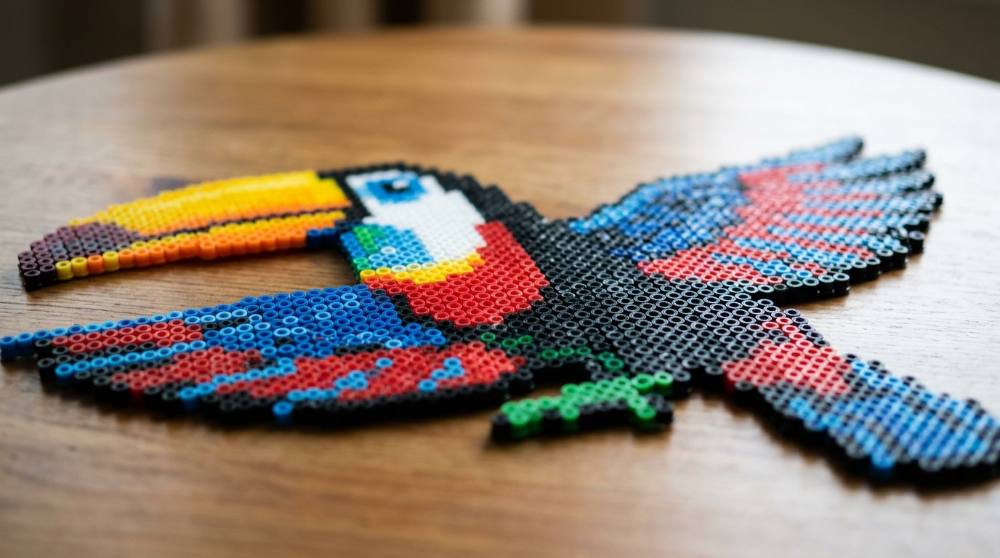
Picture a board covered in tiny pegs. A child drops little plastic rings onto them one at a time until a fish or a heart appears, and then an adult lays paper over the top and runs a warm iron across it. What was a pile of loose beads a moment ago lifts off the board as one solid piece. The odd part is who it was invented for: a Swede called Gunnar Knutsson patented the bead pegboard in the early 1960s as occupational therapy for elderly people, and the first designs could not be ironed at all, so they were glued to cardboard and used as trivets. Children inherited it later, and one Swedish school eventually built a picture out of 1,680,200 beads that now hangs in Stockholm Arlanda Airport.
Two people make this work, and only one of them is the child. Yours does the slow part, picking beads out of a pile and setting them on pegs, row by row, for anywhere between ten minutes and a whole afternoon. You do the thirty seconds with the iron. That split is the reason it lands so well at six or seven, because the fiddly half is genuinely theirs and the dangerous half genuinely isn't.
Start small. A decent spread of colours, a couple of boards, something to pick beads up with, and paper to iron through is the whole setup. Anything with a licensed character on the box can wait.
Nothing on this page costs enough to sting if the whole thing gets abandoned by March.
Where This Little Kit Can Take You
A few real moments and results from this hobby — made with tools no fancier than the ones below.
Rainbows and clovers, ready to hangEvery one of these started as loose beads standing on pegs.
A heart, ironed smoothPress long enough and the holes close over completely.
One bead at a timeA sprite this size is a couple of hours of quiet.
Neon letters on a clear boardThe pegs hold each bead upright until the iron arrives.
A bucketful of midi beadsThirty-odd colours, and you will still run out of black first.
If you already own an iron and a roll of baking parchment, you are most of the way there. What follows is the short list of things you cannot improvise. Fair warning about the noise a spilled tub makes on a wooden floor, because you will learn it early.
Four Things and One Free Afternoon
These four cover the whole distance between an empty kitchen table and a finished keychain. They get used in that order too: beads, board, tweezers, paper. The one nearly everyone underestimates is the tweezers, and the reason is physical rather than fussy. An adult hand can place a 5 mm bead. It cannot place the one next to it without toppling the first.
Disclosure: This section may contain affiliate links to Amazon. We may earn a small commission from qualifying purchases at no extra cost to you.
01Pick 01 of 07
Assorted 5mm Fuse Beads
Fuse beads are short plastic cylinders that stand upright on a pegboard and melt into one another under a warm iron. Five millimetre is the standard size that almost every pegboard and printed pattern is built around. A first tub should be judged on how many colours it has rather than how many beads, and on whether it carries enough black and white, because outlines eat more beads than anything else.
Why we picked this exact one: The Perler assorted 11,000-piece jar covers 30 colours, and that colour range matters here far more than the bead count. It averages 4.8 stars across roughly three thousand ratings, and the jar it arrives in is the container you will actually keep beads in for the first few months. The colours come premixed, so expect to spend an evening sorting before anyone can work quickly.
A pegboard is a stiff plastic square covered in short pegs that hold each bead upright until the iron fuses them together. Clear boards let you slide a printed pattern underneath and copy it peg by peg, which is how most children work before they start inventing designs. Boards are sold per bead size, so the board and the beads have to be bought as a matched pair.
Why we picked this exact one: The H&W six-pack gives you 5.7-inch squares with tabs that lock together, so two children can work side by side and a larger design can run across several boards. At 4.4 stars over four thousand ratings it is the most-reviewed board set at this price. Four ironing sheets come in the box, which is enough to start with and not enough to keep going.
These are wide-gripped plastic tweezers made for picking one small bead out of a pile and setting it on a peg. The blunt tips matter for children, since metal precision tweezers are sharp enough to scratch and fiddly enough to be frustrating. A spare or two is worth having, because they are the first thing to disappear under the sofa.
Why we picked this exact one: The TTSAM plastic fuse-bead tweezers come six to a pack, which sounds excessive until two children and an adult are all at the same board. They sit at 4.5 stars across 740 ratings. Plastic is a deliberate choice over the stainless-steel precision sets sold for electronics work, which grip better but are pointed enough that nobody relaxes while a six-year-old waves one around.
Ironing sheets sit between the hot iron and the beads so the plastic fuses to itself instead of to the soleplate. Kitchen baking parchment does the same job and is what most households reach for first. Reusable sheets differ in being see-through, which turns the ironing step from guesswork into something you can watch happen.
Why we picked this exact one: The H&W transparent sheets win here because you can watch the holes closing underneath as you work, and over-ironing is the most common way a first piece gets ruined. Twenty sheets at 4.4 stars over 248 ratings covers about a year of weekends. They are stiffer than parchment, so they do not drape over a part-finished board the way paper does.
Put the board on a baking tray before anyone starts. It will not stop a spill, but it turns a floor-wide disaster into a tray-sized one. After that, nobody moves the finished board until the iron is hot and an adult is holding it.
What You Buy After the First Keychain Works
All of this is the second shopping trip, not the first. Buy it once the hobby has visibly stuck, which is usually the week your child asks whether they can make one for somebody at school. The instinct at that point is to order more beads. You almost certainly do not need more beads. You need to be able to find the ones already in the house.
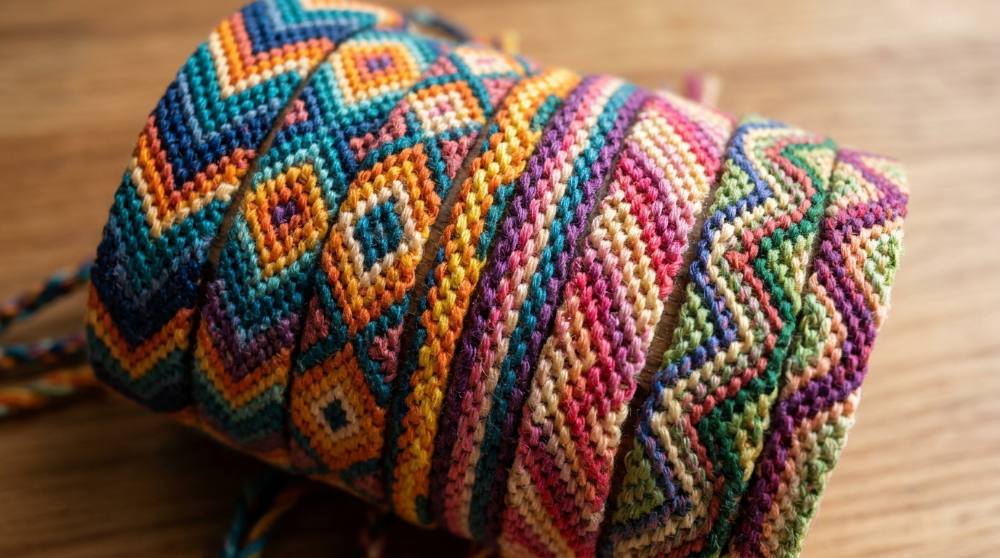
There is a particular kind of child who enjoys counting squares on a grid and then counting them again to check, and this is the hobby that finds them. The same patient streak is what makes knotted friendship bracelets click a year or two later, so it is worth noticing when it shows up.
05Pick 05 of 07
Bead Storage Organizer Box
A compartment box keeps each colour in its own cell so a child can reach for one instead of digging through a mixed pile. Fixed dividers beat adjustable ones here, since adjustable walls let beads migrate between cells the moment the box is tipped. The latch is the feature that counts, because this box gets carried around.
Why we picked this exact one: The Beadery Large Bead Keeper has 32 fixed compartments and a hinged cover that latches shut, which is why it beats the adjustable-divider tackle boxes sold next to it. It runs 4.7 stars over 693 ratings, moulded in polypropylene thick enough to survive a drop. Thirty-two cells will not hold thirty colours plus the mixed leftovers, so most people end up buying a second one.
A pattern pad is a book of full-size printed designs you slide under a clear board and copy bead for bead. Full-size matters: a pattern printed at the wrong scale cannot be traced and has to be counted out square by square instead. The blank grid pages at the back are where children start drawing their own designs.
Why we picked this exact one: The Perler Pattern Pad and Idea Book carries 110 full-size patterns plus blank grid pages, and those blank pages are the reason to pick it over a pure pattern book. It holds 4.7 stars across more than fifteen hundred ratings. Twenty-eight pages is thin for the money, and a keen child will work through the easy half inside a month.
These are the small metal fittings that turn a flat fused design into something that hangs off a schoolbag. A jump ring threads through one of the bead holes at the edge, and the split ring with its short chain clips onto that. Assembling them is an adult job, both for the pliers and because the rings themselves are small parts.
Why we picked this exact one: The Paxcoo set pairs 100 split rings and short chains with 100 open jump rings, so the matching halves arrive together instead of needing a second order. It averages 4.8 stars across more than three thousand ratings. The iron rings will mark over time on a bag that lives outdoors, which matters less than it sounds for something a child replaces within a term.
None of this makes the finished pieces look any better. It makes the hour before the ironing less annoying, and at this age that is what decides whether there is a second project at all.
The Iron Is Yours. Full Stop.
One rule covers most of it: the child places beads, the adult irons. Not with supervision, not with your hand resting on top of theirs. A dry iron on a medium setting is hot enough to blister, and the moment it becomes interesting to a seven-year-old is exactly the moment you are leaning over a finished design.
Turn the steam off and keep water out of the tank. Bead makers are unanimous about this, and it is a quality rule as much as a safety one.
The other hazard is not the heat, it is the floor. These are small parts, the boxes carry a choking-hazard warning for children under three, and a toddler will find the bead that rolled under the sofa well before you do. With a younger sibling in the house, the beads come out while they are napping or in another room, and the box gets latched shut afterwards. Ten-millimetre beads exist precisely so the little one can have something at the table too.
Worth saying out loud to the child once, in plain words: these go on the board, not in your mouth. Experienced bead makers still remind each other of that one, which tells you how often it comes up.
Why Did Ours Come Out Looking Like That?
Why is the middle still lumpy when the edges have gone completely flat?
You are either holding the iron still or lifting it to peek, and both cause this. Whatever sits under the plate longest flattens out while the rest barely softens, and lifting mid-pass drags beads upward with the paper. Keep the iron moving in slow circles across the whole piece, and when you want to check, slide it off sideways instead of picking it up. Even pressure fixes this far more reliably than more heat.
Ours curled up like a crisp the second it cooled. Is it ruined?
No, and the fix is dull. Warping happens when one face cools faster than the other, so the instant you stop ironing, lay something heavy and flat on top and leave it a few minutes before looking. A couple of school textbooks is the standard answer. Do it on both sides and the piece comes out flat. For one that has already curled, put a bag of frozen vegetables on it without peeling the paper off first.
The paper has stuck to the beads and will not come off.
It bonds as it cools, so the window is shorter than it feels. Peel the paper back while the piece is still warm, then weight it down. If it has already welded on, that face has lost its finish and there is no recovering it. This is the real argument for see-through reusable sheets over kitchen parchment, since you can watch the beads fuse through them and stop at the right moment rather than guessing.
Can we top up with the cheap beads from the supermarket?
You can, and the finished piece will give you away. Off-brand beads vary in height and in how thick their walls are, so a single pass leaves some collapsed into puddles while others keep their holes wide open. One bead maker who compared brands side by side found roughly a tenth of a cheap batch too misshapen to use at all, and the tweezers could not even grip them properly. Stick to one brand per project.
Which bead size should we actually be buying?
Five millimetre, and it is not a close call. Nearly every pattern, board and tutorial assumes that size. The 2.6 mm minis photograph beautifully and are miserable for small hands. The 10 mm ones are built for preschoolers and will not fit a normal board at all. Buy 5 mm and ignore the rest, and take some comfort in the fact that 5 mm beads from the two big brands are the same size, so your boards and your beads never have to come from the same company.
People Worth Following Into This Hobby
Real practitioners we found while researching this setup — people who do the work, show their process, and publish on sites they run themselves. No sponsorships, no affiliations; we just think they're worth your time.
Writes step-by-step craft tutorials from her own workbench, photographing each stage of a project including the attempts that go wrong.
Her ironing walkthrough is the adult half of this setup done slowly and in pictures, which is exactly the step parents ask about once the beads are laid out.
Runs a UK kids-craft site started in 2011, publishing printables and activity walkthroughs aimed at parents doing crafts at the kitchen table.
Her ten-step ironing guide covers the masking-tape method and the warping troubleshooting that this page only has room to summarise in the questions below.
Designs kawaii sewing and craft patterns, and wrote a fuse-bead book of more than fifty original pixel patterns for beginners.
Once a child has worked through the blank grid pages in a pattern pad, her patterns are the natural next source, and they were drawn for beginners rather than scaled down from adult designs.
Love what you see here? Save individual picks with on any item, or copy everything to a list of your own in one click — great for coming back to later, or dropping as a not-so-subtle hint.