Mat Pilates is a fixed set of thirty-four exercises, written down in 1945, that you work through lying, sitting and rolling on about six feet of floor. Joseph Pilates didn't call it Pilates. He called it Contrology, and he began piecing it together while the British held him in a First World War internment camp on the Isle of Man. He also said that watching cats move shaped a good deal of it, the way they stretch and reset before they go anywhere. Today you'll find it in studios, in church halls, and increasingly on somebody's rug at seven in the morning with a laptop propped against the sofa.
What surprises people first is how little ground you cover. A whole session might move you eighteen inches in any direction. The difficulty isn't range, it's that you're asked to go slowly and without momentum, which takes away the one thing most of us lean on to get through exercise. Your lower back and tailbone feel that straight away, because so much of the work happens lying down and rolling along your spine. It's also why the kit below differs from what you'd buy for a home yoga corner, even though both start with a mat.
Our take: buy three things, and don't buy a fourth until the first three are worn. A mat with real padding, a ring and a small ball will carry you through every beginner routine you can find. The rest is variety, and variety can wait.
Nothing here costs enough to sting if you decide in three weeks that this isn't for you.
Where This Little Kit Can Take You
A few real moments and results from this hobby — made with tools no fancier than the ones below.
Mid-roll with ring and ballThe ball between the knees stops the legs doing work the middle is meant to do.
The circle, mid-squeezeThe padded grips mark exactly where your palms belong.
If you're still choosing between this and five other things you've meant to try, working out which first hobby actually suits you is worth ten minutes before you spend anything. This one rewards people who like repeating a small thing and noticing it change. If that sounds tedious rather than satisfying, believe yourself.
The Three Things You Actually Unroll
The dancer connection shows up here. Balanchine and Martha Graham sent their dancers to the Pilates studio in New York, and the kit reflects what dancers had room for: almost nothing. Setting up for adult ballet at home takes a barre and a mirror. This takes a mat and two props that fit in a drawer. The catch is that each of the three has one specification that matters, and the budget version usually gets that exact one wrong.
Disclosure: This section may contain affiliate links to Amazon. We may earn a small commission from qualifying purchases at no extra cost to you.
01Pick 01 of 09
half-inch thick exercise mat for spine cushioning during floor work
A Pilates mat is built to protect the spine rather than to stop the feet slipping, so it runs thicker and denser than a mat meant for standing poses. Around half an inch is the usual target: enough padding to roll along your vertebrae without bruising, not so much that you sink and lose your balance. Density matters as much as thickness, because a soft thick mat flattens under your hips and leaves you on the floor anyway.
Why we picked this exact one: The Retrospec Solana in the 1/2-inch version lands on the thickness Pilates teachers name when asked. It's held a 4.4 average across more than nine thousand ratings, which for a foam mat mostly tells you the foam doesn't crumble in year one. The trade-off is bulk: at half an inch it won't roll as tightly as a travel mat, so it wants a corner to live in rather than a bag.
padded ring that adds squeeze resistance between the hands or thighs
The ring, also called a magic circle, is a flexible hoop with a padded grip on each side. You squeeze it between your palms, thighs or ankles and release under control, which gives the exercise something to push against and gives you something to feel. Beginners want the light foam-padded kind, because the weighted and spring-loaded versions are heavier to control and assume you already know the exercises.
Why we picked this exact one: The ProBody Pilates Circle in the 14-inch size is the straightforward beginner choice, using a fiberglass core at medium resistance rather than the weighted steel found on studio rings. Teaching studios run circles between roughly fourteen and sixteen and a half inches, so this sits at the small end, which is easier to reach around if you're shorter. Its resistance is fixed, unlike the spring circles studios use, so there's no dialling it up later.
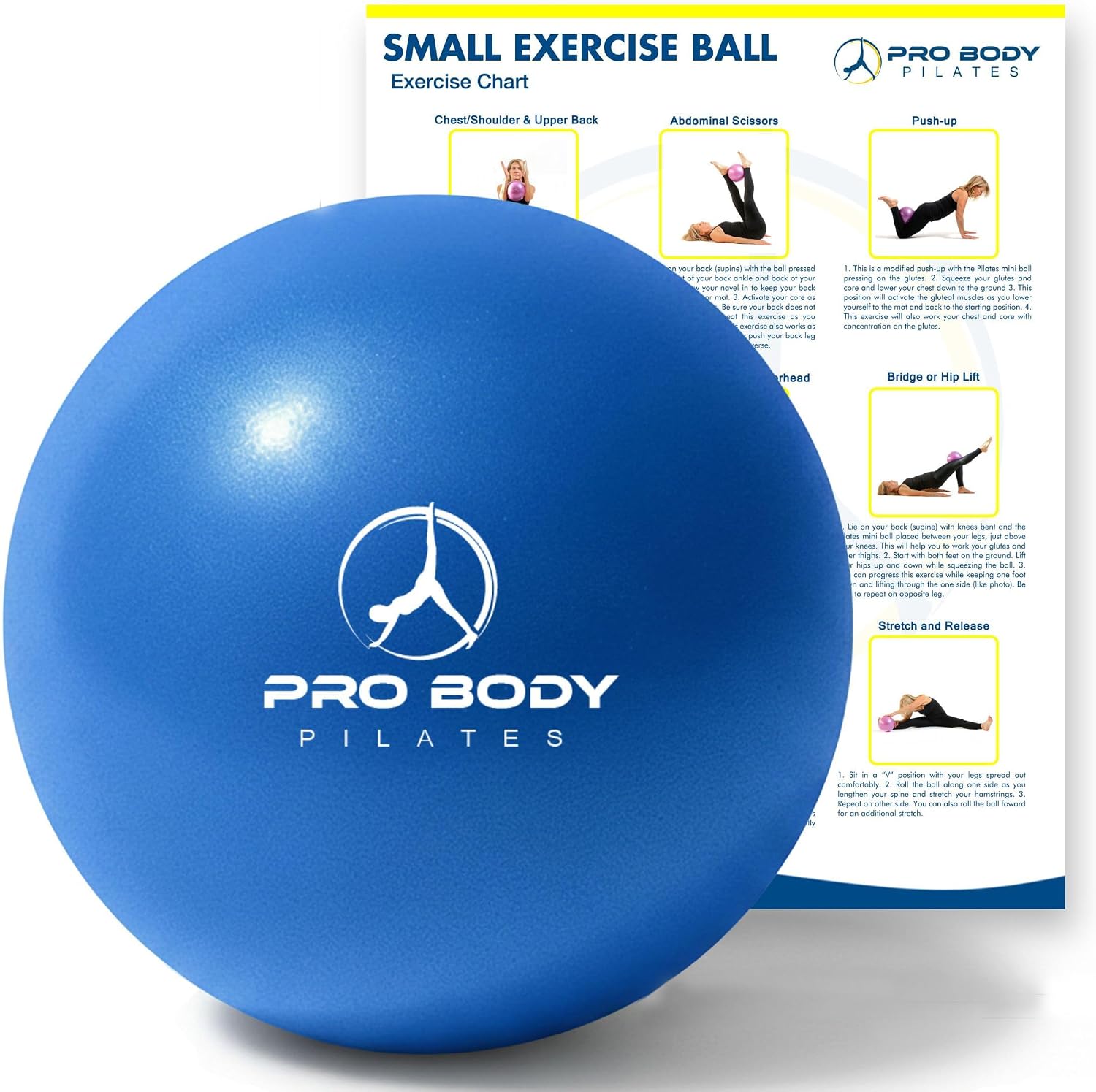
9-inch soft exercise ball for knee squeezes and lower-back support
The small ball is a nine-inch soft ball that you deliberately under-inflate. Squeezed between the knees it stops the legs taking over; placed under the lower back or the head it props you into a position you can't yet hold unaided. It does half the job of a ring and half the job of a cushion, which is why it turns up as a prop in so many studio classes.
Why we picked this exact one: The ProBody Pilates Ball Small is the nine-inch size studios stock, which matters because the exercises assume that diameter. It carries a 4.5 average over thirteen thousand ratings and is comfortably the cheapest thing in this setup. It ships with a straw rather than a pump, which is fiddly, though since you want it soft rather than firm, erring in the easy direction does no harm.
Unroll all three and the corner is finished. Plenty of people stop here for good, which is a perfectly reasonable place to stop, since the thirty-four exercises will outlast your patience long before the gear wears out. If you're the sort who likes handing a corner of a room over to one thing, you've probably already done it with a shelf of houseplants.
Month Two, If You're Still Here
Give it four weeks before buying any of this. The standard beginner mistake isn't buying bad equipment. It's buying the second tier in week one and ending up with five objects on the floor and no routine. Bands and weights change what a familiar exercise asks of you, which only helps once the exercise is familiar. There's also a smell nobody warns you about: fresh latex bands carry a strong rubber smell at first, so unwrap them and leave them somewhere airy for a while.
Pick one
These 2 do the same job. You only need one of them, so pick the one that suits you better.
04Pick 04 of 09Option A
flat latex resistance bands in graded strengths for mat work
A flat band is a plain strip of latex with no handles and no loop, which is the format most mat exercises assume. You wrap it round a foot, hold it short for more resistance or long for less, and it adapts to nearly any exercise in the repertoire. Sets arrive in several strengths, and for floor work the lighter end does more than you'd expect, since the point is control rather than load.
Why we picked this exact one: This lianjindun five-band set spans roughly three to twenty pounds of resistance, covering the whole useful range for mat work in one purchase under $12. More than eight thousand ratings sit behind a 4.6 average. Bare latex bites into the palms on longer holds, so most people end up wrapping the ends around their hands.
Pros
Adjusts to any length, so one band covers every exercise
The format most mat exercises assume
Packs flat into a drawer
Cons
Bare latex bites into bare palms on long holds
Won't stay put on its own during side-lying leg work
fabric loop bands that stay put around the thighs during leg work
A loop band is a closed ring of fabric with latex threads running through it, worn around the thighs or just above the knees. Because it's a closed loop it stays where you put it, which suits side-lying leg work and bridging, where otherwise you'd be holding a band instead of holding your position. Fabric versions grip skin without rolling into a cord the way thin rubber loops do.
Why we picked this exact one: This lianjindun fabric loop set is the simpler pick when leg and hip work is what you're after, built from a cotton-polyester blend with latex threads rather than bare rubber. It holds a 4.7 average across roughly five hundred ratings, and the non-slip weave is the specific feature that stops mid-set rolling. It's the less versatile of the two: there is nothing useful you can do with it above the waist.
Pros
Stays in place during side-lying and bridging work
one-pound ankle weights for light resistance on leg work
Ankle weights used in this practice are far lighter than the ones sold for walking or running. One pound per ankle is the standard starting point and about two and a half pounds the usual ceiling, because the aim is to reach the small stabilising muscles rather than load the big ones. If putting them on changes how you move, with the hips hiking or the lower back arching, they're too heavy for where you are.
Why we picked this exact one: This YOVKOK pair is one pound each, which is the figure classical Pilates sources name for beginners rather than the three-to-five-pound sets that dominate the category. They sit at 4.6 across roughly six hundred ratings. The straps adjust for fit but the weight doesn't, so moving up to two pounds later means buying again.
36-inch firm foam roller for lying lengthways along the spine
The long roller gets used two ways here: rolled under the legs or back for release, and lain along lengthways under the spine so the whole torso balances on a narrow unstable surface. That second use is the one specific to this practice, and it needs the full thirty-six-inch length rather than a short travel size. High-density foam keeps its round shape under body weight, which is the difference worth paying for over the softest options.
Why we picked this exact one: The ProsourceFit 36-inch high-density roller is the full-length version, which is the detail that decides it: the common thirteen- and eighteen-inch rollers can't support a whole torso. At about $21 it holds a 4.5 average over four and a half thousand ratings. Firm foam is unforgiving on tight muscles early on, and this listing offers no softer density if that turns out to matter.
Add one, use it for a month, then think about the next. If you keep stalling at the getting-on-the-mat step rather than the equipment step, the habit side of this is the real thing to fix. Ankle weights in particular tend to get bought in a burst of enthusiasm and then live under the sofa.
Two Books Worth the Shelf Space
Video is better for watching form. Books are better for the why, and for the order. Knowing which exercise follows which turns a pile of moves into a session you can run yourself without a screen, which is the same reason someone learning the ukulele gets further with a chord book than with an endless feed of tutorials.
08Pick 08 of 09Book worth reading
the founder's own 1945 guide to the thirty-four mat exercises
This is the original text in which the method was set out, with all thirty-four mat exercises in their intended order and the author's own photographs. The writing is of its period and the opinions are strong, which is part of why practitioners still hand it to newcomers. It's short, closer to a manifesto with an exercise appendix than to a modern instructional manual.
Why we picked this exact one: The revised 21st-century edition of Pilates' Return to Life Through Contrology, prepared by Judd Robbins, is the version to buy rather than one of the cheap scanned reprints floating around. It holds a 4.6 average across more than eleven hundred ratings. Be clear on what it isn't: there are no modifications and no beginner ramp, so it reads as a historical document that happens to also be the source.
an illustrated at-home mat programme with modifications and progressions
A modern mat guide built the opposite way round from the original text: many photographs, detailed form cues, and a way in that starts with a short modified routine before adding exercises one at a time. Each exercise gets its goal, the usual errors and an easier version. That format suits someone practising alone with nobody watching their form.
Why we picked this exact one: Brooke Siler's The Pilates Body, in its revised and expanded edition, is the standard modern recommendation, and Siler trained for about a decade under Romana Kryzanowska, whom Joseph Pilates chose to carry on his work. The revised edition holds a 4.7 average, though on a small base of fifty-nine ratings so far. Readers arriving completely cold sometimes find even its beginner routine demanding.
Read the first for the history and the second for the form cues, and between them you'll stop needing a video to tell you what comes next. If you want to keep track of what you did on which day, a plain notebook system handles it better than any app.
Why Your Tailbone Hates You on Day Three
Why does my neck ache more than my middle?
Two things cause this, and weak abdominals is neither of them. The first is the ring: if you're gripping it hard enough to feel it in your neck and shoulders, you're spending strength on the prop instead of your centre, and the exercise stops doing its job. The second is head position, since most people need the head lifted slightly off the floor during work on the back, and a towel folded to about two or three centimetres is the usual fix. A pillow is too bulky and locks the neck in place. Ease off the ring and prop the head before concluding you need to get stronger.
Should I pump the little ball up hard?
No, and this is the single most common thing beginners get wrong with it. A fully inflated ball is slippery, skids out from under your lower back, and can't be gripped between the knees. It's meant to stay a bit squishy so it deforms under you and stays where you put it. Inflate until it holds its shape, then let a little air back out until it gives easily under your thumb and you can still grip it in one hand.
Is mat work just the cheap version of reformer Pilates?
That has it backwards. The mat work is the original method, written down as a complete thirty-four-exercise system that needs no machine at all. A reformer's springs assist you about as often as they resist you, which is why several exercises are genuinely easier on the machine than on the floor. The mat gives you nothing to lean on. Plenty of long-term practitioners never touch a reformer and don't feel they're missing anything.
How often, and for how long?
Half an hour, three to five times a week, is the figure that keeps coming up, and it doesn't go up as you advance. That catches people out, because most exercise asks for more over time and this asks for better instead. The other half of it is that you shouldn't be sore the next day. Soreness after a mat session usually means you used momentum or braced something that wasn't meant to be working.
Which ring resistance should I buy?
Light, and padded. Heavier weighted rings do exist, but the extra mass pushes you to recruit the wrong muscles just to control the thing, which is the opposite of what the prop is for. Think of the ring as a feedback device first: it tells you whether your centre is doing the work or your arms are. Teaching studios overwhelmingly use the light foam-padded version, somewhere around fourteen to fifteen inches across.
People Worth Following Into This Hobby
Real practitioners we found while researching this setup — people who do the work, show their process, and publish on sites they run themselves. No sponsorships, no affiliations; we just think they're worth your time.
Teaches individual and small-group Pilates in Missouri and publishes the full classical mat order with starting positions, modifications and variations for each exercise.
This setup tells a beginner the thirty-four exercises come in a fixed order; their page is where you can actually read that order, with an easier version of each move written beside it.
Teaches classical Pilates online and has written a step-by-step walkthrough of Joseph Pilates' original thirty-four mat exercises, grouped into four logical sections.
Our FAQ says the mat work is the complete original method rather than a cut-down reformer class; her guide is the evidence, laying out all thirty-four moves and why they are sequenced that way.
Runs instructor training and teaches at a Portland Pilates studio, and writes a blog that answers the questions clients actually ask at the front desk.
The reformer-versus-mat question is in our FAQ, and she answers it at length from inside a studio that teaches both, which is a fairer test than anything we could say.
Teaches Classical Pilates in New York and virtually, and gives away four full thirty-minute mat classes aimed at every level.
A beginner who has just bought a mat, a ring and a ball needs somebody to follow; her free sampler is a full classical mat class rather than a highlight reel.
Love what you see here? Save individual picks with on any item, or copy everything to a list of your own in one click — great for coming back to later, or dropping as a not-so-subtle hint.