Home yoga is quieter than the pictures suggest. You clear a rectangle of floor, prop a screen where you can see it, and spend twenty minutes moving slowly between shapes while a voice talks you through them. The word for those shapes is asana, and it comes from a Sanskrit root meaning to sit down, which is why the earliest named ones are all seated postures. Standing and sweating came later. Even the props are old: a yoga strap is carved into a stone relief at the Great Stupa of Sanchi that dates to roughly two thousand years ago.
The thing nobody warns you about is that the hard part isn't the poses. It's the floor. A mat that slides on laminate, a rug that swallows your balance, a room where something has to move before you can start, those are the reasons people quietly stop in week three. If you're still working out whether this is the one you want to commit to, it's worth thinking about what you want from a first hobby before you buy a thing. Everything below assumes a clear rectangle about the size of a door and nothing else.
Our philosophy here is to buy only what every single class asks for. A mat, two blocks, one strap. That's the lot, and a bolster and blanket can wait until you know whether you actually enjoy lying still.
Everything on this page costs less than a couple of months of studio drop-ins, so if the mat ends up under the bed by February you haven't lost much.
Where This Little Kit Can Take You
A few real moments and results from this hobby — made with tools no fancier than the ones below.
Morning practice, laptop propped openThe whole studio is a patch of living-room floor and a screen you are allowed to pause.
Two blocks within easy reachSet either side of the mat, waiting for the pose that needs the floor brought closer.
None of this is complicated, which is exactly why it gets skipped. People buy the prettiest mat they can find and then wonder why their hands creep forward in the second pose. If you're weighing this up against a mat Pilates corner at home, the kit overlaps almost completely, and what differs is what you do on it.
The Three Things Every Class Asks For
Watch a beginner class and count what the teacher reaches for. A mat, a block, a strap, usually all three inside the first ten minutes. That's the whole list. Blocks get treated as a crutch for the inflexible, which is backwards: the most experienced people in a room reach for more props, not fewer. Buy these three and you won't be improvising mid-pose with a stack of hardbacks under one hand.
Disclosure: This section may contain affiliate links to Amazon. We may earn a small commission from qualifying purchases at no extra cost to you.
01Pick 01 of 09
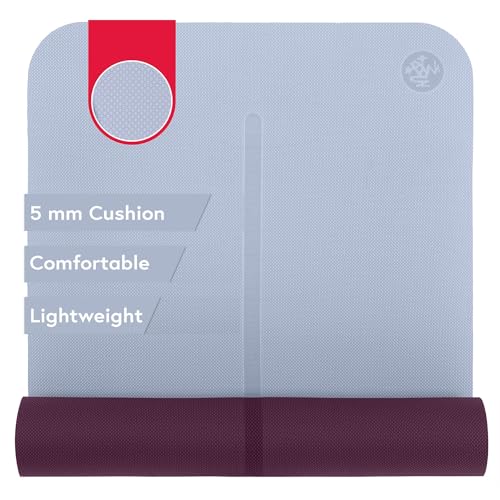
5mm reversible yoga mat with a centre alignment stripe
A yoga mat is a thin, slightly tacky sheet of foam or rubber that gives your hands and feet something to hold onto and your knees something kinder than the floor. Thickness is the main decision: around 5 to 6mm is the band most practitioners settle on, because thinner mats bite into the knees and thicker ones make standing balances wobble. Grip matters on both faces, since the mat has to stay put on the floor as well as under your hands.
Why we picked this exact one: The Manduka Begin is that brand's deliberately cheap mat, and it lands at 5mm, the thickness practitioners name most often, with a faint centre stripe that tells you if you're square when nobody is there to say so. Manduka is the name that recurs among people still rolling out the same mat five years on. Two honest caveats: it is 68 inches long, so taller practitioners will have their heels off the end, and grip reports are split, which a towel over the top fixes cheaply.
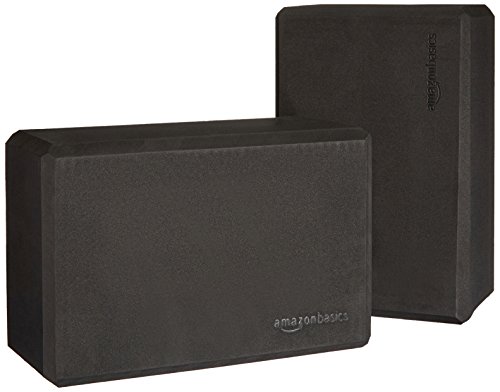
pair of firm foam yoga blocks for bringing the floor closer
Yoga blocks are dense foam bricks you slide under a hand, a hip or your head so a pose becomes reachable without rounding your back. Most are moulded at nine by six by four inches, which gives three different heights depending on which face you stand one on. Firmness is what separates a good block from a bad one, because a soft block squashes under your weight and stops being a height you can trust.
Why we picked this exact one: The Amazon Basics yoga block set is a two-pack at four by nine by six inches, which is exactly the size and shape teachers specify, beveled edges included. Buying the pair costs less than two single blocks do almost anywhere else. Reviewers who stand on them report no deflation, which is the test that matters here; if you later decide you prefer the harder feel of cork, these keep earning their place propping up a bolster.
looped stretching strap for reaching your foot without rounding your back
A yoga strap is a flat, non-elastic band you hook around a foot or hold between your hands so you can hold a shape your reach cannot quite manage yet. The useful ones run about eight feet long and an inch and a half wide. Loops versus buckle matters more than it sounds: sewn loops give you fixed pockets for a hand or foot, while a D-ring has to be threaded and re-threaded every time the length changes.
Why we picked this exact one: The Gradient Fitness multiloop strap is eight feet long and an inch and a half wide, which is the spec teachers give when they bother to give one at all. Its twelve sewn loops mean you change length by moving a hand one loop along rather than unthreading a buckle mid-pose. It is branded for physical therapy rather than yoga, which puts some people off, but the band itself is the same flat non-elastic webbing a studio hands you.
Three items, one evening of unboxing, and you can follow any beginner class without stopping to hunt for a cushion. The first surprise is usually how new a new mat smells, and how determined the corners are to curl up until it's been rolled flat a few times. A corner you actually want to sit in matters more than it should, which is why so many home practice spots end up beside a shelf of easy houseplants.
Or Buy It All in One Box
Buying the three picks above separately costs meaningfully more than a single all-in-one yoga set, and pretending otherwise would be silly. That gap is the whole reason this section is here. The trade-off is real, though, and it is almost always the mat.
The one-box alternative
all-in-one beginner yoga set with mat, two blocks and a strap
An all-in-one yoga set puts the mat, a pair of blocks and a strap in a single box, usually with a carry sling and a towel alongside. The appeal is that nothing is missing on the first evening and there is only one delivery to wait for. The compromise is nearly always the mat, which tends to be thicker and softer than a regular practice wants.
Why we picked this exact one: The BalanceFrom 7-piece set is the one that holds the full trio rather than padding the count with resistance bands and a massage ball: a mat, two blocks, a strap, a carry sling, two towels and a knee pad. Its mat is half an inch thick, roughly double the band practitioners settle on, so expect it to feel lovely under the knees and genuinely unsteady in tree pose. Nothing in the box is bad, but the mat is the piece you would replace first.
Covers everything a beginner class asks for and a bit more: mat, two blocks, strap, carry sling, two towels and a knee pad. better here
Covers the same three jobs and stops there. No knee pad and no towel until you decide you want one.
Quality of the tools
The blocks and strap are fine. The mat is half an inch thick, which cushions the knees beautifully and makes one-legged balances feel like standing on a mattress.
The mat is 5mm, the thickness practitioners actually name, and the blocks are the standard 4 by 9 by 6 inches with beveled edges. better here
The first evening
One box, one delivery, everything out on the floor inside ten minutes. better here
Three listings, possibly three delivery dates, and a strap that turns up on Thursday.
Where it leads
The blocks and strap carry on for years. The mat is the thing you quietly replace once standing poses start wobbling.
Nothing here gets outgrown. The mat is the piece you keep, and the blocks end up propping a bolster. better here
Our verdict: it depends. Buy the kit if you want to be on the floor this weekend and honestly don't know yet whether you'll still be rolling it out in March, and build it from the picks above if you already suspect you will.
Something odd happens around week four. The classes you reach for stop being the ones that make you sweat and start being the ones where you lie on the floor, held up by things, for five minutes at a stretch. That slower practice needs almost nothing: something firm underneath you and something to put over the parts that get cold. If you've also been eyeing an adult ballet setup at home, this is where the two part company, because ballet wants a barre and yoga wants a cushion.
04Pick 04 of 09
firm rectangular bolster for supported restorative poses
A bolster is a long, densely stuffed cushion you lie over, under or along so the pose holds you up instead of the other way round. Rectangular ones sit flatter and roll less than the round kind, which makes them easier to trust when your whole chest is resting on one. Insist on a removable, washable cover, because this is the prop your face spends the most time against.
Why we picked this exact one: The Gaiam yoga bolster is rectangular rather than round, so it stays where you put it when you lower your weight onto it. Its cover comes off and goes in the machine, which you will want after a summer of lying on it. It is firmer than a sofa cushion and heavier than it looks, and that weight is the point, though it does mean this one lives in the corner rather than in a cupboard.
firm woven blanket for seated height, knee padding and warmth
A yoga blanket is a tightly woven throw that holds a fold instead of flopping. Folded into a slab it lifts your hips in cross-legged sitting, folded in half it pads a knee, and opened out it goes over you for the last five minutes. The test is whether a folded edge stays square once you sit on it, which a fluffy fleece will not.
Why we picked this exact one: The Del Mex falsa throw is the striped woven blanket studios stack on their shelves, and the reason is dull and practical: it folds square and holds the fold. At 70 by 50 inches it is big enough to cover you completely at the end of a practice, which a smaller studio blanket is not. It sheds a little lint over the first few washes, which is the only real complaint.
gripping microfibre towel that lies over a slippery mat
A mat towel is a thin microfibre sheet with silicone dots on the underside so it holds onto the mat rather than sliding around on top of it. Damp palms grip microfibre better than they grip most mat surfaces, which is the entire reason these exist. The dots are the product: a plain microfibre towel without them slides, which is worse than no towel at all.
Why we picked this exact one: The Eunzel grip-dot towels come as a pair at 72 by 24 inches, which covers a standard mat with a little to spare. Having two means one is in the wash while the other is on the floor. Be honest about whether you need them at all, though: if your practice is slow and you barely sweat, this is the item on the page you are most likely to leave in its packet.
Natural rubber mats grip differently from foam or PVC ones: the surface has real friction rather than a tacky coating, so hands hold even when the palms are damp. They weigh more than synthetic mats and they wear faster, shedding slightly over the first few weeks. Natural rubber also means latex, which matters if you react to it.
Why we picked this exact one: The JadeYoga Harmony is the mat people name when asked for one that actually holds, built from open-cell natural rubber whose grip improves rather than vanishes as palms get damp. Step up to it once you are practising most weeks and have felt your hands creep forward one time too many; before that, a towel over a cheaper mat does the same job for far less. The honest cost is lifespan, since rubber wears faster than PVC, and it is heavy to carry.
None of these decide whether you can practise. They decide how long you're willing to stay on the floor once you have, and the blanket is the one people are most surprised by, right down to the scratch of woven cotton against bare shins. Buy them in the order your practice asks for them rather than all at once. If what you're really fighting is turning up three times a week, building a habit that sticks is a different problem from buying a bolster.
Two Books Worth Owning
Video classes are brilliant at telling you what to do next and hopeless at telling you why a pose is shaped the way it is. A book left open on the floor fills that gap, and it doesn't carry on without you while your hands are busy. The same patient looking that nature journaling asks for pays off here as well, since you notice far more in a photograph you can stare at than in a video that has already moved on.
08Pick 08 of 09Book worth reading
illustrated beginner pose guide with adaptations for different bodies
A beginner pose book lays out individual postures with photographs and a short explanation of what each one is doing, so you can look a shape up instead of rewinding a video. The useful ones show variations alongside the textbook version. Photographs of a range of body types matter more than they sound, because a pose that looks impossible on one frame is often simply shaped differently on another.
Why we picked this exact one: Yoga for Everyone by Dianne Bondy is built around exactly that problem: fifty poses photographed on a deliberately wide range of bodies, with adaptations rather than one correct shape. It is a paperback you can leave open beside the mat, which is most of its value. It is a reference rather than a reading book, so do not expect philosophy or sequencing from it.
the classic illustrated reference covering roughly two hundred postures
This is the reference work the modern practice is largely built on, cataloguing around two hundred postures with photographs and instructions. It is thorough to the point of being daunting, and most of what it contains sits well beyond a first year. Its value to a beginner is as somewhere to look things up, and as the place the whole prop-and-alignment approach was written down.
Why we picked this exact one: Light on Yoga by B.K.S. Iyengar is the 1966 book that set out the blocks-belts-and-alignment method, and it is still the single reference practitioners name. The paperback is cheap for what it holds. Fair warning: the photographs are of Iyengar himself in postures most readers will never attempt, and reading it as a to-do list is the wrong way round.
Neither book replaces a class and neither is meant to be read front to back in a week. Keep one near the mat and look things up when a pose confuses you. Both lie flat enough to stay open on the floor, which sounds trivial until you've tried to pin a hardback down with a block.
Nobody Is Watching You at Home
This is the real difference between a studio and a living room. In a class someone notices that your lower back is doing the work your hips should be doing. At home the video keeps going and you keep copying. The problems beginners report from home practice are boringly consistent: lower backs from pushing up too high in cobra, necks from forcing a shape, knees from sitting cross-legged on a hard floor when the hips aren't ready for it.
A few rules cover most of it. Don't stretch through sharp pain, because stiffness the next day is ordinary and a sharp signal mid-pose isn't. Come up lower than the person on screen, since copying the big version of a backbend is the most common way people hurt themselves at home. If sitting cross-legged is uncomfortable, put something under you rather than enduring it, because forcing the legs down sends the strain straight into your lower back. And treat unsupported inversions, headstand and shoulder stand especially, as things to learn with a teacher in the room rather than from a screen.
None of this is a reason not to start. It's a reason to go slower than the video suggests for the first month. Writing down what hurt and what helped is genuinely useful here, and a single notebook for everything is as much system as it needs.
Why Your Hands Keep Sliding, and Other Week-Two Surprises
Why do my hands slide forward in downward dog when the mat is brand new?
New mats are often at their least grippy, which catches everyone out. Rubber and polyurethane surfaces in particular arrive with a manufacturing residue and want a wipe with a damp cloth before the first session, plus a couple of weeks of use, before they behave. Beginners read the sliding as their own bad form, or send a perfectly good mat back. Wipe it, use it for a fortnight, then judge it. If it still slides after that, the material is the problem rather than the newness.
Should I buy grip socks for yoga?
No, and this one trips up people arriving from Pilates, where grip socks genuinely are standard kit. Yoga is practised barefoot on purpose: spreading and gripping with the toes is half of how a standing pose stays up, and a sock sole removes exactly the feedback the pose is teaching you to use. Practitioners are unusually united on this point. If your feet are cold, put socks on for the lying-down parts and take them off before you stand.
My only clear floor is carpet, and there isn't much of it. Does that ruin it?
Space first, because people overestimate it badly. A mat is about six feet by two, and you want enough room to extend your arms sideways from the middle of it without meeting furniture. Carpet is the bigger issue: the pile lets the mat creep as a unit and softens the small corrections your standing foot makes, so balances feel worse than your balance actually is. People who practise on carpet usually put something firm underneath, and an older mat doubled over does it for nothing. Seated and lying-down work on carpet is fine as it is.
How do I choose between hatha, vinyasa and yin when every class is labelled differently?
Treat the labels as pace rather than difficulty, which is the mistake that sends beginners into the wrong room. Hatha is the broad, slower category, with poses held a while and time to be told what to do, though what any given teacher means by it varies. Vinyasa ties each movement to a breath so the poses run continuously into one another. Yin is the slow one, mostly floor poses held passively for minutes at a time with very little muscular effort. None of them is the beginner version of another, so pick by how much you want to move today.
Do I need a yoga wheel?
Not to begin with, and probably not for a long time. A wheel is sold for deep supported backbends, and deep backbends are among the last things a beginner should be chasing, which is the part the product photos leave out. A block or a bolster under the upper back opens the chest in the same way with nothing that can roll out from under you. It is the prop most likely to be bought early and used twice.
People Worth Following Into This Hobby
Real practitioners we found while researching this setup — people who do the work, show their process, and publish on sites they run themselves. No sponsorships, no affiliations; we just think they're worth your time.
Has taught yoga online since 2014 and publishes more than 800 full-length free classes, weighted towards yin and slow vinyasa, plus free structured beginner and yin programmes.
This setup tells a beginner to buy a mat, two blocks and a strap and then go find a class; her free beginner journey and yin immersion are the classes those three props were bought for, and the short daily sessions are what home practitioners actually keep up.
Taught in studios for twenty years and owned one for a decade, runs a 50-hour online yin yoga teacher training, and writes openly about the years when yoga made her feel worse rather than better.
The FAQ and safety section here both rest on the idea that a pose can look different on your body and still be right; her piece on functional versus aesthetic alignment is the clearest explanation of why that is true, which is exactly what a beginner copying a video needs to read.
Teaches Iyengar yoga classes in Horsham and Hove and publishes full beginner home sequences with the prop setup, timings and modifications written out pose by pose.
Our essentials section argues for two blocks and a strap but stops short of showing them at work; her fifteen and thirty minute home sequences put those exact props into named poses, which is the step between owning the kit and knowing what to do with it.
Runs Antara Yoga in Amsterdam and films her own guided tutorials breaking single pose families down for beginners, from standing balances to shoulder work and backbends.
The wobble a beginner feels in tree pose is the thing this page blames on mat thickness and carpet pile; her beginner guide to standing balances on one leg covers the other half of that problem, which is what the standing foot is supposed to be doing.
Love what you see here? Save individual picks with on any item, or copy everything to a list of your own in one click — great for coming back to later, or dropping as a not-so-subtle hint.