Scotland Banned Golf in 1457. We've Been Hooked Ever Since.
The first time anyone wrote golf down, it was to ban it. A 1457 act of the Scottish Parliament under James II outlawed the game because men were playing it instead of practising archery, which the country badly needed them to do. The ban held for 45 years. James IV lifted it in 1502 and promptly bought himself a set of clubs. The game underneath all that hasn't changed much: you hit a small ball with a stick, walk after it, and hit it again until it drops into a hole.
Golf's reputation does it no favours. People picture club memberships, dress codes and four hours of strangers watching their backswing. The real entry point is a public driving range on a Tuesday evening, a bucket of balls, and nobody looking at you at all - which puts it closer to the ordinary end of picking a first hobby than its image suggests. Where beginners genuinely get stuck is the gear, and that's where almost all of them overspend.
Our take: carry the fewest clubs you can stand. A driver, a hybrid, a 6-iron, an 8-iron, a pitching wedge and a putter will get you round any course you'll be playing this year, and the fewer choices you have standing over the ball, the fewer bad ones you'll make.
Everything below is the version that's cheap enough to leave in the garage without wincing if golf turns out not to be your thing.
Where This Little Kit Can Take You
A few real moments and results from this hobby — made with tools no fancier than the ones below.
Holding the finish on the tee
One ball in cut grassThose dimples are the reason it flies as far as it does.
None of this asks you to join anything. A public range, a municipal course and a bag you carry yourself will keep you occupied for a couple of seasons, and if it doesn't take, golf just joins the long list of hobbies adults try and move on from. Stick with it long enough to hit one properly, though. There's a click, the ball leaves without any feeling in your hands at all, and that's usually the shot people are still chasing years later.
The Four Things You Buy Before Your First Bucket
A pro shop will happily sell you a fourteen-club bag, a rangefinder and spiked shoes before you've hit a ball. Don't let it. The Rules of Golf cap a player at fourteen clubs, which most people read as a target rather than a ceiling, and a beginner carrying fourteen just owns eight extra ways to pull the wrong one. It's the same trap as the art supplies beginners waste money on: the expensive version of a tool you can't use yet doesn't make you better, it makes the mistake costlier. Four purchases get you to the range.
Disclosure: This section may contain affiliate links to Amazon. We may earn a small commission from qualifying purchases at no extra cost to you.
01Pick 01 of 10
Beginner Golf Club Set
A package set bundles the clubs a beginner needs together with a bag to carry them: usually a driver, a fairway wood, a hybrid, a run of mid and short irons, and a putter. Graphite shafts in the woods keep the swing weight down, and cavity-back irons spread the usable part of the face wider. Look for a set that includes a hybrid rather than long irons, which beginners rarely get airborne.
Why we picked this exact one: The Ram Golf Accubar set covers the whole bag for around $200: a 460cc driver, a 3-wood, a 5-hybrid, cavity-back 6-iron through pitching wedge, a mallet putter and a stand bag. It sits at 4.2 stars across 81 reviews, which is modest, though package sets at this price rarely clear even that. The iron shafts are steel rather than the graphite you get higher up the range, and the bag is basic - fine for the range, less so for 18 holes in the rain.
A golf glove goes on the lead hand only, which is the left hand for a right-handed player, and its job is stopping the grip from turning in a damp or sweaty palm. Most are a synthetic back with a leather palm and thumb, which survives range sessions better than all-leather. Sizing runs snug: the one that feels slightly tight in the shop is the right one.
Why we picked this exact one: The Callaway Weather Spann is the glove to start on: a synthetic back with a leather palm and thumb, at 4.7 stars across nearly 4,900 reviews. Around $13 is roughly a quarter of what a cabretta-leather tour glove costs, and it lasts longer on a practice mat, where the friction is brutal. It will still stretch out over a season, so buy the size that feels a touch tight.
Two-piece balls put a large solid core under a firm cover, so they fly straighter and spin less than the multi-layer balls tour players use. Less spin means a slice curves a little less, and the cover shrugs off cart paths and tree trunks. Buy them by the three-dozen box rather than the sleeve.
Why we picked this exact one: The Wilson Profile Distance 36-pack works out near $0.85 a ball - above the 60 cents some bargain hunters hold out for, and a fraction of a urethane tour ball. It is a low-compression two-piece with a spin-reducing dimple pattern, rated 4.7 stars over 5,000 reviews. You will feel the difference around the green, where these check up far less, but that matters less than it sounds while you are still learning to find the green at all.
Tees hold the ball above the turf for the first shot on each hole and for driver work at the range. Two and three-quarter inches is the common all-round length for a modern oversized driver head; the shorter ones are for irons. Wooden tees snap, which is exactly why they come in boxes of hundreds.
Why we picked this exact one: Pride's 2 3/4-inch Deluxe tees come 500 to a box for about $18 and carry 4.7 stars over 2,100 reviews. Pride is the tee brand most American pro shops stock, so these are the default rather than a novelty. They are plain hardwood and they break like every wooden tee does, which is the point at three and a half cents each.
With those four you can stand in a bay, work through a bucket, and find out whether the sound of a clean strike does anything for you. Expect to be humbled. Nobody mentions that the grip of a brand-new club is tacky enough to stick slightly to a glove, or that you'll spend the first session convinced the clubs are too long for you - they almost certainly aren't. If the walking and aiming part appeals more than the equipment part, a three-disc starter set for disc golf gets you outdoors for a fraction of this.
Practice That Fits in a Garage
Range trips cost money and daylight, and the gap between them is where a beginner's progress quietly leaks away. A net in a garage changes that arithmetic: ten honest minutes on a Tuesday night beats the hour on Saturday you keep postponing, which is the same argument behind building a small daily creative routine. One warning before you spend anything here. The mat matters more than the net.
05Pick 05 of 10
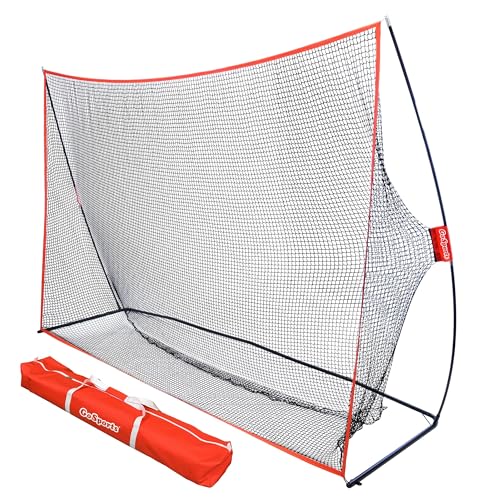
Freestanding Golf Hitting Net
A hitting net is a framed mesh target that absorbs a full-speed golf shot and drops the ball at your feet. The better ones have a ball-return panel so you are not collecting after every swing, and they pack into a carry bag. You get no ball flight to look at, which is the trade for practising at home.
Why we picked this exact one: The GoSports Golf Practice Hitting Net comes in a 10 x 7 ft or 7 x 7 ft size and holds 4.6 stars across 5,222 reviews, the longest track record of any net near this price. Its ball-return panel is the feature that decides whether the thing keeps getting used. No mat is included, which is deliberate on their part and worth knowing before you order.
A hitting strip is a narrow band of practice turf you strike off, set beside a stance mat or straight onto a garage floor. The dense-fibre kind lets the clubhead move down and through instead of bouncing off, so a fat shot feels fat. Most will take a real wooden tee pushed into the turf.
Why we picked this exact one: The Country Club Elite 1x3-ft hitting strip by Real Feel Golf Mats is the one experienced home practisers name once a cheap mat starts hurting: dense nylon fibres the club can dig slightly into, and a surface that takes a real tee. It is $70 against roughly $25 for a foam pad, and at 4.6 stars over 190 reviews it has far fewer ratings than the budget mats. Worth the step up once you are swinging indoors most weeks; if you only hit off grass a few times a summer, wait.
An indoor putting mat is a strip of short-pile turf with one or two holes and a track that rolls the ball back to you. The useful ones print alignment lines and pace markers on the surface, so you can see where your start line actually went. Lengths close to ten feet cover both short putts and lag speed.
Why we picked this exact one: The Perfect Practice 9'6" putting mat is the one that keeps coming up in home-setup threads, mostly for the alignment lines and the two hole sizes - a regulation cup plus a narrowed one that makes the real thing feel generous. At $110 it is the priciest item in this section, and its crystal-velvet surface rolls faster than most club greens. It holds 4.5 stars across 2,229 reviews.
Alignment sticks are thin fibreglass rods you lay on the ground to mark the target line and the line of your feet. They cost almost nothing and are the standard self-check for aim, which is close to impossible to judge while standing over the ball. Most come with rubber end caps and a tube so they live in the bag.
Why we picked this exact one: The Rhino Valley alignment sticks come two to a pack for under $10, in fibreglass rather than the hollow plastic that snaps the first time a club clips one. They hold 4.5 stars over 925 reviews. The high-visibility colours matter more than they sound, because a dull rod vanishes into cut grass from six feet away.
Put the mat somewhere you walk past, not in the corner behind the car - the usual fate of home practice gear is being perfectly good and never unrolled. Putting is where a home setup pays off fastest, because the stroke needs no space and no ball flight to get better. And if what you actually want is four quiet miles outdoors with something to look at, a starter pair of binoculars costs less than anything on this list.
Two Books Before You Pay for a Lesson
Golf instruction is the most crowded corner of the internet and most of it contradicts the rest. Two books keep surfacing when experienced players are asked what a beginner should actually read, and between them they cover the two halves of the problem: how to swing, and how to score. Neither fixes anything on its own. Both stop you chasing the wrong thing for a whole season.
09Pick 09 of 10Book worth reading
Beginner Golf Instruction Book
A short, plain-English book about everything in golf that is not swing mechanics: course strategy, how to practise, how to manage expectations, and how much of a hole is decided before the club moves. Written for recreational golfers rather than competitors. About a weekend's reading.
Why we picked this exact one: Jon Sherman's The Four Foundations of Golf is the title experienced players name first when a beginner asks what to read, specifically because it contains no swing instruction. It rates 4.7 stars across more than 2,800 reviews. If what you want is someone to tell you how to take the club back, this is the wrong book - which is rather the point of it.
A short illustrated book covering the grip, the stance, the first part of the swing and the second, written in the 1950s and still the reference most teachers point at. The drawings carry most of the explanation. It covers the full swing only: no putting, no chipping, no strategy.
Why we picked this exact one: Ben Hogan's Five Lessons: The Modern Fundamentals of Golf turns up on practically every experienced golfer's reading list, at 4.8 stars over 15,000 reviews. The Definitive Edition reproduces Anthony Ravielli's original drawings, which are the real content of the book. It is seventy years old and parts of the swing section get argued over now - the grip and setup chapters do not.
Read the strategy one first. Nearly every beginner assumes getting better means a better swing, and nearly every beginner's scorecard disagrees.
The Questions Nobody Asks Out Loud at the Range
Why do my first ten balls go nowhere?
Almost everyone starts with the driver, because it's the fun one, and it's also the hardest club in the bag: longest shaft, least loft, smallest margin. Topping and slicing through the first dozen then sets the mood for the whole bucket. Start with the 8-iron or the pitching wedge and hit twenty of those before anything else. Short clubs make clean contact available on day one, and clean contact is the thing you're actually there to learn.
Do I really need a lesson, or can I learn from videos?
You can learn a great deal from video, but video can't see you. Self-taught beginners usually settle on a grip and an aim that feel correct and aren't, then spend months fixing swing faults that only exist to compensate for them. One or two in-person lessons early, specifically on grip, posture and alignment, cost less than a wedge and remove the faults you'd otherwise rehearse into permanence. After that, video is genuinely useful.
Why am I fine at the range and terrible on the course?
A range bay hands you a flat lie, a known distance and fifty attempts at the same shot. A course hands you one ball, a slope, and a different club every time. The gap isn't your swing - it's that you've never practised the actual task. Spend part of each session hitting one ball per target: new flag, new club, no repeats, and a full routine before each one. It feels much worse and transfers much better.
Should I buy second-hand clubs instead of a new set?
Used clubs are real value and plenty of experienced players will tell you so. The catch for a beginner is that you can't yet separate a club that doesn't suit you from a swing that doesn't work, so a bargain bag of mismatched shafts adds a variable you have no way to diagnose. If you do go used, buy a matched set from one model line rather than assembling it one club at a time. Check the grips first - they're the cheapest thing to replace and the most likely thing to be dead.
How many balls should I hit in a session?
Most beginners buy the big bucket and empty it by raking a new ball over and swinging again, which turns practice into exercise. Strike quality falls off long before the balls run out, and a tired swing rehearses bad habits as diligently as a fresh one does. Take the small bucket, give every ball a target and a pause, and stop when your contact starts drifting. A short deliberate bucket teaches more than a long raked one.
People Worth Following Into This Hobby
Real practitioners we found while researching this setup — people who do the work, show their process, and publish on sites they run themselves. No sponsorships, no affiliations; we just think they're worth your time.
Coaches golfers on strike quality and writes long, data-led articles picking apart the swing advice everyone repeats.
This setup tells a beginner to buy alignment sticks and check their aim; his article on the alignment myth is the clearest explanation of why that check keeps surprising people.
Works as a mental coach for golfers from juniors to tour winners and has written several hundred articles on nerves, routines and attention.
The hardest part of a beginner's first round is not the swing but standing on the first tee in front of people, and his piece on exactly that moment is more use than another gear list.
Teaches at Forest of Arden and publishes free drills built around the faults he sees most often in twenty years of lessons.
His fundamentals pieces question the standard grip-stance-posture checklist, which is useful for a beginner who has just read Hogan and taken it as law.
Writes an unbroken personal golf blog since 2012, including hickory tournaments and rounds where the ball ends up stuck in a tree.
Beginners mostly read people who never miss; this is a good player writing honestly about mishits and recovery, which is better company for a first season than another swing tip.
Love what you see here? Save individual picks with on any item, or copy everything to a list of your own in one click — great for coming back to later, or dropping as a not-so-subtle hint.