You walk up to a concrete pad, throw a plastic disc down a gap in the trees, then walk to wherever it landed and throw again — until it clatters into a waist-high steel basket hung with chains. That is the game. More than 16,000 courses are listed in the sport's biggest course directory, and most of them sit in ordinary public parks. Ed Headrick patented the Frisbee in 1967 and then spent years working out what people should throw it at; his first official course, built in 1975, used bare metal poles, and the chain basket everyone aims for now was not patented until 1977. Here is the part nobody believes: Headrick asked for his ashes to be moulded into a run of discs, and one of them is on display at a Ripley's Believe It or Not.
The thing that trips people up is not the throwing. It is the wall of plastic. Walk into any disc shop and you will find hundreds of discs with four numbers stamped on them, sorted into categories whose names – putter, midrange, fairway driver, distance driver – sound like they are telling you how far each one goes. They are not. They are telling you how fast you have to throw the thing before it behaves, which is a completely different question.
Three discs, something to carry them in, go play. A putter, a midrange and one slow fairway driver cover every shot a new player can actually make, and the rest of the bag can wait until you know you will keep showing up.
Nothing below costs enough to sting if you play twice and decide it is not your thing, which is roughly the test any of the better starter hobbies for adults should pass.
Where This Little Kit Can Take You
A few real moments and results from this hobby — made with tools no fancier than the ones below.
Disc in the air, basket waitingThe whole sport in one frame: the throw already finished, the disc still travelling.
Chains at first lightRust on the pole and frost on the chains, with the next basket just visible beyond.
Everything that follows assumes you are heading to a public course rather than building one in the garden. If there is a park with baskets within driving distance, you already have most of what you need. Compared with the clubs-and-balls version of golf, the opening cheque here is almost comically small.
Three Discs, One Bag, and You Are Playing
Here is the mistake nearly everyone makes on day one: buying the fastest driver in the shop because the word distance is on the label. A speed 12 disc needs an arm you have not built yet. Thrown by a beginner it will not travel as far as a midrange, and it will finish hard to one side of where you aimed. The four numbers on every disc are speed, glide, turn and fade, in that order, and for your first year you want speed 1 to 6, glide 3 to 7, turn between 0 and -3, and fade no higher than 1. Every disc below sits inside those numbers. If you are still weighing up which first hobby to commit to, the low entry cost here is a real argument in its favour.
Disclosure: This section may contain affiliate links to Amazon. We may earn a small commission from qualifying purchases at no extra cost to you.
01Pick 01 of 08
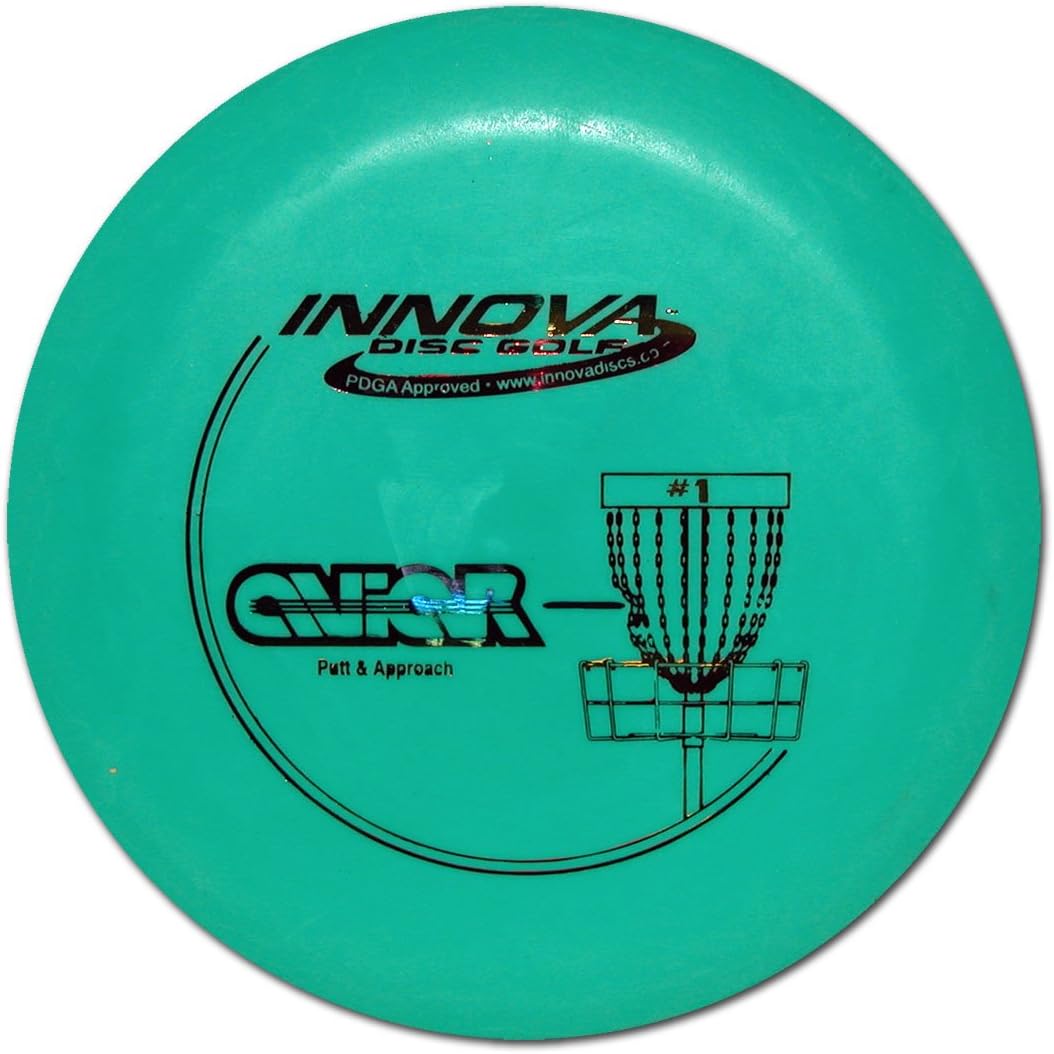
Putt and Approach Golf Disc
A putter is the slowest, deepest-rimmed disc in a bag, built to fly a short distance on a predictable line and drop when it meets the chains. Beginners also throw them from the tee on tight wooded holes, because a slow disc does roughly what you tell it. Look for base-grade plastic with a grippy, slightly tacky feel rather than a hard premium blend, since grip matters more than durability on a disc that mostly lands on grass.
Why we picked this exact one: The Innova DX Aviar has been the sport's default putter for decades, and its flight numbers of speed 2, glide 3, turn 0 and fade 1 sit inside the beginner range on every count. DX is Innova's cheapest plastic, which sounds like a downgrade until you hold one: it is grippy, it keeps that grip when wet, and it wears in instead of skipping off the chains. It scuffs faster than premium plastic, but this is the disc you will throw the shortest distances.
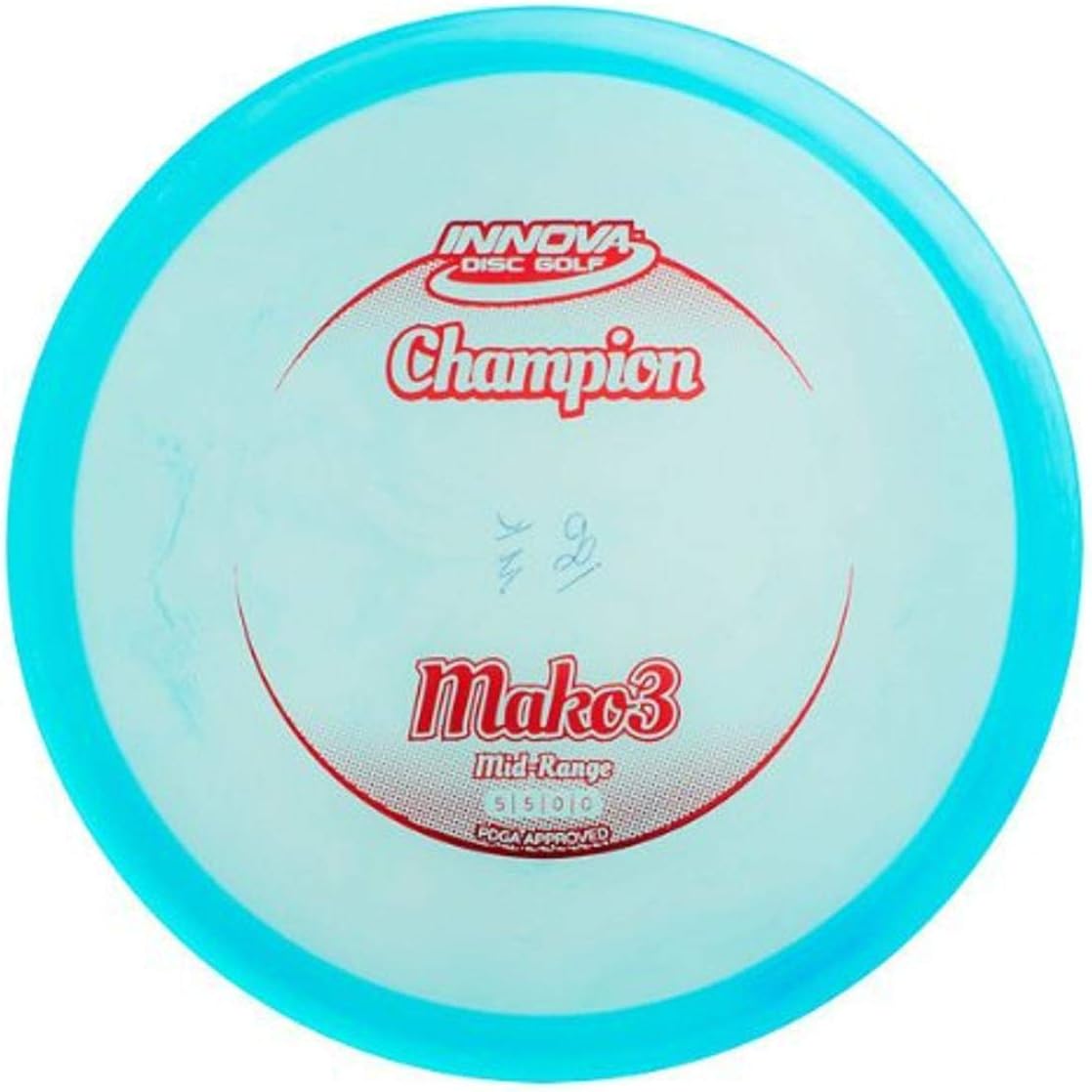
A midrange is wider and slower than a driver, and it is the disc most new players throw farthest, because it does not need much arm speed to fly the way it is meant to. It covers tee shots on short holes, approaches, and anything where you want the disc to finish where you pointed it. Premium plastic earns its few extra dollars here, since this is the disc you will be feeding into trees while you learn where the gaps are.
Why we picked this exact one: The Innova Champion Mako3 reads speed 5, glide 5, turn 0, fade 0, meaning it has no built-in curve in either direction, so whatever it does in the air is something you did to it. Champion is Innova's durable clear plastic, and the listing's own suggested use is one-disc rounds, which is exactly how a beginner should spend a first month. It sits firmer in the hand than cheaper blends, so if you prefer something softer the same mould exists in other plastics.
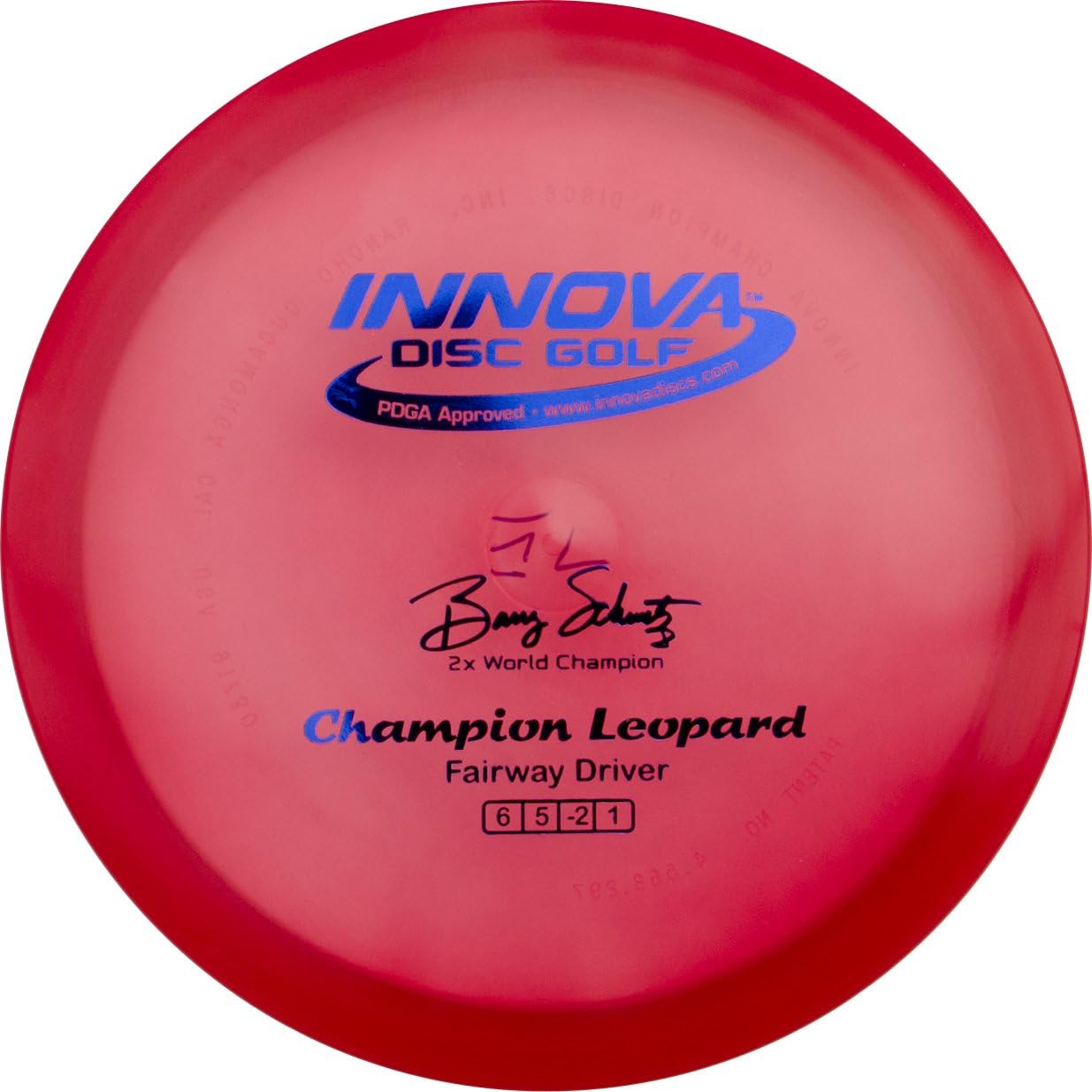
A fairway driver has a sharper rim than a midrange and is built to travel farther, but only once you can get it up to speed. The slow end of the category, speed 6 and below with a little built-in turn, is where beginners actually gain distance instead of watching the disc dive off to one side. Think of it as the disc you are growing into rather than the one you reach for on every hole.
Why we picked this exact one: The Innova Champion Leopard is the disc Innova itself calls the one everybody should start with, and at speed 6, glide 5, turn -2, fade 1 it stays inside the beginner flight-number range. That -2 turn is the useful part, because it resists the hard left finish a right-handed backhand throw produces. One caveat: Champion plastic runs firmer and more stable than the same mould in Innova's cheaper DX, so a slower arm gets a straighter flight for less money out of the DX version.
A small disc golf bag is a shoulder sling with a main compartment for discs, a separate pocket for the one you putt with, and somewhere to drop keys and a drink. Capacity is the whole decision: a bag sized for nine or ten discs suits someone carrying three, because it leaves room for the few you will add without flapping around half empty. The enormous backpacks you will see on the course belong to players hauling twenty or more moulds.
Why we picked this exact one: The MVP Cell Starter Bag holds nine to eleven discs and gives the putter its own pocket, which is roughly triple what you will start with and about right for the first couple of years. It is made from 900D polyester with an adjustable shoulder strap and a drink holder, and it costs less than most of the discs going into it. There are no padded backpack straps, so on a long walk between holes the whole weight sits on one shoulder.
With these four things you can walk onto any public course and play a legal round. That really is it. Expect to lose a disc in long grass eventually, so write your name and number on the underside in permanent marker before you go — the rules specifically allow marker ink, and disc golfers return lost discs at a rate that will genuinely surprise you. If the appeal is a hobby that is mostly an excuse to walk the same park loop over and over, beginner birdwatching runs on the same quiet logic.
What to Add Once You Are Hooked
Nothing in this section will make you better at disc golf on its own. What these do is remove the friction between wanting to practise and actually practising, which for most people is the entire problem. Putting is where that matters most. It is the part beginners ignore, and I would argue it is the easiest place to find a few strokes, partly because it is the only part you can practise properly without leaving the garden. Ten minutes folded into a day you already have beats an ambitious plan, much the way a small repeatable creative routine outlasts the grand one you abandon in March.
05Pick 05 of 08Worth the upgrade
Portable Disc Golf Practice Basket
A practice basket is a free-standing target with a cage and a ring of hanging chains, made to be carried out to the lawn and folded away afterwards. Chain count and chain weight decide how it behaves: too few or too light, and putts that would stick on a real course rattle straight through. Ground stakes matter too, because a light basket tips over in wind or takes a walk after a firm putt.
Why we picked this exact one: The MVP Black Hole Pro hangs 24 course-weighted chains, the detail separating a real practice target from a toy: a thin-chained basket spits out putts a course basket would hold. It builds from six pieces in about a minute, collapses flat, and three ground stakes come in the box. This is the step up worth making once you have played a dozen rounds and know you are staying; if you are still deciding, keep putting at a laundry basket and spend the money on a second midrange.
A mini marker is a palm-sized disc you set on the ground to mark where your last throw finished, so you can lift the thrown disc and stand where it lay. It is not needed on every shot, because the thrown disc itself marks the lie, but the rules call for one when your disc ends up somewhere you cannot play from. Any PDGA-approved mini does the job; the differences come down to grip and how easy it is to spot in grass.
Why we picked this exact one: The MVP Neutron Nano is a 5mm-class mini in MVP's premium Neutron plastic, PDGA approved for marking your lie, and it costs less than a sandwich. It is genuinely throwable, so it doubles as the disc for the backyard mini version of the game. There is not much to hold against it beyond the obvious, which is that a small bright disc is very easy to leave behind in the grass.
A retriever is a telescoping pole with a grabbing or hooking tip, used to fish a disc out of a pond, a ditch, or a bramble you would rather not climb into. Reach is the spec that matters, and around sixteen feet covers most of what a course puts in your way. Rubberised screw-on tips are worth having, because a bare metal hook scratches the disc you are rescuing.
Why we picked this exact one: The Rogue Iron Sports retriever extends from sixteen inches out to sixteen feet and ships with three interchangeable rubberised screw-on tips, so you can match the tip to whether the disc is floating, sunk or wedged in a hedge. The maker switched to wing nuts in 2021 so the sections tighten by hand rather than needing a tool, which is the sort of change that only happens after enough people complain. It costs more than two of the discs it rescues, so buy it after you have lost one, not before.
A backpack bag spreads the load across two shoulders instead of one and holds the twenty-odd discs a player gathers once they start buying different moulds for different shots. Match the capacity to the discs you actually own: a 25-disc pack carrying six rattles and sags. Padded straps and an outside putter pocket are the features that get used on every single hole.
Why we picked this exact one: The Innova Adventure Pack holds 25 discs behind padded shoulder straps, with five zippered pockets and a front putter pocket, and a mini marker comes in the box, which makes the standalone mini above redundant if you buy this. The current revision widened the main compartment opening, which matters when you are fishing for one disc in the rain. Hold off until you are carrying ten or twelve discs; before that the small shoulder bag is the better bag, not just the cheaper one.
None of this is urgent. If you buy one thing here, make it the basket, and leave it somewhere you walk past — a target you have to drag out of the shed is a target you will use twice. Ten minutes most days beats an hour on Sunday, the same unglamorous arithmetic that keeps a small indoor plant corner alive while a more ambitious one quietly dies.
Why Your Drives Hook Left, and Four Other Things Nobody Warns You About
Why does every drive I throw finish hard to the left?
Almost every new right-handed backhand thrower sees this and assumes their technique is broken. Often the disc is the problem. Fade, the fourth number stamped on the disc, is the leftward hook it makes as it slows down, and anything above 1 will do it before the disc has gone far. The other common cause is release angle: tip the far edge of the disc upward and it stalls early, then fades sooner. Check the fade number first, because swapping a fade 3 driver for a fade 1 one fixes in a single purchase what months of form work would.
Everyone says buy premium plastic. Does it actually matter?
It matters for the discs you throw hard, and barely at all for the one you putt with. Premium blends hold their shape and their flight numbers through tree strikes, while cheap plastic takes gashes and gradually turns more understable, so the disc you learned on slowly becomes a different disc. Putters are the exception, because base plastic's tackier feel is what most players actually want and you are not smashing a putter into oaks. Premium for the midrange and the driver, cheap and grippy for the putter.
Can I just use the flying disc from the beach?
For an afternoon of messing about, sure. For a real course, two things go wrong. A catch-style disc is lighter and flatter, so it flips over and rolls away the moment you put power behind it, and basket chains are not shaped to catch it, which means it bounces out of putts a golf disc would hold. There is a rules side too: in sanctioned play a disc has to be PDGA approved and meet the association's technical standards, which rules out novelty and toy discs completely.
What weight should I buy, and does lighter really mean farther?
Lighter means easier, not automatically farther. The usual adult band is 165 to 180 grams, and the sensible rule is to sit at the bottom of it if you do not have much throwing-sport background and higher if you do. A light disc needs less power to reach its intended flight, but wind shoves it around and it flips over more readily on a strong throw. Children under about twelve genuinely do better below 165 grams. The weight is usually printed on the disc, often on the underside.
Do I need a mini marker from day one?
No, and the reason is worth knowing, because this is the rule beginners most often have backwards. Where your thrown disc lies is your lie, so you can stand behind it and throw again without placing anything at all. A mini is only required when the disc is not on the in-bounds playing surface, or when a rule moves your lie. What you must not do is flip the thrown disc upside down and treat that as your marker: that is a marking violation, and in a sanctioned round it costs a warning the first time and a stroke every time after.
People Worth Following Into This Hobby
Real practitioners we found while researching this setup — people who do the work, show their process, and publish on sites they run themselves. No sponsorships, no affiliations; we just think they're worth your time.
Josh White and Mikey O'Brien film their own throws and break the backhand into 69 lessons that run grip, coil, throw, footwork in that order.
This setup tells a beginner to buy a slow fairway driver and stop blaming their form for a left-finishing drive; Overthrow is where they go when the disc is right and the throw still is not.
Writes long instruction pieces that take the sport's folklore apart, including a two-part series on the physics behind why a disc turns and fades.
The flight numbers this setup leans on get explained properly there, which is the natural next step for a reader who has just learned that speed, glide, turn and fade are not a distance rating.
Coaches on-course lessons out of Shadow Pines in Penfield, New York, and publishes a short, opinionated list of the online coaches he actually rates.
A beginner who has bought the three discs and wants someone to watch them throw needs exactly this: a named coach plus a vetted shortlist of instructors instead of an algorithm's guess.
Love what you see here? Save individual picks with on any item, or copy everything to a list of your own in one click — great for coming back to later, or dropping as a not-so-subtle hint.