Three small arrows, a wall, a line on the floor. That's the whole game. Darts grew up in British pubs and never really left them, though it now fills arenas with walk-on music and a crowd in fancy dress. The earliest boards were cut straight off the end of a tree trunk, and it's thought the growth rings and the drying cracks suggested the segments and scoring rings still in use today - those wooden boards had to be soaked overnight or they split. The compressed-sisal board that replaced them was patented in the 1930s, then sat as a curiosity for forty years, until Dutch elm disease destroyed the elm supply and the pubs had nothing left to hang.
The thing that decides whether a home board gets thrown at twice a week or quietly ignored isn't the darts. It's the wall. Hang a board on bare plaster at the right height and your first evening will leave a scatter of small holes around it, because beginners miss high and wide rather than low. The board is the cheap part of this. Everything around it is what you'll be glad you bought.
Buy as little as you can get away with. A sisal board, one set of steel-tip darts, something soft around the board and a mark on the floor at the right distance - that's a complete darts setup, and every game in the sport runs on it. Lighting, scoreboards and a second set of darts can all wait.
Nothing below is expensive enough that a board gathering dust in the garage would really bother you.
Where This Little Kit Can Take You
A few real moments and results from this hobby — made with tools no fancier than the ones below.
Darts clustered round the bullThe sisal closes over each hole as the dart comes out, which is why the board does not fill up.
Mid-throw at the ocheEverything in front of the thrower sits at a fixed distance that never changes, anywhere in the world.
What darts gives you that most living-room hobbies don't is an answer within three seconds of letting go. You throw, you see where it landed, you adjust. That loop is the same thing that makes a first ukulele so hard to put down - you can hear yourself getting less bad inside a single sitting. Nobody needs to teach you the rules either, and you can be playing a real game of 501 a minute after the board goes up. If you're still deciding what to take up at all, it's worth seeing where this sits among the easier hobbies to start as an adult.
The Four Things That Make It a Darts Setup
Three of these go on the wall and one goes on the floor. The board is where people assume the money goes, and it's where the biggest jump in quality happens for the smallest outlay - but it isn't the item beginners get wrong. That's the wall protection, which almost everyone skips and almost everyone regrets. Darts has no waiting in it: unlike the crafts whose payoff arrives after three weekends, you find out whether you can hit a treble 20 about four seconds after deciding to try. The flip side is that week one is mostly misses, and the misses have to land somewhere.
Disclosure: This section may contain affiliate links to Amazon. We may earn a small commission from qualifying purchases at no extra cost to you.
01Pick 01 of 08
Regulation Sisal Bristle Dartboard
An 18-inch competition-size board made from compressed sisal fibre, the material that closes back over the hole when a dart is pulled out. The scoring segments are divided either by thin metal blades set directly into the fibre or by round wire held down with staples, and that choice decides how often a dart deflects back at you instead of sticking. Look for a number ring you can unclip and turn, because that is how a board's life gets spread across all twenty beds instead of being spent on the 20.
Why we picked this exact one: The Target Darts Aspar is the entry point into the proper-board tier rather than a step below it: thin wire, self-recovering African sisal and a fully rotational number ring, at a price where most listings still come with staples and round wire. Target is one of the handful of brands players name without being asked. Its 4.5-star average sits a little under the premium Winmau and Unicorn boards, and that gap is real - the sisal is less densely packed, so it won't take a decade of league play.
A set of three steel-tip darts sized for a standard bristle board, with screw-in stems and flights that come apart for replacement. The tungsten content matters more than it sounds: tungsten is far denser than brass, so the same weight is packed into a slimmer barrel and three darts can sit together in one bed instead of knocking each other out. Most beginners end up somewhere between 22 and 26 grams, and the only way to find your number is to throw.
Why we picked this exact one: The Red Dragon Defender uses 85% tungsten barrels at 24 grams, right in the middle of the range most players settle into, and it ships with spare nylon shafts and thick flights so a snapped stem doesn't end the evening. Red Dragon sits in the same group as Winmau, which is reassuring for a set at this price. The grip is a fairly plain knurl - fine to learn on, though players with dry hands usually want something more aggressive later.
A panel of dense EVA foam that sits around the board and covers the wall behind and beside it. Stray darts bury themselves in the foam rather than the plaster, and the points survive too, since a steel tip that meets a brick wall at speed usually comes away bent or burred. A side effect worth knowing about is sound: foam around and behind a board takes a lot of the thud out of every throw.
Why we picked this exact one: The Harrows Extra Large Dart Board Surround measures 41 by 28 inches, putting foam well above and to each side of the board instead of only around its rim - the right call while the first hundred throws are the wild ones. Harrows has been making darts gear since the 1970s. It's a flat panel rather than a moulded ring, so it reads more workshop than tournament, and getting it level is a two-person job.
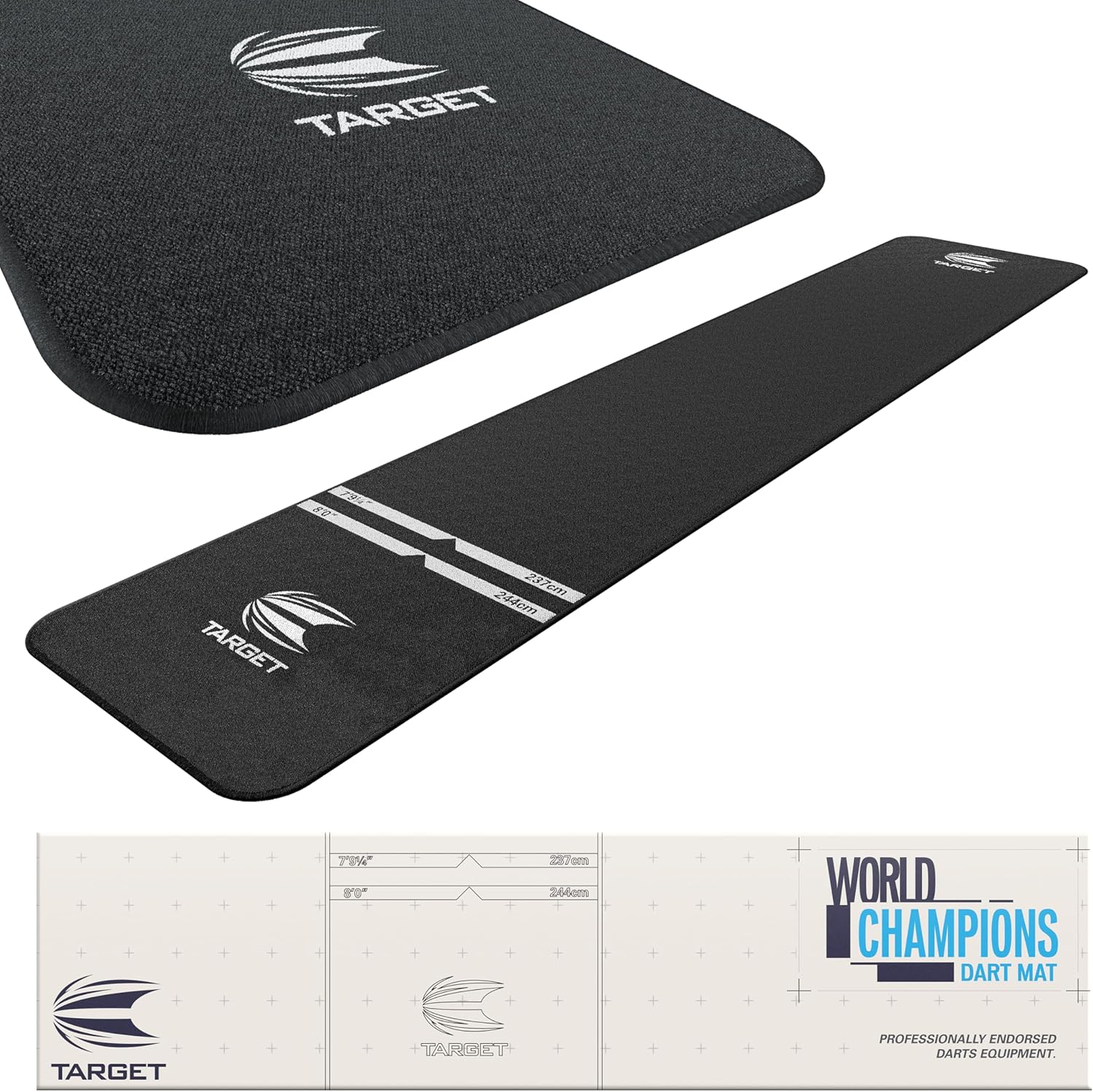
A long carpet-backed mat that runs from under the board out past the throw line, with the official distances printed across it. It does two jobs at once: it marks where you stand without anyone reaching for a tape measure, and it stops dropped darts from spiking the floor. Most carry separate lines for steel-tip and soft-tip play, because the two codes throw from different distances.
Why we picked this exact one: The Target Darts World Champions mat has both the steel-tip and soft-tip lines printed on it, so there's no measuring and no argument about where the oche sits. Its rubber-backed underlay stops it creeping while you stand on it. On thick carpet a full-length mat will still work its way out of square with the board over time - players who've been through this usually end up taping it down, or using a short standing mat instead.
Set up like this you can play every darts game there is, from 501 to Cricket to Round the Clock, on the same gear a league player uses. Give yourself one evening of simply throwing at the 20 before anything competitive - the first hour is mostly about learning how hard to throw, and it's oddly quiet work, just the soft thud into sisal and the clatter of the one that didn't stick. If you haven't settled on a hobby yet, the questions in our guide to picking a first hobby land pretty neatly here: space, noise, and whether anyone else in the house has to agree to it.
Or One Box, Hung in an Afternoon
Buying those four things separately is a real outlay for something you haven't tried yet, and a boxed cabinet set costs a fraction of it. You get a board, a wooden case whose open doors do most of the surround's job, a handful of darts and a pair of chalk scoreboards, all hanging off four screws. It's here because for plenty of households it genuinely is the right answer, and for others it's the thing they replace in six months.
The one-box alternative
Dartboard Cabinet Set
A wooden wall cabinet with a regulation sisal board mounted inside, chalk scoreboards on the inner face of each door and a set of steel-tip darts in the box. Closed it reads as a cupboard; open, the doors sit either side of the board and take most of the near misses. The board inside is usually a step below a standalone sisal board, but it is real sisal rather than coiled paper.
Why we picked this exact one: The EastPoint Belmont cabinet set keeps turning up in people's garages for a reason: an official-size self-healing sisal board with a rotating steel number ring, which is the feature budget boards almost always drop, plus six steel-tip darts and two built-in chalk scoreboards. Its 4.6-star average across more than 6,500 ratings is a lot of agreement for a product at this level. The spider is round wire rather than blade, so expect more bounce-outs than from the standalone board above.
Every darts game there is. The board inside is regulation size and marked the same way, so 501, Cricket and the rest all work on day one.
Exactly the same games. Nothing in the separate picks unlocks a game the cabinet cannot run.
Quality of the tools
Round wire held on with staples, over a softer sisal bed. Bounce-outs are common, and the darts in the box are heavy brass that will not group tightly.
Thin wire set into the fibre so darts deflect into the bed, a denser sisal bed, and tungsten barrels slim enough to sit three in one treble. better here
The first evening
One box, four screws, playing inside an hour. Scoreboards and darts are already there, so nothing is waiting on a second delivery. better here
Four separate parcels, a tape measure, and a decision about where the throw line goes before anyone throws anything.
Where it leads
The cabinet keeps earning its place once you upgrade the board inside it, and the doors go on protecting the wall. The darts get retired early.
All of it carries forward. The board outlasts a cabinet board by years, and the mat and surround never need replacing at all. better here
The rest of the house
A board bolted inside a hollow wooden case does nothing to soften the thud, and it carries straight through the wall behind it.
Foam around the board and against the wall noticeably deadens each throw, which matters in a flat or a shared wall. better here
Our verdict: it depends. Take the cabinet if darts is something the house does on a Friday night and you want it playable this weekend; build it from the picks if you can already picture yourself throwing alone for an hour on a Tuesday.
None of this changes what you can throw at. It changes how often you bother. The big one is light, and not for the reason you'd guess - a dark room isn't really the problem, a single bulb above the board is, because the darts already in the board then throw their own shadows across the segments you're aiming at. Counting backwards from 501 in your head turns out to be its own small pleasure, incidentally, and it scratches much the same itch as learning to solve a cube against the clock: a number goes down, you got better, there's nothing to argue about.
05Pick 05 of 08Worth the upgrade
Dartboard Ring Light
A circular LED unit that fits around the outside of the board and throws light inward from every direction at once. Because the light arrives from the rim rather than from a lamp somewhere above, the darts already in the board stop casting shadows over the beds you are aiming at. Most fit over or under a standard surround and run from a single mains lead.
Why we picked this exact one: The Target Darts Corona Vision is the step up worth making once darts has turned into a routine rather than an experiment - players who use it in league venues describe it as bright with no shadow at all, which is precisely what a desk lamp cannot do. It carries a 4.8-star average across more than 7,000 ratings. Wait on it through your first few weeks: it costs more than the board does, and two cheap clip lights angled in from either side get you most of the way there.
A small slate-style board with the Cricket columns already ruled on it and room for running an 01 game down the side, hung beside the dartboard. Chalk and an eraser normally sit on a ledge along the bottom. The point is less the record keeping than the arithmetic, since writing the running total down is how most people learn to take 501 apart.
Why we picked this exact one: The Viper Cricket Chalk Dart Scoreboard is ruled for both Cricket and 01 games, so one board covers everything a beginner will play. Its 4.4-star average across more than 2,700 ratings is steady for something this cheap. The small size is genuinely small at 15.5 by 8 inches - fine for two players, cramped once four people want a Cricket night.
A box of replacement flights and screw-in shafts, usually with a sharpening stone and a tool for extracting a snapped stem. Shafts are the part of a dart that fails: a hard hit from the dart behind can shear one clean off mid-game. Different shaft lengths and flight shapes also change how a dart sits in the air, so a mixed box doubles as a cheap way to experiment.
Why we picked this exact one: The MageRabbit dart accessories kit covers the two parts that actually break, with 36 flights and 45 shafts, plus a sharpener and a broken-stem remover in the same box. The shaft threads are the industry standard, so they fit barrels from any brand. The flights are thin standard-weight ones rather than the thick hardcore sort, so they will crease sooner than the pair your darts arrived with.
A small spirit level shaped to sit against a dartboard, used to check that the board hangs flat and square before anyone throws at it. The underside carries guide tracks that line the number ring back up with the wires, which is the fiddly half of rotating a board. It takes about a minute to use.
Why we picked this exact one: The Winmau Spirit Master is a dartboard-shaped level with radial guide tracks on its underside, so it handles both jobs: hanging the board true, and putting the number ring back where it belongs after a rotation. It holds a 4.6-star average. The review count is still small, and a phone level app plus a careful eye gets you most of the way - this is for people who would rather not eyeball it.
I'd buy the light first and the rest whenever. The spare shafts in particular are the sort of thing you only appreciate at nine on a Sunday evening when a stem shears off and the shops are shut - they're consumables, they break, and every brand's threads fit every other brand's barrels. If the idea of an evening hobby you can do alone at a table with a scoresheet appeals, solo miniature wargaming runs on much the same instinct.
Four Things Nobody Tells You Until the Board Is Already Up
How high does the board go, and what am I measuring from?
Almost everyone measures to the top of the board, or from the floor under their own feet, and both are wrong. The number that matters is 1.73 metres (5 feet 8 inches) from the floor to the centre of the bullseye, with the throw line 2.37 metres (7 feet 9.25 inches) back, measured horizontally from the face of the board rather than from the wall behind it. If the floor isn't level - a garage, a sloped shed - check the diagonal instead: 2.93 metres (9 feet 7.5 inches) from the centre of the bull to the back of the oche. Soft-tip boards are played from 8 feet, which is why a mat printed with both lines will not mislead you as long as you read the right one.
Why do my darts keep bouncing straight back out?
Bounce-outs are usually the board rather than your throw, and beginners blame themselves for months. Cheap boards divide the segments with round wire held down by staples; a dart that lands on top of a round wire punches a small crater in the metal and has nowhere to go but back at you. Thin blade wire is set straight into the sisal with no staple heads standing proud, so the dart slides off the edge and drops into the bed instead. Throwing harder makes it worse, not better, and on a round-wire board it is the one thing you cannot practise your way around.
My darts stuck fine for a fortnight and now they fall out. What changed?
The points, almost always. Steel tips blunt and pick up small hooks and burrs from clipping wires, and a burred point tears the sisal fibres apart instead of parting them, so the hole never closes and the next dart finds nothing to grip. A sharpening stone fixes it in about thirty seconds a dart: take the burr off and leave the tip smooth and slightly rounded rather than needle sharp. Grinding points to a fine needle is a common beginner instinct and it backfires, because a needle point develops more hooks and catches the wire more readily. While you are there, check the stems, since one that has worked loose lets the barrel droop and levers the point out of the board.
Is a dartboard going to annoy the people I live with?
More than you would expect, and the noise travels through the wall rather than across the room. A board screwed straight onto plasterboard turns that wall into a drum skin, and every dart that lands registers in the room on the other side. Foam around the board helps, and players who care about it put something soft behind the board as well - a square of carpet underlay or a sheet of rigid foam between the board and the wall takes most of the thud out. Hanging the board on solid masonry rather than a stud partition does more than any accessory you can buy.
People Worth Following Into This Hobby
Real practitioners we found while researching this setup — people who do the work, show their process, and publish on sites they run themselves. No sponsorships, no affiliations; we just think they're worth your time.
Coaches darts online and from his own studio in Worcestershire, and writes up the practice games and throw diagnostics he uses with the players he coaches.
This setup stops at the point where the board is on the wall, and his practice games are the obvious next page: every one of them has a score, so a beginner who has just measured out an oche has something to throw at other than the 20.
Has researched and written darts history for nearly four decades, including how the wooden board gave way to the compressed-sisal one still hanging in every pub.
The first thing this setup asks a beginner to buy is a sisal board, and his piece on the dartboard explains what sisal actually is, why the holes close behind a dart, and why blade wire replaced staples.
Runs darts coaching built around the mental side of the game, with named head and technical coaches publishing long pieces on throwing faults, dartitis and nerves.
A beginner who has just set up a board will hit everything one night and nothing the next, and their piece on consistency names the four throwing faults behind that rather than telling anyone to practise more.
Has run an independent darts reference site since 2004, covering board construction, equipment, practice routines, checkout charts and original darts history research.
Their dartboards page is the long version of the single decision this setup leans on hardest - blade wire against round wire and staples - written by people with no board to sell.
Love what you see here? Save individual picks with on any item, or copy everything to a list of your own in one click — great for coming back to later, or dropping as a not-so-subtle hint.