Threading is one hole, one lace, and a great deal of concentration. A child grips a fat wooden bead in one fist, pushes a stiffened lace at the hole with the other, and then has to do the hard part: let go of the bead and catch the lace coming out the far side. You will see it on nursery fine-motor tables, on Montessori practical-life shelves, and on a lot of kitchen tables at half past four. Montessori classrooms have used bead stringing for a century, not as a craft but as groundwork for sewing. It is official enough to count as a milestone, too - the CDC lists "strings items together, like large beads or macaroni" among the things most children can do by three.
Most of what gets sold as a threading toy is perfectly fine. What decides whether a session works is the lace, not the beads. A soft shoelace with a frayed end behaves like a worm the second a three-year-old tries to aim it, and that is usually the exact moment the box gets shoved away. So start with something that holds its shape.
Our take: buy less than you think. A handful of big wooden beads, something rigid to thread them onto, and a card with holes punched round the edge will cover the first month comfortably.
Nothing below costs enough to sting if the whole thing gets abandoned by Tuesday.
Where This Little Kit Can Take You
A few real moments and results from this hobby — made with tools no fancier than the ones below.
Small hands, one long stringBeads and cords spread across a sunlit table mid-session.
A tray sorted by colourEvery compartment holds a different colour, which is half the activity before a lace appears.
One thing worth saying before the shopping starts: this page stops at the lace. Once a child laces a card confidently, the next rung up is a blunt large-eye needle and a real stitch, which means a different kit and a different level of supervision - that is the ground covered by our first hand sewing kit for kids. Here we are staying with fat beads and holes you can see through.
The Three Things That Make It Work
Beads, something rigid to thread them onto, and a flat card for the days when beads are too much. That really is the kit. The mistake almost everyone makes is buying one good lacing set and assuming the laces inside are the good part - there are usually two of them, they are the first thing to go missing under the sofa, and a toddler can chew the stiff tip off one in an afternoon. Get your threaders separately and you will stop rationing them.
Disclosure: This section may contain affiliate links to Amazon. We may earn a small commission from qualifying purchases at no extra cost to you.
01Pick 01 of 07
jumbo wooden beads with laces for toddler threading
A set of chunky painted wooden beads in mixed shapes, with a couple of laces and a case to tip them back into. The beads are sized for a whole fist rather than fingertips, and the holes run wide enough that a lace goes through without being aimed precisely. Look for beads too big to swallow and a hole you can see daylight through from across the table.
Why we picked this exact one: The Melissa & Doug Primary Lacing Beads set is the one I would start with, mostly because the beads come in different shapes rather than thirty identical rounds, which gives you sorting and pattern games later without buying anything else. It is graded for 36 months to 5 years, which lines up with this page almost exactly. The two laces it ships with are the weak point - they are short, and they are the first thing to vanish.
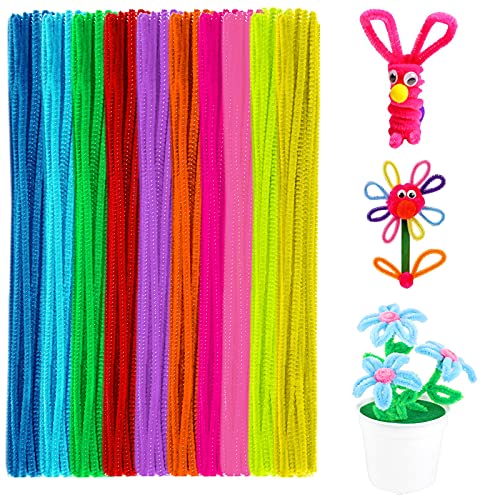
extra-thick chenille stems as a rigid first threader
Fuzzy wire stems, roughly six millimetres thick and a foot long, in mixed colours. Because the wire holds its shape, a child can hold one upright and drop beads down it instead of chasing a swinging lace. Bend the far end into a loop before handing one over, both to stop beads sliding off and to cover the cut wire.
Why we picked this exact one: I would go with the Anvin 6 mm chenille stems rather than the standard craft thickness, because the thin ones buckle the moment a bead meets resistance. A hundred of them costs less than a single lacing set, so you can write off the ones that get bent into glasses and left on the floor. They are a craft supply rather than a toy, so the cut wire ends need an adult's attention first.
Thick printed cards with holes punched around the outline of an animal, plus a lace for each card. The card is held in one hand and stays put, so the threading hand has a fixed target instead of a rolling bead. Choose cards stiff enough that a hard pull does not tear the hole out of the edge.
Why we picked this exact one: The SpriteGru animal lacing cards win on arithmetic more than anything - nine cards and nine laces for what most brands charge for four, and those spare laces quietly solve the shortage in the bead set. Double-sided printing gives each card two outlines. They are card rather than wood, so a determined yank will eventually open up a hole.
With all three on the table you can run the same activity at two difficulty settings in one sitting: stems when hands are tired, laces when they are not. Expect the first few attempts to stop after four or five beads, with the string promptly tipped out again. That is not boredom. It is a hand doing something genuinely unfamiliar, and the tipping-out is half the fun.
What to Add Once They Have the Knack
There is a gap of months between a child who can get a bead onto a lace and one who wants to make something specific, and this is the stuff that fills it. None of it is urgent. I would add one item at a time and watch which way they pull - some children go straight for sorting by colour and never care what the finished string looks like, while others want a necklace on day one and find the pattern boards maddening.
04Pick 04 of 07
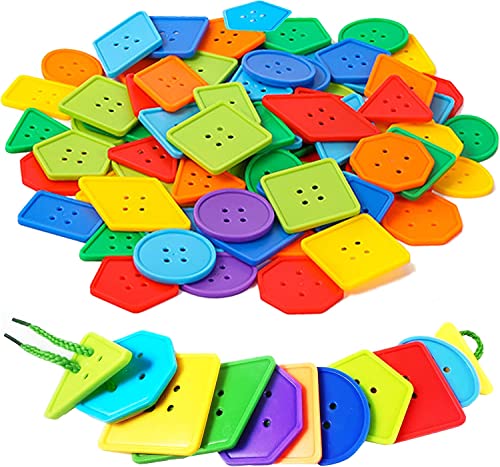
large geometric shape beads for colour and shape sorting
Seventy chunky plastic beads in seven outline shapes across four colours, with a few bead strings. Having shapes and colours in a known grid is what turns threading into sorting, matching and simple patterns rather than just filling a string. Useful once a child threads reliably and wants the beads to mean something.
Why we picked this exact one: I picked the KUTOI geometric lacing set over another bag of round beads because every shape appears in all four colours, so red triangle, blue triangle and so on actually line up for matching games. It is graded 36 months to 6 years. The beads are plastic rather than wood, which some people will mind and most three-year-olds will not.
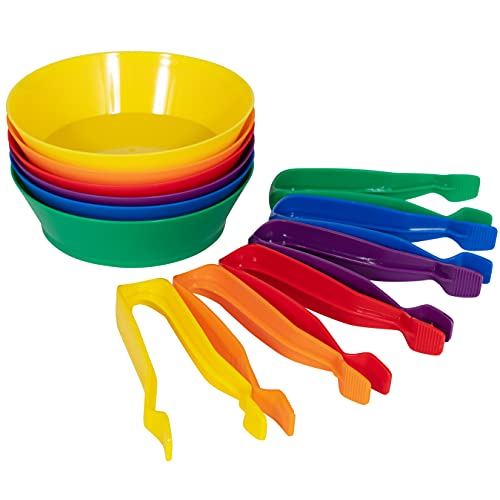
sorting bowls and jumbo tweezers for a contained bead tray
Six wide plastic bowls in matching colours with six chunky child-sized tweezers. The bowls give loose beads somewhere to live on the table, and the tweezers add a pinching job for days when threading has worn thin. Shallow and wide beats deep and narrow here, so small hands can reach the bottom.
Why we picked this exact one: The edxeducation Sorting Bowls and Tweezers set is graded from 18 months to 7 years, the widest band of anything on this page, so it stays useful either side of the threading phase. Six bowls is enough to sort a whole bead set by colour before a single lace comes out. The tweezers are the part that sits in the drawer at first.
wooden pattern boards with beads for copying bead sequences
Wooden beads with double-sided boards showing bead patterns to copy, and upright rods on a base rather than loose laces. Threading onto a fixed rod takes the floppy-string problem away entirely and leaves only the sequence to think about. The step up here is cognitive, not manual.
Why we picked this exact one: The Melissa & Doug Bead Sequencing Set earns its place because the beads go onto fixed upright rods, so a three-year-old who cannot yet manage a lace can still do the pattern work. Two things worth being straight about: it is the most expensive item here by some distance, and the listing is graded 4 to 8 years, so it is the one to buy second rather than first.
wooden lacing shoe for criss-cross lacing practice
A wooden high-top shoe with holes up both sides and one long lace. Unlike a card or a bead, it asks the child to cross the lace from one side to the other in order, which is the pattern real shoes use. Tying comes much later; the lacing itself is the point at this age.
Why we picked this exact one: The Melissa & Doug Deluxe Wood Lacing Sneaker is the one with nearly eight thousand ratings behind it, and the wooden body survives being dropped in a way the fabric versions do not. Its recommended band is 36 months to 5 years, so it sits squarely inside this page. Expect the lace to come out entirely at least once a session for the first week.
A fair warning about the pattern work: copying a row of beads in the right order is a much bigger ask than threading, and a child who sails through the lacing cards can stall completely on a four-bead pattern. That is normal and not worth pushing. There is a nice moment waiting further along this road, though - somewhere past three, children start learning to tie the end knot around the last bead themselves, and the string stops being something you have to rescue.
The One Measurement That Decides Everything
There is a single rule here and it is worth knowing properly rather than vaguely. US toy safety uses a small-parts cylinder: a tube 1.25 inches across with a slanted bottom running from 1 inch to 2.25 inches deep, sized to approximate the fully expanded throat of a child under three. Anything that drops entirely inside it, in any orientation, counts as a small part, and products intended for children under three are banned from containing one at all.
Here is the catch that trips parents up. Almost every threading set on the market, including the ones on this page, is graded 3 and over - and at that grade small parts are perfectly legal, with only a visible choking-hazard warning required on the box. A 3+ label is not a promise that the beads are big. So check the beads yourself when the box arrives, against a tube of roughly those dimensions, and do it before the first session rather than after. If your child is nearer two and a half than three, or still puts things in their mouth, stay with the largest wooden beads only and keep the smaller sorting sets in a cupboard until later.
Two smaller points. Chenille stems are a craft supply rather than a toy, so an adult should fold the cut ends over before a child gets one. And beads on a hard floor travel further than seems possible - if there is a baby in the house, this is a table activity with the door shut, not a living-room-floor one.
Why the First Week Usually Goes Badly
Why does my child jab the lace at the bead instead of threading it?
Because threading is two jobs rather than one, and the second job is invisible from the outside. The bead hand has to stay still while the lace hand moves, and then the bead hand has to let go and grab the lace emerging on the other side. Most children can do each half and come unstuck at the handover, so they compensate by stabbing. The fix is to take one half away: hold the bead steady for them so they only have to push, or stand a chenille stem upright so they only have to drop beads on. Hand the second half back a week later.
The tip on our lace has gone soft. Is the set ruined?
No, and this is probably the most useful thing on this page. A frayed end is the single most common reason threading stops working, because without a firm tip there is nothing to aim with. Montessori teachers fix it with a wide piece of sticky tape wrapped tightly round the last inch of the lace and rolled thin, which stiffens the end and lasts for weeks. Keep the tape with the beads rather than in a drawer, because you will be doing this often enough that a trip upstairs means you will not bother.
She is two and a half. Is it too early to start?
Not for threading itself, but probably for a lace. Stringing large beads is something most children manage by three, which means plenty are still working on it well before that and some are nowhere near. The mistake is reading a slow start as failure and putting the whole thing away for a year. Start with the rigid stems and the biggest beads in the set, skip the cards entirely, and let it be a two-minute thing a few times a week. The lace can wait until the hands are ready.
He threads the whole string and then tips it all off. Should I stop him?
Leave him to it. The repetition is the part doing the work - the same movement over and over is what builds both the hand control and the ability to stay with one thing. Children this age are generally not making a necklace; they are practising a motion, and emptying the string is simply the reset that lets them start again. If you want a finished object to survive, that is the moment to introduce the knot, not a moment to intervene.
People Worth Following Into This Hobby
Real practitioners we found while researching this setup — people who do the work, show their process, and publish on sites they run themselves. No sponsorships, no affiliations; we just think they're worth your time.
A registered paediatric occupational therapist in Sydney who writes up the mechanics of fine-motor tasks, photographing what each hand is doing.
Her threading post explains the hand swap this setup is built around - the bead hand letting go and catching the lace - which is exactly the failure parents watch in the first week and cannot name.
A paediatric occupational therapist and a physical therapist who publish toddler fine-motor activities and run training for therapists and teachers.
Their toddler fine-motor list sets threading alongside the other jobs that build the same grip, which is where a parent should go once the beads alone stop holding attention.
An AMS-certified infant and toddler Montessori guide who co-taught a toddler classroom and writes up how materials are introduced at home.
Her writing on presenting a new material to a toddler answers the question this setup raises next: how to put the beads out so a child engages with them instead of tipping them straight onto the floor.
A Montessori teacher who has catalogued more than a decade of practical-life activities, including the lacing and stringing work that comes before sewing.
Her sewing round-up maps the rung above this page - what a child moves on to once lacing cards are easy - which is the question parents ask about three months in.
Love what you see here? Save individual picks with on any item, or copy everything to a list of your own in one click — great for coming back to later, or dropping as a not-so-subtle hint.