Here's the part nobody expects: the inline skate came first. The earliest wheeled skates on record, from around 1760, ran their wheels in a single line, and they were close to unsteerable - you went roughly where you were pointed. Quads arrived a century later, when James Plimpton's 1863 rocking skate let a skater turn simply by leaning, and rinks spread across America and Europe soon after. Those four wheels are still what fills a rink on a Saturday, along with every smooth car park and seafront path. In 2020 shops across North America sold out of them completely.
Your first ten minutes on quads are mostly about your knees. Straighten them and your weight slides behind your wheels, which is exactly how people land on their tailbone in the first hour. Bend them and everything gets easier. That's why the protective gear below isn't a footnote to the skates - it's half the purchase, and you'll use it on day one.
Our philosophy here: buy the smallest kit that lets you fall safely, and nothing more. Skates that fit, wrist guards, knee pads, elbow pads, a helmet. Wheels, tools and bags can all wait until you know where you actually like to skate.
Everything below is gear skaters still reach for after their first year, so none of it turns into a shelf ornament if the hobby doesn't stick. If you're still weighing this up against half a dozen other ideas, our guide to choosing a first creative hobby without wasting money is worth ten minutes first.
Where This Little Kit Can Take You
A few real moments and results from this hobby — made with tools no fancier than the ones below.
Rolling home at golden hourArms up, knees soft, three skaters crossing an empty seafront lot as the light goes orange.
Wheels worn soft by milesThe outside edge of every wheel tells you which way this skater likes to turn.
None of this takes long to learn. Most people roll in a straight line within one session and stop on purpose within three. What takes longer is trusting the pads enough to really bend your knees.
What Goes On Your Feet, and What Saves Your Wrists
Sizing is the first trap, and it catches almost everyone. Skate sizes don't follow shoe sizes, and they don't even agree with each other - two brands can sit a full size apart. Trace your foot on paper with your weight on it and your knee pushed over your toes, measure the longest point and the widest part, then check the chart for the exact model you're buying. A boot half a size loose feels fine in the hallway and hands you blisters and wandering ankles twenty minutes into a session.
One more thing before the list. Ignore any listing that calls itself double-row roller skates, and put back anything with a plastic plate or plastic trucks. Those are the adjustable children's skates with a weight limit, dressed up for adults.
Disclosure: This section may contain affiliate links to Amazon. We may earn a small commission from qualifying purchases at no extra cost to you.
01Pick 01 of 09
High-Top Quad Roller Skates
Quad skates put four wheels in a rectangle under a boot, with a rubber toe stop at the front for braking. The parts that decide whether a skate lasts sit underneath: a metal plate and metal trucks hold their shape under an adult, where moulded plastic versions flex and eventually crack. A suede or leather upper softens around the foot over a few sessions, while a vinyl one never really does.
Why we picked this exact one: The Candi GRL Carlin from Roller Derby clears the bar most skates in this price band miss: an aluminium plate and metal trucks rather than moulded plastic, under a suede boot that actually breaks in. Its rating sits at 4.6 stars across more than a thousand buyers. The toe stop is bolt-on rather than adjustable, so you can't raise or lower it as your technique changes, though it's a cheap part to swap later.
Wrist guards are a close-fitting sleeve with a stiff plastic splint running along the palm, usually with a second one across the back of the hand. The splint stops the wrist bending backwards past its limit when you land on your hands, and the plastic slides along the ground instead of catching. Fit matters more than padding here: a guard that rides up the forearm on impact has moved out of the way.
Why we picked this exact one: The 187 Killer Pads Derby wrist guards are the derby-floor default, and they're the slide-on kind rather than the strap-everything-down kind, which makes them quick enough that you'll actually put them on. The splint runs the full length of the palm. They're bulky enough that holding a phone is awkward while wearing them, which is arguably the point.
Skating knee pads pair a foam core with a hard plastic cap, so a landing slides across the ground rather than stopping dead on the kneecap. The cap is the part that matters. Fabric-only sports pads bunch up and grip, which twists the joint instead of protecting it, so look for straps above and below the knee that keep the pad in place mid-fall.
Why we picked this exact one: The 187 Killer Pads Fly knee pads are the slimmer of that brand's two main models, cut for people who want to keep their knees bent all session rather than armour up for contact. More than a thousand buyers rate them 4.6 stars. Less bulk also means less foam, so a hard fall on concrete registers more than it would in the thicker Pro version.
Elbow pads use the same hard-cap-over-foam build as knee pads, in a smaller sleeve. They cover the point of the elbow and a little of the forearm, which is what reaches the ground first when a fall goes backwards and sideways. Most people find them the least noticeable piece of the kit once they're on.
Why we picked this exact one: Triple Eight's EP 55 elbow pads are the long-running skate-shop staple, with a hard cap and a sleeve that stays put once it's on. The rating sits at 4.5 stars. They're warm enough to notice on a hot afternoon, and they have to go on before your skates, which is easy to forget until you're already laced.
A skate helmet covers more of the back of the head than a bicycle helmet, which is where a backwards fall lands. The certification printed inside is what separates the two: skate standards test for more than one moderate impact, while bicycle standards assume a single serious crash and replacement. Sizing comes from measuring around the head with a tape, not from guessing.
Why we picked this exact one: The Triple Eight Certified Sweatsaver is triple-certified - CPSC for bicycles, ASTM F1447 for recreational skating and ASTM F1492 for skateboarding and trick roller skating - which is unusually explicit for a helmet in this price band. It ships with two sets of liner pads so the fit can be tuned. The liner is tight when new and only settles after a few hours of wear, which fools some people into thinking they sized wrong.
Buy all five of these before your first session rather than after it. Beginners routinely get the skates, skip the elbow pads, and work out in week two why they were on the list. If you're sizing up a few hobbies at once, our round-up of creative hobbies for adults starting from scratch covers the quieter options.
Or Buy the Protection in One Box
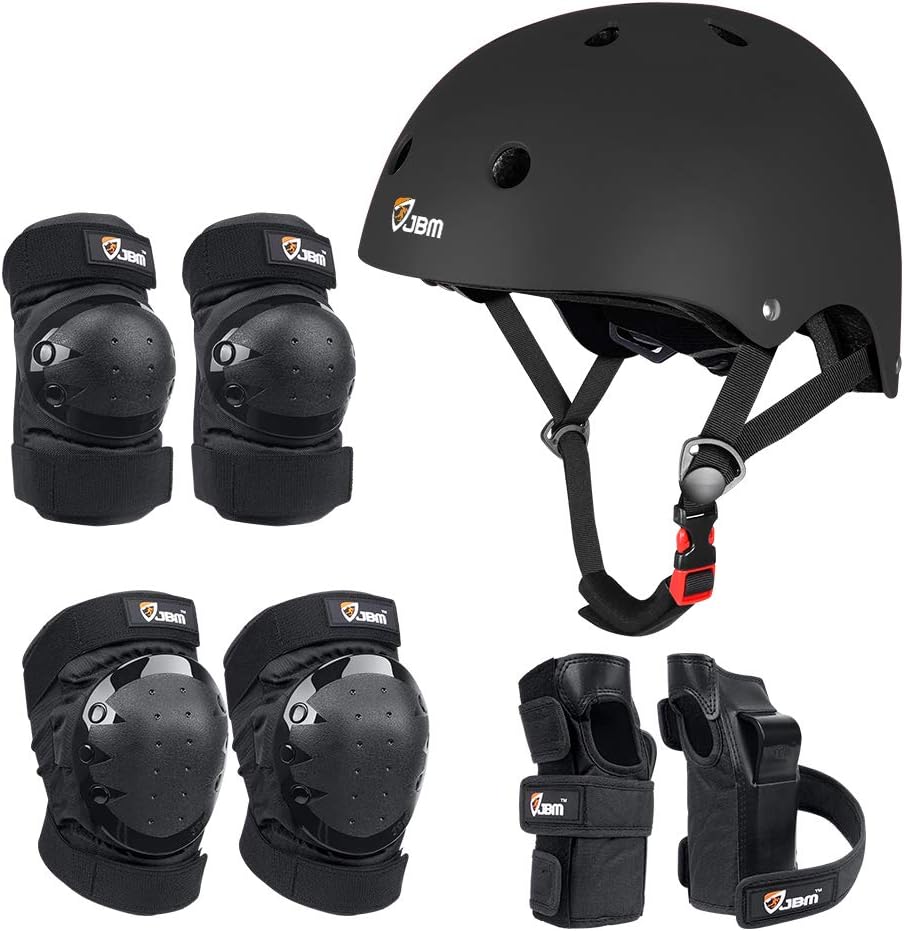
Four separate pieces of protection cost more than the skates do, which is a brutal opening bill for something you might not stick with. There's a cheaper route: one box with a helmet, knee pads, elbow pads and wrist guards sized as a set. It isn't the same gear as the picks above, and the differences are worth knowing before you decide.
The one-box alternative
Skating Protective Gear Set
A protective set packs the four pieces a skater needs into one box, sized together. The helmet adjusts with a dial at the back rather than interchangeable liner pads, and the pads are plastic caps over foam held on with elastic straps. One overall size covers the whole set, so there's a single measurement to get right instead of four.
Why we picked this exact one: The JBM adult set is the long-standing default in this category, rated 4.7 stars by more than five thousand buyers. It's specified for ages fourteen and up, so it fits adults rather than being a scaled-up children's set. Its helmet doesn't carry the skate-specific certifications the standalone pick does, and the pad straps are plain elastic rather than the layered strapping on dedicated skate pads.
Helmet, knee pads, elbow pads and wrist guards in one box, sized as a set. The skates are still a separate purchase.
The same four pieces, each sized and chosen on its own, plus the skates themselves.
Quality of the gear
Plastic caps over foam with elastic straps, and a dial-fit helmet without skate-specific certification printed on it.
Derby-grade caps and splints, and a helmet certified to CPSC, ASTM F1447 and ASTM F1492. better here
Your first session
One order, one size to get right, and you're padded head to palm the day it arrives. better here
Four separate sizes to measure and four listings to compare before anything ships.
Where it leads
Fine for learning to roll and fall. The pads start sliding out of position once you skate harder.
Still the pads you'd wear in a skate park or at a derby intake two years from now. better here
Our verdict: it depends. Buy the set if you want to be rolling this weekend and you're honestly not sure skating will stick; buy the four pieces separately if you already know you'll be out every week, because the wrist guards and the helmet are where the set gives up the most.
Falling isn't the failure state here. It's a skill, and the people who practise it on purpose improve faster, because they stop skating tense. Get low, bend hard, and go down forwards onto your knee pads with your chin tucked, letting the wrist guards take the slide. The instinct to shoot a straight arm out behind you is the one to train away, because that's the arm that breaks. Do a few deliberate falls on grass or carpet, in full pads, before you ever do one by accident.
Where you skate decides how often you'll need any of this. Flat, smooth and empty is the whole brief: a rink floor, an empty tennis court, a car park early on a Sunday. Hills, gravel, wet ground and busy paths all belong to later. A gradient you'd never notice on foot becomes a runaway problem on wheels, and quads have no heel brake to bail you out. Much of this kit carries straight over to a first skateboard setup, which shares the same pads and the same falling technique.
The other half of safety is stopping, and there's an order to learn it in: plough stop first, then the toe stop drag, then the T-stop. The plough asks nothing of your one-foot balance, which is exactly why it comes first. If you'd rather get your balance on a blade before wheels, a beginner ice skating setup teaches a lot of the same edge control in a rink with walls to grab.
The Small Things That Make Skating Easier
None of this is needed on day one, and I'd genuinely wait on all of it until you've skated a few times and know whether you're a rink person or a seafront person. The wheel set in particular only makes sense once you've discovered that your skates came with the wrong ones for where you actually go. Rain, meanwhile, ends a skating session completely, which is why a lot of skaters keep something indoors for wet weekends - a first speedcubing setup is about as different as it gets and still scratches the same itch for measurable progress.
06Pick 06 of 09
Three-Way Skate Tool
A skate tool gathers the handful of sizes a quad skate actually uses into one piece of metal: the axle nuts, the kingpin that sets how loose the trucks sit, and the toe stop bolt. Most skates ship without one. The alternative is a spanner set and a lot of guessing about which size fits what.
Why we picked this exact one: Powerdyne makes skate plates, so its Y-Series tool carries the sizes a quad skate uses rather than a skateboard's. It's rated 4.8 stars. It's a solid lump of metal with no screwdriver bit, so an Allen key still has to live in the bag for some toe stops.
Wheel hardness is printed on the wheel as a number followed by an A, and lower means softer. Outdoor wheels sit roughly between 78A and 85A so they deform over grit and cracks instead of skidding off them, while rink wheels run much harder because they're meant to slide on a polished floor. Diameter matters as well, since bigger wheels roll over rough ground more easily.
Why we picked this exact one: The CLAS FOX 78A set covers all eight wheels at 65mm, the usual outdoor size for quads, and the bearings arrive already pressed in. That second detail matters more than it sounds: with a spare set of bearings living in these wheels, switching between indoor and outdoor is four nuts rather than an evening of pressing bearings in and out. They're an unbranded set, so expect them to wear faster than skate-shop outdoor wheels.
Impact shorts are a close-fitting base layer with foam panels over the hips, outer thighs and tailbone. They go under whatever you're already skating in and disappear once you're dressed. The foam is thin enough to skate in and thick enough to change what a tailbone landing feels like.
Why we picked this exact one: The Bodyprox padded shorts are the pair that turns up under most skaters' leggings, rated 4.4 stars across more than eleven thousand buyers. The foam is sewn in rather than removable, so the whole garment goes in the wash as one item. They run warm, which is the trade-off on a summer afternoon.
A skate backpack keeps the boots in their own compartment or side holders, so wheels and grit stay away from everything else, with room left for pads and a helmet. Skates are heavier and more awkward than they look, and carrying a pair by the laces gets old on the walk to the rink. Ventilation helps, because skate boots hold sweat.
Why we picked this exact one: The GOBUROS skate backpack takes boots up to a US men's 13 and puts a dedicated helmet pocket on top, which is the detail most general backpacks miss. It's rated 4.7 stars. Its review count is modest next to the big protective brands, so it has less of a track record over years of use.
Buy these one at a time, as problems appear, rather than all at once. The usual order is the tool first, because something always needs tightening, then wheels once you know your surface. Keeping it to a weekly habit is harder than the skating is, and our notes on building a creative habit that actually sticks apply more or less unchanged to something with wheels.
The Things Nobody Tells You Until You've Already Bought the Wrong Thing
Everyone says quads are the stable ones, so why do I keep falling backwards?
Because the stability claim is half wrong, and the half that's wrong is the half that hurts. A quad's wide base feels reassuring standing still, which is where the reputation comes from, but its wheelbase is short from front to back and the plate pivots on rubber cushions. That makes going over backwards the quad beginner's signature fall, especially if you straighten your knees or let your hips drift behind your heels. Quads genuinely win on turning tightly and on rink and dance skating, which is why people choose them. Keep your knees bent and your weight over the balls of your feet, and wear the helmet from the very first session.
My skates fitted in the hallway but my feet are killing me after twenty minutes. Did I size wrong?
Probably, and the usual direction is too big. People size up for comfort, the foot then slides inside the boot, and the result is blisters, a lifting heel and ankles that feel weak when they aren't. Thick socks make it worse because they compress and fake a snug fit that vanishes once you're warm. Your toes should brush the front when you stand straight and pull back when you bend your knees. If the boot is heat-mouldable, use that before you conclude the skate is wrong.
Can I just take my new skates straight to the seafront path?
Only if they came on soft wheels, and plenty of skates don't. Hard rink wheels are built to slide on a polished floor, so outdoors they skitter over grit and stop dead on small stones, which feels exactly like being a bad skater. Outdoor wheels sit around 78A to 85A and squash over cracks instead of bouncing off them. Check the number printed on the wheel before you blame yourself - swapping wheels is the cheapest change you can make to a skate.
Which stop should I learn first, and does the toe stop really work?
Learn the plough stop first, then the toe stop drag, then the T-stop. The plough keeps both feet on the ground, so it asks nothing of the single-leg balance you don't have yet. The toe stop drag does work, but the mistake is treating the trailing leg as a passenger: it has to press down hard, or you'll trail it prettily behind you and not slow at all. Practise all of them at walking pace long before you need one at speed.
I've got a helmet. Do I really need wrist guards too?
Yes, and if anything the wrists are the more likely injury. Everyone's reflex is to catch themselves on an outstretched hand, and wrist and forearm fractures are what dominate the published roller-skating injury numbers. A guard with a rigid palm splint stops the wrist folding backwards past its limit and lets the plastic slide. Buy them tight enough that they can't ride up your forearm on impact, because a guard that has moved is a guard that isn't there.
People Worth Following Into This Hobby
Real practitioners we found while researching this setup — people who do the work, show their process, and publish on sites they run themselves. No sponsorships, no affiliations; we just think they're worth your time.
Runs a skate school and online quad courses, teaching adults the four static positions and the stops in a fixed order.
This setup tells a beginner to learn the plough stop before the toe stop drag and the T-stop, and to expect backwards falls on quads; Skatefresh is where that progression is taught lesson by lesson.
Builds custom quad conversions in a workshop and posts a weekly diary of the builds, including destructive tests of its own 3D-printed parts.
This setup tells a beginner to refuse plastic plates and trucks; Pabloskates' build diaries show what a plate, truck and cushion actually are and why the metal ones survive.
A volunteer-run league whose coaches write up what a complete beginner's first sessions on quads are actually like.
The hardest part of this setup isn't the kit list, it's staying on the wheels through the wobbly weeks, and their beginner posts are written by coaches who watch people through exactly that.
A skater-run league that publishes its own gear notes, practice drills and falling work for people arriving on quads for the first time.
Their gear page makes the same argument this setup does - that protection deserves a real share of the budget and that forward falls onto knee pads are the technique being protected.
Love what you see here? Save individual picks with on any item, or copy everything to a list of your own in one click — great for coming back to later, or dropping as a not-so-subtle hint.