Metal detecting is walking very slowly with a coil held an inch or so off the ground, waiting for the moment the tone changes. People do it on permissioned farmland, on the strip of beach between the tide lines, and on whatever bits of park the local rules allow. The machine's ancestor wasn't built for treasure at all: in July 1881, after President Garfield was shot, Alexander Graham Bell adapted the induction balance from his telephone work and had a crude metal detector running within days. It worked. He never found the bullet, because the president's doctor sent him scanning the wrong side of the chest, and the autopsy later found it lodged exactly opposite.
Here's the thing nobody says out loud at the start: the ratio is brutal. Plan on digging something like ninety-nine bits of junk, caps and nails and pull tabs, for every object you'd actually keep. That sounds grim until you've spent an afternoon doing it, at which point it becomes the same slow scanning patience that makes beginner birdwatching with binoculars and a field guide absorbing rather than dull. You're not really hunting silver. You're learning to read a field.
My advice: buy five things and stop. A detector you can actually learn, a pinpointer, something sharp enough to cut turf cleanly, a pouch for the junk, and headphones. Knee pads and sand scoops can wait until you know whether you enjoy kneeling in wet grass.
Nothing below is the machine a ten-year veteran swings, and that's deliberate, because this hobby either grabs you in the first month or it quietly doesn't.
Where This Little Kit Can Take You
A few real moments and results from this hobby — made with tools no fancier than the ones below.
A morning's worth of dug findsSoil still in the lettering, because nothing comes out of the ground looking like a coin.
Two detectorists at first lightLow tide and an empty beach are worth getting up in the dark for.
Nobody hands out a licence for this, but somebody does have to say yes to the ground you want to search, and that part isn't optional. We come back to it properly at the bottom of the page, because it decides what you can do with the kit before you buy any of it. If you're still weighing up whether this is your thing at all, the questions in our guide to choosing a first hobby are worth ten minutes first.
The Five Things You Actually Carry
A detector on its own is half a kit. You'll get a good signal and then stand over a patch of grass with no idea which six inches of it to open, which is how beginners end up cutting dinner-plate holes in somebody's lawn and losing the permission in one go. These five cover the complete minimum: the machine, the pinpointer that shrinks the hole to a fist, something that cuts turf properly, somewhere to put the scrap, and headphones so the faint stuff is audible. The total is real money. It's more than most of the starter hobbies for adults we write about ask for, and it's better said plainly than buried under a cheerful number.
Disclosure: This section may contain affiliate links to Amazon. We may earn a small commission from qualifying purchases at no extra cost to you.
01Pick 01 of 11
Waterproof Metal Detector
A single-coil VLF machine built for coin and relic hunting in parks, fields and on the beach. The things to look for are a numeric target ID on screen, a discrimination or notch setting so you can mute iron, and a ground balance you can actually reach. Switchable frequencies help too: lower ones tend to favour larger, deeper targets while higher ones pick up small thin objects better.
Why we picked this exact one: The Minelab X-Terra Pro sits where entry-level machines stop being toys, with three selectable frequencies and a fully waterproof body. Buyers rate it 4.7 stars, and detectorists comparing it against the Nokta Simplex Ultra give it the edge on build and on having a choice of frequency at all. Headphones are sold separately and the menu takes an evening to learn, which is the honest trade for the price.
A short wand that only picks up metal within a couple of inches of its tip, used once the hole is already open. You run it round the sides and floor of the cut until it screams, then dig exactly there. Waterproofing matters more than it sounds, because the tip spends its whole life in wet soil, and a holster keeps it off the grass where these things get left behind.
Why we picked this exact one: The Minelab PRO-FIND 15 is the stripped-back model in the brand's pinpointer line, with plain audio indication rather than the tone ID of the dearer PRO-FIND 35. It sits at 4.2 stars across more than 300 reviews and costs roughly half what the Garrett carrot does. The trade is that it beeps instead of buzzing, so on a windy headland you will sometimes miss it.
A one-piece steel blade with a serrated edge, shaped to slice through grass roots instead of tearing them. The point goes in vertically, you cut three sides of a square, and the plug folds back on the fourth side like a hinged flap. A garden trowel will do this badly for a while; the serration is the bit that stops the roots shredding.
Why we picked this exact one: The Lesche digging tool is the one detectorists treat as the standard, and this version ships with a sheath so it isn't rolling loose in the car. It holds 4.8 stars across more than 500 reviews, and the blade is a single piece of steel rather than a riveted head that eventually works loose. Check the serration side before you order: Lesche makes left- and right-serrated versions and they are not interchangeable.
A belt-mounted bag with at least two compartments, one for the scrap you dig and one for anything you want to keep. Some have a mesh-bottomed section so wet sand and soil drain out instead of collecting in the corners. A loop or holster for the pinpointer saves you putting it down in long grass, which is how people lose them.
Why we picked this exact one: The CKG finds pouch holds 4.8 stars across more than 500 reviews and splits into compartments that keep rusty nails away from a coin you would rather not scratch. At around twenty dollars it is the cheapest thing on this list and the most likely to be replaced within a year, since the zips go first. A carpenter's nail apron genuinely works as a stopgap.
Closed-back headphones that shut out wind and traffic so the quiet, broken tones at the edge of a machine's depth are audible at all. Low-latency wireless models pair straight to detectors that support it, which keeps a cable from snagging round the shaft every time you kneel. Check the plug or wireless standard your detector uses before buying, because a quarter-inch jack will not go into a 3.5 mm socket.
Why we picked this exact one: Minelab's ML85 is the wireless pair the brand's own X-Terra and Equinox machines are built to talk to, so there is no adapter and no cable across your chest. It sits at 4.6 stars, though from a modest 62 reviews, and it is the item here most people try to economise on. Any closed-back wired pair with the right plug will see you through a first season for a fraction of it.
With these five you can walk onto a field on day one and work it properly. Expect the first two or three outings to turn up almost nothing but iron and foil; that's the machine teaching you its own vocabulary, not a fault in the gear. If it turns out you like the staring-at-the-ground part more than the beeping part, a beginner rockhounding kit with a hammer, loupe and field guide scratches a very similar itch for a lot less.
What You'll Want By The Third Outing
Nothing here will find you anything the five essentials won't. What this lot changes is how long you last. Two hours of kneeling on cold ground with bare hands in wet soil ends a session early, and sessions that end early don't become finds. Detecting pays off for the same stubbornness as the slow crafts with jaw-dropping results, and comfort is mostly what buys you the stubbornness. The one genuine upgrade below is the scoop, and only if sand is where you're headed.
06Pick 06 of 11
Puncture-Resistant Leather Gardening Gloves
Leather work gloves with a long cuff that keeps soil out of your sleeve when you reach into a hole. The palm needs to resist punctures, because most of what comes out of the ground is rusted iron, broken glass and the torn lip of an old can. A touchscreen fingertip saves taking them off every time you want to photograph a find where it lay.
Why we picked this exact one: Vgo's extra-long leather gauntlets hold 4.4 stars across more than 1,200 reviews and cover the wrist gap that short gardening gloves leave wide open. The leather stiffens after a proper soaking and wants a day to come back, which is the recurring complaint. They are cut as a men's glove, so order a size down if your hands are small.
A closed-cell foam mat you drop beside the hole before you kneel. Density matters more than area: a firm pad keeps stones out of your kneecap and cold water off your trousers. It doubles as somewhere dry to sit while you rub enough soil off a find to see what it is.
Why we picked this exact one: The Gorilla Grip kneeling pad carries 4.5 stars from more than 21,000 buyers, which says less about detecting than about it being the default garden pad everywhere. The foam is water-resistant rather than waterproof, so the underside holds a little damp. At twelve dollars it is the cheapest comfort this hobby sells.
A long nylon bag sized for a detector with the shaft collapsed, usually with a pocket for the pinpointer, spare batteries and digger. The point is less about impact protection than about not leaving a search coil loose in a car boot where something gets stood on it. Check the length against your own machine, since bags are cut for particular shaft styles.
Why we picked this exact one: The Bounty Hunter carrying case rates 4.6 stars across more than 2,600 reviews and is cut for S-rod detectors, which covers most entry-level machines. It is nylon rather than hard-shell, so it stops knocks and dirt but will not survive being sat on. Measure your collapsed shaft first; buyers with longer rods report a tight fit.
A perforated stainless basket on a long handle, used instead of a hand digger once you are working sand. You push it past the target, lift, shake, and the sand drains out through the holes leaving whatever set the machine off sitting in the bottom. Hole size is the whole design question: smaller holes hold thin coins in, larger ones drain faster.
Why we picked this exact one: The CKG stainless scoop on a carbon-fibre handle is the step up worth making once you know beaches are where your weekends go, and it rates 4.6 stars across 380 reviews. It lifts a target in one pass instead of six. Skip it entirely if you detect fields and parks, where the hand digger is simply better, and wait until a second season if you are still unsure which ground suits you.
Buy these in the order the ground tells you to: gloves after the first cut finger, a pad after the first soaked trouser leg. Keep a note of where each find came out, which field, how deep, what the machine called it, because the pattern across twenty of those entries is worth more than any single coin. If you take to that part, a beginner nature journaling field kit turns out to be a very good way to log digs.
Two Books Worth The Winter
Detecting has a long dead season across most of Europe and the northern US, when the ground is either frozen or under a crop and there's nothing to swing at. That's when reading earns its keep, because the thing holding most beginners back isn't the machine, it's not knowing where people used to stand. Both of these are cheap, both are written by people who dig, and either sits well inside the sort of steady beginner routine that turns a new hobby into a habit.
10Pick 10 of 11Book worth reading
Metal Detecting Beginner Handbook
A single-volume how-to running from choosing a machine through sweep technique, site research and cleaning what you dig up. For a beginner the chapters that earn their keep are the ones on reading target ID numbers and on dating common finds, because those are the two jobs no machine does for you. Prefer a guide with photographs of real dug objects over diagrams; identification is a visual skill.
Why we picked this exact one: Brandon Neice's The Metal Detecting Bible is the title that keeps coming up when experienced detectorists are asked what a newcomer should read. It holds 4.6 stars across more than 1,700 reviews and is heavily illustrated, which matters for a book you use to put a name to a lump of corroded metal. It is American in focus, so a reader in the UK will want a local finds reference beside it.
A compact book arranged as a numbered list of individual lessons rather than chapters, so it reads in five-minute pieces. The subjects are the unglamorous ones: how to ask a landowner, how not to ruin a coin, why the first hundred signals are rubbish. It works best after an outing or two, when you have your own mistakes to match against the list.
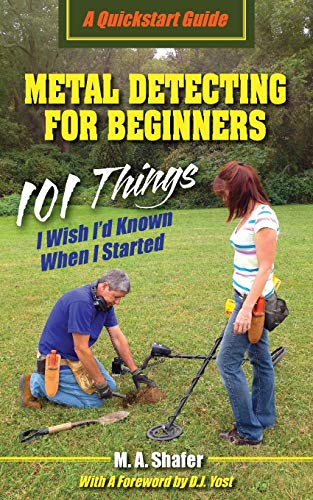
Why we picked this exact one: M. A. Shafer's 101 Things I Wish I'd Known When I Started is the ten-dollar companion to a fuller manual, built as short numbered lessons you can read between outings. It rates 4.4 stars from more than 1,200 readers, and its plainness is the point: few photographs, no gear tables. Buy it second rather than first.
Read the research chapters first and the target-ID chapters second. Learning to read an old estate map will put you on better ground than any settings change ever will, and no amount of kit on this page teaches you that.
The Part Nobody Puts On The Box
Do I actually need permission, or is a public park fair game?
Public access and detecting permission are two different things, and beginners run them together constantly. In the UK you need the landowner's consent for any ground at all, parks and commons and woods and even a public footpath included, and where the land is let the tenant has to agree too. In the US the rule that catches people is federal: metal detectors are prohibited outright on National Park Service land, while state parks, city parks and beaches each set their own policy. Ring the council or the parks department before you spend anything, because the answer decides whether your nearest green space is usable at all.
What happens if I dig up something genuinely old?
In England, Wales and Northern Ireland there's a legal duty to report potential treasure, and the clock is 14 days from the find or from the moment you realise it might qualify. Scotland runs a one-month window and a broader definition, since all finds there are potentially claimable. Failing to report is an offence, not an oversight. The practical move is to stop digging, photograph the spot, and take it to a Finds Liaison Officer. Worth knowing too: in England and Wales anything that isn't treasure belongs to the landowner unless you agreed otherwise in writing before you started.
Why do I keep opening holes and finding nothing in them?
Nine times in ten the signal never repeated. A real target answers the same way when you sweep across it from a second direction, ninety degrees to the first; ground mineralisation and buried iron give you one convincing beep and then go quiet. Beginners dig the first promising noise because digging is the fun part and checking isn't. Cross-check every signal from two angles before the blade goes in and the empty-hole rate falls off a cliff.
How much does it really matter if the turf doesn't go back neatly?
It's the one mistake that costs other people their access as well as yours. A badly refilled hole in pasture is an injured cow or horse waiting to happen, which is why a farmer who has had one careless detectorist never allows a second. The method is to cut three sides of a square, fold the plug back on the fourth like a hinged flap, dig down below the root line, then drop the flap in and stand on it. Done properly the patch has vanished in a week. Done badly it's a brown square until spring.
Should I just buy the cheapest detector and upgrade later?
The machines under about a hundred dollars are where most of the quitting happens. Their target ID wanders, so every signal is a coin flip and every hole is a gamble, and the beginner concludes they're bad at the hobby rather than badly equipped. The opposite failure is just as common: buying a flagship you can't read yet and drowning in settings menus. Spend in the entry band that still gives you a numeric target ID and a ground balance, learn that one machine for a season, and only then decide what you're missing.
People Worth Following Into This Hobby
Real practitioners we found while researching this setup — people who do the work, show their process, and publish on sites they run themselves. No sponsorships, no affiliations; we just think they're worth your time.
Posts a near-daily beach-detecting report from Florida's Treasure Coast, reading surf and tide conditions and writing multi-part breakdowns of discrimination, target ID and dating dug finds.
The FAQ here tells beginners to cross-check a signal from two directions before digging; this blog runs a whole series on what discrimination actually hides from you and why, which is the next thing a reader will want after that answer.
Has been coin and relic hunting since 1993 and field-testing detectors for manufacturers since 1998, and writes the whole of MetalDetectingWorld.com himself, including the photography.
Our FAQ lands hard on permission, and his illustrated walk-through of asking a private landowner is the most practical thing written on that subject anywhere, down to what to say at the door.
Detects as Swing4TheRing, returns lost rings to their owners, and writes up his own early mistakes and recovery hunts with the photographs of the finds that came out of them.
His beginner-mistakes piece covers the same ground as this page's first-season warnings from the other side, written by someone who made the mistakes rather than listing them.
Hosts the largest US detecting board, where members post their own hunts, help identify each other's finds and answer first-detector questions in the purchase-advice section.
The detector choice on this page is one opinion; this is the room where the same question gets answered weekly by people who own every machine in the entry band.
Love what you see here? Save individual picks with on any item, or copy everything to a list of your own in one click — great for coming back to later, or dropping as a not-so-subtle hint.