Affiliate link: we may earn a small commission, at no extra cost to you.
Two Hours or Six, You'll Open That Bag Forty Times
A short flight with a baby under one is the most ordinary parenting you already do, performed in a seat the width of your shoulders with an audience. Most of it is feeding, changing and settling, the same loop as at home, except the changing table folds down over a toilet in a cubicle you can touch both walls of. Here is the part first-time flying parents rarely know: nearly every passenger aircraft has one, and a small sign on the lavatory door tells you which. Security surprises people too. In the US, formula, pumped milk, water for the baby and food pouches all go through over the 3.4 ounce limit, cool packs included, as long as you say so before your bag reaches the belt.
Two to six hours is its own kind of trip. It's long enough that you'll feed at least once and change at least twice, and short enough that nobody is sleeping through it. The whole question is whether the thing you need is in the seat pocket or in the bin above somebody else's head.
Pack as if the bag has to live under the seat in front of you, because it does. A way to carry the baby, one slim changing kit, whatever you feed with, and two spare outfits will cover most flights in this range. The rest is optional, and optional is what makes a bag too heavy to lift one-handed.
Nothing below costs enough to resent if your baby ignores it, with one honest exception we flag where it comes up.
Copy the picks into a list of your own and you can send one link to whoever asks what the baby needs.
What It Looks Like in Real Life
A few real moments from this situation, with nothing fancier than the things below.
Sling and a departures windowThe long wait before boarding, with both hands still free.
Walking on, hands freeThe carry that gets you from the kerb to the gate.
What Has to Stay Within Arm's Reach
Everything here has to be reachable while you're holding a baby in one arm and buckled into a seat, which rules out the overhead bin for all of it. Parents who fly often keep this lot in one small bag at their feet and send the rest up top. The first decision isn't what to buy, though. It's how the baby gets through the terminal.
Disclosure: This section may contain affiliate links to Amazon. We may earn a small commission from qualifying purchases at no extra cost to you. Certain content that appears on this site comes from Amazon.
Pick one
These 2 do the same job. You only need one of them, so pick the one that suits you better.
01Pick 01 of 10Option A
soft baby carrier for hands-free airport walking
A soft structured carrier holds the baby against your chest on padded shoulder straps and a waist belt, leaving both hands free. The convertible kind adjusts between a narrow inward-facing seat for a small baby and a wider position later, usually across a range of roughly 8 to 32 pounds. Look for a waist belt that takes the weight off your shoulders and a seat you can change one-handed, because you will be adjusting it in a queue.
Why we picked this exact one: The Infantino Flip 4-in-1 is the one we would put in a carry-on: it weighs about a pound and carries from 8 to 32 pounds, which covers the first year and a good while after. At around $29 it costs a fraction of the premium carriers and still has a padded waist belt, which is what keeps your shoulders quiet by the second concourse. The straps take longer to adjust than the buckle-heavy models, so set it up before you leave home.
Pros
Stays with you through security, the jet bridge and baggage reclaim
A compact travel stroller folds small enough to go in an overhead bin rather than into the hold, so you keep it between flights instead of waiting at the oversize belt. This class folds to roughly the size of a large handbag, weighs around ten pounds and stands up on its own once folded. Check the folded dimensions against your airline's cabin allowance, because carry-on compliant means different things on different carriers.
Why we picked this exact one: The gb Pockit+ All-Terrain is the one parents name when the test is whether it fits in the bin: it folds to about 13 by 8 by 17 inches, stands on its own and reclines, which the original Pockit does not. At roughly $160 it costs several times what a carrier does, and that is the honest trade. Its 4.3 rating sits below the budget strollers here, mostly from people who found the fold fiddly for the first week.
Pros
Somewhere to put the baby down on a long connection
slim changing clutch that fits an aircraft lavatory
A changing clutch is a folded pouch holding a wipeable mat, a few diapers and a wipes pocket, so the whole changing kit leaves the bag as one object. Unfolded it covers a surface; folded it is about the size of a paperback. The useful ones have a mat long enough for the baby's shoulders to clear the plastic and a cover you wipe rather than wash.
Why we picked this exact one: The Skip Hop Pronto is the clutch most parents settle on, and the reason is the layout: a wipe-clean 36 by 21.5 inch mat, a wipes pocket you reach without opening the whole thing, and a shoulder strap so it hangs instead of resting on a wet surface. It weighs 12 ounces and rates 4.8 across about 3,000 reviews. It holds three or four diapers rather than a day's worth, so top it up at the gate.
These 2 do the same job. You only need one of them, so pick the one that suits you better.
04Pick 04 of 10Option A
pre-measured formula container for feeds on board
A formula dispenser is a stack of sealed compartments, each holding the powder for one feed, so you tip rather than scoop in a moving cabin. Three compartments is the common size and covers most short-haul flights with a feed to spare. Look for a flip-top spout narrow enough to pour into a bottle neck without a funnel.
Why we picked this exact one: Dr. Brown's Travel Formula Dispenser is the cheap, boring one that works: three compartments holding 27 ounces of powder in total, a secure flip-top, and a spout shaped to pour straight into a bottle. It is under $5 and rates 4.7 across roughly 2,100 reviews. The lid seals well, but the compartments will not stack with other brands, so buy two if you need more than three feeds.
A nursing cover is a single panel of light cloth on an adjustable neck strap, worn to feed in a seat with strangers on both sides. The useful design has a stiffened hoop at the neckline so the fabric holds open and you can see the baby's face instead of guessing. Muslin is the fabric to look for, because anything heavier becomes a tent in a warm cabin.
Why we picked this exact one: The Konssy muslin cover with the rigid hoop is the version worth having: the hoop holds the neckline open so you can see the latch, and 100 percent cotton muslin breathes in a cabin that runs warm on the ground. It is around $11 and rates 4.7 across more than 4,000 reviews. The hoop means it will not fold quite flat, so it takes up a fist of space rather than none.
Pros
Nothing to mix, and no water supply to find airside
Doubles as shade over a bassinet or a sunlit window
With those sorted, the flight stops being a logistics problem and turns into a few hours of ordinary baby-tending in a strange little room. One thing worth knowing: cabin air is dry, and babies tend to drink more in the air than they do at home, so bring more feed than the flight length suggests. Check with your airline about what counts toward your carry-on allowance before you pack, since a changing bag rides free on some carriers and not on others.
The Small Stuff That Buys You Ten Quiet Minutes
None of this is needed to get from A to B. All of it earns its space on a bad flight. Honestly, a baby under one doesn't want entertainment so much as something new to put in their mouth and something soft that smells like home. I'd skip anything with a speaker. Cabin noise swallows it, and the people around you will notice the attempt.
06Pick 06 of 10
large muslin squares for spills, shade and warmth
Muslin squares are big, loose-woven cotton cloths that work as a burp cloth, a light blanket, a shade over a window or a clean surface on a tray table. The useful size is around 40 inches square, large enough to drape over a whole baby and over you. They soften with every wash and dry fast enough to use again on the return leg.
Why we picked this exact one: The Comfy Cubs three-pack is the one we would take: 42 inches square, which is larger than most and the difference between covering a baby and almost covering one. Cotton muslin at around $18 for three means losing one at an airport is annoying rather than expensive. The review count is modest at 273, so this is a newer listing than the rating alone suggests.
A cloth book is a few fabric pages with crinkle material inside the covers and bold black-and-white shapes printed on them. It is machine washable, weighs a few ounces and makes no electronic noise at all. Check the age grade on the listing, since many sensory toys that look similar are sold for toddlers rather than babies.
Why we picked this exact one: The beiens high-contrast cloth book is the pick here on age fit: Amazon lists it for 0 to 12 months, it weighs 3.5 ounces, and the black-and-white pages suit a baby too young for picture books. At about $9 with a 4.8 rating across nearly 7,000 reviews it is the cheapest thing in this section that reliably buys ten minutes. The pages are small, so an older baby works through the whole book quickly.
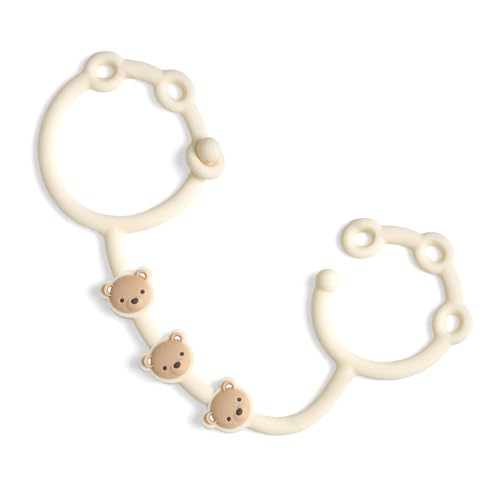
silicone tether that keeps a toy off the cabin floor
A toy tether is a short adjustable silicone strap with a loop at each end, clipping a toy, teether or cup to a stroller, a seat or a bag. The length usually adjusts to around 14 inches so the toy hangs within reach. They wipe clean, which matters when the alternative is a cabin floor.
Why we picked this exact one: The Itzy Ritzy silicone toy strap is the one that actually fits this age band: Amazon grades it 0 to 3 years, where most of the cheap multi-packs start at 18 months. It is BPA-free silicone, rates 4.8 across 72 reviews and costs about $10 for a single strap rather than five. One strap is all a lap baby needs, though you are paying more per strap than the bulk sets.
A lovey is a small square of soft fabric with a stuffed animal head attached, sized to fit in one small hand. The point is familiarity rather than play: it travels everywhere with the baby, picks up the smell of home and becomes the thing they reach for somewhere unfamiliar. Around 12 to 14 inches is the usual size, small enough to live in a coat pocket.
Why we picked this exact one: The SILI Factory Baby Bear lovey is a plain, well-made version of the format: 13.8 by 11.8 inches, 4.2 ounces, soft polyester with no beads, rattles or rings to work loose. It rates 4.8 across 139 reviews at about $13. Buy two if you can, because the whole point is the specific one the baby knows, and these do get left behind in departure lounges.
zip bags that keep soiled clothes away from clean ones
A wet/dry bag is a waterproof zip pouch, usually with two separate compartments, so clean spares go in one side and whatever came off the baby goes in the other. They are washable and seal well enough to hold a smell for a few hours. Eleven by fifteen inches takes a change of clothes for a baby and a shirt for an adult.
Why we picked this exact one: The Nora's Nursery two-pack earns its place on the two separate zippered pockets, which most cheaper wet bags leave out. Each bag is 11 by 15 inches, the pair weighs under 6 ounces, and they rate 4.8 across 166 reviews at around $20. Two is more than one flight needs, which is rather the point: the second stays clean in the suitcase.
Keep the new thing in your pocket until the last hour. Hand it over at boarding and it's just another object on the floor by the time the descent starts. When the same child is two and the journey is a ten-hour day, the kit changes entirely, and the quiet things that work for a toddler on a plane or car day are a different list altogether.
The Questions Parents Ask at the Gate
Will security make me throw out the milk I packed?
The common mistake is packing too little because you assumed the 100 millilitre rule applied. In the US it doesn't: formula, pumped milk, water for the baby and food pouches all go through over 3.4 ounces, they don't have to fit the quart bag, and cool packs are allowed too. What trips people up is the process. Tell the officer before your bag goes on the belt and take those items out separately, or you'll be the one holding up the line while everything gets re-screened. Clear bottles clear faster than opaque ones, pouches sometimes need a second test, and rules differ outside the US, so check your airport before you fly.
Is a bassinet seat worth asking for on a four-hour flight?
Parents book a bulkhead seat and assume the bassinet comes with it. It doesn't. Airlines carry a small number, apply weight and length limits that vary by carrier, and allocate them separately from seats, so you can end up at the bulkhead with no cot. The part nobody mentions is that when the seatbelt sign comes on you take the baby out and hold them, which on a bumpy afternoon can mean most of the flight. Ask at booking, ask again at check-in, and check with your airline for their own limits.
Everyone says feed at take-off. Why did it not help?
Because take-off gets all the attention and descent is the longer, slower pressure change. Parents feed during pushback, the bottle is empty before the wheels leave the ground, and there's nothing left for the part that actually goes on for twenty minutes. The cue cabin crew hand you for free is the announcement to use the restrooms before the seatbelt sign comes on, which means descent is starting. Save something to suck on for then, whether that's a feed or a pacifier. Earplugs aren't normally an option at this age, because baby ears are too small for them.
Why would I need spare clothes for myself?
The baby's spare outfit is on every list. Yours isn't, and you're the one who sits in it for the rest of the flight. A leak or a mouthful of milk at the wrong angle lands on the adult, and there is no changing table for grown-ups. One clean shirt rolled small is enough. Pack it in its own sealed bag together with the baby's spare so you grab both in one reach, rather than excavating a dark bag with one hand.
Parents Who Have Done This Before
Parents and writers we found while researching this list. They write from their own trips and days, on sites they run themselves. No sponsorships, no affiliations.
Writes up every one of her family's flights with a baby, including the ten-hour one where nobody slept.
Her flying guide walks through the same two-to-six-hour window this list packs for, and answers the bassinet and security questions in our FAQ from her own trips.
Has published baby-travel trip reports and printable packing lists from one family's own trips since 2007.
Their separate carry-on packing list is the natural next step for a parent who has chosen the picks here and now wants to check nothing is missing before they zip the bag.
A mother of four writes up her own flights with babies and sorts every tip under one checklist she uses at home and in the air.
Her HALT checklist is a good companion to the carrier-or-stroller decision this page opens with, and she covers the settling side we deliberately leave alone.
Copy these picks into a list of your own in one click. Take out what you don't need, add your own, then send one link to your partner, the grandparents or whoever asks. When someone reserves a pick, everyone sees it, so nothing gets bought twice.
Disclosure: This section may contain affiliate links to Amazon. We may earn a small commission from qualifying purchases at no extra cost to you. Certain content that appears on this site comes from Amazon.
Your next hobby might be in here
Every so often I stumble on a hobby too good not to share. Get new hobby setups and guides by email — no spam, unsubscribe anytime.