Affiliate link: we may earn a small commission, at no extra cost to you.
Everybody Asks. Almost Nobody Guesses Right.
Somewhere around month seven, the same question starts arriving from every direction. Your mother, your partner's mother, the colleague who sends a card every year: what do you want for the baby? It's kind, and it's impossible, because you have never done this before and every shop is stacked with things that look necessary. Midwives and doulas have a name for the stretch you're heading into, by the way. They call the first twelve weeks after the birth the fourth trimester, on the grounds that pregnancy doesn't really end when the baby arrives, it just moves outside. Ask parents a year later which present they still think about, and most of them name something that was for them.
So here's one concrete answer to hand over. It covers two overlapping stretches: the last weeks of pregnancy, when sleeping is the hard part, and the first weeks at home, when you are permanently one hand short. Nothing on this page needs trying on in a shop first. We've deliberately left out the car seat, the cot and anything the baby sleeps in, because those get chosen in person, by you.
Our advice: ask for less than you think. A pillow you can actually sleep against, a stack of big soft cloths, somewhere clean to change a nappy and something that keeps a drink warm will carry you a surprising distance. Parents on their second baby say the same thing every time. Most of it can wait, and next-day delivery exists.
Everything below is the sort of thing people still reach for at three in the morning in March, rather than the sort that is in the loft by February.
What It Looks Like in Real Life
A few real moments from this situation, with nothing fancier than the things below.
Waiting out the last weeksA knitted cardigan, a hand resting where the kicking is.
A stack of soft folded clothsWashed twice before anyone arrives, so they drape instead of standing up.
One note on how to use this. Pick the ones that suit your flat, your budget and the way you think you'll do things, copy them into a list of your own, and send that single link to whoever asks, so three relatives don't all turn up with the same pillow.
The Things That Get Used Every Single Day
Four jobs come up constantly across both stretches: sleeping while heavily pregnant, mopping something up, changing a nappy somewhere that isn't your own floor, and drinking tea before it goes cold. None of them is glamorous. All of them are daily. The one real disagreement is the pillow, where parents split cleanly down the middle, so you get both answers rather than a pretend consensus.
Disclosure: This section may contain affiliate links to Amazon. We may earn a small commission from qualifying purchases at no extra cost to you. Certain content that appears on this site comes from Amazon.
Pick one
These 2 do the same job. You only need one of them, so pick the one that suits you better.
01Pick 01 of 10Option A
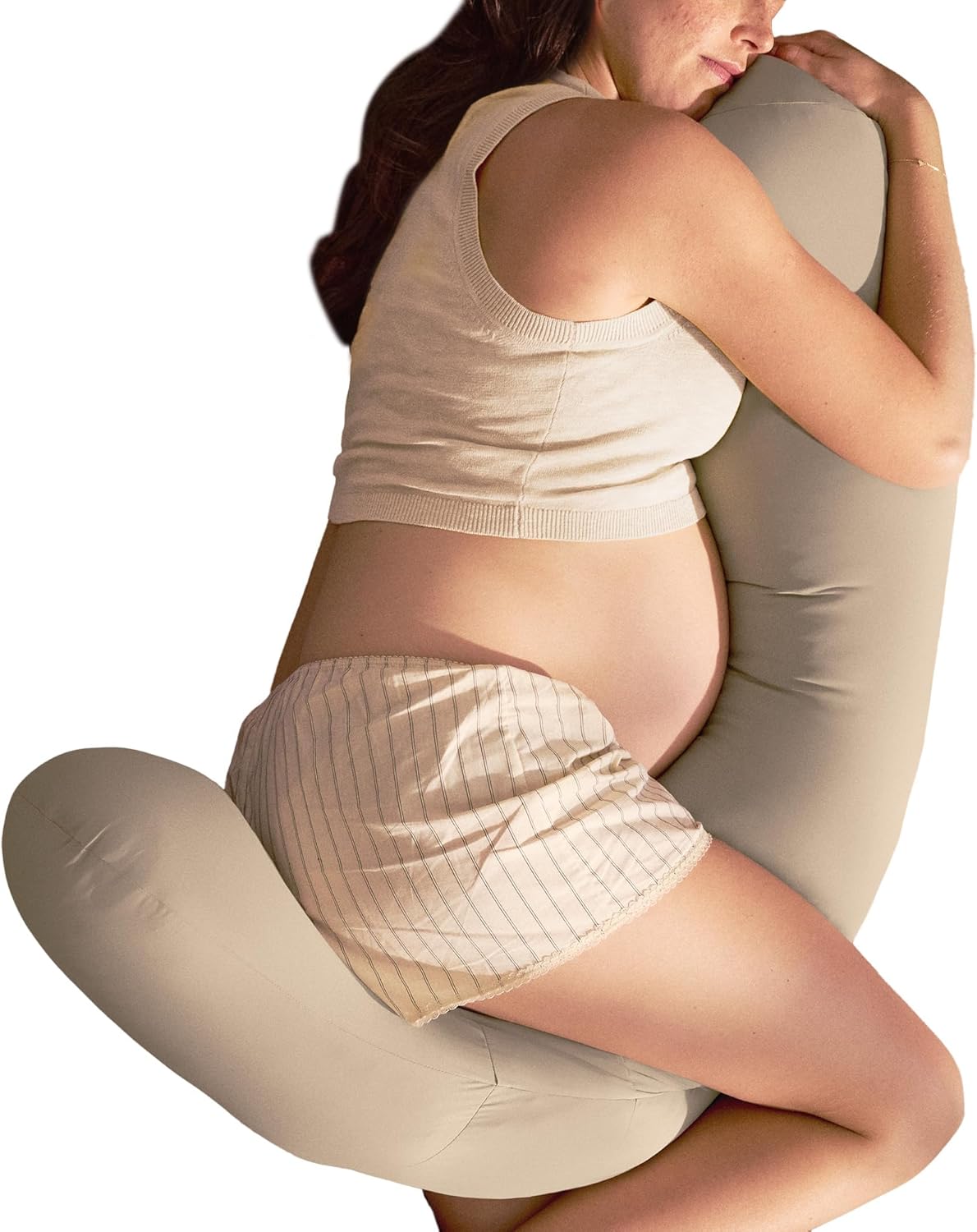
wrap-around U-shaped pregnancy pillow for side sleeping
A single pillow bent into a U so it holds your head, back, bump and knees at the same time, instead of the four separate cushions most people start with. It runs about 57 inches end to end, so it claims most of one side of a bed. Look for a cover that comes off and goes in the wash, because it will need to.
Why we picked this exact one: The Momcozy 57-inch U-shaped maternity pillow is the one we'd point a first-timer at: 4.5 stars across more than 22,000 ratings, a cover that unzips for the wash, and a price that doesn't sting if you end up preferring two normal pillows. The trade-off is floor space in the bed. At 57 inches it takes a side of the mattress, and people who sleep hot say the big ones hold warmth.
compact bendable pregnancy pillow for a shared or small bed
A short pillow with two inner cushions that let you twist it into a straight line, a C, an L or a U, depending on what aches that night. Because it bends rather than wrapping right round you, it leaves room in the bed for whoever else is in it. The cover unzips and goes through a normal wash.
Why we picked this exact one: Frida Mom's Compact Support 4-in-1 twists into four shapes and packs into its own bag, which makes it the pick if your bed is small or you're travelling over Christmas. It holds 4.2 stars, though across only 54 ratings so far, so it is a much newer listing than the big U-shapes. You do give up the all-round support of a wrap-around pillow.
Big squares of loose-woven cotton, roughly 47 inches on a side, that soften every time they go through the wash. Parents end up using them for everything except what the packet suggests: mopping up, draping over a shoulder, shading a pram, laying down a clean surface on someone else's sofa. Get the large ones, because the small squares run out of uses fast.
Why we picked this exact one: Comfy Cubs' four-pack measures 47 inches square, which is the size parents keep naming, and it sits at 4.8 stars across more than 5,000 ratings. The cotton comes out of the packet stiff and needs two or three washes before it drapes properly, which catches people out. At a little over six dollars a cloth you can afford to keep one in every room.
foldable changing mat with pockets for nappies and wipes
A padded mat that folds into a flat clutch with pockets for a couple of nappies and a pack of wipes. The surface wipes clean with water or a wipe, so it goes on a cafe bench, a bed or the back seat of a car. The useful ones have a built-in headrest and a strap, so you can carry one without a changing bag.
Why we picked this exact one: The KeaBabies Ezee portable changing pad opens to 23 by 21 inches, which is enough that a wriggling newborn stays on it, and it holds 4.8 stars over 2,400 ratings. Three pockets and a shoulder strap mean it works on its own for a short trip out. The padding is deliberately thin so it rolls up small, so it won't soften a hard surface much.
insulated travel mug that keeps a drink hot for hours
A vacuum-insulated steel mug with a lid that seals between sips, so knocking it over doesn't empty it onto a sofa. The button lids open and close with a thumb, which matters when the other hand is holding a baby. Sixteen ounces is about two mugs of tea.
Why we picked this exact one: Contigo's West Loop 3.0 is the mug parents name by brand, and it is rated to keep a drink hot for eleven hours. It carries 4.5 stars from more than 82,000 ratings. The whole thing opens, locks and drinks one-handed, and the lid comes apart for cleaning, which it needs: milky tea left in the seal turns unpleasant fast.
A word on the pillow, since it's the priciest thing here: plenty of people buy one at twelve weeks and then barely touch it until twenty-eight, which feels like a mistake at the time and isn't. If you're asking in December and due in spring, it will come into its own. The rest of this earns its keep from the first day home, and the cloths in particular are still in rotation years later, smelling faintly of fabric softener and doing jobs nobody planned for. If you're also putting together the bag you'll take to the birth, two or three of these go straight into it.
What to Say When Someone Wants to Spend a Bit More
This is the layer for the aunt who asks what the big present should be, and for the friend who wants to give something that isn't a babygro. A carrier is the usual answer and a good one, with a catch worth knowing before anybody spends the money. The rest here are small, unglamorous and in constant use. If I had to argue for one of them it would be the mug, which sounds like a joke present until the first week it saves you.
Pick one
These 2 do the same job. You only need one of them, so pick the one that suits you better.
06Pick 06 of 10Option A
stretchy cotton wrap for carrying a newborn
Several metres of stretchy cotton jersey that you tie onto yourself once and then slot the baby into, over and over, without retying. It feels closer to wearing a jumper than strapping on equipment, which is why people reach for it indoors. The maker gives a range of 7 to 35 pounds, though most parents move on from a stretchy wrap well before the top of that.
Why we picked this exact one: The Boba Baby Wrap is the stretchy wrap babywearing educators point beginners at, and it is 95% cotton with 5% spandex, so it keeps its shape through washes instead of sagging. It carries 4.6 stars from over 16,000 ratings. In a warm room it is a lot of fabric against you, and tying several metres of it in a car park in January is nobody's favourite moment.
Pros
Sits better on a tiny newborn than most buckled carriers
Comfortable for long stretches around the house
Tie it once, then lift the baby in and out
Cons
Takes practice to tie well, which is hard on no sleep
soft buckled carrier for a newborn, with head support
A soft carrier that clips on with buckles instead of being tied, with a panel that adjusts as the baby grows and padding behind the head. It goes on in under a minute, which is the entire point of it. The maker's range is 7 to 25 pounds, roughly the first year.
Why we picked this exact one: The Ergobaby Embrace is the soft buckled carrier parents keep naming after trying a wrap and wanting something faster; it is cut from knit fabric rather than stiff webbing, so it stays soft against a newborn. It holds 4.6 stars across nearly 6,000 ratings. It costs well over twice what the wrap does, and it is bulkier than fabric once you sit down at home in it.
Pros
On in under a minute, nothing to tie
Easy to hand between two parents of different sizes
A flat, firm cushion that buckles round your waist so it stays where you put it when you lean back, rather than a soft crescent you balance on your lap. The flat top keeps the baby on one level instead of rolling into the gap at your middle. Most have a pocket on the side for a phone or a drink.
Why we picked this exact one: My Brest Friend's Deluxe is the back-fastening style parents name when they say the crescent-shaped ones slid off their lap, and it is firm and flat rather than squashy. It sits at 4.6 stars from more than 7,000 ratings. Worth being honest with whoever buys it, though: plenty of experienced parents say a feeding pillow only got in their way and two sofa cushions did the job.
Squares of plain cotton, about eight inches across, that you dampen yourself and wash with everything else. They replace a fair share of the disposable wipes a household gets through, and they double as flannels. Keep them dry in a tub and wet a few at a time.
Why we picked this exact one: Nora's Nursery's 25-pack is plain 100% cotton with nothing added to it, which is the version to pick when a face and a bottom get wiped with the same cloth. It holds 4.5 stars, though across only 129 ratings. The real cost is laundry, so these only pay off in a household already running a wash most days.
felt caddy for keeping nappy-changing things in one place
A stiff felt basket with a handle and a removable divider, around 13 inches long, meant to hold nappies, wipes and a spare vest as one liftable unit. It lives downstairs and comes upstairs when you do. Once the nappy stage ends it holds toys or books instead.
Why we picked this exact one: The Parker Baby felt caddy measures 13 by 9 by 7 inches, with eight outer pockets and a divider you can lift out, which is why it keeps getting used after the nappies stop. It sits at 4.7 stars from more than 17,000 ratings. Felt is light and folds flat, but it won't take a knock the way a hard-sided box would, and the pale oatmeal shows marks.
If a relative keeps pushing for something bigger, the carrier is the honest answer, but ask them to hold off until the baby is here and one has been tried on. Fit depends on your own body and on how big the baby turns out to be, and plenty of carriers labelled from birth don't sit well on a small newborn. Sling libraries, which exist in a lot of towns and are mostly run by volunteers, lend them out for a few weeks for exactly this reason. For anyone shopping for the baby rather than for you, what a baby still gets use out of at Christmas is a better place to send them.
What Parents Wish Someone Had Told Them in November
Should bottles and a steriliser go on the list?
The instinct is to decide now and buy the set, and the regret parents describe afterwards is rarely about the bottles themselves. It is about having to choose a whole feeding setup at four days postpartum, sleep-deprived and in no state to compare anything. Babies also reject one teat and take another for no reason anyone can explain, so six bottles bought in November can turn out to be the wrong six in March. The approach most experienced parents land on: read about the options now, put nothing large on the gift list, and keep one bottle and a carton of ready-made formula in a cupboard as a backstop.
Why do people keep warning us off the baby things that look most useful?
Moses baskets, nursing chairs, nappy bins, sound machines and the various padded pods all look like solutions to real problems, which is why they sell. The catch is that they either solve a problem that lasts about six weeks, or they solve one you can solve with furniture you already own. A chest of drawers with a mat on top is a changing table. Any armchair is a nursing chair. Put the furniture-shaped items on a wait-and-see list instead, and if the baby turns out to need one, it can be in the house tomorrow.
What do we tell the people who only want to buy clothes?
Clothes are the default gift and the one most likely to go unworn, because nobody knows yet how big this baby will be. Plenty of babies skip the newborn size entirely, and a drawer of unworn tags is a quietly annoying thing to deal with in week two. Ask for sleepsuits and vests rather than outfits, since those are what gets worn around the clock, and ask people to keep the receipt. A voucher for a shop that sells baby clothes is the version of this gift that parents consistently name as the most useful.
Is there anything worth asking for that isn't an object?
This is the one most people leave off, and it is the one parents remember. Food, specifically: a takeaway voucher, a delivery of something that only needs heating, a friend who turns up with a cooked dinner and doesn't stay long. In the first fortnight the bottleneck is almost never equipment, it is that nobody has had both hands free since Tuesday. Add a line to your list saying so, plainly, because relatives who want to help usually have no idea this counts as a present.
Parents Who Have Done This Before
Parents and writers we found while researching this list. They write from their own trips and days, on sites they run themselves. No sponsorships, no affiliations.
Runs a sling library and babywearing training in Sheffield, and publishes step-by-step photo tutorials for every carrier type.
This page asks readers to choose between a stretchy wrap and a buckled carrier; her photo tutorial is where a beginner actually learns to tie the wrap properly.
A postpartum and neonatal nurse and certified lactation counsellor who writes first-hand about her own five babies and teaches online courses for new parents.
The FAQ here tells readers not to commit to a feeding setup before the birth, and she writes about feeding and the first weeks from both sides of that.
A certified babywearing consultant who photographs and films every carry step by step, including the troubleshooting nobody puts in the box instructions.
She covers the exact split this page sets up, stretchy wrap against soft buckled carrier, and her fit-check guides answer the question of why a carrier feels wrong.
A practising midwife who runs antenatal classes and writes plainly about the parts of late pregnancy people are too embarrassed to ask about.
The pregnancy pillow is the first pick on this page, and her third-trimester sleep piece is the context for why one shape suits some people and not others.
Copy these picks into a list of your own in one click. Take out what you don't need, add your own, then send one link to your partner, the grandparents or whoever asks. When someone reserves a pick, everyone sees it, so nothing gets bought twice.
Disclosure: This section may contain affiliate links to Amazon. We may earn a small commission from qualifying purchases at no extra cost to you. Certain content that appears on this site comes from Amazon.