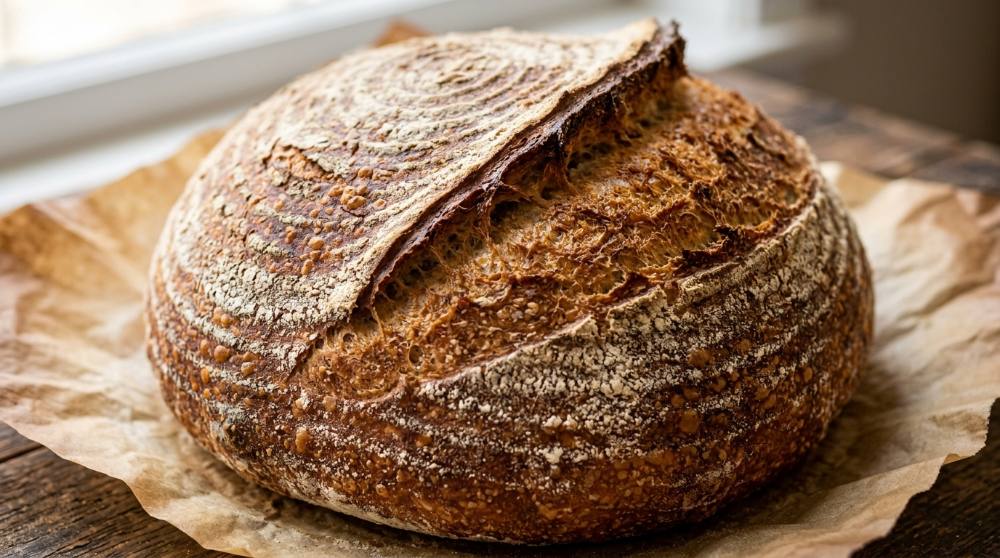
Sourdough starts as a jar of flour and water left alone until wild yeast and bacteria move in. Feed it and it bubbles, doubles, and smells faintly of yogurt. That jar is the whole engine. For most of human history this was simply how bread got made, and purpose-cultured baker's yeast only took over after 1871, so the packet is the shortcut and the slow way is the original. The oddest chapter is the Klondike gold rush, where prospectors carried their starter in a pouch worn against the body so it wouldn't freeze, and the men themselves ended up nicknamed sourdoughs after it.
Most people meet sourdough online, where it looks like a precision sport. Hydration percentages, crumb shots graded like diamonds, everybody saying the word lamination. That's the far end of a hobby whose near end is four ingredients and a lot of waiting. Your first loaf will probably be denser than the ones on your screen and it will still beat anything in a supermarket bag. What separates a flat disc from a real loaf isn't skill with your hands, it's knowing when the dough has fermented enough, and that takes a few bakes to learn rather than a better tool.
Our take: buy the four things that change the outcome and stop there. A scale, a basket, a pot with a lid, and something sharp enough to part wet dough cleanly. Flour, water, salt and time do the rest, and none of that is sold as equipment.
Nothing below costs enough to sting if the jar dies in week two and you quietly stop mentioning it.
Where This Little Kit Can Take You
A few real moments and results from this hobby — made with tools no fancier than the ones below.
Wheat-stalk score, golden crustEvery one of those cuts was made with a single pass of a blade.
Two halves, one open crumbThose irregular holes are what bakers mean when they say open crumb.
Give it three or four bakes before you judge yourself. The first one shows you what underproofed looks like, the second shows you what your oven does, and somewhere around the fourth you start reading the dough instead of the clock. If you're still weighing up whether this is your hobby at all, our guide to choosing a first creative hobby without wasting money is a sane place to begin.
The Four Tools That Change the Loaf
Here's the honest list. Sourdough has a reputation for gadgets and most of them really are optional, but these four earn their counter space because each one fixes a specific way a first loaf goes wrong. Skip the scale and your hydration drifts from one bake to the next. Skip the pot and the crust comes out pale and leathery. I'd buy all four before the first bake rather than discover the gap at seven in the morning with sticky hands and a dough that won't wait.
Disclosure: This section may contain affiliate links to Amazon. We may earn a small commission from qualifying purchases at no extra cost to you.
01Pick 01 of 10
Digital Kitchen Scale
A flat digital scale that weighs in one-gram steps and zeroes out the weight of whatever bowl is sitting on it. Bread recipes are written in grams because the ratio of flour to water decides the texture, and volume measures cannot hold that ratio steady. Look for a tare button, a platform wide enough to take a mixing bowl, and a capacity of at least five kilos.
Why we picked this exact one: The Escali Primo is the flat chrome scale most home bread bakers end up with, and it holds a 4.6 rating across more than seven thousand ratings. It weighs in single grams, tares cleanly, and the slim platform slides under a big bowl without rocking. The display sits on the front edge, so a wide bowl hides it; nudge the bowl back a centimetre and you can read it again.
A coiled cane basket that holds a round of shaped dough through its final rise, usually with a cloth liner that drops inside. The cane ridges leave the spiral pattern you see on bakery loaves and the open weave lets the dough's surface dry a little. Bakers size them by dough weight: an eight-inch basket takes about 500 to 600 grams, a nine-inch takes closer to a kilo.
Why we picked this exact one: The Saint Germain Bakery nine-inch banneton ships with its own linen liner, which matters more than it sounds, because a bare basket needs a much heavier crust of flour to release. It sits at 4.6 stars across more than four thousand ratings and costs about what two bags of good flour do. One basket is enough to start, though you will want a second the first time you decide to bake two loaves at once.
A heavy cast iron pot that goes into the oven empty to preheat, then holds the loaf under a lid for the first half of the bake. The dough's own moisture turns to steam inside and stays there, which keeps the crust soft long enough for the loaf to expand. The combo style pairs a shallow skillet with a deep pot, so the skillet becomes the base and the pot becomes the lid.
Why we picked this exact one: The Lodge cast iron combo cooker is the pot sourdough bakers name most often, and its 3.2-quart deep pot with a 10.25-inch skillet lid sits at 4.8 stars across roughly eighteen thousand ratings. Loading the dough onto the shallow skillet and lowering the deep pot over it keeps your knuckles well away from the walls, which is the part people burn with a conventional Dutch oven. It is bare cast iron, so it wants drying and a wipe of oil rather than a soak in the sink.
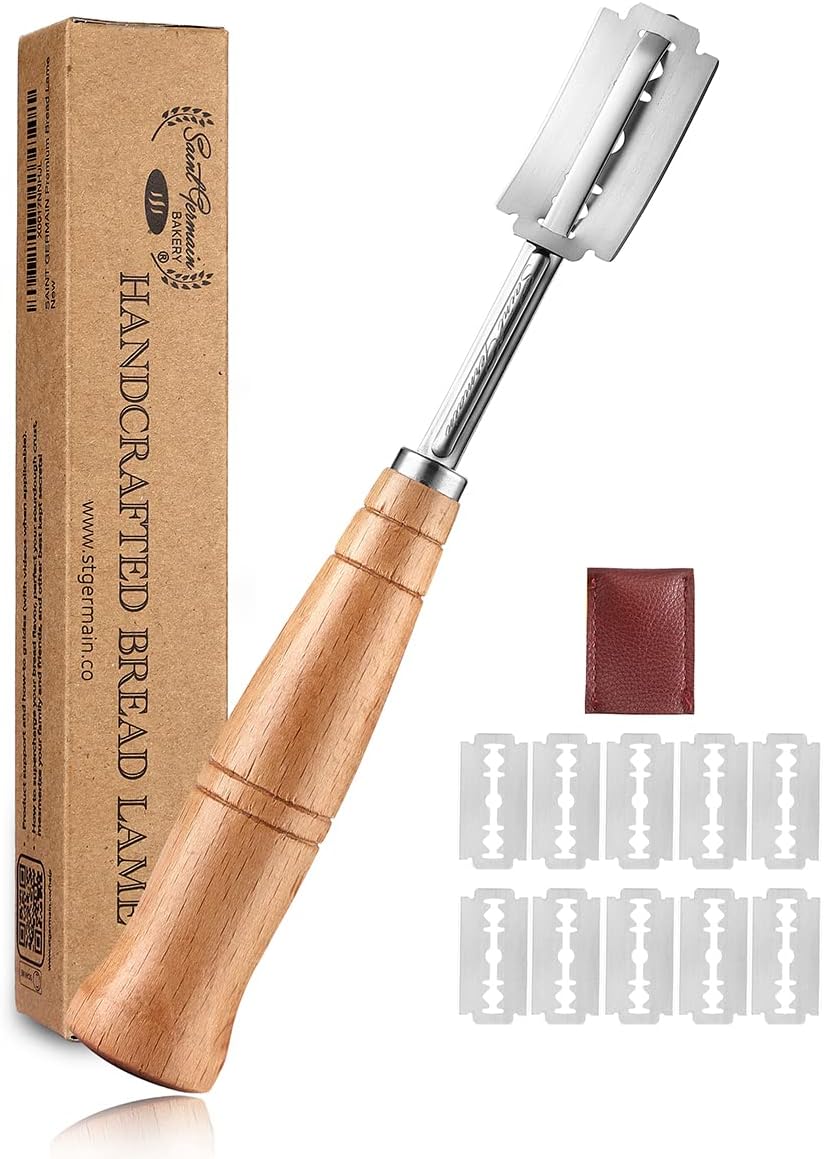
A short handle that grips a replaceable razor blade, used to cut the top of a proofed loaf in the moment before it goes into the oven. The cut gives the expanding dough one place to open instead of splitting wherever it likes. Held at a shallow angle of twenty to thirty degrees, that cut lifts into the raised flap bakers call an ear.
Why we picked this exact one: The Saint Germain hand-crafted lame is a wooden holder with ten spare blades and a leather cover, rated 4.6 across more than eight thousand ratings. Double-edged razor blades like these are thinner than the single-edged kind, and thin is what stops the drag. Plenty of experienced bakers score perfectly well with a very sharp serrated knife, so treat this as the cheap way to make a shallow-angle cut repeatable, not as a tool that scores for you.
With these four on the counter you can bake the standard beginner loaf from start to finish, and the only variable left is time. That's the hard one. Feeding a jar on a schedule turns out to be the part people underestimate, and if you want help making a small daily thing stick, our piece on building a creative habit that actually holds applies to a starter almost word for word.
What You'll Add After Loaf Number Three
None of this is needed for good bread. Each one removes a particular annoyance you'll meet around the third bake, usually while your fingers are webbed with dough and something won't let go of the counter. The classic beginner mistake is buying this list first and the essentials second, which gets you a beautifully equipped kitchen and a flat loaf.
05Pick 05 of 10
Stainless Steel Dough Scraper
A flat rectangle of steel with a handle along one edge, used to lift wet dough off a work surface, cut it into pieces and push it into a tight round. Dough that clings to your fingers slides straight off steel. It also clears dried flour and scraps off a counter in one pass, which is most of the cleanup.
Why we picked this exact one: The OXO Good Grips multi-purpose scraper and chopper is stainless rather than carbon steel, so it will not rust if it sits wet in the rack, and it holds 4.8 stars across some nineteen thousand ratings. The cushioned handle is the reason to pay a few dollars over a bare-metal restaurant scraper, because you lean on this harder than you expect. It is not a delicate tool, and that is the point.
A square food-service tub with straight walls and a snap lid, used to hold the dough through its first long rise. Straight sides mean the dough climbs in a readable line instead of spreading up a curve. A strip of tape on the outside at the starting level turns the whole thing into a gauge.
Why we picked this exact one: The Cambro six-quart classic square is the commercial tub sitting in every bakery back room, rated 4.6 across twelve hundred ratings, and six quarts gives a kilo of dough room to double without touching the lid. It is translucent rather than crystal clear, so you read the dough's level and the bubbles against the wall rather than studying the crumb through it. It takes up real fridge space, which is the honest cost of being able to see what is happening.
A folding probe thermometer that returns a reading in a couple of seconds. In bread it does two jobs: checking the temperature of freshly mixed dough, and checking the middle of a baked loaf before it leaves the oven. Anything that reads in one-degree steps and folds flat into a drawer will do.
Why we picked this exact one: The Alpha Grillers instant-read probe is the cheap end of this category done properly, at 4.7 stars over about thirteen hundred ratings, and its listing names bread rather than treating baking as a barbecue afterthought. It reads fast enough that you are not standing there with the oven door open. It is not a sealed professional probe, so wash the tip rather than the body.
A collapsible insulated box with a heating plate and a thermostat, set to hold a chosen temperature while dough or starter sits inside. It folds down to a couple of inches when it is not in use. The useful range for bread sits in the seventies and eighties Fahrenheit, well below anything that would cook the dough.
Why we picked this exact one: The GIYUDOT folding proofing box holds a set temperature between 50 and 113 degrees Fahrenheit and sits at 4.7 stars across 564 ratings. The step up is worth making once you have baked enough to know your kitchen is the problem, usually one cold winter in; if your home runs warm all year, skip it and keep using the oven with the light on. It is not the long-established Brod and Taylor unit professionals name, and it costs roughly a third as much.
Buy these one at a time, as the annoyance shows up, rather than all at once. If the part you enjoy is watching precise tools make a visible difference to a finished thing, our royal icing cookie setup runs on the same instinct with a far shorter wait.
Two Things Here Can Actually Hurt You
Nothing about sourdough is dangerous until the bake, and then two things are. The first is a cast iron pot that has sat at around 480 degrees Fahrenheit for an hour. It holds that heat long after it leaves the oven and it gives no visual signal at all. The lid catches people out, because they lift it off halfway through and then look around for somewhere to put it. Use dry oven mitts rather than a folded tea towel, and decide where the lid is going before you pick it up. A damp cloth turns to steam against your palm.
The second is the lame. A fresh razor blade is sharper than anything else in your kitchen and it sits on a handle that doesn't look like a weapon, so it ends up blade-up on a worktop or fished out of a drawer by feel. Keep the cover on it, and change blades over a bin well away from the dough.
There's a third, milder one. When the lid comes off at the halfway point, a cloud of trapped steam goes straight up at your face. Tilt the lid away from you and let it clear before you lean in.
None of that should put you off, but it's worth knowing before you're holding something heavy with both hands full. If the hot cast iron side of it genuinely doesn't appeal, there are plenty of gentler creative hobbies to start from scratch that ask nothing at all of your oven.
Two Books Worth Owning Before You Own More Gear
Sourdough is one of the few hobbies where a book still beats a search result, because what you're missing isn't a recipe. It's a picture in your head of what fermentation is doing while you're not watching. Both of these come up constantly in bread forums when somebody asks where to start, and they do quite different jobs.
09Pick 09 of 10Book worth reading
Sourdough Bread Baking Book
A hardcover built around one long country loaf method, told in photographs that follow the whole process from starter to bake. The first stretch of the book is effectively a single recipe explained at unusual length. Later chapters move into baguettes, enriched doughs and ways of using up older bread.
Why we picked this exact one: Chad Robertson's Tartine Bread is the title bread forums name when people describe how they learned, and it is rated 4.8 across more than seven thousand ratings. The photographs do real work here, because you can see what a properly fermented dough looks like instead of reading an adjective for it. Its timings assume a warm kitchen and somebody who is home all day, which is the complaint that comes up about it most often.
A thorough hardcover covering starter maintenance, fermentation, shaping and baking, followed by a wide range of recipes that run well past plain loaves. It leans harder on explanation than most baking books do. Schedules are laid out as timetables you can shift rather than fixed instructions.
Why we picked this exact one: Maurizio Leo's The Perfect Loaf grew out of a site home bakers have leaned on since 2012, and the book sits at 4.7 stars across roughly thirty-six hundred ratings. It is the more systematic of these two, with temperature and timing set out plainly enough to adapt to a cold flat. If you only want one book, this is the one that answers questions; the other is the one that makes you want to bake.
Read one of them before your third loaf rather than before your first. You need a couple of failures to hang the explanations on. If a project bake with a hard deadline sounds more fun than a weekly loaf, our gingerbread house setup is the other kind of baking entirely.
The Questions Every Beginner Ends Up Googling at Eleven at Night
My starter bubbled like mad on day four and now it's gone totally flat. Did I kill it?
Almost certainly not, and this catches nearly everyone. That first burst in a brand new starter comes from organisms that aren't the ones you want, and once the mixture turns acidic enough they die back, which looks exactly like failure. What follows is usually several quiet days while the yeast you actually need establishes itself. Keep feeding on the same schedule and ignore the silence. Most starters come back and are bakeable within a couple of weeks.
My starter won't pass the float test. Should I bake with it anyway?
Usually yes. The float test gets repeated everywhere, but experienced bakers point out it mostly tells you whether a spoonful held on to its gas while you moved it into water. A wet starter at 100 percent hydration often falls apart and sinks when it is perfectly ripe, and a stiff one can float well past its peak. Judge it by the jar instead: keep the starter in a clear straight-sided container, mark the level after feeding, and use it when it has risen and is still domed rather than sunken.
The loaf looked great coming out, but the inside is sticky and claggy. What went wrong?
There are two causes and they're easy to tell apart. If you cut into it within an hour of the bake, that's your answer: the crumb is still setting and steam is still leaving, and a warm sourdough smears into paste under a knife. If you waited and it's still gummy, the loaf was underbaked. Take its temperature next time instead of trusting the colour, because a dark crust forms well before the middle is done. Bakers pull sourdough at around 205 to 210 degrees Fahrenheit in the centre.
How much starter am I meant to throw away, and does the feeding ratio actually matter?
You discard about half or more at each feed, and the reason is arithmetic rather than waste: if you only ever add, the jar doubles forever. The ratio of old starter to fresh flour and water sets how long the rise takes, not whether it works at all. A one-to-one-to-one feed peaks in a few hours and suits same-day baking, while something like one-to-five-to-five stretches it out and fits a once-a-day rhythm. Pick whichever matches when you're actually in the kitchen, keep a small jar rather than a big one, and the discard problem mostly goes away.
Why does everyone preheat the pot? Can't I just put the dough into a cold one?
You can, and some bakers get decent results that way, but a preheated pot is more predictable while you're learning. Hot cast iron drives the base of the loaf upward in the first few minutes, and the lid keeps the dough's own steam pressed against the crust so it stays soft enough to stretch. Take the lid off for the second half so the crust can dry out and colour. Cold-starting shifts the timing of all of that at once, which is a lot of moving parts on a loaf you can't read yet.
People Worth Following Into This Hobby
Real practitioners we found while researching this setup — people who do the work, show their process, and publish on sites they run themselves. No sponsorships, no affiliations; we just think they're worth your time.
Runs bread-making classes and publishes a free weekly video and recipe aimed at people baking in ordinary home ovens.
His beginner sourdough loaf strips the method back to principles, which is the antidote to the gadget-first mistake flagged in the nice-to-have section here.
Writes and gives away The Sourdough Framework, a free book on the science of starters, fermentation and hydration, and revises its methods as his own baking changes.
His starter guide covers the quiet phase after day four that the first question in our FAQ describes, and his no-expensive-tools stance matches this page's short gear list.
Bakes a weekly sourdough loaf and documents the variations around it, answering several hundred reader questions underneath the recipe itself.
Her everyday loaf is the realistic next bake after a first attempt, and the thread under it is a live record of the gummy-crumb problem our FAQ answers.
Love what you see here? Save individual picks with on any item, or copy everything to a list of your own in one click — great for coming back to later, or dropping as a not-so-subtle hint.