Sensory Bin for Toddlers: Scoop, Pour and Dig Without the Mess Everywhere

Sensory Bin for Toddlers: Scoop, Pour and Dig Without the Mess Everywhere

Curated by Daria

This page may contain affiliate links.

lidded long storage tub used as a floor-level sensory bin

Where I'd start

A lid that clips on keeps the mess sealed and the play waiting, even when the fun stops halfway through.

lidded long storage tub used as a floor-level sensory bin

See it on Amazon
Jump to the 9 picks

Pour It Out, Scoop It Back, Pour It Out Again

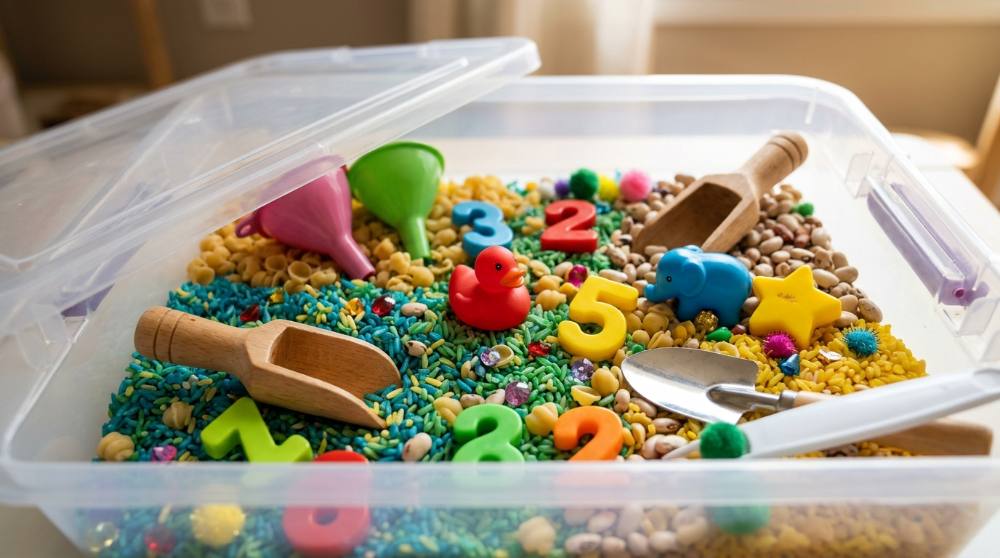
A sensory bin is a tub of something pourable, a scoop, and a patch of floor. That's it. In English early-years settings the activity has a name and a slot in the curriculum - messy play - and the official guidance for it was written by the head of a London children's centre whose job title, as her godson understood it, was "head mischief". The point is exploring what materials do, so there's deliberately nothing to make and no model to copy. Which explains the part outsiders find odd: the best moment in a sensory bin is usually a small failure, like reaching into cornflour that looks completely solid and feeling it collapse into powder and run away through your fingers.

Here's what actually happens the first time. You put the tub down, and within a minute your toddler has a handful in their mouth and the whole lot tipped sideways to see what it does. That isn't a failed session, that is the session. So the real question isn't which filler photographs best under the heading "sensory play ideas" - it's whether you've set things up so the dumping and the tasting don't wreck your afternoon.

Which is why the list here is four things. Something with a lid to hold it, something waterproof to go underneath, a few chunky scoops, and a sleeved cover-up for your child. The first filler is tap water, and it costs nothing.

I kept the whole list cheap on purpose: this is a tub of sand on your floor, not an investment.

Those four things are the entire setup. Get them in and you can run a bin tomorrow morning on water from the kitchen tap with nothing else bought. Everything after that is about keeping it interesting once the novelty of water has worn off.

The Four Things That Make the First Bin

Nearly every photo you'll see of a sensory bin shows a shallow wooden tray on a little table. Skip that. The early-years guidance for the youngest children is to put the whole thing on or near the floor, because water in a tray on the floor lets a one-year-old explore without wobbling, and a toddler leaning over a table edge tips things by sheer leverage. A clear tub with a lid does the job, goes back under the sofa with the sand still in it, and costs a fraction of the tray.

Disclosure: This section may contain affiliate links to Amazon. We may earn a small commission from qualifying purchases at no extra cost to you.
lidded long storage tub used as a floor-level sensory bin

Pick 01 of 09

lidded long storage tub used as a floor-level sensory bin

A long, shallow plastic tub with a clip-on lid, the kind sold to slide under a bed. For sensory play the shape matters more than the capacity: low sides let a toddler reach in without climbing, and the length leaves room for two children side by side. Look for clear walls so you can see what is still in there, and a lid that clips rather than just rests on top.

Why we picked this exact one: The IRIS USA 50-quart long under-bed bin is the shape this job actually needs: sides low enough for a toddler to reach over, and long enough for two of them to kneel at. It holds 4.4 stars across more than 1,700 reviews, which for a storage tub mostly comes down to whether the lid clips stay on. The trade-off is that it is sold as furniture storage rather than a toy, so there is no moulded handle for a child to drag it around by.

See it on Amazon
wipe-clean floor mat that catches spilled sensory filler

Pick 02 of 09

wipe-clean floor mat that catches spilled sensory filler

A large waterproof sheet that goes under the bin and catches whatever misses it. The useful part is not the wiping: you gather the corners when you are finished and tip the spill straight back into the tub. Pick one wider than your child's arm span, with a backing that grips the floor rather than sliding on it.

Why we picked this exact one: The Blissful Diary splat mat covers just over four feet square, which is wide enough that a tipped tub mostly lands on it rather than past it. It sits at 4.6 stars across more than 4,000 reviews, most of them from parents using it under a high chair, which is the same job in a messier form. It is square, so a long tub crosses it with some overhang at the ends - fine in practice, but don't expect it to catch a determined sideways tip.

See it on Amazon
chunky bucket, sifter and scoop set for pouring and digging

Pick 03 of 09

chunky bucket, sifter and scoop set for pouring and digging

A small set of scooping and sifting tools sized for a fist rather than for fingers. Pouring from one container into another is the move toddlers repeat endlessly, so a set that gives them something to fill and something to pour through earns its place ahead of anything decorative. Read the age marking on the box rather than trusting the photo - plenty of sand sets that look toddler-ish are graded for three and up.

Why we picked this exact one: The Hape Beach Basics set carries 18 months and up in its own safety information, which is unusual in an aisle where nearly everything is stamped 'not for under 3'. It runs 4.7 stars across more than 3,400 reviews, and the pieces are large enough that none of them disappears into a deep tub of sand. There is no funnel in the set, so if you want pouring-through as well as pouring-out, that comes from your kitchen drawer.

See it on Amazon
long-sleeved waterproof cover-up sized for one to three year olds

Pick 04 of 09

long-sleeved waterproof cover-up sized for one to three year olds

A sleeved waterproof layer worn over clothes, fastening at the back so it cannot be pulled off halfway through. Forearms are the part that actually gets soaked in water play, which is why a sleeveless apron is close to useless here. Sizing matters more than it looks: a smock cut for a four-year-old leaves a toddler standing on the hem.

Why we picked this exact one: The Madrona Brands smock is cut for ages one to three rather than the usual 2-8 catch-all, so the cuffs land near the wrist instead of past the fingertips. It rates 4.7 stars, though on a much smaller base than most things here - 79 ratings. The back fastening is the feature that matters at this age, and it is why I would take it over the cheaper sleeveless multipacks.

See it on Amazon

With these four you can run a bin before breakfast tomorrow: a shallow layer of warm water, whatever cups are in the drying rack, and you sitting next to it rather than across the room. Expect the first one to be short and fairly chaotic. That's normal, and it settles once they work out the tub isn't for tipping.

What to Add Once Water Stops Being Enough

The jump from water to a dry filler is where the age rules start to bite, and the labels are genuinely confusing. Most of what's sold for sensory play is graded three and up and carries a small-parts warning, even when the product photo shows a baby - I rejected a tub literally sold as a "sensory bin for toddlers" on this run because its own listing said not for children under three. Under three, the rule practitioners keep repeating is simpler: the filler has to be something you'd be relaxed about a handful of going in a mouth. And when you do end up with two fillers, set the trays next to each other. Toddlers want to carry material from one into the other, and you'll get far more out of letting that happen than out of policing it.

fine washed play sand for a first dry filler

Pick 05 of 09

fine washed play sand for a first dry filler

Washed, graded sand sold for sandboxes and sensory trays rather than for building work. Dampen it before it goes in the tub: wet sand holds a shape, which is what makes moulding possible at all, and damp grains stop drifting around the room. A 50-pound sack is far more than one tub needs, but sand does not go off and the rest lives in the bag.

Why we picked this exact one: Palmetto's soft-texture play sand is sold for sensory bins specifically and is described as low-dust, which is the thing that matters when the tub is indoors on your own floor. It holds 4.7 stars across nearly 900 reviews, a better record than most bagged play sand. The catch is the format - 50 pounds turns up as one heavy sack, so work out where it is going to live before it arrives.

See it on Amazon
mouldable sand that clumps instead of scattering, for ages three and up

Pick 06 of 09

mouldable sand that clumps instead of scattering, for ages three and up

Sand treated so the grains stick to each other rather than to the floor, which lets it cut and mould like damp sand without ever drying out. It is graded three and up and carries a small-parts warning, so it belongs in a later block rather than in a one-year-old's tub. It still wants a container: it holds together, but it does not stay put.

Why we picked this exact one: The Kinetic Sand 5.5lb brown refill is the plain sand rather than one of the themed playsets, which is the right buy once you already own the tub and the tools. Its 4.7 stars rest on more than 20,000 ratings, so the texture is a known quantity rather than a gamble. Note the grade: the box says three and up and the listing carries a choking warning, and on a page about toddlers that is worth taking at face value.

See it on Amazon
oversized animal figures for burying and digging back out

Pick 07 of 09

oversized animal figures for burying and digging back out

Chunky moulded animals several inches across, big enough to find by feel under a layer of sand. Burying and retrieving is the game that gives a bin a point once pouring on its own has gone flat, and large figures work far better for it than the small ones sold in tubes. These are graded three and up and carry a small-parts warning in spite of their size.

Why we picked this exact one: Learning Resources Jumbo Farm Animals are genuinely large - the listing puts the tallest at 7.25 inches - so they do not vanish in a deep tub. They run 4.5 stars across more than 2,000 ratings and are solid rather than hollow, which matters when they are being rinsed off. They still carry the standard 'not for under 3' warning, so this is a buy for the top of the age band rather than for a one-year-old.

See it on Amazon
wooden tongs, scoops and spoons for fine-motor sensory work

Pick 08 of 09

wooden tongs, scoops and spoons for fine-motor sensory work

A small set of wooden tools - tongs, spoons, scoops - meant for picking up and transferring rather than shovelling. Tongs in particular ask for a pincer grip, which is a real step on from the whole-fist grip a toddler uses on a spade. Wooden sets want drying properly after water play or they stain and go rough.

Why we picked this exact one: The Yowlieu ten-piece wooden set covers tongs, scoops and spoons in a single buy, which saves assembling the same thing out of three kitchen drawers. It rates 4.6 across nearly 400 ratings. Like most wooden tool sets it carries a 'not for under 3' small-parts warning, so it joins the bin later than the chunky plastic scoops do.

See it on Amazon
outdoor water play table with a raised pond and spinners

Pick 09 of 09 · Worth the upgrade

outdoor water play table with a raised pond and spinners

A standing table with a water basin, a tower that drops water through spinners, and a handful of cups and balls. It moves water play outdoors and up to standing height, which suits a child who has outgrown kneeling at a tub on the floor. The accessories are small; on this kind of table they are the part to read the label about, not the table.

Why we picked this exact one: The Step2 Rain Showers Splash Pond is the step up worth making once water play has clearly stuck, and not before - it is a large plastic object that will never go under the sofa. It carries 4.7 stars across more than 24,000 ratings, an unusually deep record for outdoor children's furniture. One label detail: the table is marked 18 months and up, but the listing still carries the standard 'not for under 3' warning for the loose cups, so hold those back for a younger child.

See it on Amazon

None of this needs buying at once. Sand is the natural second filler, the animals and the tongs are what make it last another year, and the table is a decision for the summer after you're sure. Before any of it, though, there are three things worth being dull about.

Three Things Worth Being Dull About

Water beads come first, and they aren't a judgement call. These are the small polymer balls sold as sensory filler, and they swell to around a hundred times their dry size in water - which they carry on doing after a child swallows one. The US Consumer Product Safety Commission puts emergency-room visits linked to them at an estimated 7,800 between 2016 and 2022, with at least one death, and its advice is to take them out of any home or setting where a child of three or under lives or visits. Dry ones are about the size of a pinhead, so a spilled bead is effectively invisible on a floor. They do real damage in ears and noses too.

Second, size. The standard for under-threes is that nothing in the bin should fit inside a small-parts cylinder about an inch and a quarter across - which is a lot bigger than most parents picture. A dried bean drops straight through it. That's why rice, lentils and dried beans are off the list for any child who still mouths things, and why burying toys means genuinely big ones.

Third, food. If you're using edible fillers - oats, cornflour, cooked pasta - check allergies first, and not only your own child's; siblings and visiting toddlers reach into the same tub. A nursery worker's list of safe fillers I read while researching this included made-up jelly but flagged jelly cubes as a choking hazard, which is about the level of detail this deserves.

None of that makes sensory play risky, exactly. It makes it supervised. The honest version is that you sit down next to the bin rather than using it to buy yourself a shower.

The Dumping Phase, and Other Things Nobody Warns You About

My toddler just tips the whole bin out. Is it too early?

Tipping is the first thing a toddler tests, not a verdict on their readiness - the tub is a new object and emptying it is the most interesting question about it. The damage is that parents read it as "not ready", put the bin in a cupboard and don't try again for a year. Start shallow, stay within arm's reach, and show them scooping rather than telling them to stop; when the tipping starts, end the session cheerfully and bring it back tomorrow. It's a skill they learn by repetition, the same as everything else at this age.

Can I just use rice? Everyone seems to use rice.

The people photographing rice bins usually have three- and four-year-olds, and the photos don't say so. For a child who still puts things in their mouth, rice, lentils and dried beans are all choking-sized, which makes the most-copied setup online the one least suited to the age the pictures imply. Use water first, then damp sand, both of which are too big or too fine to be a small part. Rice waits until mouthing has genuinely stopped, which for most children is nearer three than two.

Isn't it wasteful to play with food?

This argument comes up every single time the subject appears on a parenting forum, and it's worth knowing the practical half of the answer. Dry fillers are reusable: parents who do this routinely keep the same rice or pasta sealed and dry and play with it for months. What genuinely gets thrown out is the cooked stuff - dyed spaghetti, jelly, custard - which is a one-afternoon material. The early-years position is that a setting should decide its own line on food play rather than pretend there isn't one; if it sits badly with you, water and sand aren't food at all.

How do I stop sand getting into everything?

The instinct is to sweep, and sweeping is what grinds grains down into floorboard gaps and carpet pile where they stay. The fix parents pass around is purely mechanical: a sheet or waterproof mat under the whole operation, and when you're done you lift the toys out, gather the four corners and tip the spill back into the tub. The other half is height - a bin on the floor spills less than the same bin on a table, because a toddler reaching across a table edge is pulling it towards themselves.

They lost interest almost straight away. Did I buy the wrong filler?

Early sessions are short, and how short varies wildly day to day, which is exactly why early-years guidance tells you to watch the child rather than run a clock. The mistake is concluding that a better or more elaborate filler would have held them - so the next purchase is a themed kit, and that doesn't hold them either. What actually extends it is an adult in the play rather than an adult who set it up and stepped back: wondering aloud what happens if you add more water, filling a cup and handing it over. Sit down in it.

Love what you see here? Save individual picks with on any item, or copy everything to a list of your own in one click — great for coming back to later, or dropping as a not-so-subtle hint.

Disclosure: This section may contain affiliate links to Amazon. We may earn a small commission from qualifying purchases at no extra cost to you.