Travel Ink Wash Sketching: One Brush, One Small Kit

Travel Ink Wash Sketching: One Brush, One Small Kit

DariaCurated by Daria
Jump to the 7 picks

Wet the Line and Watch It Bloom

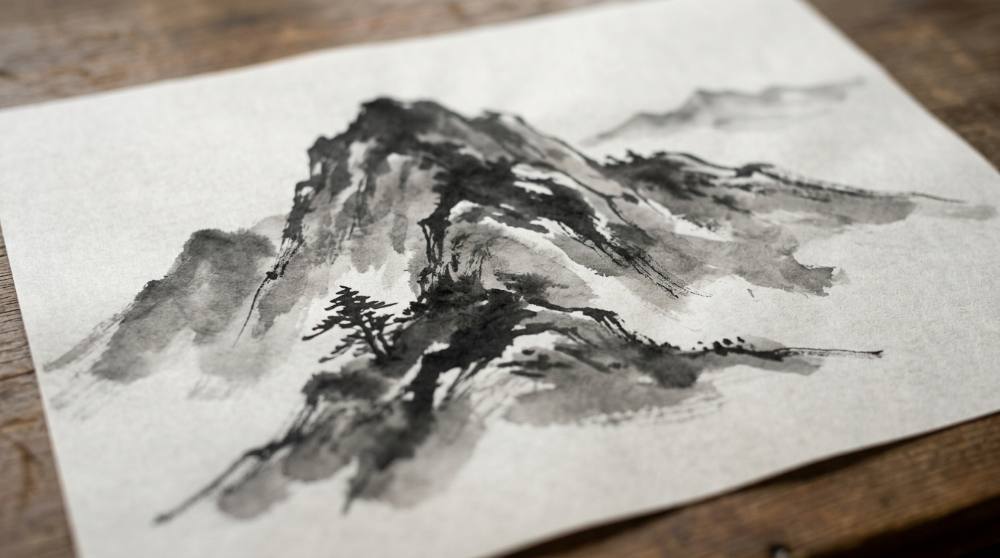
Ink wash means building a whole picture out of one black ink, thinned to different strengths: a dark roof, a mid-grey wall, a pale ridge behind both. Chinese painters were working this way more than a thousand years ago, in the Tang dynasty, and Zen monks carried the idea to Japan in the 1300s. The portable version is nearly as old. From the Kamakura period onwards Japanese travellers carried a yatate — a pocket set with a brush shaft and a tiny ink box packed with ink-soaked cotton so it could not spill. The name literally means 'quiver', because early warriors stashed their inkstones in with their arrows, and some yatate were built solid enough to swing at someone, since only samurai were allowed a katana.

The travel version of this is a different animal from the home version. At a desk you grind an inkstick on a stone, keep a water pot on your left and rest the brush on a little ceramic bridge, which is what our beginner sumi-e kit is built around. None of it survives a backpack. On location you have one hand holding the book, maybe fifteen minutes before the light shifts, and nowhere to put a water pot down. So the whole thing collapses into a brush that carries its own water and an ink source small enough to lose.

Carry less than you think you need. A water brush, one black ink that dilutes, and a little book whose paper can take a wet stroke will get you a complete tonal sketch. Everything after that is comfort, not capability.

Nothing below costs enough to make you precious about it, which is rather the point when you are still learning to ruin pages.

The thing that catches people out first is not the brush, it is the drying. A wash that looks right while it is wet dries noticeably lighter, so your darks come out weaker than you meant them. On thin paper you do not always get a second pass to fix that, which is why the paper below matters more than it looks.

Three Things That Fit in a Coat Pocket

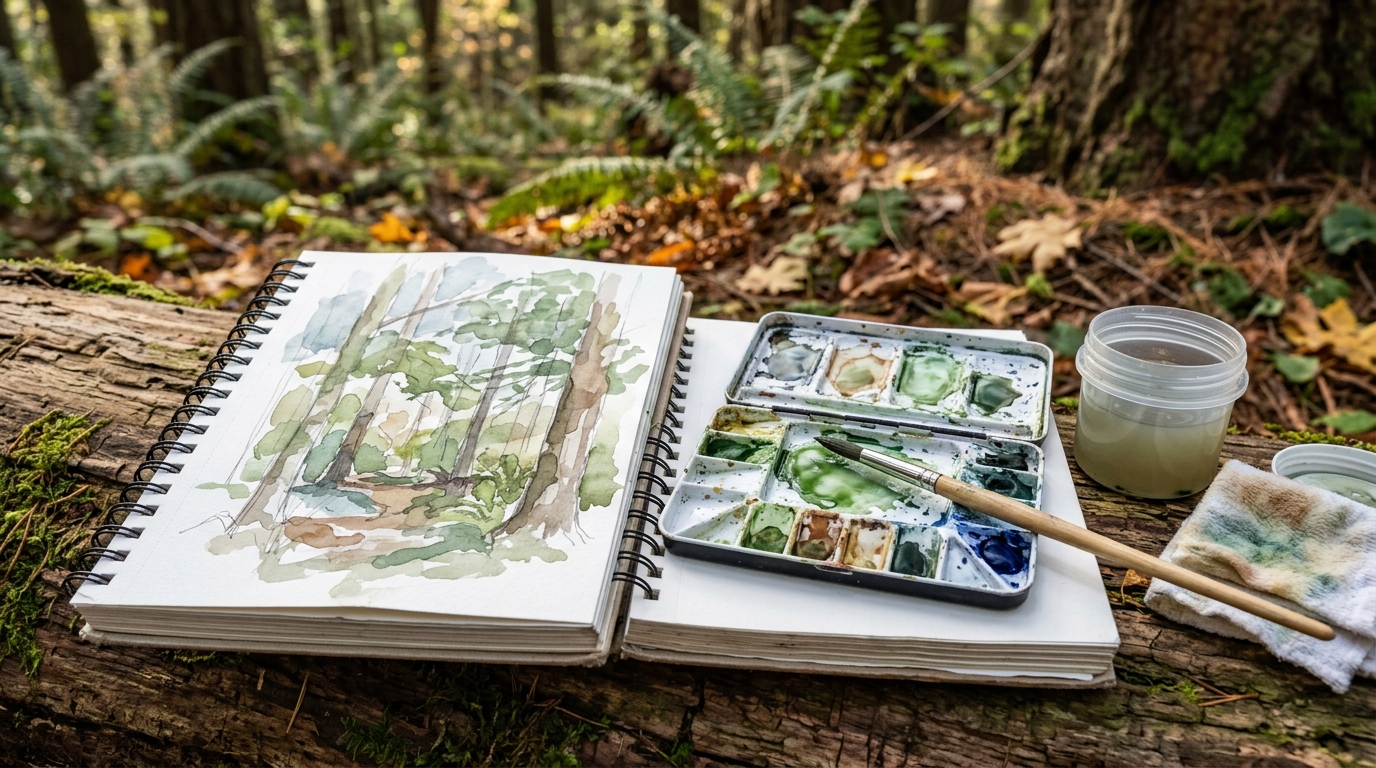
A water brush, something black to dilute, and paper that can get wet. That is it. The temptation when you are new is to pack a full palette plus a pencil case plus a folding chair, and then not go out because the bag is annoying — our guide to what actually fits in a travel art bag works through the same trap from the packing side. I would rather you left the house with three things and came back with a drawing.

Disclosure: This section may contain affiliate links to Amazon. We may earn a small commission from qualifying purchases at no extra cost to you.
water-reservoir brushes in three tip sizes for on-location ink washes

Pick 01 of 07

water-reservoir brushes in three tip sizes for on-location ink washes

A water brush carries its own water in the barrel, so a squeeze feeds the bristles and you never need a jar. Tip size decides how wide a wash you can lay in a single pass, which is why a set spanning fine to broad goes further than one brush on its own. Look for a synthetic tip that keeps a point when wet and a barrel you can refill under a running tap.

Why we picked this exact one: The Pentel Aquash set gives you fine, medium and broad tips in one pack, which is the cheapest honest way to cover the full range of wash widths. It holds a 4.6-star average, and sketchers who compare water brushes side by side tend to rate Pentel at or near the top for detail work. The quirk worth knowing: squeeze too hard and water lands where you did not want it, so the first week is mostly learning a lighter grip.

See it on Amazon
water-soluble black brush pen for lines you can wash into tone

Pick 02 of 07

water-soluble black brush pen for lines you can wash into tone

A brush pen with a flexible nylon tip and a refillable ink cartridge in the handle, loaded with water-based ink rather than permanent pigment. Because the ink stays soluble after it dries, a wet brush dragged across a line pulls grey straight out of it, which is how a two-tool kit covers a whole range of tones. When choosing one, check the ink is described as water-based or non-waterproof, because the same product lines usually sell a permanent version that looks identical on the shelf.

Why we picked this exact one: The Pentel Color Brush in black is the water-based member of that family, and the listing says so plainly: water-based dye ink, not the pigment ink used in the Pocket Brush. It refills, so the pen outlasts its first cartridge and you replace the barrel instead of the brush. The honest downside is drying time, since water-based ink sits wet longer than a permanent liner and you will close the book too early at least once.

See it on Amazon
pocket-size landscape watercolour book on 200gsm paper

Pick 03 of 07

pocket-size landscape watercolour book on 200gsm paper

A hardbound book of heavyweight, fine-grain watercolour paper in a format small enough for a coat pocket. The weight is the whole point, since ordinary sketchbook paper pills and cockles the moment a loaded brush touches it. A landscape format also lets a street or a skyline run across the full width of the spread.

Why we picked this exact one: The Hahnemuhle Watercolour Book in A6 landscape is 200gsm, the common weight for thin watercolour paper and a clear step up from the 160gsm stock that struggles with a second layer. It carries a 4.7-star average, which is high for this category, and the cover is water-repellent. Sixty pages is not many if you sketch daily, and at 4.1 by 5.8 inches you are committing to small compositions rather than sweeping ones.

See it on Amazon

With these three you can sit on a wall anywhere and come away with a real tonal sketch. Expect the first few to go muddy. That is usually the brush releasing more water than you asked it for, and it sorts itself out once your hand learns the squeeze. If committing to ink feels like a lot for a first outing, a pencil and graphite travel kit is a gentler way in, and the seeing skills carry straight over.

When One Grey Stops Being Enough

After a few outings you notice the gap: your darks are fine, your mid-tones are a lottery. Diluting on the fly with a squeezy brush is genuinely hard to repeat, and two washes that should match come out a shade apart. Most of this section fixes that — somewhere to mix tones before you need them, and somewhere to sit while you use them. If you find yourself wanting colour at this point, the watercolor travel sketching essentials cover that jump properly.

small bottle of non-waterproof liquid sumi ink for mixing wash tones

Pick 04 of 07

small bottle of non-waterproof liquid sumi ink for mixing wash tones

Liquid sumi ink is soot-based black ink sold ready to use, which skips the grinding a traditional ink stick and stone would need. Because it is not waterproof it thins cleanly with water into any strength of grey, and that is precisely what tonal work runs on. A small bottle is the travel-sensible size, since the ink is strong enough that a few drops make a palette's worth.

Why we picked this exact one: Yasutomo's 2oz Liquid Sumi Ink is made from vegetable soot with gum arabic, and the label states plainly that it is non-waterproof, which is the property that lets it dilute. Two ounces travels easily and lasts a long time at the few drops a sketch actually uses. It is heavily pigmented, so anything you dip in it wants rinsing the same day, and it is not an ink to put in a fountain pen.

See it on Amazon
airtight travel palette with deep wells and a collapsible water cup

Pick 05 of 07

airtight travel palette with deep wells and a collapsible water cup

A flat box of individual mixing wells with a sealing lid, plus a silicone cup that folds down to nothing. The wells let you mix a ladder of ink dilutions before you start, and the seal keeps them wet between sessions instead of drying to a crust. The folding cup handles the other travel problem, which is refilling a water brush when there is no tap in sight.

Why we picked this exact one: The DUGATO 16-well palette seals with a removable silicone gasket, so a set of ink dilutions survives the journey rather than drying on the way. Its sixteen wells hold roughly 8ml each, far more than ink work needs, which means you can pour generously instead of rationing. At 5.3 by 4.4 inches it is wider than a pocket, so it lives in the bag rather than on your person.

See it on Amazon
sub-two-pound folding tripod stool for long sketching stops

Pick 06 of 07

sub-two-pound folding tripod stool for long sketching stops

A three-legged stool with a fabric seat on a steel frame that folds into a stick and straps to a bag. For sketching it buys you the thing standing cannot: a stable lap for the book and a position you can hold while a wash dries. Look for low weight and a folded length that sits alongside a water bottle rather than jutting out of the bag.

Why we picked this exact one: The Amazon Basics folding camping stool weighs 1.7 pounds, which is the number that decides whether a stool actually comes with you or stays by the door. It folds to roughly 3 by 3 by 24 inches and takes 225 pounds, and the triangular footing is steadier on cobbles than it looks. At 4.4 stars it is the least loved item here, and the fair reason is comfort: this is a perch, not a chair, and a long session will remind you.

See it on Amazon
pocket travel brush in natural sable that caps for transport

Pick 07 of 07 · Worth the upgrade

pocket travel brush in natural sable that caps for transport

A short-handled round brush whose metal handle reverses to cap the bristles, so it travels in a pocket without losing its point. Natural sable holds far more liquid than the synthetic tip of a water brush and releases it slowly, which gives a wash that stays even instead of fading partway across. It needs a separate water container, and that is the trade you make for the control.

Why we picked this exact one: The Escoda Reserva 1214 in size 4 is pure Kolinsky-Tajmyr sable, handmade in Spain, and it is the step up worth making once you know you will keep sketching, not before. Size 4 suits a pocket-sized book; work bigger and the larger sizes climb steeply. It also obliges you to carry water separately, so in practice it rides along with the water brush rather than replacing it.

See it on Amazon

None of this is urgent. I would buy the ink bottle first, the palette second, and leave the stool until you have been rained on enough times to know you want one. The brush at the end is a different kind of purchase — it is what you buy once you have stopped wondering whether this is a phase.

Why Your Second Wash Ruined the First One

Why did my water brush stop working after I filled it with ink?

Almost always it is the ink. Waterproof India and Chinese inks are built to set hard, and inside a sealed barrel they do exactly that, gumming up the tip and the small filter behind it. Sketchers who do carry ink in a water brush use a non-waterproof ink and dilute it first. Flush the brush with clean water before you put it away, and take the tip off now and then so the inside can dry properly.

Why can't I get a wash out of my brush pen?

You have probably got the waterproof one. Several brush pen lines come in two ink families that look identical on the shelf: a pigment version that is permanent once dry, and a water-based version that lifts. Washes only work with the second kind, because the technique is pulling tone back out of a line you already drew. Check the barrel or the listing for water-based or non-waterproof before you buy, and if you already own the permanent one, keep it — it is the right pen for lines you want to survive a wash laid over them.

My page buckled and the ink pooled in the dips. What went wrong?

Two things stacked up. Thin sketchbook paper buckles as soon as it is properly wet, and if the book is lying flat the water runs straight into whatever dips it has just made. Tipping the book up at an angle fixes most of it, which is partly why sketches done standing outdoors behave better than ones done at a kitchen table. The other half is weight: 160gsm is thinner than the 200gsm that is standard for light watercolour work, and at that weight two layers is about the ceiling.

Why do my sketches look flatter than the ones I'm copying?

Usually it is tone, not drawing. Ink wash gets its depth from clearly separated strengths of the same black, and when you dilute by eye mid-sketch you tend to produce three greys that are nearly the same grey. Mix two or three dilutions before you start and keep them apart. One near-black for the deepest shadows, one middle, one barely more than dirty water for the far distance.

How long do I have to wait before closing the sketchbook?

Longer than you would like, and it depends on the ink. Sumi-type inks dry fast and stop smudging once they are down, which is why they are safe in a book whose pages touch. Water-based brush pen ink is slower, especially anywhere you laid it on thick. The habit worth building is dull but it works: finish, then walk somewhere with the book open for a few minutes before it goes back in the bag.

Love what you see here? Save individual picks with on any item, or copy everything to a list of your own in one click — great for coming back to later, or dropping as a not-so-subtle hint.

Disclosure: This section may contain affiliate links to Amazon. We may earn a small commission from qualifying purchases at no extra cost to you.